Research
Stateless Language Agents: Scaling Long-Horizon Automated Research
Stateless Language Agents: Scaling Long-Horizon Automated Research Overview Research area: Machine learning — LLM agents for automated research (AutoResearch), specifically long-horizon agent orchestr
- arXiv
- 2610.07625
- Published
- 2026-10-06
- Authors
- Qizheng Zhang, Changxiu Ji, Isaac Sun, Yuetai Li, Shubhangi Upasani, Sherry Ruan, Boyuan Ma, Fenglu Hong, Vamsidhar Kamanuru, Yoonho Lee, Yuzhen Mao, Genghan Zhang, Rulin Shao, Qiuyang Mang, Andy Dimnaku, Changran Hu, Radha Poovendran, Kunle Olukotun
AI summary
Stateless Language Agents: Scaling Long-Horizon Automated ResearchOverview
Research area: Machine learning — LLM agents for automated research (AutoResearch), specifically long-horizon agent orchestration, context management, and multi-agent search.
Technical level: Intermediate. The paper assumes familiarity with LLM coding agents, token budgets, evolutionary search baselines, and benchmark scoring, but its central design principle is explained from first principles.
Scope in one sentence: The paper introduces Stateless Language Agents (SLAs), a framework in which the harness — not the agents — owns all research state and rebuilds a fresh, role-specific context for every agent invocation, and evaluates it against EvoX, CORAL, and SwarmResearch on software engineering, kernel optimization, and algorithm design tasks at token budgets up to one billion.
Authors and venue metadata: Qizheng Zhang, Changxiu Ji, Isaac Sun, Yuetai Li, Shubhangi Upasani, Sherry Ruan, Boyuan Ma, Fenglu Hong, Vamsidhar Kamanuru, Yoonho Lee, Yuzhen Mao, Genghan Zhang, Rulin Shao, Qiuyang Mang, Andy Dimnaku, Changran Hu, Radha Poovendran, Kunle Olukotun. Affiliations include Stanford University, Carnegie Mellon University, University of Washington, SambaNova Systems, Inc., and UC Berkeley. Published 2026-10-06 as arXiv:2610.07625v1 [cs.LG], under CC BY 4.0.
What This Paper Is About
Automated research systems run LLM agents for very long periods, but more inference does not automatically produce more progress: agents replay ever-growing conversation histories, duplicate each other's work, or simply stop experimenting while tokens keep being consumed. The paper traces these failures to two design choices — where the research state lives, and who decides what to try next — and proposes keeping all durable state in the harness while making every agent stateless. The goal is to show that this arrangement sustains research progress and uses tokens efficiently over horizons far longer than a single context window.
Key Contributions
-
The principle of stateful search with stateless agents. The paper distinguishes an agent's state (what persists across invocations) from its context (what it sees within one invocation). In SLA, nothing an agent accumulates, including its conversation, carries over to its next invocation; the harness owns candidate solutions and measured outcomes and reconstructs a fresh, role-specific context each time.
-
The SLA framework itself. A stateless Advisor reads a harness-built evidence summary spanning all search directions and turns it into concrete experiment assignments for parallel stateless Workers. Each Worker sees only its assignment, its retained candidate, and compact local feedback, and runs several local trials in an isolated workspace (§3).
-
An enforced implementation. Statelessness and isolation are enforced rather than requested: the Advisor starts each epoch in a new session, Workers run as unprivileged processes under Linux Landlock filesystem restrictions with restricted network access, the harness clears saved sessions between trials, candidates are evaluated outside Worker environments with protected evaluator code, and the harness checkpoints the full research state (§3.3, Appendix B.1).
-
A long-horizon evaluation methodology. Budgets are measured in cumulative input and output tokens (up to 1B) rather than iterations or wall-clock time, tasks are chosen for benchmark headroom, and checkpoint-based ablations let variants resume from identical research states. The paper argues that short evaluation horizons can misjudge research systems and their components (§2.2, §4.3).
Main Findings
-
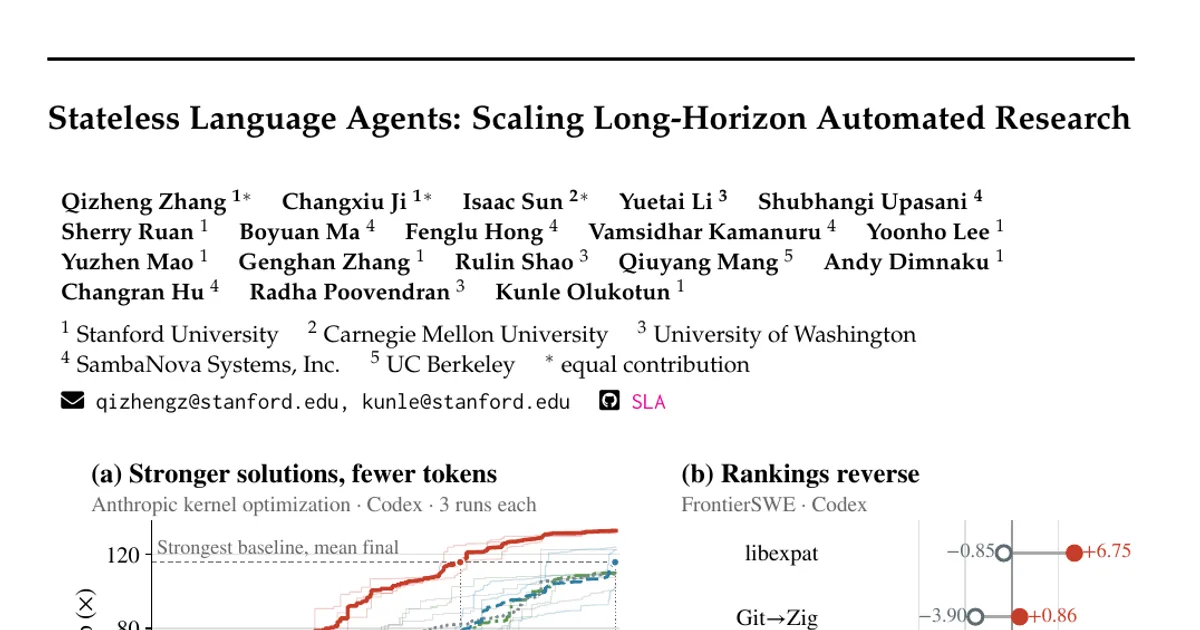
SLA reaches the best full-budget result on every evaluated task. On Anthropic kernel optimization with Codex, SLA achieves 1112.0 ± 8.9 cycles versus 1275.7 ± 133.9 for SwarmResearch, the strongest baseline by mean performance, a 12.8% reduction. It reduces Anthropic kernel cycles by 8.1–12.8% and improves FrontierSWE scores by 4.95 points on average.
-
On Anthropic kernel optimization with Codex, every SLA run beats every baseline run. All three SLA runs outperform all nine baseline runs (three baselines × three runs) at 1B tokens; the worst SLA run beats the best baseline run, 1122 versus 1191 cycles.
-
SLA reaches the strongest baseline's final performance with far fewer tokens. On Anthropic kernel optimization with Codex, SLA needs 67.9M tokens versus 986.3M for SwarmResearch — a 93.1% reduction (Figure 1 reports 14.5× fewer tokens). With Claude Code, SLA needs 138.5M tokens versus 888.3M, an 84.4% reduction. The abstract states the strongest kernel baseline's final performance is reached with over 84% fewer tokens. Token savings reach 95.9% on SOL-ExecBench #58.
-
SLA trails early but leads late on FrontierSWE. At 175M tokens (25% of the budget), SLA trails the strongest per-task baseline on all four FrontierSWE tasks; at 700M tokens (the full budget), it leads on all four. At full budget it scores 31.33 versus 24.58 on libexpat → x86-64, 28.84 versus 27.98 on Git → Zig, 45.27 versus 38.59 on Dart → Haskell, and 96.15 versus 65.38 on Lua Native Compiler.
-
Gains on other tasks. SLA increases SOL-ExecBench scores by 5.5% on average across three tasks and improves the FrontierCS Structured-LWE score by 1.5 points. Gains are smallest on SOL-ExecBench #210, where no method, including SLA, improves by more than 0.02 between 25% and 100% of the budget; the best kernels from all methods there use Triton.
-
One exception to the token-efficiency pattern. On SOL-ExecBench #1, EvoX reaches the common target sooner (46.1M versus 152.7M tokens) even though SLA ends with the higher score (0.763 versus 0.710).
-
Focused contexts and explicit assignments each contribute. From shared checkpoints, removing Advisor context reconstruction, Worker context isolation, or Advisor assignments reduces mean progress in every comparison. Removing Worker isolation costs 5–11 cycles over 100M-token continuations but 224 cycles over a full 1B-token run (1336 cycles versus the 1112.0-cycle mean of full SLA runs), suggesting the cost compounds over longer horizons.
-
Without assignments, parallel Workers duplicate work. Trace examples in Appendix D.3 show Workers repeatedly implementing the same feature; with assignments, the Advisor guides one Worker to build on another's improvement.
-
Coordination is cheap. The Advisor consumes 0.24–0.51% of total tokens (less than 0.6%) and 1.2–2.3% of model cost, compared with 8.39–10.70% of tokens and 6.14–7.35% of cost for SwarmResearch's Shepherd. In the Anthropic kernel run, the Shepherd's average call reads about 99K input tokens versus about 8K at the start of a fresh session. Cached inputs make up over 90% of tokens in both methods (SLA: 93.11% on Anthropic kernel, 90.15% on FrontierSWE libexpat).
-
Long runs reveal unproductive inference in prior systems. In a CORAL run on a GPU kernel task, the last improvement arrives at 231M tokens, yet token consumption continues to 1B; 98% of the final 1,500 sessions make no tool calls. CORAL resumes each agent's own session after a restart, so a restarted agent continues from the same conversation in which it decided to stop.
-
Benchmarks can saturate early. On 26-circle packing, four methods finish within 2.3 × 10⁻¹⁰ of one another by 5M tokens, and two methods come within 10⁻³ of the best observed score by 0.67M tokens.
-
Worker scaling is task-dependent. Going from 1 to 15 Workers cuts elapsed time by 6.6× on Anthropic kernel and mean elapsed time by 7.3× on FrontierSWE. On Anthropic kernel, W = 7 and W = 15 trail W = 1 by 337 and 174 cycles at 25% of the budget, yet all four widths finish within 1107–1113 cycles. On FrontierSWE, the best width depends on the task: Dart peaks at W = 3 (45.2), Git and libexpat at W = 7 (29.0 and 34.5), and Lua at W = 1 (97.3). The default W = 3 finishes within 5 cycles on Anthropic kernel and 3.2 points on every FrontierSWE task while running 2.5–2.7× faster than W = 1.
-
Worker model choice depends on the task. With a GPT-5.5 Advisor, GPT-5.4 mini Workers reach a higher Git → Zig score than GPT-5.5 Workers at a matched cost of $100 (20.88 versus 19.68), whereas GPT-5.5 Workers perform better on Anthropic kernel optimization.
Methodology in Plain English
The researchers start from the observation that two things go wrong in long-running agent systems: growing conversation histories waste tokens and degrade behavior, and recorded findings do not automatically translate into the next productive experiment. Their fix is architectural. A "harness" program — ordinary software outside the model — holds every durable artifact: candidate solutions, scores, failed attempts, and Worker status. Agents never keep anything.
The framework alternates two phases. In the planning phase, the harness assembles an evidence summary covering recent attempts,
Authors’ abstract
Automated research systems increasingly run LLM agents over long horizons, but more inference does not by itself produce more progress: agents replay growing histories, duplicate one another's work, or stop experimenting while token consumption continues. Yet most evaluations use short budgets or benchmarks that saturate early, leaving these failure modes untested. We trace these failures to two choices: where research state lives and who decides what to try next. We introduce Stateless Language Agents (SLAs), built on the principle of stateful search with stateless agents: no agent carries its conversation across invocations; instead, the harness owns the research state (candidate solutions and measured outcomes) and reconstructs a fresh and role-specific context for every invocation. What each agent sees becomes an explicit design choice rather than a history that grows with the run. We implement this principle in the SLA framework, where a stateless Advisor reads harness-summarized evidence across search directions and assigns concrete experiments to parallel Workers. We evaluate SLA against three recent frameworks on software engineering, kernel optimization, and algorithm design at budgets of up to one billion tokens. SLA achieves the best final result on every task and reaches the strongest kernel baseline's final performance with over 84% fewer tokens. Ablations from shared checkpoints show that focused contexts and explicit assignments each contribute to SLA's progress, with effects that can compound over full runs, while the Advisor consumes less than 0.6% of tokens. These results argue for SLAs, which keep durable research state out of agent conversations, and show that short evaluation horizons can misjudge research systems and their components.