Research
SPoRC-VIST: A Benchmark for Evaluating Generative Natural Narrative in Vision-Language Models
Overview Research area: Vision-language models (VLMs), visual storytelling, generative dialogue, and evaluation methodology for creative text generation. Technical level: Intermediate. The paper is re
- arXiv
- 2601.01062
- Published
- 2026-01-03
- Authors
- Yunlin Zeng
AI summary
Overview
Research area: Vision-language models (VLMs), visual storytelling, generative dialogue, and evaluation methodology for creative text generation.
Technical level: Intermediate. The paper is readable without deep math, but assumes familiarity with VLM architectures, LoRA fine-tuning, and metrics such as CLIPScore and Distinct-n.
Scope: The paper introduces SPoRC-VIST, a benchmark and training pipeline that turns sequences of images into two-host podcast dialogue, using synthetic images for training and real photographs for evaluation.
What This Paper Is About
Vision-language models are good at describing what is in a picture, but poor at turning a picture sequence into an engaging multi-turn conversation with personality and flow. The authors argue that standard overlap metrics like BLEU and ROUGE actively reward safe, repetitive output, so they build a training pipeline and an evaluation framework aimed at narrative style instead. Their goal is to make a smaller model (Qwen3-VL-32B) produce podcast-style banter that beats a much larger base model (Qwen3-VL-235B) without losing accuracy about what the images actually show.
Key Contributions
- A curated dataset of 4,000 visual-dialogue pairs built by pairing real podcast transcripts from the Structured Podcast Research Corpus (SPoRC) with synthetic images generated by Stable Diffusion 3.5, used to fine-tune Qwen3-VL-32B with LoRA for style transfer from "captioner" to "podcaster."
- A style-aware evaluation framework that replaces textual overlap with average turn length, speaker switch rate, Distinct-2, CLIPScore, and an AI-as-a-Judge protocol using Gemini 3 Pro, Claude Opus 4.5, and GPT 5.2 to assess conversational naturalness and "hallucination of personality."
- A demonstration that a fine-tuned 32B model outperforms a 235B base model on conversational naturalness (>80% win rate) and narrative depth (+51% turn length) while maintaining identical visual grounding (CLIPScore 20.39).
- Validation of a synthetic-to-real generalization strategy, showing that training on synthetic imagery transfers to real-world VIST photo sequences.
Main Findings
- Naturalness win rate above 80%: Averaged across 50 test samples and three judges (Gemini 3 Pro, Claude Opus 4.5, GPT 5.2), the fine-tuned 32B model won pairwise comparisons. All three judges independently declared it the winner, unanimous at 3/3.
- Identical visual grounding: Both the 32B fine-tuned model and the 235B base model scored a CLIPScore of 20.39 (Δ 0.00), meaning the style gains did not come at the cost of visual accuracy.
- Longer, more substantial turns: Average turn length rose from 38.0 words (235B) to 57.5 words (32B), a +51% increase, while the number of turns fell from 24.5 to 15.8 (−35.5%).
- Lower speaker switch rate: Switches per 1,000 words dropped from 27.0 to 16.0 (−41%), moving the model toward the 14.8 turns per 1,000 words measured in the source SPoRC transcripts.
- Slight diversity decrease: Distinct-2 fell from 0.85 to 0.82 (a change of −0.04). The authors attribute this to adopted human speech patterns such as fillers ("you know," "I mean") rather than degraded output.
- Faster and cheaper inference: The 32B model runs on 1× A100 and generates in 266.6 ± 31.6 seconds, versus 475.0 ± 25.9 seconds for the 235B model on 8× A100 — a 1.8× speedup. Output length was slightly longer for the smaller model (972.1 ± 83.1 vs 918.6 ± 51.7 words).
- Format shift in what the models produce: The 235B base model behaved like a "scripted narrator" with sequential turns and polished prose; the fine-tuned 32B model produced interruptions, immediate reactions, casual phrasing, and invented backstories (e.g., a "sandwich smuggler," a drunk best man quoting Shakespeare).
- Hallucinated shared history: The fine-tuned model generated references to past events not visible in the pixels (e.g., "I remember you texting me during the race"), which the authors describe as creating synthetic intimacy mimicking real podcast rapport.
- Real transcripts beat AI-generated ones: A preliminary study comparing human SPoRC transcripts against transcripts generated by Qwen3-VL-235B and GPT-5.2 found that human transcripts consistently won on naturalness, personality, and conversational flow, which motivated treating the task as style transfer rather than dialogue generation.
Methodology in Plain English
The authors needed paired images and dialogue, which is scarce, so they built it themselves in three stages. First, they filtered the SPoRC corpus of over 1.1 million podcast episodes down to over 81,000 suitable two-speaker episodes, then used Claude Sonnet 4.5 to pull 4,000 excerpts with rich visual descriptions, averaging 900–1,100 words each. Second, Claude Sonnet 4.5 wrote five detailed image prompts per excerpt. Third, Stable Diffusion 3.5, run through AWS Bedrock, rendered those prompts into images — about 20,000 images total.
The result was 4,000 samples where the visuals match the spoken narrative exactly. Because Stable Diffusion's safety filters blocked some prompts, 6.6% of samples ended up with fewer than five images; 93.4% have exactly five. Most transcripts (27.6%) fall in the 1,000–1,200 word range.
They then fine-tuned Qwen3-VL-32B with LoRA (rank 16, alpha 32, dropout 0.05), freezing the vision encoder so general visual features would not be forgotten, and training only the language backbone's attention and MLP modules. Hyperparameters were deliberately conservative: learning rate 4e-6, weight decay 0.1, gradient clipping at 0.3, cosine scheduling, one epoch, NEFTune noise alpha 5.0, model max length 8192, bf16 precision, and DeepSpeed ZeRO-3. Training ran about 11 hours (40,138 seconds, 88 A100-GPU-hours) across 126 optimization steps on 8× A100 80GB GPUs, peaking near 75GB per device, and converged to a final loss of 2.56.
At inference they used nucleus sampling with temperature 0.7, top-p 0.8, and a 2,048-token generation limit, prompting for roughly 800 words of casual dialogue without references to the images. Evaluation used a hold-out set of 50 real-world photo sequences from the VIST dataset, roughly 50,000 generated words, which the model never saw in training since it only trained on synthetic imagery.
Why This Matters
Impact on research: The paper argues that for creative generation tasks, style metrics such as turn length and speaker switch rate carry more signal than n-gram overlap metrics, and it offers a reproducible synthetic-to-real recipe for domains where paired multimodal data is scarce. It also shows that targeted fine-tuning of a small open-weights model can beat a model roughly eight times its size on narrative quality, which challenges the assumption that scale is the only path to better storytelling.
Real-world applications (potential, not evaluated in the paper):
- Automatically producing podcast or audio-show scripts from photo albums and travel or event photography.
- Generating narrated audio descriptions for accessibility, with a more conversational and engaging tone than standard captions.
- Storyboarding and pre-visualization tools for media production, turning image sequences into dialogue drafts.
- Educational or archival narration that turns photo collections into spoken narrative content.
Industry relevance: The 1.8× inference speedup and single-A100 footprint make the approach far cheaper to deploy than a 235B model requiring 8× A100, which matters for cost-sensitive production systems. The paper also explicitly warns that the same capability could be misused for impersonation and fabricating events, and recommends watermarking to distinguish authentic human testimony from AI-generated content.
Future Directions
- Variable-length and streaming input: The current method processes a fixed sequence of five images; extending it to variable-length sequences, streaming frames, or video remains future work.
- Prosody control: Training the model to emit structured markers such as Speech Synthesis Markup Language (SSML) tags or explicit emotion tokens like (excited) and [laughter], so a VLM can direct pacing, tone, and emotional nuance in the final audio.
- Grounding versus persona hallucination: The model sometimes invents visual details, such as smells or sounds, when they fit the podcast persona. Separating harmless personality invention from factual error is an open problem.
- Judge reliability and bias: The authors note that "naturalness" and "narrative quality" remain inherently subjective, and that generated narratives may inherit biases from podcast training data, including stereotypes about gender, accent, or dialect. How reliable AI-as-a-Judge panels are for these attributes is unresolved.
Target Audience
Researchers and engineers working on vision-language models, multimodal generation, and visual storytelling; practitioners building dialogue or narrative systems on top of open-weights VLMs; and anyone interested in evaluation methodology for creative text generation who wants an alternative to BLEU and ROUGE-style scoring.
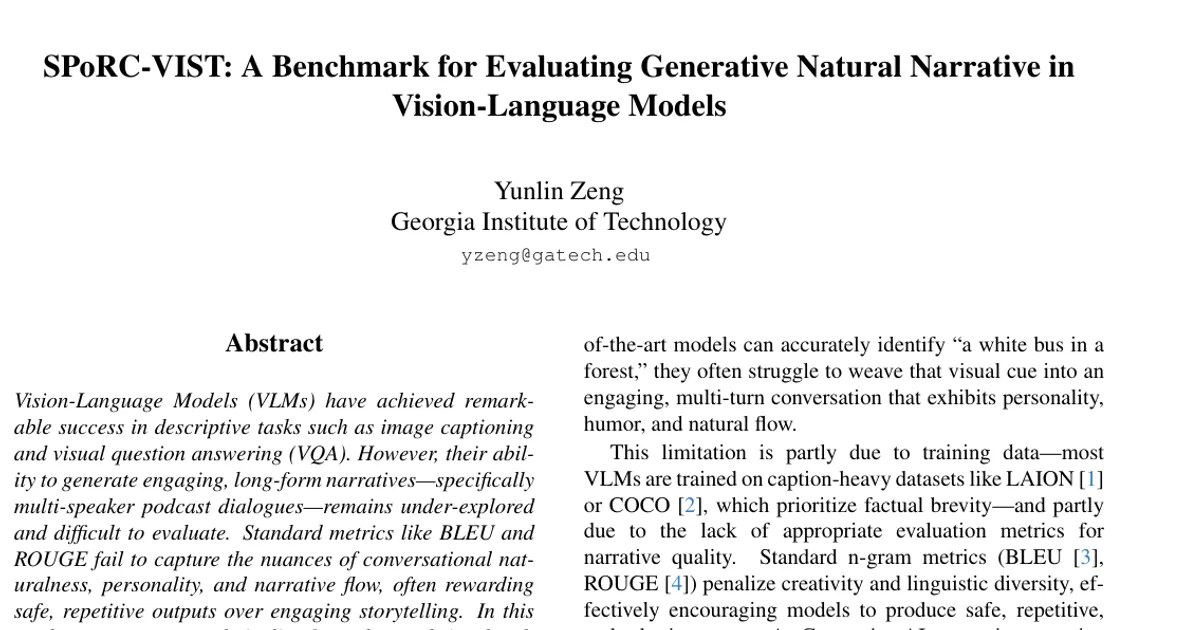
Authors’ abstract
Vision-Language Models (VLMs) have achieved remarkable success in descriptive tasks such as image captioning and visual question answering (VQA). However, their ability to generate engaging, long-form narratives -- specifically multi-speaker podcast dialogues -- remains under-explored and difficult to evaluate. Standard metrics like BLEU and ROUGE fail to capture the nuances of conversational naturalness, personality, and narrative flow, often rewarding safe, repetitive outputs over engaging storytelling. In this work, we present a novel pipeline for end-to-end visual podcast generation, and fine-tune a Qwen3-VL-32B model on a curated dataset of 4,000 image-dialogue pairs. Crucially, we use a synthetic-to-real training strategy: we train on high-quality podcast dialogues from the Structured Podcast Research Corpus (SPoRC) paired with synthetically generated imagery, and evaluate on real-world photo sequences from the Visual Storytelling Dataset (VIST). This rigorous setup tests the model's ability to generalize from synthetic training data to real-world visual domains. We propose a comprehensive evaluation framework that moves beyond textual overlap, and use AI-as-a-judge (Gemini 3 Pro, Claude Opus 4.5, GPT 5.2) and novel style metrics (average turn length, speaker switch rate) to assess quality. Our experiments demonstrate that our fine-tuned 32B model significantly outperforms a 235B base model in conversational naturalness ($>$80\% win rate) and narrative depth (+50\% turn length), while maintaining identical visual grounding capabilities (CLIPScore: 20.39).