Research
SpiralThinker: Latent Reasoning through an Iterative Process with Text-Latent Interleaving
Overview Research area: Natural Language Processing / large reasoning models — specifically latent (implicit) reasoning as an alternative or complement to explicit chain-of-thought text generation. Te
- arXiv
- 2511.08983
- Published
- 2025-11-12
- Authors
- Shengmin Piao, Sanghyun Park
AI summary
Overview
Research area: Natural Language Processing / large reasoning models — specifically latent (implicit) reasoning as an alternative or complement to explicit chain-of-thought text generation.
Technical level: Advanced. The paper assumes familiarity with transformer hidden states, embeddings, hidden-state alignment losses, LoRA fine-tuning, and autoregressive decoding.
Scope: The paper introduces a training and inference framework, SpiralThinker, that performs repeated iterative updates over latent token representations while alternating them with textual reasoning steps, and validates it on mathematical, logical, and commonsense reasoning benchmarks.
What This Paper Is About
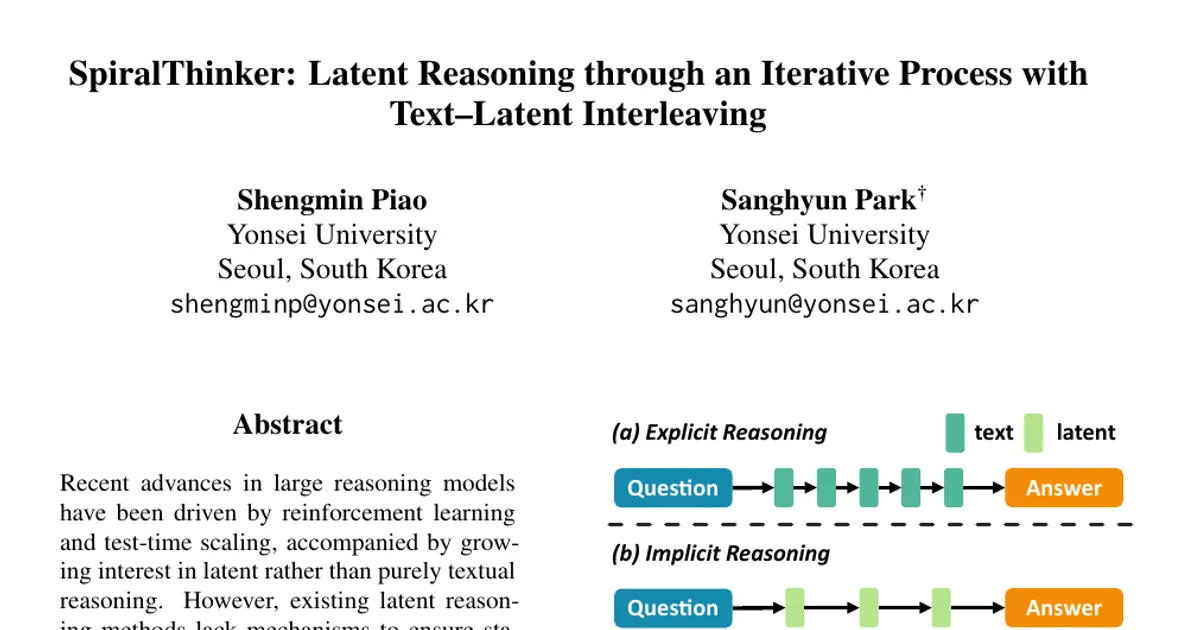
Most latent reasoning methods treat latent representations as ordinary token-level inputs processed in a single forward pass, which forces each latent representation to encode an entire reasoning step at once and provides no mechanism for keeping latent updates stable. At the same time, text-only reasoning frameworks verbalize every step, which risks overthinking or underthinking, while latent-only frameworks sacrifice interpretability and controllability.
SpiralThinker addresses both problems: it models latent reasoning as an explicit iterative refinement process over latent representations, and it defines a structured way to alternate (interleave) latent steps with textual steps within a single unified reasoning sequence. The goal is deeper implicit computation that remains coherent, controllable, and consistent with the model's textual reasoning.
Key Contributions
-
A stabilized iterative latent reasoning framework. SpiralThinker performs repeated updates over latent representations across iterations, enabling extended implicit reasoning without generating additional tokens, and formalizes structured text–latent interleaving as an alternating reasoning process within one unified framework.
-
A progressive alignment objective. The method introduces iteration-aware supervision that constrains latent representations across refinement steps to stay consistent with their corresponding textual reasoning counterparts. A softmax-based weighting vector increases monotonically with the iteration index so later iterations (which should hold more consolidated reasoning states) receive greater weight, while earlier exploratory passes still contribute.
-
Dataset-specific optima for latent tokens and iterations. The paper identifies that the best number of latent tokens and the best number of iterations both depend on the dataset, and reports the specific values found for each benchmark.
-
Demonstration that alignment is essential. Ablations show that iteration alone can degrade performance in latent space, and that proper alignment is the decisive factor for making iterative latent reasoning work.
Main Findings
-
Best-in-class across three reasoning domains. SpiralThinker reaches 56.56% on GSM8K-Aug (surpassing the previous best by 3.19 points), 99.40% on ProsQA (surpassing the previous best by 0.40 points), and 63.32% on StrategyQA (surpassing the previous best by 0.44 points). Prior bests in Table 1 were 53.37% (Pause Token) on GSM8K-Aug, 99.00% (iCoT-SI) on ProsQA, and 62.88% (iCoT-KD) on StrategyQA.
-
Iteration and alignment are complementary, and alignment is the dominant factor. The ablation on GSM8K-Aug goes from 45.49% (no iteration, no alignment) to 48.67% with alignment only (+3.18), to 45.72% with iteration only (+0.23), and to 56.56% with both (+11.07). The same pattern holds on ProsQA (98.00 → 98.60 → 97.40 → 99.40) and StrategyQA (59.39 → 61.14 → 58.08 → 63.32). Iteration alone actually degraded ProsQA and StrategyQA.
-
Optimal latent token counts vary by dataset. Sweeping N ∈ [1, 10] with iteration removed but alignment retained, the best results came at N = 5 for GSM8K-Aug and ProsQA, and N = 6 for StrategyQA. StrategyQA accuracy decreases when N > 6, while the other datasets remain largely stable across the range.
-
Optimal iteration counts also vary by dataset. Sweeping K ∈ [1, 6], the best results with the softmax weighting schedule were K = 5 on GSM8K-Aug, K = 4 on ProsQA, and K = 3 on StrategyQA. Moderate iteration helps; excessive iteration leads to saturation or slight degradation, most notably on GSM8K-Aug and ProsQA.
-
The weighting schedule matters. Uniform weighting across iterations consistently underperformed, most visibly on ProsQA and StrategyQA. Last-iteration-only weighting improved performance, but the proposed softmax-based schedule generally performed best, reaching the highest peak accuracy on GSM8K-Aug and ProsQA and converging to its plateau with fewer iterations on StrategyQA.
-
The method transfers across backbone families and scales with model size. Beyond Llama-3.2-1B, SpiralThinker was trained on Qwen2.5-0.5B (46.85 / 96.80 / 58.95) and Qwen2.5-1.5B (58.45 / 99.40 / 65.07) on GSM8K-Aug / ProsQA / StrategyQA. Within the Qwen2.5 family, scaling from 0.5B to 1.5B yielded gains of 11.60 points on GSM8K-Aug, 2.60 points on ProsQA, and 6.12 points on StrategyQA.
-
Textual verbosity drops, but total computation does not always drop. Compared with an explicit reasoning baseline, SpiralThinker reduces generated textual tokens by 54.22% on GSM8K-Aug, 24.92% on ProsQA, and 48.44% on StrategyQA. Total forward count falls on GSM8K-Aug (30.56 → 22.54) and StrategyQA (77.14 → 46.16), but is nearly unchanged on ProsQA (44.71 → 44.89). The paper states SpiralThinker is not designed as a reasoning acceleration method but as a controllable trade-off between computation and reasoning quality.
-
Latent representations carry recognizable reasoning signals that evolve. In a GSM8K-Aug case study, the first latent token encodes the multiplication operator "*", the third primarily stores intermediate results that progressively converge to correct values, and the fourth and fifth frequently produce the
<eol>symbol marking reasoning termination.
Methodology in Plain English
The approach is trained in two stages.
Stage 1 — Explicit reasoning. The base model (Llama-3.2-1B, fine-tuned with LoRA) is first trained to produce step-by-step textual reasoning with cross-entropy loss. Each textual reasoning step is wrapped in boundary tokens <bot> (begin-of-text) and <eot> (end-of-text), which later serve as alignment anchors.
Stage 2 — Implicit reasoning with interleaving. Training data is restructured so that every other reasoning step is replaced by N latent <latent> tokens, wrapped in <bol> and <eol> boundary tokens. Textual and latent steps therefore alternate in the same sequence, and the final answer is kept unchanged. This teaches the model to move between explicit and implicit modes.
Within a forward pass, the latent tokens' final-layer hidden states are extracted and passed through a lightweight latent adapter — a residual MLP followed by RMSNorm and scaling. Because final-layer hidden states and input embeddings live in different subspaces, the adapter projects the hidden states back into the embedding space before they are written back into the input sequence. The scaling factor (target_rms) is computed from the pretrained embedding matrix, excluding newly added special tokens, so the rewritten representations stay consistent with the base embedding distribution.
The rewritten sequence is then fed forward again, and this cycle repeats for K iterations. Crucially, the model is supervised so the latent updates do not drift. The alignment objective compares the hidden state at each <eol> (end of a latent step) with the corresponding <eot> hidden state (end of the matching textual step) taken from a frozen model trained in Stage 1, using an L1 distance normalized by a per-layer scale factor estimated from the frozen model. Because the implicit model is initialized from the same explicitly trained backbone, latent and textual representations start from a shared reasoning-aware space.
The progressive part comes from computing this alignment loss at every iteration and aggregating them with weights from a softmax over the iteration indices, scaled by a positive constant. Later iterations get more weight. The total training objective is the cross-entropy loss plus a weighted progressive alignment term; because <latent> has no surface form, its prediction is excluded from the cross-entropy supervision.
At inference, N <latent> tokens are prepended to the question. The model reasons implicitly over them, produces a textual step, then autonomously inserts another block of N <latent> tokens, alternating until it emits the final answer or hits the generation limit. All reported results use greedy decoding for deterministic trajectories.
Why This Matters
The paper makes a conceptual argument that latent reasoning should be treated as an iterative process rather than a single-pass substitution for text, and backs it with an ablation showing that unconstrained iteration is not just unhelpful but actively harmful. It supplies a concrete mechanism — iteration-aware alignment supervision — for keeping that iterative computation on track, plus a simple way to alternate between interpretable text and compact latent steps. For a research community currently pushing reinforcement learning and test-time scaling for reasoning, this offers a complementary axis: enriching internal computation instead of generating longer chains of thought.
Real-world applications:
- Math and STEM tutoring systems that need to expose some reasoning steps to students while keeping intermediate arithmetic hidden, reducing visible verbosity without hiding the final logic.
- Multi-step question answering and logical planning agents, where ProsQA-style structured logical reasoning and StrategyQA-style commonsense decomposition are the target workloads.
- Latency- or bandwidth-constrained deployments where the number of generated text tokens, not just the number of forward passes, drives cost — relevant because the paper shows text reductions of 24.92% to 54.22%.
- Model porting across backbone families, since the method was shown to work on both Llama-3.2 and Qwen2.5 and to improve with model size within the Qwen2.5 family.
Industry relevance: the framework is trained with LoRA on a 1B-parameter backbone over four A100 GPUs, which is a modest setup for a reasoning method, and its value proposition is controllability of the text-versus-latent trade-off rather than raw speed. That makes it interesting for teams that want to tune how much reasoning is verbalized — for cost, latency, safety review, or user-facing clarity — rather than for teams purely chasing throughput.
Future Directions
- Difficulty-adaptive iteration. SpiralThinker currently applies a fixed number of iterations to every reasoning step regardless of difficulty. The authors suggest dynamically spending fewer iterations on easy steps and more on hard ones, possibly via lightweight calibration on a small held-out set or adaptive stopping based on convergence or confidence signals.
- Adaptive activation of latent reasoning. The design interleaves latent and textual steps according to a fixed data scheme; the authors note that interleaving may not be necessary at every reasoning step and call for mechanisms that let the model decide when latent reasoning should be switched on.
- A better efficiency story. The computational cost analysis shows total forward count can stay roughly flat (ProsQA) even as textual tokens drop substantially, so reducing the per-iteration overhead of latent refinement is an open engineering question.
- Generalization beyond the three benchmarks. The results cover GSM8K-Aug, ProsQA, and StrategyQA, with several hyperparameters (number of latent tokens, number of iterations) tuned per dataset and different settings used for the small StrategyQA dataset; whether the reported optima transfer to other task families and larger backbones is not established here.
Target Audience
Researchers and graduate students working on latent reasoning, chain-of-thought alternatives, and iterative or recurrent transformer architectures; practitioners building reasoning systems who want a training recipe for interleaving implicit and explicit computation; and readers interested in how alignment-style supervision (in the style of distillation between teacher and student hidden states) can be repurposed to stabilize multi-iteration latent updates. The paper is best suited to an audience comfortable with transformer internals and hidden-state-level training objectives, since the central mechanisms operate entirely at that level.
Authors’ abstract
Recent advances in large reasoning models have been driven by reinforcement learning and test-time scaling, accompanied by growing interest in latent rather than purely textual reasoning. However, existing latent reasoning methods lack mechanisms to ensure stable reasoning dynamics in latent space and a systematic way to interleave implicit and explicit reasoning. We introduce SpiralThinker, a stabilized iterative latent reasoning framework that performs iterative updates over latent representations while interleaving latent and textual reasoning steps. At its core, it combines a progressive alignment objective that explicitly regulates latent representations across iterations with structured annotations for text-latent interleaving, thereby stabilizing latent updates and maintaining coherence with textual reasoning. Across mathematical, logical, and commonsense reasoning tasks, SpiralThinker achieves state-of-the-art performance among latent reasoning baselines. Further analysis shows that both iteration and alignment are essential, that the optimal numbers of latent tokens and iterations vary by dataset, and that proper alignment is crucial for effective iterative latent reasoning. Overall, SpiralThinker bridges iterative computation and latent reasoning, demonstrating that aligned iterative updates can reliably steer reasoning in the latent space.