Research
SpinCastML an Open Decision-Making Application for Inverse Design of Electrospinning Manufacturing: A Machine Learning, Optimal Sampling and Inverse Monte Carlo Approach
Overview Research area: Machine learning for materials and manufacturing, specifically inverse design of electrospinning — the process used to spin polymer solutions into micro- and nanoscale fibers.
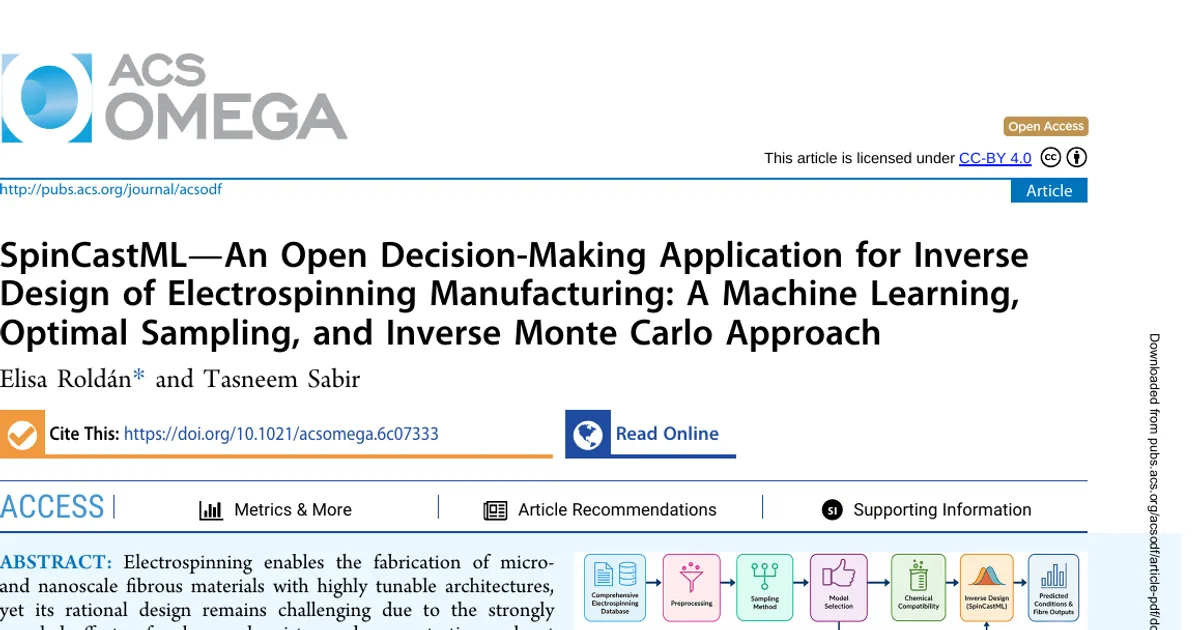
- arXiv
- 2602.09120
- Published
- 2026-02-09
- Authors
- Elisa Roldan, Tasneem Sabir
AI summary
Overview
Research area: Machine learning for materials and manufacturing, specifically inverse design of electrospinning — the process used to spin polymer solutions into micro- and nanoscale fibers.
Technical level: Intermediate. Readers should be comfortable with machine learning concepts such as regression models, sampling strategies, R² as a performance measure, and the general idea of inverse design, plus basic familiarity with polymer processing.
Scope: The paper describes SpinCastML, an open-source software tool that couples a curated electrospinning dataset, a library of machine learning models, and an Inverse Monte Carlo engine to predict full fiber diameter distributions and to work backwards from a desired fiber outcome to feasible polymer–solvent process parameters.
What This Paper Is About
Electrospinning is sensitive: small changes in the polymer solution or the operating conditions can push the jet into a different regime and produce fiber diameters that are not normally distributed. Existing modeling frameworks predict only average diameter and generally ignore chemical constraints on which polymer–solvent combinations are actually usable. The goal of SpinCastML is to provide an open, distribution-aware and chemistry-informed framework that both predicts the entire fiber diameter distribution and performs inverse design, proposing physically and chemically feasible parameter combinations — with success probabilities — for a target the user specifies.
Key Contributions
-
An open-source inverse design application for electrospinning. SpinCastML is presented as an open executable that laboratories can run on their own datasets rather than a closed, one-off model.
-
A curated, distribution-level dataset and modeling suite. The framework is built on 68,480 fiber diameters drawn from 1,778 datasets spanning 16 polymers, and combines three structured sampling methods with a suite of 11 learners to predict the whole distribution rather than just the mean.
-
Chemistry-aware constraints in the design loop. Polymer–solvent chemical constraints are integrated so that generated design candidates are chemically feasible, not merely numerically optimal.
-
An Inverse Monte Carlo engine with quantified success probabilities. The IMC component supports both retrospective analysis and forward-looking inverse design, returning parameter combinations for user-defined targets along with an estimated probability that each will succeed.
Main Findings
-
Best global predictor combination: A Cubist model paired with polymer-balanced Sobol D-optimal sampling achieved the highest global performance reported in the abstract, with R² greater than 0.92.
-
Distribution-level accuracy: The Inverse Monte Carlo engine reproduced fiber distributions with R² greater than 0.90 and less than 1% error between predicted and experimental success rates.
-
Inverse design produces usable candidates: The engine generates polymer–solvent parameter combinations that are described as physically and chemically feasible, each carrying a quantified success probability for the user's target.
-
Two modes of use: The same engine supports retrospective analysis of existing data and forward-looking inverse design for new targets.
-
Framing claim: The authors position SpinCastML as shifting electrospinning from trial-and-error experimentation toward a reproducible, data-driven design process.
Note: the abstract reports the performance figures above but does not give model-by-model comparisons, dataset splits, or ablations; those details are not available here.
Methodology in Plain English
The authors assembled a large, carefully curated collection of measured fiber diameters — tens of thousands of measurements drawn from well over a thousand source datasets covering sixteen different polymers. Rather than fitting a single model, they set up a systematic comparison: several different ways of sampling the data for training, crossed with a library of eleven different machine learning algorithms. This let them test which combination of sampling strategy and learner predicted fiber diameters most reliably.
Because the fiber diameter distributions are not Gaussian, the modeling target was the distribution itself, not just its average. A chemistry layer restricts what the models are allowed to propose, so candidate solutions respect which polymers and solvents can actually be combined.
The inverse part works in the opposite direction to normal prediction. Instead of asking "given these settings, what fibers do I get?", the Inverse Monte Carlo engine asks "given the fiber outcome I want, which settings could produce it?" It explores the parameter space, filters candidates through the chemical constraints, and attaches a probability of success to each. Those probabilities were checked against experimental success rates to confirm they were close.
The whole thing is packaged as an open-source executable so other laboratories can apply it to their own data.
Why This Matters
Impact on research. Most electrospinning models stop at predicting a mean diameter, which hides the spread that determines whether a fiber mat actually performs as intended. Treating the full distribution and the inverse direction as the modeling target, and publishing the tool as open source, gives the field a shared, reproducible baseline instead of many disconnected in-house models.
Real-world applications:
- Biomedical: scaffolds and fibrous constructs where the diameter distribution governs cell response and degradation behavior.
- Filtration: filter media where the distribution of fiber diameters controls capture efficiency and pressure drop.
- Energy: fibrous components for batteries, fuel cells, or other energy devices where architecture-specific fiber size matters.
- Laboratory process development: any group that wants to identify feasible polymer–solvent settings for a target fiber size without exhaustive trial-and-error runs.
Industry relevance. The abstract frames the tool's value in terms of reduced experimental waste, faster discovery, and democratized access to advanced modeling. For manufacturers, that translates into fewer physical trials — less material consumed, less time on the electrospinning rig, and design candidates that are already screened for chemical feasibility rather than being filtered out later.
Future Directions
-
Community growth. The abstract explicitly invites laboratories to analyze their own datasets and "co-create an expanding community software," raising the question of how data contributions will be governed and quality-checked as the dataset grows.
-
Generalization beyond the current data. The framework is built on 16 polymers; whether its predictions and its distribution-aware behavior hold for polymers, solvents, and process regimes outside that set is left open.
-
Prospective validation. The reported success rates were compared against experimental success rates, but the abstract does not describe a prospective trial in which designs proposed by the IMC engine were fabricated and measured. Testing that loop end-to-end is a natural next step.
-
Extension to other fiber manufacturing routes. The distribution-aware inverse design framing could plausibly be transferred to related processes that show non-Gaussian, regime-sensitive outputs, though the abstract makes no such claim.
Target Audience
Researchers and engineers working on electrospinning, nanofiber fabrication, and polymer processing who want design guidance rather than pure trial-and-error. It is also relevant to machine learning practitioners interested in inverse design, distribution-level regression, and chemistry-constrained optimization, and to laboratory and manufacturing teams looking for an open tool they can apply to their own measurements. Readers wanting full algorithmic detail, model comparisons, or validation protocols will need the full paper, since only the abstract was available here.
Authors’ abstract
Electrospinning is a powerful technique for producing micro to nanoscale fibers with application specific architectures. Small variations in solution or operating conditions can shift the jet regime, generating non Gaussian fiber diameter distributions. Despite substantial progress, no existing framework enables inverse design toward desired fiber outcomes while integrating polymer solvent chemical constraints or predicting full distributions. SpinCastML is an open source, distribution aware, chemically informed machine learning and Inverse Monte Carlo (IMC) software for inverse electrospinning design. Built on a rigorously curated dataset of 68,480 fiber diameters from 1,778 datasets across 16 polymers, SpinCastML integrates three structured sampling methods, a suite of 11 high-performance learners, and chemistry aware constraints to predict not only mean diameter but the entire distribution. Cubist model with a polymer balanced Sobol D optimal sampling provides the highest global performance (R2 > 0.92). IMC accurately captures the fiber distributions, achieving R2 > 0.90 and <1% error between predicted and experimental success rates. The IMC engine supports both retrospective analysis and forward-looking inverse design, generating physically and chemically feasible polymer solvent parameter combinations with quantified success probabilities for user-defined targets. SpinCastML reframes electrospinning from trial and error to a reproducible, data driven design process. As an open source executable, it enables laboratories to analyze their own datasets and co create an expanding community software. SpinCastML reduces experimental waste, accelerates discovery, and democratizes access to advanced modeling, establishing distribution aware inverse design as a new standard for sustainable nanofiber manufacturing across biomedical, filtration, and energy applications.