Research
Spherical Physics-informed Neural Operator with Multi-scale Coupling for Meteorological Downscaling
Overview Research area: Scientific machine learning — neural operators for meteorological downscaling on the sphere (AI for Earth systems / climate). Technical level: Advanced. The paper assumes famil
- arXiv
- 2610.24708
- Published
- 2026-10-17
- Authors
- Yiqiang Ye, Yichi Wang, Haodi Zhang, Jiawei Wen, Jiahui Jiang, Zhaoyu Zhong, Jiangjian Yu, Chunxia Xiao
AI summary
Overview
Research area: Scientific machine learning — neural operators for meteorological downscaling on the sphere (AI for Earth systems / climate).
Technical level: Advanced. The paper assumes familiarity with neural operators (DeepONet, FNO, transformer-based operators), spherical geometry, and physics-informed loss terms.
Scope (one sentence): The paper introduces MSPNO, a neural-operator framework that combines a spherical Laplacian multi-scale decomposition, a geometry-aware localized integral operator, and differentiable physics constraints to downscale coarse global atmospheric fields to high-resolution regional fields on the sphere.
What This Paper Is About
Global climate models produce coarse-resolution outputs, and "downscaling" is the process of turning those coarse fields into high-resolution regional weather fields. The authors argue that existing learned downscalers have three weaknesses: they mishandle the geometry of the sphere (causing artifacts such as discontinuities at the poles), they do not explicitly model how atmospheric processes interact across spatial scales, and they ignore physical laws, so their predictions can violate conservation principles. The goal is a single operator that handles all three at once and can be queried at arbitrary locations and resolutions it was never trained on.
Key Contributions
- Spherical Laplacian Decomposition encoder. A hierarchy of scale-dependent spherical convolution filters splits an input field into residual bands from fine to coarse, without any spatial subsampling, so every scale keeps exact point-wise correspondence with the original grid.
- Hybrid location encoding and localized spherical integral operator. Query points are encoded with Fourier features plus geodesic radial-basis-function interpolation, and the operator evaluates a continuous kernel integral by restricting attention to a spherical disk of radius θ around each query — making inference grid-agnostic and geometry-consistent.
- Cross-scale fusion with FiLM modulation. Scale tokens are pooled with latitude weighting, contextualized by scale-aware attention, and used to modulate each scale's feature map before cross-scale aggregation, letting the model dynamically reweight spatial frequencies.
- Differentiable physics-guided objective. Residuals for horizontal divergence, vorticity, and moisture-flux divergence are added to a latitude-weighted MSE, with exponential-moving-average normalization and a dynamic weight to avoid over-regularization early in training.
Main Findings
- Best average accuracy among seven operator baselines. On ERA5/WeatherBench data (2014–2015, 6-hour intervals, 7 target variables), MSPNO reaches average MSE 0.1117, RMSE 18.4779, and ACC 0.8881, versus the next-best OFormer at 0.1156 / 19.1033 / 0.8819 and DeepONet at 0.1873 / 32.6814 / 0.8377. The paper states the model "consistently outperforms" baselines; per-variable tables show small exceptions, e.g. R500 MSE 0.3526 vs OFormer 0.3505, R500 ACC 0.7293 vs OFormer 0.7305, and T850 ACC 0.9683 vs LOCA 0.9694.
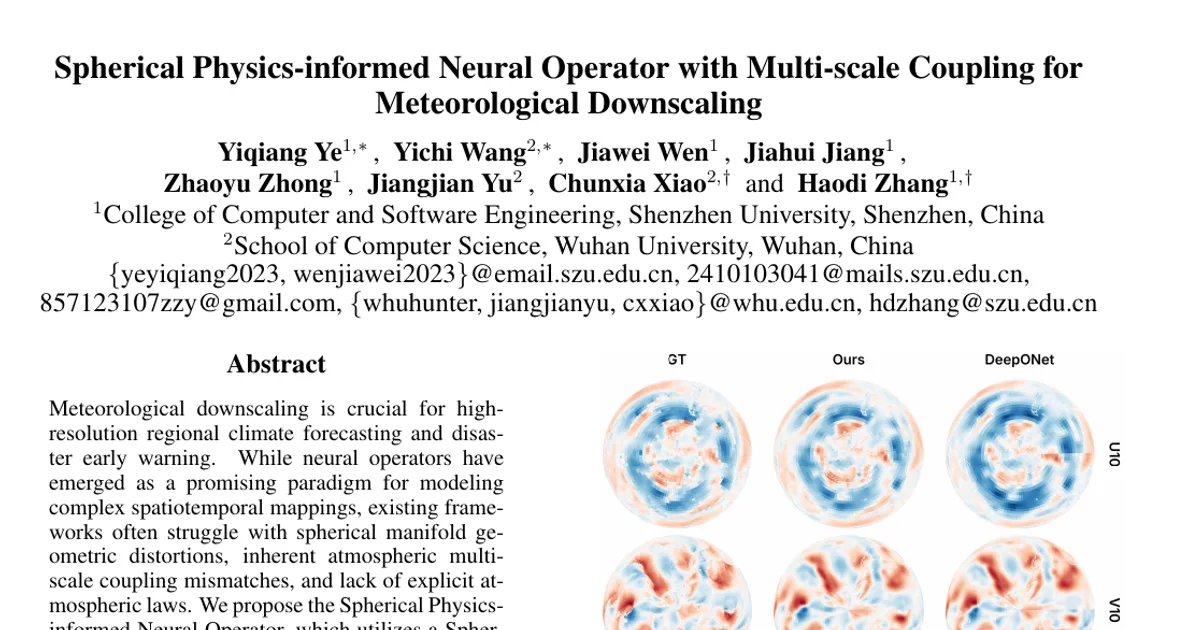
- Strongest gains on dynamic fields. The largest relative improvements appear for near-surface winds (V10 MSE 0.1637 vs 0.1763 for OFormer; U10 0.1293 vs 0.1397) and geopotential height (Z500 RMSE 102.8555 vs 106.7649).
- Zero-shot generalization to unseen resolution. Trained on a 2×2 task (5.625° → 2.8125°) and applied directly to a 4×4 task (5.625° → 1.40625°) without fine-tuning, MSPNO achieves the best average RMSE and ACC; baselines such as OFormer, GNOT, and LNO degrade more.
- Lowest physical residuals. Total physical violation 428.4856 (×10⁻⁵) versus 458.3572 for the strongest baseline, a stated 6.5% reduction; divergence 189.0197, vorticity 78.5133, vapor transport 160.9526.
- Four scales is the sweet spot. Moving from 1 (non-hierarchical) to 4 scales improves all metrics (MSE 0.1125 → 0.1117, RMSE 18.5787 → 18.4779, ACC 0.8876 → 0.8881); going to 8 scales gives only marginal change (MSE 0.1117, RMSE 18.5175, ACC 0.8882).
- Every component matters. Replacing spherical convolutions with standard 2D kernels worsens average RMSE to 18.5541; replacing the localized operator with global attention worsens it to 18.7909; removing the physics objective worsens it to 18.5288 (vs 18.4779).
- Robust to temporal training resolution. Training at 3-, 6-, and 9-hour intervals gives consistent performance, with 6 hours marginally optimal (detailed table in Appendix F, not included in the analyzed content).
- Interpretable scale behavior. Scale 0 captures localized high-frequency residuals while Scale 3 isolates low-frequency large-scale structure; modulation emphasizes fine scales in meteorologically active regions and global features in stable areas.
Methodology in Plain English
Start with a coarse atmospheric field on a lat-lon grid. Instead of downsampling the grid (which breaks point-wise alignment and amplifies polar distortion), the model applies a stack of increasingly smooth spherical filters. Each filter's output is subtracted from its input, and the difference is one "scale band" — a map of structures at a particular size. Because nothing is ever subsampled, band s lines up cell-for-cell with the original grid.
Each band goes through a residual block with spherical kernels, then is summarized into a single vector by averaging over the globe with weights proportional to the cosine of latitude (so polar cells don't get over-counted). Those per-scale vectors attend to each other to capture cross-frequency interactions, and the resulting context vectors produce per-scale scaling and shifting parameters that reweight the band's feature map. The reweighted bands are merged by a cross-scale convolution into one latent field.
To answer a query at an arbitrary point on the sphere, the model encodes that point twice: with Fourier features over its (latitude, longitude) coordinates, and by interpolating nearby latent features using weights that decay with true geodesic distance on the sphere, with a learned bandwidth. An MLP merges the two into one query embedding.
The output at that query is a weighted sum over reference points inside a spherical cap of radius θ — attention restricted to a geodesic neighborhood, normalized over just that neighborhood. This mirrors a continuous integral operator on the sphere but is cheap to compute, and because it depends only on distances and local neighborhoods, it works at any output resolution.
Finally, training adds to the latitude-weighted MSE three penalty terms measuring how much the predicted horizontal divergence, vorticity, and moisture-flux divergence differ from the ground truth's. Derivatives are computed spectrally on the grid, the physics term is rescaled by a running average, and its weight is scheduled dynamically so it does not dominate early training.
Why This Matters
For research: The paper argues that meteorological downscaling needs operators built for the sphere and for multi-scale coupling, and it provides a template for combining manifold-aware convolutions, geometry-aware querying, and differentiable physical constraints in one architecture. It also gives concrete evidence that zero-shot scale extrapolation is achievable, which is a different capability from fitting one fixed upsampling factor.
Real-world applications (as motivated in the paper):
- Extreme weather early warning, where the paper says downscaling accuracy "directly determines the reliability of disaster risk assessment and emergency decision-making."
- Climate change assessment needing high-resolution, physically consistent regional fields.
- Ecological environment governance and regional planning that depend on fine-grained climate projections.
- Replacing or supplementing dynamical downscaling with Regional Climate Models, which the paper notes is effective for extremes but computationally expensive and requires expert interpretation.
Industry relevance: Any organization consuming global model output but needing regional detail — national meteorological services, climate-risk and insurance analytics, and infrastructure planning — could in principle benefit from faster, physics-aware, resolution-flexible surrogates. The code is released at https://github.com/YanisYe/MSPNO.
Future Directions
- Beyond the seven evaluated variables. The study targets T2m, U10, V10, Z500, T850, R500, and S850; extending to precipitation and other strongly convective or non-smooth fields is untested here (the authors note PIANO targets precipitation but is not optimized for spherical topology plus cross-scale consistency).
- Larger-scale and longer-duration validation. Experiments use ERA5 from 2014–2015 at 6-hour intervals; generalization across seasons, decades, and climate regimes is not reported.
- Fuller physical constraints. The current physics terms cover divergence, vorticity, and moisture flux; the authors frame this as an attempt toward "large-scale neural surrogate models of Earth system processes," implying more complete governing-law constraints as a next step.
- Cost and scaling characterization. The analyzed content reports no parameter counts, training hardware, or inference latency, so the practical trade-off of the multi-scale hierarchy versus baselines remains an open question.
Target Audience
Graduate students and researchers in AI-for-science, geophysical fluid dynamics, and climate informatics who already know neural operators and want a geometrically principled design for spherical domains; practitioners building operational or research downscaling pipelines who need arbitrary-resolution, physically constrained emulators; and machine-learning methodologists interested in combining manifold-aware architectures with differentiable physical priors.
Authors’ abstract
Meteorological downscaling is crucial for high-resolution regional climate forecasting and disaster early warning. While neural operators have emerged as a promising paradigm for modeling complex spatiotemporal mappings, existing frameworks often struggle with spherical manifold geometric distortions, inherent atmospheric multi-scale coupling mismatches, and lack of explicit atmospheric laws. We propose the Spherical Physics-informed Neural Operator, which utilizes a Spherical Laplacian Decomposition to partition atmospheric fields into hierarchical frequency components, maintaining exact point-wise correspondence across scales. To evaluate these representations at arbitrary locations, we introduce a localized spherical integral operator that approximates continuous kernel transforms via geometry-aware attention. Dynamical consistency is further enforced by embedding differentiable constraints into the learning process. Extensive experiments demonstrate that our framework attains superior accuracy and zero-shot generalization across various meteorological variables and unseen queries, representing a robust and interpretable solution for global-to-regional meteorological downscaling.