Research
Speculative Forcing for Efficient Autoregressive Video Generation
Overview Research area: Efficient inference for autoregressive (AR) diffusion video generation and interactive world models — specifically, adaptive denoising and token-level computation allocation. T
- arXiv
- 2610.22347
- Published
- 2026-10-15
- Authors
- Hyunwook Choi, Seungryong Kim, Dongyoon Han, Sangdoo Yun
AI summary
Overview
Research area: Efficient inference for autoregressive (AR) diffusion video generation and interactive world models — specifically, adaptive denoising and token-level computation allocation.
Technical level: Advanced. The paper assumes familiarity with diffusion/flow-matching sampling, distribution-matching distillation (CausVid, Self Forcing), KV caching, and VBench-style video evaluation.
Scope (one sentence): The paper introduces Speculative Forcing, a framework that treats each token's intermediate clean latent estimate in a distilled four-step AR video generator as a draft, verifies per-token whether that draft has converged to its full-step output, and freezes accepted tokens early so only the remaining tokens continue to be denoised.
What This Paper Is About
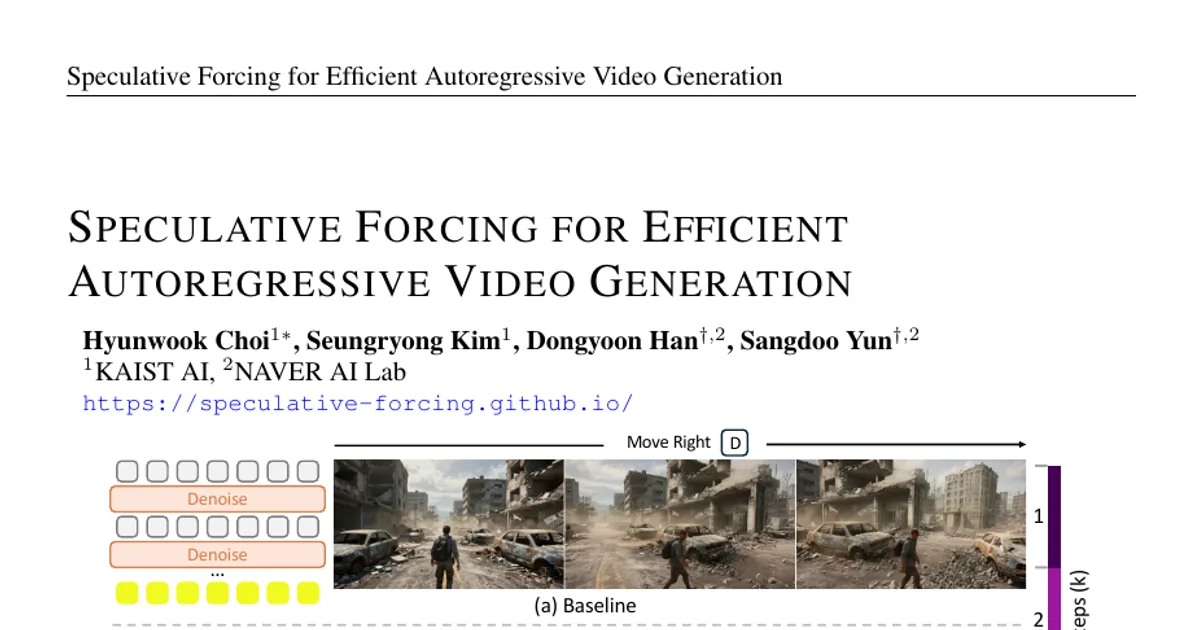
Distilled few-step autoregressive video generators make streaming generation possible, but at inference they still push every token through all K denoising steps, even though many tokens already closely match their eventual full-step output after the first step or two. The authors ask whether every token really needs to be denoised until the final step, and propose accepting tokens whose intermediate estimates have converged while continuing to refine the rest. The goal is to preserve the quality of the four-step generator while cutting the number of denoising evaluations per token and raising throughput.
Key Contributions
-
A token-wise convergence observation and principle. The authors show (Figure 2) that in AR video generation, regions reproducing previously observed content converge early while newly appearing structures keep changing, and that in world models previously observed regions converge early while newly revealed regions need more denoising. This motivates stopping denoising per token rather than per chunk or frame.
-
A token-wise commitment scheme with cache preservation. Each intermediate clean estimate is treated as a draft; once accepted, the token's output is fixed, it receives no further denoising updates, and its layer-wise keys and values stay cached as context for active tokens. Denoising cost drops from K·N to the sum of each token's commit step, with mean denoising depth reported alongside.
-
Two verifier designs, both generator-preserving. A training-free verifier scores the first-step draft by redundancy (minimum L2 distance to the most similar clean latent in the history/reference bank) and later steps by stability (difference between consecutive drafts of the same token). A learned verifier is a shallow 3D convolutional head (4.11M parameters, 1536→96→48→1) that reads a frozen backbone layer's hidden state and predicts each token's remaining gap, trained with a Huber / smooth-ℓ1 loss against the oracle gap; the generator weights are never modified.
-
Evaluation across three regimes with ablations. Short videos, 30-second long videos, and controllable world-model rollouts on LongLive (1.3B) and Lingbot-World 2.0 Causal-Fast (1.3B), plus ablations on verification tolerance, alternative routing signals, oracle verification, and commitment granularity (token-wise vs chunk-wise).
Main Findings
-
Convergence is genuinely non-uniform: visualizing latent differences between each chunk's k-step prediction and the baseline four-step output shows background and history-consistent regions converging early while other regions keep changing; camera-driven world-model rollouts show the same split between previously observed and newly revealed regions.
-
5-second LongLive videos keep quality at under 1.7 steps: the learned verifier ("Ours H") averages 1.68 denoising steps per token at 41.74 FPS with VBench Total 83.21, Quality 83.54, Semantic 81.89, versus the uniform four-step baseline's 4.00 steps at 26.40 FPS with Total 83.08, Quality 83.49, Semantic 81.43. The training-free verifier ("Ours TF") averages 1.65 steps at 43.61 FPS with Total 83.12.
-
30-second LongLive videos (VBench-Long) stay competitive: Ours H uses 1.72 steps at 37.8 FPS with Total 82.81 and Drift 1.707; Ours TF uses 1.71 steps at 38.8 FPS with Total 82.75 and Drift 1.685; the four-step baseline uses 4.00 steps at 24.5 FPS with Total 82.69 and Drift 1.722. Dynamic Degree remains comparable (40.74 / 41.57 vs 39.17 for the four-step baseline), which the authors read as evidence that lower drift is not simply suppressed motion.
-
World-model rollouts are harder and need more steps: on Lingbot-World 2.0, Ours H averages 2.55 steps at 24.5 FPS with Quality 82.65 and Drift 2.839, versus the four-step baseline's 4.00 steps, 18.1 FPS, Quality 82.62, Drift 3.094. Camera-following accuracy is preserved: translation error 0.328 vs 0.328 and rotation error 0.260° vs 0.253° relative to the four-step generator. The abstract summarizes this as roughly 2.5 steps per token and 1.35× faster at 24.5 fps.
-
Reported speedups: the abstract reports over 1.5× faster at 41.7 and 37.8 fps on LongLive and 1.35× faster at 24.5 fps on Lingbot-World 2.0, with approximately 1.7 and 2.5 denoising steps per token respectively.
-
Tolerance is a test-time speed/quality knob: sweeping ϵ on Lingbot moves mean steps from 3.47 (ϵ=0.16, 20.1 FPS, Quality 82.56, Drift 3.010) through 2.95 (ϵ=0.20, 82.72, 2.862) and 2.55 (ϵ=0.24, 82.65, 2.839) to 2.24 (ϵ=0.28, 82.53, 2.943) and 1.97 (ϵ=0.32, 82.07, 3.398). The paper notes that at ϵ in [0.20, 0.24] the sampler exceeds the uniform four-step baseline on quality metrics, and that Drift is lowest in this range rather than at the full budget.
-
Token-wise beats chunk-wise commitment: at comparable mean steps on Lingbot, token-wise acceptance gives Quality 82.65 and Drift 2.839, chunk-wise gives 82.54 and 3.214, and Oracle gives 82.61 and 2.903 at 2.46 steps (no throughput reported for Oracle).
-
Adapted routing signals underperform: channel-variance routing reaches Quality 78.23 with Drift 4.996 at 2.60 steps; temporal-difference routing (MotionCache-inspired) reaches 80.97 with Drift 4.116 at 2.58 steps — both below the learned verifier and below uniform four-step sampling at similar mean steps.
-
The learned verifier approaches oracle accuracy: table A reports AUROC for identifying tokens needing further refinement (rel_k(i) > ϵ). At ϵ=0.24, Ours H scores 0.934 / 0.890 / 0.906 at steps 1/2/3, versus stability – / 0.774 / 0.854 and redundancy 0.828 / 0.692 / 0.611; motion-based scoring is lowest at 0.701 / 0.592 / 0.561. A per-token MLP head is marginally higher (e.g., 0.940 / 0.894 / 0.911 at ϵ=0.24).
Methodology in Plain English
The starting point is a distilled AR video generator that produces a clean latent estimate at every one of its K = 4 denoising steps. Instead of always returning the fourth-step estimate, the method treats each earlier estimate as a draft of what the final answer would be.
At each step, a verifier looks at every token still being denoised and produces a score. If the score says the token has converged, the token is "committed": its current estimate is written into the output and it is removed from future denoising passes. Crucially, its cached keys and values stay in the attention cache, so the still-active tokens can keep attending to it — this is what prevents committed content from disappearing from the context. Rejected tokens are re-noised to the next noise level and refined as usual, and anything still active at step K is committed there. Because different tokens commit at different steps, one output chunk can mix estimates from several steps; after the chunk is assembled, the base generator runs a clean pass at timestep 0 to refresh the cache before the next chunk.
The "ground truth" for convergence is defined as a normalized distance between the k-step estimate and the full-step estimate, divided by the median token norm in the chunk's full-step output, with acceptance when this gap is ≤ ϵ. That reference is unavailable at inference, so it serves as an oracle for training and for calibrating thresholds.
The training-free verifier uses two proxies: at step 1, the distance from the draft to the nearest clean latent token in the history bank (previous chunks within the attention window, reference frames, attention sinks), and from step 2 on, the difference between consecutive drafts of the same token. Thresholds are calibrated on held-out data. The learned verifier instead attaches a small 3D convolutional head to the frozen generator's final transformer block, trains it on full-step rollouts to predict the oracle gap with a smooth-ℓ1 loss (Adam, learning rate 10⁻³, batch size 4), and accepts tokens whose predicted gap falls below ϵ. Training data: 1K VidProM prompts for LongLive and 1K initial images with scenes disjoint from evaluation for Lingbot.
Both verifiers apply a spatiotemporal smoothing operator to their score maps before thresholding — a 9×9 Gaussian kernel with standard deviation 1.0 token spatially, plus temporal averaging with standard deviation 1.0 latent frame — to keep acceptance decisions coherent across neighboring tokens. Evaluation uses VBench (16 dimensions) on 5-second clips, VBench-Long on 30-second clips, and a six-dimension VBench quality aggregate plus relative pose error and the Reward Forcing Drift metric on 200 held-out Lingbot navigation scenes, with throughput measured on a single NVIDIA H100 excluding VAE encoding/decoding.
Why This Matters
Impact on research. The paper reframes inference-time efficiency for distilled AR video generators as a per-token decision problem rather than a schedule- or chunk-level one. It distinguishes itself from caching methods and spatially adaptive samplers, which the paper notes carry every token to the end of the schedule and never declare a token finished, and from frame- or chunk-level depth selection (DSA, Surprise Forcing), which the results show is measurably worse at matched mean steps. The learned-verifier result — that a 4.11M-parameter head on frozen intermediate features predicts remaining convergence error with AUROC around 0.89–0.94 — is a reusable finding about what those features encode.
Real-world applications:
- Interactive streaming video generation and avatar/telepresence, where per-frame latency determines usability.
- Real-time controllable world models for games, virtual production, and embodied-agent simulation, where camera or action input continuously changes the visible content.
- Cost reduction for large-scale video generation serving, since the savings are in denoising passes rather than in model size.
- Edge or on-device generation, where a roughly 1.35×–1.6× throughput gain at unchanged quality changes what is feasible within a latency budget.
Industry relevance. The method requires no retraining or weight modification of the base generator, works with either a zero-training heuristic or a small trained head, and exposes ϵ as a deployable speed/quality dial adjustable at inference. That combination is unusually practical for production serving, where operators want a single knob rather than a retraining pipeline.
Future Directions
- Push mean depth closer to one step. The gap between the learned verifier (2.55 steps on Lingbot) and the oracle (2.46 steps) is small, but both are far from 1; the paper's own tolerance sweep shows quality degrading at 1.97 steps (ϵ=0.32), so the frontier is the verifier's precision rather than the acceptance rule itself.
- Reduce verifier cost and improve its signals. The learned head reads only one backbone layer; whether other layers, cross-chunk context, or a stronger predictor of the residual would raise AUROC at step 1 (currently 0.933–0.944) and permit earlier acceptance is left open.
- Automatic per-content tolerance selection. ϵ is currently set per setting (0.28 for short videos, 0.24 for long videos and world rollouts) and calibrated on held-out data; adapting it online to scene difficulty, particularly under heavy camera motion, is a natural extension.
- Generalization beyond these two generators. Both models are 1.3B four-step distilled AR generators; whether the convergence pattern and the head transfer to other distilled schedules, other step counts, or non-AR diffusion video models is not established by the reported experiments. The provided content truncates before the paper's own Limitations section (Appendix D.1), so the authors' stated limitations are not available here.
Target Audience
Researchers and engineers working on diffusion and flow-matching video generation, few-step distillation (CausVid, Self Forcing, Causal Forcing lineage), and interactive world models, especially those concerned with inference latency and serving cost. It is also relevant to practitioners who need a drop-in acceleration technique that leaves model weights untouched, and to readers interested in adaptive computation and speculative/draft-verification ideas applied outside language modeling. Beginners will find the core intuition accessible from Figure 1 and Figure 2, but the experimental sections assume working knowledge of VBench metrics and denoising schedules.
Authors’ abstract
Few-step autoregressive video generators enable streaming generation, yet they run every token through the final denoising step, regardless of how much refinement it needs. We find this uniform computation is often unnecessary: many tokens already closely match their eventual full-step outputs in the initial steps, while others require refinement until the end. We introduce Speculative Forcing, a framework that treats intermediate clean estimates as drafts and predicts when individual tokens can be safely accepted early. Once accepted, a token is frozen as its final output and undergoes no further denoising, while its cached keys and values remain available as context for the remaining tokens. We explore two alternative verifier designs: a training-free one based on similarity to clean content and stability across steps, and a learned one that reads the frozen generator's intermediate features to estimate each token's remaining gap to its full-step output. Across short-video, long-video, and world generation, Speculative Forcing preserves the quality of full-step sampling while substantially reducing computation. On LongLive, it matches the four-step generator with ~1.7 denoising steps per token, running over 1.5x faster at 41.7 and 37.8 fps. On Lingbot-World 2.0, where camera motion continually changes the visible content, it maintains quality with ~2.5 denoising steps per token and runs 1.35x faster at 24.5 fps.