Research
SpectralCanary: Embarrassingly Simple Low-Frequency Traces for T2I Dataset-Use Auditing
Overview Research area: Computer vision / generative-model provenance — specifically proactive dataset-use auditing for text-to-image (T2I) models. Technical level: Intermediate. The core idea (blend
- arXiv
- 2610.31659
- Published
- 2026-10-22
- Authors
- Sy-Tuyen Ho, Anirudh Satheesh, Soham Chawathe, Huy Nghiem, Yongkyun Lee, Andrew Adams Schoen, Furong Huang
AI summary
Overview
Research area: Computer vision / generative-model provenance — specifically proactive dataset-use auditing for text-to-image (T2I) models.
Technical level: Intermediate. The core idea (blend a small amount of one image's low-frequency content into every image in a collection) is conceptually simple, but reading the paper comfortably requires familiarity with Fourier transforms, LoRA fine-tuning, diffusion models, and detection metrics such as AUC, TPR/FPR, SSIM, LPIPS, and FID.
Scope: The paper proposes and empirically evaluates SpectralCanary, a deterministic spectral-blending method for planting a detectable collection-level trace in an image dataset so that a rights holder can later test whether a suspect T2I model was fine-tuned on that collection.
What This Paper Is About
Rights holders who release image collections have little way to tell whether someone quietly fine-tuned a T2I model on their images, because a model can absorb a collection's overall look without ever reproducing a specific training image. The paper introduces SpectralCanary, which pre-emptively mixes a small amount of a single fixed "canary" image's low-frequency Fourier content into every image in the collection before release, leaving captions untouched. Later, a lightweight verifier is applied to a suspect model's generated images to test statistically whether the trace transferred through fine-tuning.
Key Contributions
-
Identifying the frequency band as the design lever. Through matched-band-size and matched-perturbation-energy ablations on Pokemon and ROCOv2 with SD1.5, the authors show that placing the trace in low frequencies yields higher per-generation TPR than placing it in mid or high frequencies.
-
The SpectralCanary method itself. A deterministic, caption-preserving spectral hybridization: a smooth radial low-pass Gaussian mask blends a fixed canary spectrum into each image with strength α, requiring no auxiliary generative model and no per-image optimization.
-
A broad joint evaluation. Per-generation discrimination, KS-based multi-query auditing, fixed-threshold model-level verification, image fidelity, generative utility, robustness, and protection cost are measured across two architecture families (SD1.5 and SD3.5), five datasets, three direct auditing baselines (SIREN, DIAGNOSIS, EnTruth), plus an adapted poisoning baseline (Silent Branding, reported separately in an appendix) and three realistic data transformations.
-
A characterized robustness boundary. The paper maps how much quality damage three adaptive removal attacks must inflict before the trace is erased, finding that effective removal costs more than 25 ΔFID points under the strongest evaluated attack.
Main Findings
-
Per-generation discrimination on Pokemon: Across the eight Pokemon model–transformation settings, SpectralCanary reaches 98.0% AUC and 91.1% TPR at 1% FPR, versus 73.2% average TPR for the next-best method. Its weakest single result is 65.9% (SD3.5 with training-time augmentation), while the best competing method's worst case is 19.4%.
-
Model-level decisions: Aggregating 30 generations per held-out model with a threshold calibrated per method–architecture pair, SpectralCanary achieves 94.8% average model-level accuracy across the same eight settings. Each setting includes five clean-data and five protected-data models, giving 320 held-out models across the four methods.
-
Cross-domain generalization: With SD3.5 on five datasets spanning artistic, medical, satellite, and fashion domains, SpectralCanary averages 92.4% per-generation TPR at 1% FPR (99.5% AUC) while keeping SSIM 0.989, LPIPS 0.022, and mean ΔFID of 0.05.
-
Best and worst domains: Sparse Sketch-Scene drawings reach 100% AUC and 100% TPR with SSIM 0.997 and LPIPS 0.002. The hardest dataset is RSICD (satellite), at 78.9% per-generation TPR with LPIPS 0.048.
-
Protection cost: Protection takes 0.39 seconds per image on the authors' CPU setup. DIAGNOSIS is faster but averages only 32.2% TPR; SIREN and EnTruth need substantially more computation for lower per-generation TPR.
-
Low frequency beats mid/high frequency even at matched energy: The low-frequency band exceeds the high-frequency band by 16.9 percentage points on Pokemon and 88.9 points on ROCOv2, with the mid-frequency band also weaker in both cases.
-
Not a clean sweep: DIAGNOSIS is strongest for ordinary SD1.5 training, and EnTruth is strongest for SD3.5 with training-time augmentation.
-
Removal is costly: Among the three evaluated attacks (fixed-donor replacement, per-image donor replacement, and direct estimation of the shared low-frequency pattern), driving TPR back toward the clean-training baseline requires more than 25 additional FID points under the strongest attack and also produces large LPIPS changes.
Methodology in Plain English
Protection step. The dataset owner picks one fixed canary image and a few settings: the fraction of images to protect (δ, default 1, meaning all of them), a blending strength (α, default 0.02), and a Gaussian bandwidth (c, default 0.20). Each image is converted into the Fourier domain, where an image is represented as a grid of frequency coefficients. A smooth radial mask — highest at the center (lowest frequencies) and decaying outward — is used to nudge each coefficient slightly toward the canary's corresponding coefficient. Because the mask covers low frequencies and α is small, the image keeps most of its own spectrum and looks nearly unchanged. The result is converted back, clipped, quantized to 8-bit, and saved as lossless PNG. Captions are not modified.
Why this creates a collection-level signal. Every protected image is pulled slightly toward the same low-frequency target. The collection mean shifts toward the canary while variation shrinks in the low-pass-weighted frequencies — a shared, subtle statistical signature rather than a visible logo.
Verifier training. A ResNet-50 with a binary head is trained using protected images as positives and their originals as negatives. Because each pair shares semantic content, the protection transform is the only systematic label-aligned difference. No model generations are used in training.
Auditing. The owner queries the suspect model with trigger-free prompts (the collection's own captions) and scores each generated image with the verifier. Per-generation metrics (AUC, TPR at a target FPR) ask whether outputs from a protected-data model score higher than outputs from a clean-data model. For a model-level decision, scores from 30 generations are combined using a one-sided two-sample Kolmogorov–Smirnov test against a clean-data reference distribution, or aggregated against a threshold fixed after independent calibration.
Baselines and stress tests. Comparisons are against SIREN and DIAGNOSIS (pixel-level traces) and EnTruth (explicit canary samples). On Pokemon, each method is additionally tested after image augmentation, after diffusion-based regeneration of every training image, and after automatic recaptioning with Qwen2.5-VL 7B.
Ablations and attacks. The frequency-band ablation holds both the number of Fourier coefficients and the total amount of Fourier-domain change constant, so no band can win simply by altering more of the image. The adaptive attacks assume the attacker knows the algorithm, α, and c, but not the canary, the originals, or the verifier.
Why This Matters
Impact on research. The paper reframes proactive dataset auditing as a question of where in the spectrum to place a trace, rather than how to engineer a stronger signal. The matched-energy ablation is a clean, controlled argument that low-frequency placement is intrinsically more transferable, which gives future traceability work a principled starting point and a comparable baseline protocol.
Real-world applications:
- Stock photography and illustration marketplaces auditing whether licensees fine-tuned generative models beyond their terms.
- Medical imaging repositories checking whether diagnostic or reporting models were adapted from restricted patient data.
- Satellite and geospatial data providers detecting unauthorized model customization on licensed imagery.
- Artist and illustrator communities or collective licensing bodies verifying whether a member's portfolio was scraped into a personalized model.
Industry relevance. The protection step is a single deterministic FFT-based transform at 0.39 seconds per image on CPU, with no auxiliary generator and no per-image optimization. That makes it plausible to apply at catalog scale before release, which is the practical bottleneck for any proactive scheme. The paper also reports that the trace survives common pipeline changes — augmentation, image regeneration, recaptioning, and a switch from a U-Net latent-diffusion model to a transformer-based rectified-flow model — which is where weak pixel watermarks typically break.
Future Directions
- Broader architecture and mixing coverage. The evaluation covers two architecture families, five datasets, and both LoRA and full-parameter fine-tuning, but not transfer to every model, nor the case where a protected collection is mixed into a much larger unprotected corpus.
- Canary diversity and key reuse. The main experiments use one fixed natural canary image. The authors call for evaluation across independently chosen canaries and across repeated key use, noting that their phase-randomized controls isolate spatial coherence but do not settle this.
- Stronger adaptive and collusive attacks. The current threat model assumes the canary and verifier stay private. The authors flag collusion across multiple releases, learned removal models, stronger shared-structure estimators, and adaptive access to verifier feedback as untested.
- Perceptual and task-level validation. SSIM, LPIPS, and FID capture only part of fidelity and utility; human perceptual studies and task-specific utility measurements are needed to support stronger claims about invisibility and harmlessness, alongside broader calibration of clean-data references for deployment.
Target Audience
Researchers working on data provenance, watermarking, and generative-model accountability; dataset owners and licensing teams at image marketplaces, medical archives, and geospatial providers evaluating pre-release protection; and practitioners who fine-tune or audit diffusion models and want a cheap, deterministic traceability baseline. Readers primarily interested in watermark security proofs should note the authors' explicit framing that the audit yields calibrated statistical evidence under a stated threat model, not cryptographic attribution or white-box robustness.
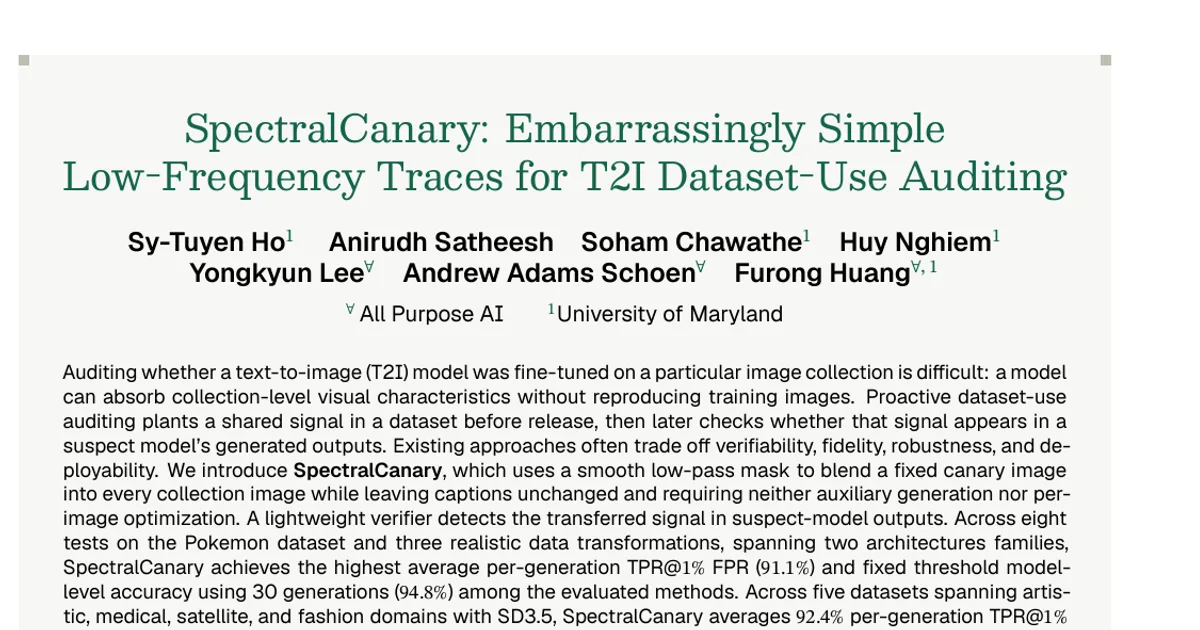
Authors’ abstract
Auditing whether a text-to-image (T2I) model was fine-tuned on a particular image collection is difficult: a model can absorb collection-level visual characteristics without reproducing training images. Proactive dataset-use auditing plants a shared signal in a dataset before release, then later checks whether that signal appears in a suspect model's generated outputs. Existing approaches often trade off verifiability, fidelity, robustness, and deployability. We introduce $\textbf{SpectralCanary}$, which uses a smooth low-pass mask to blend a fixed canary image into every collection image while leaving captions unchanged and requiring neither auxiliary generation nor per-image optimization. A lightweight verifier detects the transferred signal in suspect-model outputs. Across eight tests on the Pokemon dataset and three realistic data transformations, spanning two architectures families, SpectralCanary achieves the highest average per-generation TPR@$1\%$ FPR ($91.1\%$) and fixed threshold model-level accuracy using 30 generations ($94.8\%$) among the evaluated methods. Across five datasets spanning artistic, medical, satellite, and fashion domains with SD3.5, SpectralCanary averages $92.4\%$ per-generation TPR@$1\%$ FPR while preserving the released images (SSIM $0.989$, LPIPS $0.022$) with a near-zero mean change FID (mean $Δ$FID $0.05$) across datasets. Matched-energy ablations on Pokemon and ROCOv2 support our design choice, low-frequency placement transfers more reliably compared to mid/high-frequency placement. Under the evaluated adaptive attacks, the most effective removal requires aggressive modification and incurs more than $25$ $Δ$FID points. These results identify low-frequency visual signals as effective carriers for collection-level T2I audit traces.