Research
Spectral World Renderer: Unified 3D Hyperspectral Unmixing
Spectral World Renderer: Unified 3D Hyperspectral Unmixing Authors: Chia-Ming Lee, Yu-Jou Hsiao, Ming-Ching Chang, Xin Li, Yu-Lun Liu, Chih-Chung Hsu Affiliations: University at Albany, State Universi
- arXiv
- 2610.19520
- Published
- 2026-10-14
- Authors
- Chia-Ming Lee, Yu-Jou Hsiao, Ming-Ching Chang, Xin Li, Yu-Lun Liu, Chih-Chung Hsu
AI summary
Spectral World Renderer: Unified 3D Hyperspectral UnmixingAuthors: Chia-Ming Lee, Yu-Jou Hsiao, Ming-Ching Chang, Xin Li, Yu-Lun Liu, Chih-Chung Hsu Affiliations: University at Albany, State University of New York; National Yang Ming Chiao Tung University; National Cheng Kung University arXiv: 2610.19520v1 [cs.CV], 14 Oct 2026
Overview
Research area: Computer vision and 3D scene reconstruction, combining hyperspectral imaging, spectral unmixing, 3D Gaussian splatting, and programmatic (agent-driven) world generation.
Technical level: Advanced. The paper assumes familiarity with radiance fields, Gaussian splatting, linear mixing models, endmembers, and abundance constraints.
Scope (one sentence): The paper presents a single framework that generates synthetic 3D worlds with exact material composition and then performs hyperspectral unmixing inside the rendering process, so that one render simultaneously produces spectra, material maps, and queryable per-primitive abundances.
What This Paper Is About
Cameras and the RGB foundation models built on them (CLIP, SAM, DINOv2) recognize what objects a scene contains but not what surfaces are made of: surfaces of the same colour can be different materials, and one object may combine wood, laminate and metal. Hyperspectral unmixing can explain each measured spectrum as a non-negative mixture of material signatures, but in 3D it is applied to images after the views have already been composited, or tied to slow implicit fields, and no multi-view dataset with known composition exists to verify the result. The paper builds both the missing data and the missing method: an agent-driven world generator that renders worlds with measured spectra and exact sub-pixel material proportions (SWR-Bench, eight indoor and outdoor worlds), and Spectral World Renderer (SWR), which decodes material abundances at every ray intersection before compositing.
Key Contributions
-
The SWR world generator and SWR-Bench. A coding agent turns reference images, maps and a text brief into executable scene programs; shared sub-pixel samples render aligned hyperspectral images, material labels and area proportions from the same camera samples, giving eight worlds with measured spectra that make decompositions verifiable.
-
Spectral World Renderer. A compact Gaussian representation in which each Gaussian stores a band-independent harmonic feature instead of a spectrum, and a shared decoder maps that feature to abundances over a scene-wide endmember dictionary at every ray intersection. One render yields spectra and queryable 3D abundances at any band count.
-
Multi-view appearance regularization. A method that pools foreground training pixels across all views, clusters them by spectral shape and brightness, and binds each cluster to its own endmember, so no material label enters training.
-
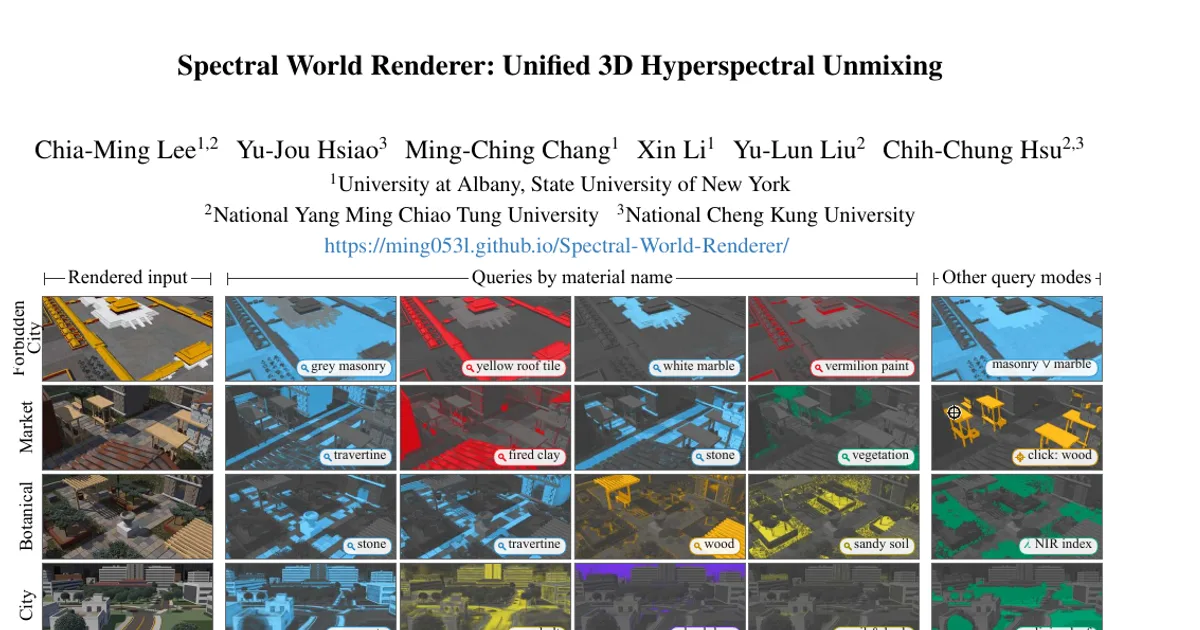
Real-time material queries. Queries by name, click, reference spectrum or band index (reported at 3 ms per query), consistent across views, that separate same-coloured materials (metamers) and resist shadow.
Main Findings
-
Highest mIoU in every world. Without material labels, SWR has the best mIoU on all eight SWR-Bench worlds: 0.55 on Forbidden City, 0.78 on Market, 0.71 on Botanical, 0.31 on NVIDIA HQ, 0.52 on Study, 0.73 on Karst, 0.52 on City and 0.53 on Office, versus 0.19/0.13/0.10/0.08/0.20/0.38/0.10/0.11 for UnMix-NeRF and 0.17/0.24/0.22/0.13/0.30/0.35/0.21/0.17 for 3DGS + VCA/NNLS.
-
Best endmember recovery. SWR learns the endmembers closest to the true spectra in every world, with mean endmember angles in degrees of 4.4, 2.4, 2.4, 3.7, 0.9, 2.9, 3.1 and 3.3, versus 27.4, 30.9, 38.8, 43.0, 22.9, 25.8, 30.4 and 18.8 for UnMix-NeRF.
-
Fidelity does not imply identification. On Market and Study, 3DGS with post-hoc unmixing reaches a lower spectral angle (1.85 and 1.52 degrees) than SWR (1.95 and 2.01) yet a far lower mIoU (0.24 and 0.30 versus 0.78 and 0.52), because unmixing afterwards acts on contributions that compositing has already mixed.
-
Best PSNR on every real source. On NeSpoF (21 bands) SWR reaches 29.39 PSNR versus 28.36 for HyperGS; on the 204-band HSI-SC apple 30.67 versus 27.95; on HS-NeRF (128/141 bands) 26.51 versus 26.32 for 3DGS, where 3DGS has a lower mean and 95th-percentile spectral angle.
-
Fastest training and rendering. City trains in 6 min 37 s for SWR, versus 24 min 17 s for UnMix-NeRF and 85 min 2 s for 3DGS+VCA/NNLS (a 3.7× to 12.9× speedup). SWR renders 34.9 labelled views/s on average at 960×540×64 (36.5 Market, 39.3 Botanical, 36.3 Study, 27.4 Karst), against 0.18 for UnMix-NeRF and 3.6 for 3DGS+VCA/NNLS.
-
Noise and decomposition both limit identification. NNLS with the true spectra reaches 0.84–0.94 mIoU on clean radiance but only 0.32–0.77 under noise.
-
RGB feature refinement matters. Refinement on the fixed anchor takes 36.5 s of the 397 s City pipeline, yet improves Market by 2.9 dB and 0.12 mIoU, and the real apple by 2.6 dB.
-
Within-primitive variation matters. With one feature per Gaussian instead of the harmonic texture, Market loses 1.6 dB and mIoU drops from 0.47 to 0.34; a fixed intensity keeps PSNR but lowers mIoU to 0.22.
-
Decoding before compositing matters. Decoding after compositing raises Market PSNR from 33.72 to 34.37 dB yet lowers mIoU from 0.47 to 0.37.
-
Queries separate metamers and shadows. Foliage-coloured mineral leaves are 2 degrees apart in RGB but 42 degrees apart in spectrum; the mineral-leaf query retrieves no ordinary tree, whereas the RGB query retrieves eleven. A pixel clicked in shadow retrieves 77% of the sunlit part of its material, against 10% for RGB (mean over four outdoor worlds).
-
Appearance clusters resolve brightness ambiguity. White marble is four times brighter than grey masonry but only 3.8 degrees apart in spectral shape; the multi-view appearance clusters give marble its own layer, whereas without them it is absorbed into masonry.
Methodology in Plain English
The authors first solve the data problem. A coding agent reads reference photographs, available maps and a short text brief, and writes an executable scene program that fixes geometry, materials, lighting and camera paths; the agent and the authors review rendered previews for support, collisions and clearance. Materials are grounded in measured reflectance from ECOSTRESS and USGS libraries, and outdoor worlds use ASTM G173 sunlight and skylight while interiors use white sources (or are path traced in Mitsuba). Every pixel is rendered from the same 16 sub-pixel camera samples for the hyperspectral image, the RGB image, the material labels and the area proportions, so a label cannot disagree with the image it describes. Each world is checked for label alignment, spectral provenance and train/test separation, and 64 bands from 420 to 980 nm are rendered both clean and with shot and read noise.
The renderer then changes where unmixing happens. Geometry is fitted first as an RGB-trained 3D Gaussian splatting anchor, using FastGS densification and pruning, because hyperspectral observations are noisy and can degrade geometry. After fitting, colours are dropped and each Gaussian instead carries a neural harmonic texture of four feature vectors of dimension 12, so a ray reads a different feature depending on where it crosses the primitive, and storage does not grow with the band count L (each Gaussian stores 11 geometry and 48 feature values). At every ray intersection, a shared three-layer MLP decoder turns that feature (plus a degree-2 spherical-harmonic direction code) into K abundances plus one intensity. The abundances mix a scene-wide dictionary of K unit-normalized endmembers, and the intensity carries magnitude, so shading does not have to be explained by merging materials.
Because decoding happens before compositing, the same visibility weights that render the spectrum also render the abundances; each intersection keeps its own mixture, and averaging a Gaussian's abundances over its training rays makes them queryable in 3D. To initialize and regularize the dictionary without labels, the authors pool foreground pixels from all training views, describe each smoothed spectrum by its normalized shape plus a bounded brightness term, cluster them with farthest-point seeding and k-means, initialize one endmember per cluster, and apply a persistent assignment loss that pushes each pixel's abundance toward its own cluster's endmember. Endmembers stay frozen for the first 3k updates and the loss weight decays (from .05 to a floor of .005 by update 3000), so initially distinct appearances do not merge. K is chosen from validation mIoU: 24 for Market, NVIDIA HQ and Study, 32 elsewhere, and 16 for real captures.
Why This Matters
Impact on research. The paper reframes hyperspectral 3D reconstruction as a verifiable problem rather than a fidelity race. By releasing worlds whose spectra, material labels and sub-pixel proportions all come from the same samples, it provides the ground truth that existing multi-view hyperspectral datasets (tabletop or turntable captures such as NeSpoF, HS-NeRF and HSI-SC) cannot supply, because radiance records carry no material labels. It also shows that a lower spectral angle can hide a worse decomposition, a measurement that only becomes visible once composition is known. Since the geometry is an RGB anchor, advances in RGB Gaussian splatting transfer directly.
Real-world applications (from the paper's stated motivation and experiments):
- Robotic sorting of materials that look identical in RGB.
- Agriculture, including distinguishing foliage from dry or mineral-like crowns via the red edge near 700 nm.
- Building inspection, where surfaces such as marble and masonry share colour but differ in composition.
- Remote sensing and material analysis, where 2D abundance maps are the established product and 3D consistency adds a new capability.
Industry relevance. The method plugs into the 3D Gaussian splatting pipeline that already powers real-time novel-view rendering, needs no material labels for training, and answers material queries in 3 ms with per-primitive, rasterizable abundances. That combination matters for teams building perception or inspection systems on RGB foundation models (CLIP, SAM, DINOv2), which the paper argues remain weak at material identity.
Future Directions
- Enrich light transport and sensor models beyond the current Lambertian-plus-effects approximations (glossy highlights, glass, hazy sky, refracting water, path-traced interiors).
- Allocate endmembers better to rare materials: appearance regularization recovers Forbidden City marble, but misses ink in Study, which NNLS with the true class spectra mostly separates. Rare classes (under 3% of test pixels) remain hard.
- Handle dynamic scenes, which are explicitly excluded from the current benchmark.
- Extend querying and evaluation to object-level queries, which the stored instance labels make possible for every object.
Target Audience
Researchers and engineers working on 3D scene reconstruction, Gaussian splatting and hyperspectral imaging, particularly those interested in inverse rendering, material or intrinsic decomposition, and spectral unmixing. It is also relevant to practitioners who need multi-view, material-aware perception for robotics, agriculture, inspection or remote sensing, and to anyone building synthetic benchmarks where labels and sub-pixel proportions must be exact. The paper is advanced: readers will get the most from it with prior exposure to radiance fields, mixing models and endmember
Authors’ abstract
Cameras and the foundation models built on them recognize what a 3D scene contains, but not what it is made of: surfaces of the same colour can be different materials. Hyperspectral unmixing explains each spectrum as a mixture of material signatures, yet in 3D it is applied to rendered images after the views are composited, or tied to slow implicit fields, and no multi-view data with known composition exist to check the result. We present the Spectral World Renderer (SWR), which unifies world generation and unmixing. A coding agent builds executable 3D worlds that are rendered with measured spectra, so every hyperspectral image comes with exact labels and sub-pixel proportions; the resulting SWR-Bench provides eight indoor and outdoor worlds in which decompositions can be verified. SWR then unmixes inside rendering: each Gaussian of a compact 3D representation is decoded into material abundances before compositing, so one render yields spectra and material maps, and any surface can be queried by material name, a clicked pixel or a reference spectrum. Without material labels, SWR identifies materials best in all eight worlds, has the best mean PSNR on real captures, trains 3.7-12.9x faster than unmixing baselines, renders 34.9 labelled views/s and separates same-coloured materials.