Research
Sparsity-Aware Low-Rank Representation for Efficient Fine-Tuning of Large Language Models
SALR: Sparsity-Aware Low-Rank Representation for Efficient Fine-Tuning of Large Language Models Overview Research area: Parameter-efficient fine-tuning of large language models, specifically combining
- arXiv
- 2601.16991
- Published
- 2026-01-08
- Authors
- Longteng Zhang, Sen Wu, Shuai Hou, Zhengyu Qing, Zhuo Zheng, Danning Ke, Qihong Lin, Qiang Wang, Shaohuai Shi, Xiaowen Chu
AI summary
SALR: Sparsity-Aware Low-Rank Representation for Efficient Fine-Tuning of Large Language ModelsOverview
Research area: Parameter-efficient fine-tuning of large language models, specifically combining low-rank adaptation (LoRA) with magnitude-based weight pruning for real model compression.
Technical level: Intermediate. The paper relies on familiarity with LoRA, pruning, singular value decomposition, and matrix-multiplication kernels, though each piece is introduced from scratch.
Scope: The paper proposes SALR, a fine-tuning and deployment paradigm that prunes only the frozen base weights of a LoRA model, recovers the discarded information through a truncated-SVD low-rank residual adapter, and adds a bitmap encoding plus two-stage decoding pipeline so that sparsity translates into genuine model-size reduction and inference speedup.
What This Paper Is About
LoRA cuts the number of trainable parameters, but the dense base weights it sits on still cost full memory and compute, so LoRA alone does not compress a deployed model. Naively pruning a LoRA-fine-tuned model tends to destroy the learned low-rank subspace and hurt accuracy, and most prior LoRA-pruning work claims a sparsity ratio without actually shrinking the stored model. SALR's goal is to achieve real sparsity, real compression, and real inference speedup while matching LoRA's accuracy.
Key Contributions
- A unified, MSE-based theoretical framework for pruning inside LoRA-fine-tuned models, proving that applying a static mask to the frozen base weights W₀ yields the lowest error bound, with E₁(p) ≤ E₃(p) ≤ E₂(p) for every pruning ratio p.
- SALR itself: a sparsity-preservation pruning method that captures the residual of pruned weights with a truncated-SVD low-rank adapter, provably reducing per-entry MSE by a factor of (1 − r/min(d,k)).
- An adapter concatenation scheme that stacks all low-rank adapters along the rank dimension, replacing 2n small matrix multiplications with two larger GEMMs and reducing kernel-launch overhead.
- A deployment pipeline using bitmap encoding of the pruned base weights plus a two-stage pipelined decoding + GEMM design, so sparsity produces actual model-size reduction and compute-bound throughput.
Main Findings
- Pruning the base weights is provably the best-place static mask. Theorem 2 shows that a static mask on W₀ (Method 1) always has the lowest per-entry MSE among the three schemes analyzed; a dynamic mask on the full update U = W₀ + Δ (Method 3) sits in the middle, and a dynamic mask driven by U but applied only to W₀ (Method 2) is worst.
- Pruning is theoretically cheap. For a normally distributed weight and 50% pruning, the paper's Theorem 1 gives t₀.₅ = Φ⁻¹(0.75) ≈ 0.674 and MSE(0.5) ≈ 0.072σ².
- SVD residual recovery has a provable bound. Theorem 3 shows the per-entry MSE after pruning plus rank-r SVD correction satisfies MSE_prune+SVD(p, r) ≤ (1 − r/min(d,k)) · MSE(p), using the Eckart–Young theorem.
- An optimal residual learning rate is derived. Theorem 4 gives the Lipschitz constant L_SVD = σ_max(X)², a convergence range 0 < η < 2/σ_max(X)², and the worst-case-optimal choice η*_SVD = 1/σ_max(X)², estimated in practice by a few power iterations on a representative mini-batch each epoch.
- Accuracy matches LoRA at 50% sparsity. On Llama2-7B, SALR scores 56.0 on MMLU and 56.7 on GSM8K versus LoRA's 56.0/56.8, LoSA's 45.0/34.2, SparseLoRA's 56.0/37.6, and DeepSparse's 45.1/36.5. On Llama3-8B it scores 68.2/79.5 versus LoRA 69.2/79.5, LoSA 64.4/71.4, SparseLoRA 69.0/72.0, and DeepSparse 60.4/47.9. On Mixtral-8x7B it scores 71.4/79.1 versus LoRA 71.0/79.2 and LoSA 69.2/57.9. Rank is set to 64.
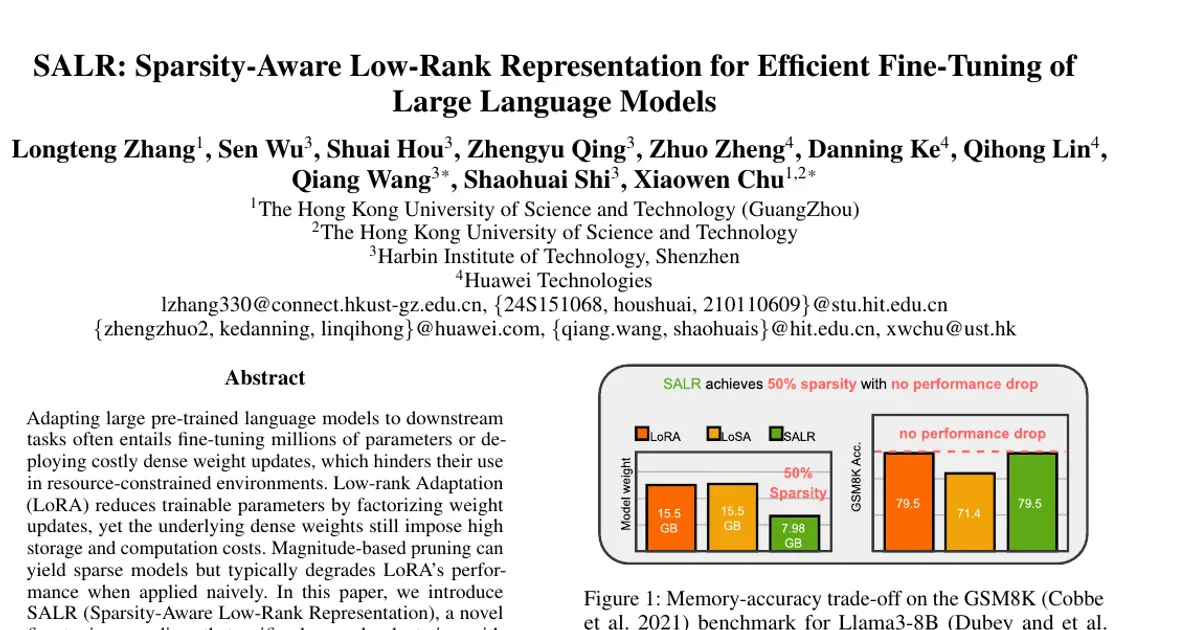
- Memory-accuracy trade-off. Figure 1 reports that on Llama3-8B fine-tuned on MetaMath, SALR at 50% sparsity keeps the dense LoRA GSM8K accuracy of 79.5% while shrinking the model from 15.5 GB to 7.98 GB; LoSA at 50% sparsity drops to 71.4%.
- Fine-tuning efficiency improves over LoSA. On Llama3-8B, LoSA uses 27.1 GB and reaches 74.5 TFLOPS, while SALR uses 19.2 GB and reaches 89.2 TFLOPS, both at 50% sparsity with a 2.0× compression rate. Dense LoRA reports 26.7 GB and 91.9 TFLOPS. The paper summarizes this as roughly a 30% reduction in fine-tuning memory and a 20% increase in TFLOPS relative to LoSA.
- Inference speedup is measured, not assumed. Under the 2:4 pattern on one RTX4090 for Llama3-8B on GSM8K, SALR reaches 78.9 accuracy at 104.9 tokens/s (1.7× speedup), versus LoSA at 69.4 accuracy and 113.5 tokens/s (1.9×), and dense LoRA and SparseLoRA at 79.5/72 accuracy, 60.1 tokens/s, 1.0×.
- Training the residual matters. On MMLU, freezing the SVD residual costs 1.8 points on Llama2-7B (54.2 vs LoRA's 56) and 2.4 points on Llama3-8B (66.8 vs 69.2); training it recovers to 56 and 68.2 respectively, leaving a 1.0 gap on Llama3-8B.
- Sparsity is nearly free up to 50%. On Llama3-8B GSM8K, LoRA scores 79.5, SALR scores 79.5 at 10% sparsity, 80.1 at 30% sparsity, and 79.5 at 50% sparsity.
- Sparsity composes with quantization. QSALR (20% static sparsity + NF4) cuts DeepSeek-V2-Lite from 31.8 GB to 6.5 GB with accuracy 70.4 vs LoRA's 71, and Mixtral-8x7B from 93.9 GB to 19.2 GB with accuracy unchanged at 79.2 — roughly a 5× size reduction. On Huawei NPU, Mixtral-8x7B goes from 94.0 GB / 79.2 to 19.2 GB / 78.0.
- SALR retains more residual spectrum energy. Figure 3 shows i₀.₉₉ for LoSA is much smaller than for SALR on Llama3-8B after MetaMath fine-tuning, meaning SALR keeps a much longer tail of singular values — consistent with the Theorem 3 bound.
- Contrast with prior work. The paper's Table 1 characterizes LoSA (ICLR2025) as low performance / sparse / speedup yes, and SparseLoRA (ICML2025) as high performance / dense / speedup no, positioning SALR as high performance / sparse / speedup yes.
Methodology in Plain English
The authors begin by writing down the error that pruning introduces, then compare three ways of choosing which weights to remove: a fixed mask on the frozen base weights, a mask that looks at the combined update but still only removes base weights, and a mask that removes entries from the combined update. The math says the first option is the safest, so SALR adopts it.
Since deleting weights throws away whatever information those entries held, SALR does not simply discard them. It computes the residual — the difference between the original weight and the pruned weight — and compresses that residual with a truncated SVD, keeping only the top r singular values as a small extra pair of matrices. This residual adapter is also trained, not just frozen, and the paper derives the learning rate that makes that training converge fastest.
Because a SALR layer now has more than one low-rank adapter acting on the same input, doing them one after another wastes hardware. SALR stacks the adapter matrices along the rank axis so a single large matrix multiplication handles them all at once.
Finally, to make sparsity actually shrink the file and speed up inference, SALR stores the pruned base weight as a bitmap plus a compact array of the surviving values, with a precomputed 256-entry lookup table per byte block to reconstruct the matrix fast. A two-stage pipeline decouples this decoding from the tensor-core GEMM, connected by a ring buffer, so decoding block b+1 overlaps with multiplying block b and the hardware stays busy.
Why This Matters
Impact on research. The paper reframes LoRA pruning as an error-minimization problem and gives closed-form bounds for which pruning scheme is best and how much a rank-r correction can recover. It also directly attacks a gap the authors identify in recent literature: many LoRA-pruning papers report a sparsity ratio while leaving the deployed model dense (the paper specifically notes SparseLoRA's gains exist only during training). SALR's combination of a theoretical bound, a residual adapter, adapter fusion, and a bitmap pipeline gives a template for making sparsity claims verifiable in deployment.
Real-world applications
- Serving large models on a single commodity GPU: the reported 15.5 GB to 7.98 GB reduction on Llama3-8B and the 1x RTX4090 benchmark point to single-device inference where the dense model would not fit comfortably.
- On-device or edge deployment of fine-tuned assistants, where the 1.7× inference speedup and halved model size directly reduce latency and storage.
- Multi-task serving: the adapter concatenation scheme is designed for the case where several adapters share the same input, which is exactly the multi-tenant or multi-task scenario.
- Ultra-large model deployment under a memory ceiling: the QSALR combination with NF4 quantization brings DeepSeek-V2-Lite to 6.5 GB and Mixtral-8x7B to 19.2 GB, and the Mixtral NPU result shows the format carries over to non-GPU accelerators.
Industry relevance. The author list spans The Hong Kong University of Science and Technology (GuangZhou), The Hong Kong University of Science and Technology, Harbin Institute of Technology Shenzhen, and Huawei Technologies, and the appendix acknowledges funding from a Guangzhou municipal joint university-enterprise grant (2024A03J0616) and Hong Kong CRF grants (C6015-23G). The inclusion of an explicit Huawei NPU result indicates deployment on production accelerators is part of the intended use case.
Future Directions
- Wider architecture and scale coverage. The evaluation covers Llama2-7B, Llama3-8B, Mixtral-8x7B, and DeepSeek-V2-Lite at ranks and sparsity levels mostly up to 50%; behavior on much larger dense models and on architectures with different attention or expert layouts is not reported.
- Pushing beyond 50% sparsity. Table 7 shows accuracy holding from 10% to 50%, and the theory places no obvious wall at 50%, so the point at which the SVD residual can no longer compensate is an open question.
- Combining with other compression axes beyond NF4. QSALR demonstrates complementarity with 4-bit quantization; how the bitmap pipeline interacts with other quantization schemes, or with structured patterns other than 2:4, is not explored.
- Extending the static-vs-dynamic analysis. The theoretical framework is built on Gaussian assumptions for W₀ and the update Δ; testing whether the E₁(p) ≤ E₃(p) ≤ E₂(p) ordering survives non-Gaussian, heavy-tailed, or layer-correlated weight distributions would strengthen the method's guarantees.
Target Audience
Researchers and engineers working on parameter-efficient fine-tuning, model compression, and LLM inference systems. It is most useful to readers who already know what LoRA is and want to understand how to fold pruning into it without losing accuracy or ending up with a model that is theoretically sparse but practically dense. Practitioners deploying fine-tuned LLMs on constrained GPUs or on NPUs will find the compression and pipeline sections directly actionable; theorists will find the MSE bounds in the main text and Appendix A self-contained.
Authors’ abstract
Adapting large pre-trained language models to downstream tasks often entails fine-tuning millions of parameters or deploying costly dense weight updates, which hinders their use in resource-constrained environments. Low-rank Adaptation (LoRA) reduces trainable parameters by factorizing weight updates, yet the underlying dense weights still impose high storage and computation costs. Magnitude-based pruning can yield sparse models but typically degrades LoRA's performance when applied naively. In this paper, we introduce SALR (Sparsity-Aware Low-Rank Representation), a novel fine-tuning paradigm that unifies low-rank adaptation with sparse pruning under a rigorous mean-squared-error framework. We prove that statically pruning only the frozen base weights minimizes the pruning error bound, and we recover the discarded residual information via a truncated-SVD low-rank adapter, which provably reduces per-entry MSE by a factor of $(1 - r/\min(d,k))$. To maximize hardware efficiency, we fuse multiple low-rank adapters into a single concatenated GEMM, and we adopt a bitmap-based encoding with a two-stage pipelined decoding + GEMM design to achieve true model compression and speedup. Empirically, SALR attains 50\% sparsity on various LLMs while matching the performance of LoRA on GSM8K and MMLU, reduces model size by $2\times$, and delivers up to a $1.7\times$ inference speedup.