Research
SONIC: Spectral Oriented Neural Invariant Convolutions
SONIC: Spectral Oriented Neural Invariant Convolutions Overview Research area: Computer vision — specifically spectral-domain neural operators for image classification, synthetic spatial-reasoning ben
- arXiv
- 2601.19884
- Published
- 2026-01-27
- Authors
- Gijs Joppe Moens, Regina Beets-Tan, Eduardo H. P. Pooch
AI summary
SONIC: Spectral Oriented Neural Invariant ConvolutionsOverview
Research area: Computer vision — specifically spectral-domain neural operators for image classification, synthetic spatial-reasoning benchmarks, and 3D medical image segmentation.
Technical level: Advanced. The paper builds on signal processing (Fourier transforms, convolution theorem), linear time-invariant system theory (resolvent/transfer functions, state-space models), and frequency-domain neural architectures. The summary below translates the core ideas into plain language, but the original formulation is mathematically dense.
Scope: The paper introduces a continuous, orientation-aware spectral parameterisation of convolutional operators and benchmarks it against convolutional, attention-based, and prior spectral architectures on synthetic, natural-image, and medical-imaging tasks.
Authors and affiliations: Gijs Joppe Moens, Regina Beets-Tan, and Eduardo H. P. Pooch (Netherlands Cancer Institute; University of Amsterdam; Maastricht University). Code is available at https://github.com/GijsMoens/Sonic. arXiv:2601.19884v1 [cs.CV], 27 Jan 2026.
What This Paper Is About
Standard convolutional neural networks use small fixed-size kernels that only see a local patch of the image, so they need very deep architectures to relate distant parts of a scene, and they are sensitive to small geometric changes such as translation, rescaling, rotation, and mild distortion. Vision Transformers solve the global-context problem through self-attention, but they cost quadratically in the number of patches, lack CNN-style spatial inductive biases, rely on explicit positional encodings, and remain tied to the patch size chosen at the start.
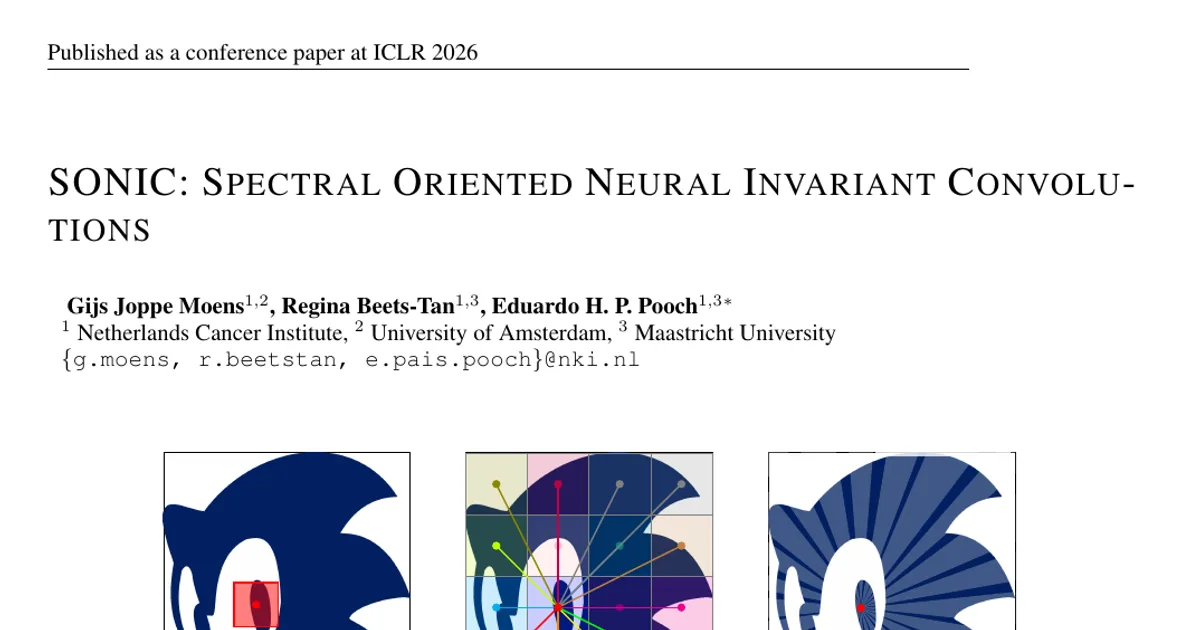
SONIC aims to bridge these two worlds by defining the convolutional filter directly as a smooth, continuous function over the frequency domain, built from a small set of shared, orientation-selective components. The goal is a layer that has a genuinely global receptive field, adapts naturally across image resolutions, and uses far fewer parameters than existing alternatives.
Key Contributions
-
A continuous spectral operator with oriented modes. SONIC parameterises the learnable frequency response of a convolution as a superposition of
Mshared spectral modes. Each mode is a smooth, analytic transfer functionT_m(ω)defined over the entire continuous frequency domain, with an explicit preferred direction. This contrasts with prior spectral methods (e.g., GFNet, FNO) that learn independent coefficients per discrete frequency bin. -
A structured, low-rank factorisation. Instead of learning an unconstrained response for every input–output channel pair, SONIC factorises the spectral operator as
Ĥ_{k,c}(ω) = Σ_{m=1}^{M} C_{km} T_m(ω) B_{mc}, with mixing matricesB ∈ ℂ^{M×C}andC ∈ ℂ^{K×M}. The total learnable real scalar count is2KM + 2MC + (4+D)M + 1. -
Resolution invariance by construction. Because the modes are continuous functions of frequency rather than grid-indexed coefficients, changing resolution simply means evaluating the same function on a new DFT grid. The authors add a resolution-aware normalisation of the orientation vectors using the pixel-spacing matrix
D_Δ = diag(Δ_1, …, Δ_D), expressing directions in physical units. -
Empirical validation across four settings. Synthetic shape segmentation and spatial reasoning (SynthShape, HalliGalli), 3D medical segmentation (KiTS, ACDC), external clinical validation (PI-CAI, Prostate158, PROMIS), and large-scale image classification (ImageNet-1K under a reduced training setting).
Main Findings
-
Parameter efficiency on synthetic tasks: On SynthShape (a 64×64 synthetic geometric shape segmentation benchmark, 5-fold cross-validation), SonicNet used 0.072M parameters and 0.006 GMACs, versus 0.153M/0.156 for ConvNet, 0.468M/0.012 for ViT, 0.186M/0.023 for S4ND, 0.042M/0.041 for NIFF, and 0.415M/0.139 for GFNet.
-
Robustness to geometric perturbations: Under combined perturbations at 10/20/30, SonicNet scored 0.90 / 0.76 / 0.48, compared with ConvNet 0.85 / 0.62 / 0.41, ViT 0.76 / 0.59 / 0.37, S4ND 0.47 / 0.30 / 0.24, NIFF 0.71 / 0.50 / 0.40, and GFNet 0.36 / 0.28 / 0.25. Under rescaling to 1.50, SonicNet reached 0.74 (ConvNet 0.62, ViT 0.68, S4ND 0.32, NIFF 0.59, GFNet 0.37).
-
Noise robustness, but not uniformly best: Under Gaussian noise at σ = 0.1 / 0.2 / 0.3, SonicNet scored 0.98 / 0.79 / 0.60, versus ConvNet 0.98 / 0.85 / 0.58 and NIFF 0.99 / 0.92 / 0.71. NIFF leads at σ = 0.2 and 0.3.
-
Rotation is the weakest axis: At 15°/30°/45° rotation, SonicNet scored 0.75 / 0.23 / 0.24. It leads at 15° (next best NIFF at 0.70) but is the lowest at 30° and 45°.
-
Long-range spatial reasoning: On HalliGalli, a task requiring classification of a central patch based on whether exactly two matching shapes appear in the four distant corners, SonicNet and NIFF both reached 1.00, versus ConvNet 0.42, ViT 0.33, S4ND 0.62, and GFNet 0.71. Under inference-time noise (σ = 0.1), SonicNet retained 0.86 while NIFF fell to 0.56 and GFNet to 0.37. The paper states SONIC was the only architecture capable of solving strict long-range dependencies within a single block.
-
3D medical segmentation with far fewer parameters: On KiTS, SonicNet achieved DSC 88.55 and NSD 81.19 with 2.59M parameters, compared with nnU-Net ResEnc L at 88.98 / 85.74 with 31.12M, MedNeXt L k5 at 87.74 / 85.67 with 55.00M, STU-Net L at 85.84 / 83.02 with 440.30M, SwinUNETRV2 at 84.14 / 80.11, nnFormer at 75.85 / 69.43, CoTr at 84.59 / 80.92, and U-Mamba Bot at 86.22 / 83.27.
-
ACDC segmentation: SonicNet reached DSC 92.02 and NSD 96.07, versus nnU-Net ResEnc L 91.40 / 96.21, MedNeXt L k5 92.62 / 96.09, STU-Net L 89.34 / 95.12, SwinUNETRV2 86.24 / 95.15, nnFormer 81.55 / 95.83, CoTr 88.02 / 93.74, and U-Mamba Bot 89.13 / 95.40.
-
Runtime and memory trade-off in 3D: SonicNet reported 67 hours runtime and 61.37 GB peak VRAM on the 3D benchmarks, versus 34 h / 23 GB for the first nnU-Net ResEnc L row and 36 h / 36.60 GB for the second. The parameter advantage is therefore not matched by a compute advantage on these runs as reported.
-
External clinical validation: On PI-CAI-trained models evaluated on Prostate158, SonicNet improved AUROC (0.841 vs nnU-Net's 0.814), AP (0.548 vs 0.533), F1 (0.649 vs 0.632), and sensitivity (0.495 vs 0.475), at 2.59M/28.4MB parameters versus 31.20M/342.0MB. On PROMIS, SonicNet improved AUROC (0.687 vs 0.646), AP (0.258 vs 0.195), F1 (0.223 vs 0.185), and sensitivity (0.127 vs 0.103), while precision was slightly lower (0.907 vs 0.912).
-
ImageNet-1K (reduced training, 200k steps, batch size 256, 224×224 evaluation): ResNet-50 Sonic reached 60.01 Top-1 and 82.28 Top-5 with 1.34M parameters, 0.81 GFLOPs, and 831 img/s. This exceeds plain ResNet-50 (58.47 / 82.68, 25.60M) and NIFF (57.52 / 82.24), but trails ViT-S/16 (62.23 / 83.91), S4ND (64.38 / 86.44), GFNet (61.43 / 84.47), RepLK (65.17 / 86.34), and Dilated (61.52 / 84.73).
-
Compute and memory at inference: At 224×224, SONIC is reported as only 1.23× slower and using 1.18× more memory, which the authors describe as a modest overhead for obtaining global receptive fields; at higher resolutions the runtime gap narrows and SONIC becomes effectively on par with convolution.
Authors’ abstract
Convolutional Neural Networks (CNNs) rely on fixed-size kernels scanning local patches, which limits their ability to capture global context or long-range dependencies without very deep architectures. Vision Transformers (ViTs), in turn, provide global connectivity but lack spatial inductive bias, depend on explicit positional encodings, and remain tied to the initial patch size. Bridging these limitations requires a representation that is both structured and global. We introduce SONIC (Spectral Oriented Neural Invariant Convolutions), a continuous spectral parameterisation that models convolutional operators using a small set of shared, orientation-selective components. These components define smooth responses across the full frequency domain, yielding global receptive fields and filters that adapt naturally across resolutions. Across synthetic benchmarks, large-scale image classification, and 3D medical datasets, SONIC shows improved robustness to geometric transformations, noise, and resolution shifts, and matches or exceeds convolutional, attention-based, and prior spectral architectures with an order of magnitude fewer parameters. These results demonstrate that continuous, orientation-aware spectral parameterisations provide a principled and scalable alternative to conventional spatial and spectral operators.