Research
SoK: Semantic Decision Engines in Network Control Loops
Overview Research area: Network control and management (cs.NI), specifically intent-based networking, semantic decision engines, and closed-loop network automation. Technical level: Advanced. The pape
- arXiv
- 2610.06425
- Published
- 2026-10-05
- Authors
- Delong Li, Chen Li, Xu Wang, Haochen Gong, Rui Lang, Guangsheng Yu
AI summary
Overview
Research area: Network control and management (cs.NI), specifically intent-based networking, semantic decision engines, and closed-loop network automation.
Technical level: Advanced. The paper assumes familiarity with network control architecture (O-RAN, SDN, 3GPP intent management), but its central argument is stated plainly: systems that answer requests in natural language can still miss deadlines, admit infeasible actions, or leave outcomes unverified.
Scope: A systematization of knowledge (SoK) of 139 paper families on semantic decision engines in network control loops, combining a three-axis classification, a reporting-evidence audit, and bounded measurements that test whether the identified gaps change an admission verdict.
What This Paper Is About
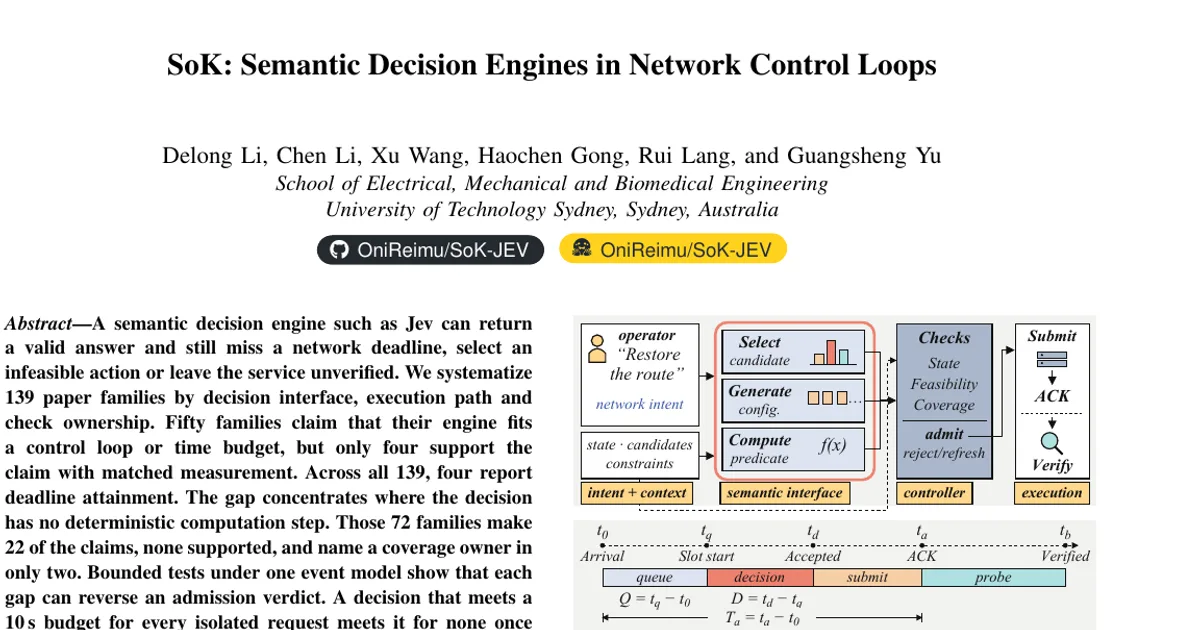
A semantic decision engine — the paper uses the shorthand "Jev" for the general class — can return a schema-valid answer that is still wrong for the network: it can exceed a shared quota, rest on contradictory observations, or come from an incomplete catalogue. The core problem is that the literature rarely measures the complete control path (state collection, communication, decision waiting, control, and observation) against the time budget the engine claims to fit. The goal is to systematize how these engines are reported, audit which claims are actually supported, and test whether the missing measurements and unnamed checks can flip an admission verdict.
Key Contributions
-
A three-axis systematization of 139 families. Each network task is located by decision interface (selection, generation, or deterministic computation), control and execution path, and check ownership (observation, feasibility, and coverage checks). The coding was recoded blind to test reproducibility.
-
An evidence audit with independent coding and explicit denominators. Of 139 families, 50 claim their engine fits a control loop or time budget, and only 4 support that claim with matched measurement. The audit yields a proposed minimum reporting record.
-
Bounded tests of the exposed gaps. One event model with four diagnostic lenses — measurement boundary, workload summary, check placement, and robustness scope — compares a service-orchestration study, a RAN study, and application tasks without pooling their effects. Fixed-action delay interventions on transport and edge stacks quantify endpoint shares and queue amplification.
-
Design rules and a research agenda for admitting decision engines to control loops, each derived from a gap found in the systematization or the audit.
Main Findings
-
Loop claims vastly outnumber matched support. 50 of 139 families (36.0%) make an explicit control-loop claim, but only 4 (2.9%) report measurement matched to the claimed budget and boundary. Across all 139 families, 4 report deadline attainment.
-
The gap concentrates where there is no deterministic computation step. 72 families have no deterministic computation step. They make 22 of the 50 loop claims, none supported by matched measurement, and only 2 name a coverage owner (versus 11 of the 67 families with such a step). 23 of the 72 name a feasibility owner, against 45 of 67.
-
All four matched claims come from families that combine computation with selection or generation. This is reported from the evidence audit as a descriptive count; these counts overlap with task groups.
-
Tail and deadline evidence is rare. 9 of 139 families (6.5%) report latency at p95 or higher, and 4 (2.9%) report deadline attainment. 92 families (66.2%) name a timing endpoint, and 49 (35.3%) specify a metric denominator.
-
Load evidence is thin. Operational input load is reported in 48 families (34.5%), queue or waiting evidence in 6 (4.3%), and stability evidence in 31 (22.3%). A non-learning comparator appears in 48 families (34.5%), and 23 (16.5%) explicitly include network round trips in a relevant timing measurement.
-
Correctness gates are unevenly reported. Semantic checks appear in 133 families (95.7%), format checks in 71 (51.1%), and final-state checks in 54 (38.8%). Only 9 families (6.5%) distinguish all three gates in some scope. Public code pointers appear in 34 families (24.5%) and public data pointers in 51 (36.7%).
-
Missing load evidence can reverse an admission verdict. A decision that meets a 10 s budget for every isolated request meets it for none at 4.992 arrivals/s once decisions queue ahead of replayed execution times.
-
Unnamed check ownership can reverse an escalation decision. An engine that owns the coverage check requests a new candidate for 45 of 48 contracts without one, but escalates only 4 of 120 infeasible routes.
-
Interface mix is broad. Generation is the most common decision interface, appearing in 94 of 139 families, selection in 76, and deterministic computation in 67. 83 families combine two or more interfaces.
-
Check-ownership coding is hard to reproduce against the published record. Independent blind coders agree with each other on check placement with κ from 0.62 to 0.73, but agreement with published entries for check presence is lower, with κ from 0.10 to 0.42. Both coders agree that 40 of 129 families place an observation check and 43 a coverage check, where the published table records 9 and 11. The paper states that its check columns therefore support no prevalence estimate, and it draws none.
-
Coverage in the broader literature is consistent with the corpus. A recall check over OpenAlex produced 966 unique works, 119 already in the corpus, and 847 screened by two model coders. A stratified random sample of 100 records (50 language-model work, 50 earlier intent networking) gave frame-weighted rates of 32.4% for explicit loop claims (95% interval 22.2–42.9%), 6.5% for matched support (1.3–12.4%), 5.3% for p95 reporting (1.2–10.8%), and 2.6% for deadline attainment (0–6.9%).
Methodology in Plain English
The authors assembled a corpus of published work on semantic and intent-based decision making for network configuration, orchestration, and diagnosis. They began with 92 records cited in the manuscript, added three fixed arXiv title-and-abstract queries covering 1 January 2016 through 28 September 2026, publisher-page discovery from IEEE and ACM, and one backward-citation round. The three complete arXiv result sets contained 159 hits and 151 unique identifiers; combining these with the starting bibliography produced 250 records.
Screening and deduplication identified 145 records for full-text review. After exclusions, the retained records formed 132 paper/report families and 138 source/version records, mapped to 137 bibliographic entries. A second screening of all 111 set-aside records, run blind by two language models from different families (one GPT and one Claude), added seven families, giving 139 families and 145 source/version records. Title-and-abstract agreement was Cohen's κ = 0.661 with Gwet's AC1 at 0.738; the seven added families were coded with agreement on 114 of 126 family-level field judgments (90.5%).
Two human researchers independently coded the retained groups using an 18-field codebook, then jointly adjudicated. The final inventory holds 429 scope records (393 step definitions and 36 linked scopes). Agreement was computed over 231 initial pairs and 174 aligned rechecks. Definitions of load and stability were clarified during adjudication, changing 65 of 810 load/stability values.
For the audit, the authors used 10,000 bootstrap resamples of whole paper/report families with seed 42 for confidence intervals. For the measurements, they built one event model that separates queueing time, decision time, and two downstream elapsed times, and defined three correctness gates with explicit denominators. They then applied perturbations (structure, irrelevant text, observations, catalogue changes, absent coverage, arrivals, check ownership, and execution path) across the service-contract, RAN, and application studies, reporting each finding with a verdict of repeated, task-dependent, unresolved, or descriptive, and a breadth of multi-task, single-task, or single-study. Reference ranges were ±3 percentage points for correctness and attainment-rate differences and ±50 ms for latency.
Why This Matters
Impact on research. The paper argues that the field's reporting practices currently make it impossible to tell whether a semantic decision engine is safe to admit to a control loop. By publishing explicit denominators, an evidence audit, and a proposed minimum reporting record, it gives reviewers and authors a concrete checklist. It also shows that the reproducibility problems are not uniform: timing fields reproduced well between coders (99.8% agreement for tail reporting, 98.3% for deadline reporting), while load, queue, and stability fields were far weaker (27.9%, 39.3%, and 30.6% exact agreement).
Real-world applications.
- O-RAN control loops: near-real-time RIC functions operate at roughly 10 ms–1 s, and non-real-time RIC functions above approximately 1 s. An interpreter shares that interval with state collection, communication, and execution.
- Service orchestration: moving or restoring a service across an edge cluster, where the paper's 10 s budget test and the 4.992 arrivals/s queueing example apply directly.
- Network configuration and repair: generating configuration edits against a retrieval catalogue, where an absent candidate should trigger escalation rather than an incorrect selection (the 45-of-48 versus 4-of-120 result).
- Transport and routing control: the FRRouting and edge-stack experiments show how much of the elapsed time is decision delay versus API acknowledgement versus verified result.
Industry relevance. The paper maps its analysis to standards and specifications that operators already use: 3GPP TS 28.312 (intent-driven management with feasibility checks), TS 23.288 (NWDAF), TS 28.104 (MDA), ETSI ZSM and its closed-loop automation specification, TM Forum TMF921 and IG1253, and RFCs 9315 and 9316. The design rules aim at the practical question of which checks a controller must keep when it delegates part of a decision to a language interface.
Future Directions
-
Adopt the minimum reporting record. The paper proposes identifying inputs, decision outputs, candidates, and assigned checks; defining measured events from arrival through queue entry, decision, execution acknowledgement, and service verification; and reporting latency distribution and deadline attainment together with operational load, decision concurrency, and observation window.
-
Resolve check ownership before deployment. The systematization shows feasibility and coverage owners concentrate in families with a deterministic computation step, and that the 72 families without one almost never name a coverage owner. Determining where these checks should live in a real workflow is left open.
-
Test the gaps across more tasks. The paper's bounded tests use one event model and three source studies, and it explicitly does not pool their effects. Whether the same gaps reverse verdicts in other domains is an open question.
-
Standardize load and stability definitions. Coding agreement was weakest for load, queue, and stability fields, and the authors had to clarify these definitions mid-adjudication. A shared definition set is a prerequisite for comparable measurements.
-
Close the gap between reported and reproducible checks. Independent coders found many more check placements in the text than the published tables recorded, which the authors attribute in part to a codebook that excludes plain reading of current state. How to report checks so that independent coders recover them is unresolved.
Target Audience
Researchers and engineers working on intent-based networking, network automation, O-RAN and SDN control loops, and language-model-driven network management. It is most useful to authors preparing measurements of a decision engine, to reviewers assessing loop and latency claims, and to standards and operations teams deciding which validation responsibilities a controller must retain when it delegates interpretation to a learned component. Readers need some background in network control architecture to follow the mapping to O-RAN, 3GPP, and ETSI roles.
Authors’ abstract
A semantic decision engine such as Jev can return a valid answer and still miss a network deadline, select an infeasible action or leave the service unverified. We systematize 139 paper families by decision interface, execution path and check ownership. Fifty families claim that their engine fits a control loop or time budget, but only four support the claim with matched measurement. Across all 139, four report deadline attainment. The gap concentrates where the decision has no deterministic computation step. Those 72 families make 22 of the claims, none supported, and name a coverage owner in only two. Bounded tests under one event model show that each gap can reverse an admission verdict. A decision that meets a 10 s budget for every isolated request meets it for none once decisions queue ahead of replayed execution times. The same engine passes one coverage check and fails another. We derive a minimum reporting record, design rules and a research agenda for admitting decision engines to control loops.