Research
Smart Timing for Mining: A Deep Learning Framework for Bitcoin Hardware ROI Prediction
Overview Research area: Deep learning for financial decision support, applied to Bitcoin mining hardware acquisition timing (time-series classification, quantitative mining economics). Technical level
- arXiv
- 2512.05402
- Published
- 2025-12-05
- Authors
- Sithumi Wickramasinghe, Bikramjit Das, Dorien Herremans
AI summary
Overview
Research area: Deep learning for financial decision support, applied to Bitcoin mining hardware acquisition timing (time-series classification, quantitative mining economics).
Technical level: Advanced. The paper assumes familiarity with Transformer encoders, recurrent baselines, Fast Fourier Transform-based spectral modulation, and time-series classification evaluation.
Scope: The paper formulates the decision of when to buy ASIC mining hardware as a three-class time-series classification problem over a one-year Return on Investment horizon, and proposes a Transformer-based model called MineROI-Net.
What This Paper Is About
Mining Bitcoin requires buying specialized ASIC machines that cost money up front, depreciate quickly, and earn revenue that swings with Bitcoin's price, network difficulty, electricity prices, and protocol halvings. The authors argue that no prior computational framework exists to tell an operator whether a given day is a good day to buy hardware, and that miners often buy at market peaks and suffer for it. They reframe the problem as a prediction task: given the past 30 or 60 days of market, network, and machine data, will buying a specific machine today return at least 100% of its cost within a year (profitable), partially recover it (marginal), or lose money (unprofitable)?
Key Contributions
-
A new task formulation. The authors introduce Bitcoin mining hardware acquisition timing as a multi-class time-series classification problem, with labels derived from an explicit one-year ROI computation that incorporates purchase price, electricity cost, network dynamics, and maintenance.
-
A constructed dataset. They assemble a multivariate daily dataset spanning October 2015 to September 2025 (with labels available to September 2024) covering 20 ASIC mining machines released between 2015 and 2024, sourced from Hashrate Index, an Amazon price tracker, and Blockchain.com, with 14 features per day.
-
The MineROI-Net model. A Transformer-based architecture combining an FFT-based spectral feature extractor with learnable complex frequency weights, a channel-mixing module, and a standard Transformer encoder, trained with weighted cross-entropy and label smoothing.
-
Benchmarking and evaluation protocol. MineROI-Net is compared against a Vanilla LSTM, an LSTM augmented with the same spectral and channel-mixing blocks, a Vanilla Transformer, and TSLANet, under a strictly time-based 80/20 split with expanding-window cross-validation and a held-out machine (S21) that appears only in the test period.
Main Findings
-
Headline classification performance: MineROI-Net achieves 83.2% accuracy and an 83.5% macro F1-score, outperforming recurrent, convolutional, and attention-based baselines.
-
High precision on the two decision-critical classes: The model reaches 97.8% precision in detecting unprofitable periods and 81.5% precision in detecting profitable ones.
-
Directional errors avoided: The abstract states the model avoids misclassifying profitable scenarios as unprofitable and vice versa, which the authors frame as economically relevant.
-
Machine-level generalization: Because the Antminer S21 appears exclusively in the test period, the evaluation tests generalization both to future market regimes and to a previously unseen hardware configuration.
-
Cost structure context: The paper cites that electricity accounts for more than 80% of miners' cash-based operating expenses (Cambridge Centre for Alternative Finance, 2025) and that commodity miners without electricity below $0.14/kWh had become unprofitable by mid-2018 (Delgado-Mohatar et al., 2019).
-
Consequence of bad timing: The paper reports that miners who bought Antminer S19j Pro hardware during the 2021 bull-market peak saw expected payback periods rise from approximately 13 months to 107 months (Hashrate Index, 2022).
-
Related prior work: Prayoga et al. (2025) used boosting ensembles to predict daily mining device income across 70 ASIC machines released between 2020 and 2024 (4,200 samples), but predicted continuous revenue rather than the capital investment decision, did not incorporate acquisition costs, and did not define an explicit ROI horizon.
Note: the provided content is truncated at Section 4.3, so per-baseline numerical results, ablation tables, and the alternative liquidation schedule analysis (Section 5.5) are not reported in the available text.
Methodology in Plain English
Framing the problem. Each training example is a candidate purchase date for a specific machine. The model sees the previous 30 or 60 days of observations and must output one of three ROI categories for a purchase made on that day.
Computing the label. For a hypothetical purchase, the authors simulate one year (365 days) of cash flows. Daily revenue is the BTC the machine is expected to mine given its hash rate and the network difficulty, multiplied by the Bitcoin price, minus a 0.1% exchange trading fee. From that they subtract electricity cost (machine wattage times a fixed tariff, evaluated across scenarios from 0.01 to 0.20 USD/kWh) and maintenance cost (5% of the purchase price per year, amortized daily). Summing daily profit over the year and dividing by the hardware purchase price gives the ROI. If ROI is at or below 0 the label is unprofitable, between 0 and 1 marginal, and at or above 1 profitable.
Building the input. Each day is described by 14 features drawn from three groups: ASIC machine specifications and purchase prices, blockchain and market variables (price, difficulty, network hashrate, network revenue, block reward, transaction fees, and days since the last halving), and electricity-rate scenarios. All features are Min-Max normalized using statistics from the training split only.
The model. MineROI-Net processes the sequence in three stages. First, a spectral block transposes the input so each feature is handled separately, applies a real FFT, multiplies the spectrum by a learnable complex modulation matrix that can amplify or suppress individual frequency bins per feature, and maps back with an inverse real FFT. This gives the model an explicit handle on cyclical patterns such as the roughly four-year halving cycle and the two-week difficulty adjustment cycle, rather than forcing the Transformer to discover them implicitly. Second, a channel-mixing module inspired by Squeeze-and-Excitation networks compresses the time dimension with global average pooling, passes the result through a two-layer bottleneck network with a reduction ratio of 4 and a GELU nonlinearity, and uses the output as per-feature importance scores that reweight the channels. This lets the model shift emphasis between, for example, price and electricity cost as market regimes change. Third, the reweighted sequence is projected to the model dimension, given sinusoidal positional encodings, and passed through stacked Transformer encoder layers. Global average pooling over time followed by a two-layer classification head produces the three class probabilities.
Training. The loss is weighted cross-entropy with label smoothing (epsilon = 0.1), where class weights are set by inverse frequency. All models use batch size 64, up to 20 epochs, and the AdamW optimizer with weight decay of 1e-5.
Evaluation discipline. The split is strictly temporal, not random: 80% of data for training up to May 2023 and 20% thereafter, with each machine contributing samples only during its availability window. Hyperparameters are chosen with expanding-window cross-validation over three sequential validation phases within the training period, which mimics deploying a model that only ever sees the past.
Why This Matters
Impact on research. The paper opens a question that the mining-economics and cryptocurrency machine learning literatures had largely left alone. Prior work modeled mining profitability descriptively (cost decomposition, break-even analysis, real option theory) or predicted continuous revenue, but not the discrete capital commitment decision. By turning ROI into a classification target with an explicit one-year horizon, the authors connect deep time-series modeling to capital allocation, and they provide an open-source Transformer architecture plus a reproducible data-collation method for others to build on.
Real-world applications:
- Mining operators deciding on capacity expansion: The model outputs a per-day signal about whether adding machines is likely to pay back within a year, which the authors position as a practical alternative to heuristics and intuition.
- Fleet procurement and financing: Lenders, lessors, and equipment financiers could use ROI-class forecasts to assess the timing risk of hardware-backed deals.
- Risk management for capital-intensive mining firms: The high reported precision on the unprofitable class (97.8%) is aimed at helping operators avoid exactly the pro-cyclical purchases that damaged returns during the 2021 peak.
- Hardware vendors and resellers: Demand for ASIC machines is cyclical, and a profitability classifier could inform pricing and inventory decisions around halving epochs.
Industry relevance. Mining is described as a capital-intensive global industry where profitability depends on Bitcoin price, network difficulty, hardware efficiency, and electricity costs, with electricity exceeding 80% of cash operating expenses. Because nothing in the current toolkit formalizes when to buy, the authors argue this gap represents a fundamental problem in both mining economics research and industry practice.
Future Directions
- Rethinking the label definition: The authors explicitly state that future research may explore different ways to bin ROI, or abandon classification entirely in favor of directly predicting ROI with a regression approach.
- Alternative liquidation schedules: The baseline assumes mined Bitcoin is converted to fiat daily, and the paper says that because conversion timing can materially affect realized profitability under volatile conditions, alternative schedules including monthly conversion are examined separately in Section 5.5 (not included in the available text).
- Generalization to unseen hardware: The S21-only-in-test setup is one probe of this, but the broader question of how the framework behaves as new ASIC generations arrive after training remains an open deployment concern.
- Robustness under temporal regime shifts: The expanding-window cross-validation suggests the authors view regime shift robustness as an ongoing design requirement rather than a settled result.
Target Audience
This paper is most useful to machine learning researchers working on time-series classification and financial decision support, particularly those applying Transformer and frequency-domain architectures to non-stationary data. It is also aimed at quantitative researchers and analysts in cryptocurrency mining economics, mining operators and fleet managers making capital expenditure decisions, and hardware financiers who need to price the timing risk of ASIC purchases. Readers without a background in deep learning will find the model architecture section demanding, but the problem framing, ROI accounting, and cost assumptions are accessible to anyone with basic finance knowledge.
Authors’ abstract
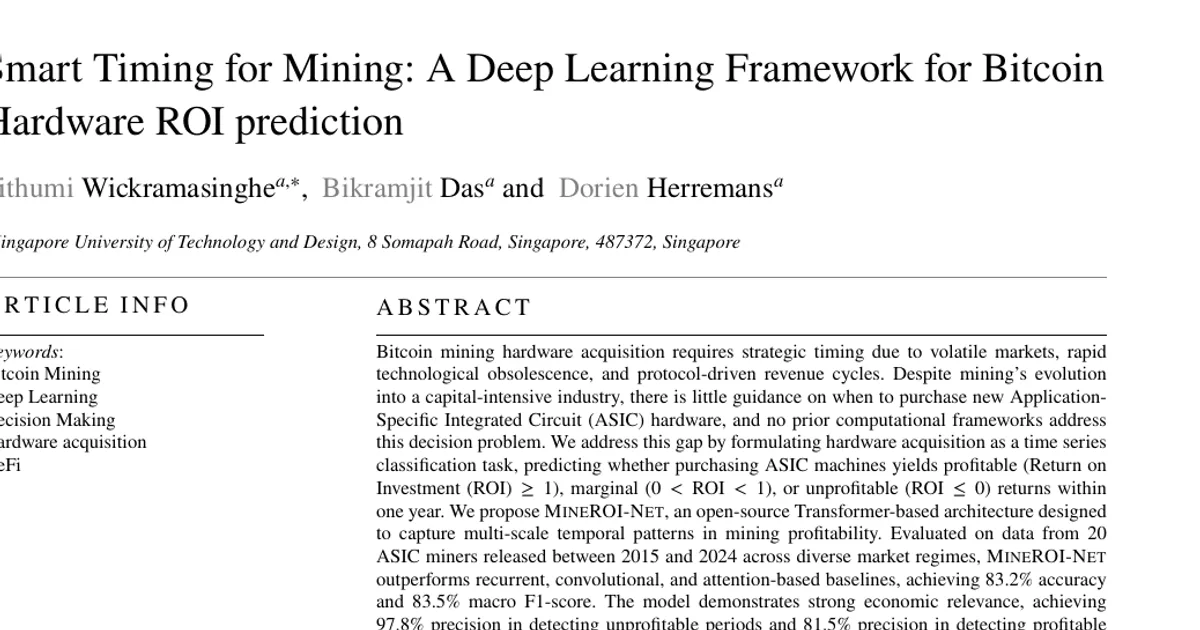
Bitcoin mining hardware acquisition requires strategic timing due to volatile markets, rapid technological obsolescence, and protocol-driven revenue cycles. Despite mining's evolution into a capital-intensive industry, there is little guidance on when to purchase new Application-Specific Integrated Circuit (ASIC) hardware, and no prior computational frameworks address this decision problem. We address this gap by formulating hardware acquisition as a time series classification task, predicting whether purchasing ASIC machines yields profitable (Return on Investment (ROI) >= 1), marginal (0 < ROI < 1), or unprofitable (ROI <= 0) returns within one year. We propose MineROI-Net, an open-source Transformer-based architecture designed to capture multi-scale temporal patterns in mining profitability. Evaluated on data from 20 ASIC miners released between 2015 and 2024 across diverse market regimes, MineROI-Net outperforms recurrent, convolutional, and attention-based baselines, achieving 83.2% accuracy and 83.5% macro F1-score. The model demonstrates strong economic relevance, achieving 97.8% precision in detecting unprofitable periods and 81.5% precision in detecting profitable ones, while avoiding misclassifying profitable scenarios as unprofitable and vice versa. These results indicate that MineROI-Net offers a practical, data-driven tool for timing mining hardware acquisitions, potentially reducing financial risk in capital-intensive mining operations.