Research
Small Agent Group is the Future of Digital Health
Small Agent Group is the Future of Digital Health Overview Research area: Digital health AI, specifically multi-agent large language model (LLM) systems for clinical reasoning, clinical safety, and de
- arXiv
- 2602.08013
- Published
- 2026-02-08
- Authors
- Yuqiao Meng, Luoxi Tang, Dazheng Zhang, Rafael Brens, Elvys J. Romero, Nancy Guo, Safa Elkefi, Zhaohan Xi
AI summary
Small Agent Group is the Future of Digital HealthOverview
Research area: Digital health AI, specifically multi-agent large language model (LLM) systems for clinical reasoning, clinical safety, and deployment feasibility.
Technical level: Intermediate. The paper is readable without deep reinforcement-learning background, but it assumes familiarity with LLMs, retrieval-augmented generation (RAG), and multi-agent debate.
Scope: A single paper arguing and empirically testing that a Small Agent Group (SAG) — several small LLM agents whose cumulative parameter count is comparable to or smaller than one giant LLM — can outperform a single large model on clinical effectiveness, reliability, and deployment cost.
What This Paper Is About
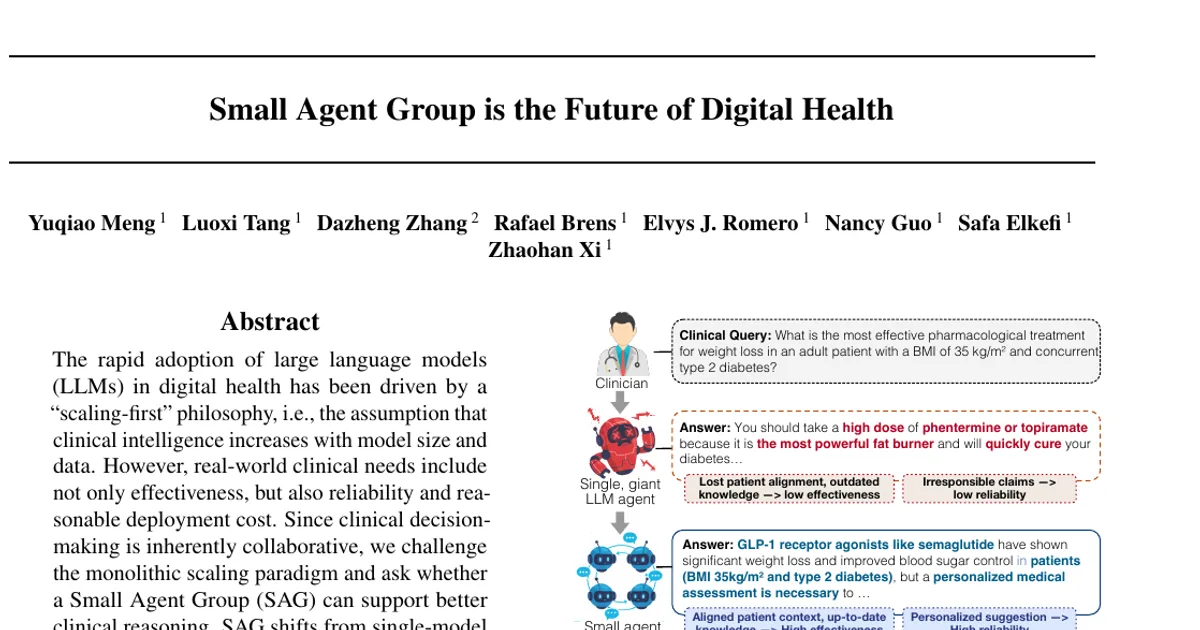
The dominant approach in clinical AI has been a "scaling-first" or "bigger is better" philosophy: assume that clinical intelligence grows with model size and data. The authors argue this ignores reliability and deployment cost, and that it mismatches the inherently collaborative, multidisciplinary nature of clinical decision-making. The paper asks whether a group of small, role-specialized LLM agents that debate and audit each other can match or beat a single giant model on clinical tasks while remaining deployable in local, privacy-preserving hospital settings.
Key Contributions
-
An inclusive SAG paradigm. A framework with four functional agent roles — reasoning agents (A_R), knowledge-providing agents (A_K), safety-check agents (A_S), and synthesis & judge agents (A_J) — combined with a hybrid multi-agent debate (MAD) pipeline and RAG grounding. Domain-adaptation strategies include Group Relative Policy Optimization (GRPO) and centralized training, decentralized execution (CTDE).
-
Comprehensive clinical utility metrics. A three-dimension evaluation scheme copied from clinical research practice: effectiveness (correctness, relevance, fairness), reliability (safety, robustness, consistency), and deployment cost (memory, FLOPs per query, latency).
-
Demonstrated clinical performance. Experiments across eight benchmarks show SAG outperforms single giant LLMs and off-the-shelf clinical specialist models on correctness, evidence grounding, fairness, safety, robustness, and consistency.
-
Deployment trade-off analysis. SAG reduces peak GPU memory relative to giant single models while incurring modestly higher latency and computational cost — an explicit, measured trade-off.
Main Findings
-
Correctness gains across benchmarks and backbones. On the Llama backbone (SAG: 3B each; Single: 70B), SAG with GRPO reaches 90.3 on MedQA, 85.2 on MedMCQA, 84.0 on NEJM-MedQA, and 88.6 on GPQA-Bio, versus 81.5, 74.2, 50.8, and 62.0 for the single giant Llama with DPO. On the Qwen backbone (SAG: 4B each; Single: 72B), SAG with GRPO reaches 91.4, 86.1, 85.6, and 92.6, versus 82.4, 75.1, 72.5, and 67.3 for the single Qwen with DPO.
-
Collaboration alone helps, before any optimization. SAG (Pre-trained) scores 84.6/77.8/64.9/70.1 (Llama) and 86.0/79.6/68.1/73.3 (Qwen), above single pre-trained baselines (59.8/51.2/42.4/43.6 for Llama; 72.0/63.0/55.7/41.1 for Qwen), suggesting multi-agent collaboration acts as a strong inductive bias.
-
Optimization shrinks worst-case cross-benchmark drop. The "Gap" metric (maximum accuracy drop across benchmarks, lower is better) falls to 6.3 (GRPO) and 10.2 (CTDE) on Llama, and 7.0 (GRPO) and 5.4 (CTDE) on Qwen, versus 30.7 for single Llama with DPO.
-
Ablations show reasoning agents matter most. Removing A_R causes the largest collapse (e.g., GPQA drops to 34.7 on Llama, with a gap of 35.5). Removing A_K (no RAG) yields 78.9/72.4/54.0/45.6. Removing A_S has a smaller effect on mean accuracy but worsens cross-benchmark stability. Majority voting underperforms debate (74.8/67.5/52.1/44.0 on Llama).
-
Stronger evidence grounding. In the Qwen-based clinical relevance landscape (Figure 3), clinical specialist baselines cluster in the lower-left of BLEU-4 versus BERTScore space; SAG (GRPO) achieves the highest BERTScore and BLEU-4 simultaneously.
-
Better fairness. On EquityMedQA, SAG (w/ CTDE) achieves the lowest counterfactual divergence rate: 0.8% race CDR, 0.7% gender CDR, 0.8% average CDR, versus 2.4% average for pre-trained Qwen-2.5-72B and 5.1% for Meditron-70B.
-
Better safety calibration. In the safety ROC analysis, SAG variants dominate the curve with higher harm-refusal rates at the same over-refusal level, with the largest separation at low false-positive rates. SAG (Pre-trained) already matches or exceeds strong single-LLM baselines.
-
Greater robustness. Under clean, linguistic-noise, and adversarial-distractor conditions, single pre-trained baselines degrade monotonically, and the clinical specialist Me-LLaMA is even more brittle on NEJM-MedQA. SAG stays substantially flatter, with the benefit most pronounced on NEJM-MedQA.
-
Higher consistency across decoding settings. Measured as standard deviation over k=5 runs on the Llama backbone, single-model variance on NEJM-MedQA reaches up to ±6.83 (DPO with candidate sampling), while SAG (Pre-trained) falls to roughly 0.8–2.1 and SAG (w/ CTDE) reaches as low as ±0.11 to ±0.51.
-
Mixed backbones help. Blending 50% Llama and 50% Qwen agents (SAG (Mix)) beats both homogeneous SAGs on every benchmark, reaching 92.9/88.1/89.4/94.7 with GRPO and 92.2/87.5/91.3/89.8 with CTDE, with the lowest Gap of all settings (3.8).
-
Deployment trade-off quantified. SAG (10 agents, pre-trained) uses 79.5–96.8 GB peak GPU memory versus 130 GB+ for large single models such as Qwen-72B, but incurs higher latency (58.7–63.9 s vs. 27–28 s) and moderately higher compute (28.6–31.4 vs. 23–25 TFLOPs).
Methodology in Plain English
The researchers built a "clinical panel" out of small LLMs. They instantiate pools of agents with distinct jobs: three reasoning agents, three knowledge agents, two safety-check agents, and two synthesis & judge agents — ten agents total — using Llama-3.2-3B and Qwen3-4B as backbones. Reasoning and knowledge agents (A_R and A_K) debate in a flat structure, and their outputs are then reviewed hierarchically by safety and judge agents, across multiple rounds, with early termination once no new substantive arguments appear.
The knowledge agents use RAG against authoritative sources: PubMed/Medline, CDC, FDA drug labels, and popular clinical guidelines, so recommendations are grounded in retrieved evidence rather than model memory alone.
Because clinical decision-making is a team activity, the authors evaluate it the way clinical research evaluates interventions — along effectiveness, reliability, and deployment cost — across eight benchmarks: MedQA (USMLE), MedMCQA, GPQA (Bio), NEJM-MedQA, PubMedQA, EquityMedQA, MedSafetyBench, and MMLU-Pro.
They compare SAG against deliberately larger single models (Llama-3-70B, Qwen-2.5-72B), domain-adapted clinical specialists (Meditron-70B, Me-Llama-70B), and SAG variants with no optimization, GRPO, or CTDE. Ablations remove individual agent roles or replace debate with non-interactive majority voting.
Why This Matters
Impact on research. The paper challenges the assumption that clinical AI progress requires ever-larger single models. It reframes clinical reasoning as a team process that can be implemented on smaller models, and it contributes a reusable three-axis evaluation protocol (effectiveness, reliability, deployment cost) for clinical LLM systems. It also shows that a multi-agent debate framework designed for general collaboration needs explicit clinical role separation — diagnostic reasoning, evidence verification, safety auditing, and adjudication.
Real-world applications:
- Local hospital deployment. Because the SAG footprint is 79.5–96.8 GB peak memory versus 130 GB+ for large single models, hospitals that prefer local deployments for data privacy or IP protection have a more accessible option.
- Small clinics and low-resource regions. Choosing agents means high-quality clinical AI does not require the supercomputers that giant models imply.
- Clinical decision support with built-in safety checks. Separate safety agents flag harmful recommendations and escalate cases needing human oversight.
- Evidence-grounded documentation and explanation. RAG against PubMed/Medline, CDC, and FDA labels supports justifications that cite authoritative evidence, and the relevance results show improved BLEU-4 and BERTScore.
- Subgroup-fairer triage and diagnosis. The low counterfactual divergence rates on EquityMedQA suggest decision stability under demographic perturbations.
Industry relevance. The paper targets hospital systems, pharmaceutical organizations, and digital-health vendors that must balance accuracy, safety, and cost. It offers a concrete architectural alternative for vendors currently benchmarking single foundation models, and an explicit cost model (memory, FLOPs, latency) for capacity planning.
Future Directions
- Configuration search. The paper states that implementation details are deferred to Appendix A and alternative SAG settings are considered in Appendix H, leaving open how group size, role counts, and interaction topology should be chosen for a given clinical task.
- Reducing the latency and compute penalty. SAG's modestly higher latency (58.7–63.9 s vs. 27–28 s) and compute (28.6–31.4 vs. 23–25 TFLOPs) are reported as deliberate trade-offs; whether these can be reduced without losing the reliability gains is not established.
- Backbone heterogeneity as a design principle. Since the mixed Llama/Qwen configuration outperformed both homogeneous setups with the lowest Gap, deciding which backbones to mix and in what proportions remains an open design question.
- Validation beyond benchmarks. The paper evaluates performance on clinical benchmarks and reports that evaluation on deployment costs is agnostic to specific datasets; it does not report prospective real-world clinical deployment trials, so translation to live care settings is untested here.
Target Audience
Clinician-informaticists and digital health researchers evaluating LLM deployment options; AI researchers working on multi-agent systems and reinforcement learning for high-stakes domains; healthcare IT and operations leaders deciding between API-based giant models and locally hosted alternatives; and health equity and safety researchers interested in fairness, robustness, and hallucination mitigation in medical AI.
Authors’ abstract
The rapid adoption of large language models (LLMs) in digital health has been driven by a "scaling-first" philosophy, i.e., the assumption that clinical intelligence increases with model size and data. However, real-world clinical needs include not only effectiveness, but also reliability and reasonable deployment cost. Since clinical decision-making is inherently collaborative, we challenge the monolithic scaling paradigm and ask whether a Small Agent Group (SAG) can support better clinical reasoning. SAG shifts from single-model intelligence to collective expertise by distributing reasoning, evidence-based analysis, and critical audit through a collaborative deliberation process. To assess the clinical utility of SAG, we conduct extensive evaluations using diverse clinical metrics spanning effectiveness, reliability, and deployment cost. Our results show that SAG achieves superior performance compared to a single giant model, both with and without additional optimization or retrieval-augmented generation. These findings suggest that the synergistic reasoning represented by SAG can substitute for model parameter growth in clinical settings. Overall, SAG offers a scalable solution to digital health that better balances effectiveness, reliability, and deployment efficiency.