Research
Simplifying and Improving On-Policy Distillation for Few-Step Diffusion
Overview Research area: Generative modeling in computer vision — specifically few-step distillation of diffusion and flow-matching models. Technical level: Advanced. The paper assumes familiarity with
- arXiv
- 2610.18472
- Published
- 2026-10-13
- Authors
- Jiawei Zhang, Ziyu Wan, Nanye Ma, Long Zhao, Dong Chen, Hongyu Liu, Qifeng Chen, Dongdong Chen
AI summary
Overview
Research area: Generative modeling in computer vision — specifically few-step distillation of diffusion and flow-matching models.
Technical level: Advanced. The paper assumes familiarity with diffusion/flow models, teacher–student distillation, velocity prediction, and sampling budgets (NFE, or number of function evaluations).
Scope: The paper proposes Simplified Matching Distillation (SMD), a purely regression-based on-policy distillation framework that produces 4-NFE generators without auxiliary score models or adversarial training, and demonstrates it across several generative modalities up to 33 billion parameters.
What This Paper Is About
Diffusion and flow models generate high-quality outputs but are slow, because they need many sequential network evaluations. Few-step distillation tries to compress that process into only a handful of steps, but existing methods typically rely on extra machinery: separate score models, adversarial training, or architectures designed specifically for distillation. This paper argues that a plain on-policy velocity regression objective is already a strong base for 4-step generation, and that two lightweight additions — a training-only residual proxy called Pivot and a mechanism that pushes the student away from weaker teacher predictions — are enough to close much of the remaining gap.
Key Contributions
-
A simplified recipe for few-step distillation. The authors show that simple on-policy velocity regression alone provides a strong foundation for 4-NFE generation, without auxiliary score models or specialized student architectures.
-
Pivot, a training-only residual proxy. Because a coarse student step spans a large interval, the teacher's velocity is not constant within it. Pivot represents that intra-interval variation by separating local corrections from the student's interval-mean prediction.
-
Repulsion from weaker teacher predictions. The method explicitly drives the student away from teacher predictions deemed weaker, giving a lightweight way to avoid undesirable modes without an adversarial discriminator.
-
The SMD framework and its breadth. SMD remains entirely regression-based, needs no online score estimation and no adversarial training, and leaves the deployed generator architecture unchanged. It is evaluated on image generation and editing, 3D generation, video synthesis, and joint audio–video generation, scaling to 33 billion parameters, and it supports cross-model, multi-teacher, and causal-video distillation.
Main Findings
- Strong 4-NFE results: At a budget of 4 function evaluations, SMD is reported to outperform strong few-step baselines.
- Sometimes better than the teacher: The abstract states SMD surpasses multi-step teachers on several benchmarks — an unusual claim, since distillation normally aims to approximate rather than exceed the teacher.
- Large-scale applicability: The method was scaled to 33 billion parameters, indicating it is not limited to small models.
- Broad modality coverage: It works on image generation and editing, 3D generation, video synthesis, and joint audio–video generation.
- Flexible distillation configurations: It supports cross-model distillation (teacher and student from different model families), multiple teachers at once, and causal video distillation.
- No special deployment requirements: The trained generator is unchanged, and no score network or adversarial objective is needed at any stage.
- Missing details: The abstract reports no per-benchmark scores, no comparison tables, no ablation numbers, and no dataset or baseline names. Those specifics are only available in the full paper.
Methodology in Plain English
The starting point is a standard teacher–student setup. A large, slow, multi-step "teacher" model defines how a noisy input should be transformed into a clean output; a smaller "student" is trained to reproduce those transformations in only four steps.
The twist is that the student trains on its own trajectories (hence "on-policy") and does so with plain regression: it predicts a velocity and is penalized for missing the teacher's velocity, with no discriminator and no separately trained score network.
Two ideas refine that basic objective. First, a single coarse student step covers a wide interval, and the teacher's velocity changes across it; instead of forcing the student to match only the average velocity over that interval, the Pivot term — used only during training, not at inference — captures the local deviation from that average, so the student learns both the mean motion and the finer corrections within the step. Second, the student is pushed away from teacher predictions judged weaker, which steers it away from poor or unwanted modes without the instability of adversarial training.
Because both additions live entirely in the training objective, the model that ships to users is an ordinary generator — nothing extra to run at inference time.
Why This Matters
Impact on research. The paper challenges the assumption that few-step distillation requires heavy machinery. If a regression-only objective with a residual proxy and a repulsion term is competitive, that simplifies the design space and invites re-examination of what the auxiliary components in prior methods were actually contributing. The reported ability to surpass multi-step teachers on some benchmarks also reframes the goal of distillation from faithful imitation toward improvement.
Real-world applications:
- Interactive image generation and editing — four-step sampling makes iterative editing and preview loops feel responsive rather than batch-like.
- 3D asset generation — fast sampling lowers the cost of generating many candidate shapes or scenes.
- Video synthesis — multi-step sampling is especially expensive per clip, so a 4-step generator offers large savings; the paper also covers causal video.
- Joint audio–video generation — synchronized audio and video generation is costly, and reducing sampling steps helps make it practical.
Industry relevance. Inference cost and latency are the main barriers to deploying diffusion models at scale. A method that keeps the deployed architecture unchanged is a drop-in substitution: no new serving infrastructure, no second network resident in memory, and no extra inference passes. Lower NFE translates directly into cheaper serving and better user-perceived latency.
Future Directions
- Understanding the repulsion term. The abstract does not explain how "weaker" teacher predictions are identified or why repelling them helps rather than destabilizes training. Clarifying this criterion and its effect on mode coverage is a natural next step.
- Pushing below four steps. The work targets 4-NFE; whether the Pivot residual proxy and the regression-only recipe remain effective at two or one step is left open.
- Wider transfer and scaling. Given support for cross-model, multi-teacher, and causal-video distillation, further questions include how far the approach scales, which teacher–student pairings work best, and whether the same recipe transfers to modalities not covered here.
- Head-to-head evidence. Because the abstract reports no scores or ablations, readers need the full paper to see which baselines were compared, how large the gains are, and how much each component (Pivot, repulsion, on-policy sampling) contributes.
Target Audience
Researchers and practitioners working on diffusion and flow-matching models, particularly those focused on sampling acceleration, distillation, and efficient inference. It is also relevant to engineers deploying generative models for images, 3D, video, or audio–video who care about latency and serving cost, and to graduate students studying generative modeling who already understand the basics of diffusion training and teacher–student distillation. Readers without that background may find the terminology dense, since the abstract assumes fluency in velocity prediction and NFE budgeting.
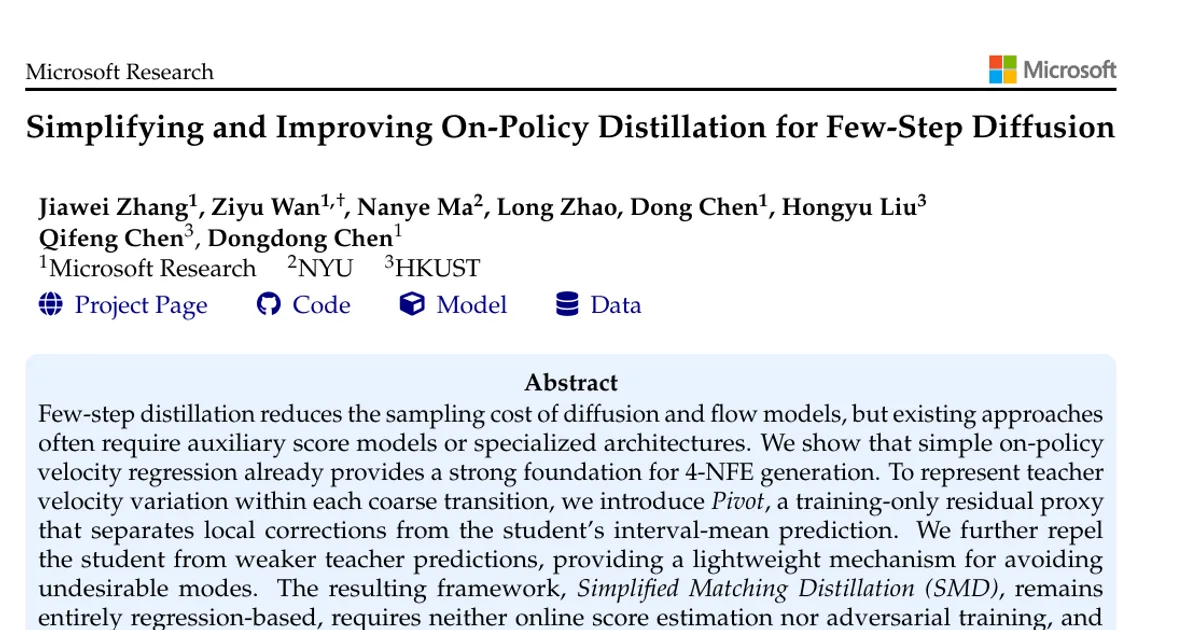
Authors’ abstract
Few-step distillation reduces the sampling cost of diffusion and flow models, but existing approaches often require auxiliary score models or specialized architectures. We show that simple on-policy velocity regression already provides a strong foundation for 4-NFE generation. To represent teacher velocity variation within each coarse transition, we introduce Pivot, a training-only residual proxy that separates local corrections from the student's interval-mean prediction. We further repel the student from weaker teacher predictions, providing a lightweight mechanism for avoiding undesirable modes. The resulting framework, Simplified Matching Distillation (SMD), remains entirely regression-based, requires neither online score estimation nor adversarial training, and leaves the deployed generator unchanged. We evaluate SMD on image generation and editing, 3D generation, video synthesis, and joint audio--video generation, scaling to 33 billion parameters. At 4-NFE, SMD outperforms strong few-step baselines and surpasses multi-step teachers on several benchmarks. It also supports cross-model, multi-teacher, and causal-video distillation.