Research
Sigma: The Key for Vision-Language-Action Models toward Telepathic Alignment
Overview Research area: Vision-language-action (VLA) models for robotic control, specifically the alignment between semantic understanding and continuous action generation. Technical level: Advanced.
- arXiv
- 2512.00783
- Published
- 2025-11-30
- Authors
- Libo Wang
AI summary
Overview
Research area: Vision-language-action (VLA) models for robotic control, specifically the alignment between semantic understanding and continuous action generation.
Technical level: Advanced. The work assumes familiarity with VLA backbones, LoRA fine-tuning, adapters, and MSE-based control evaluation.
Scope: A single-author report on building and training a VLA model called Sigma on top of an existing open-source backbone, evaluated by offline replay against the untuned baseline under the same data conditions.
What This Paper Is About
The paper identifies a gap in cognitive systems: there is no intermediary "thought space" that sits between language-level semantics and continuous motor control and that can be updated over time. The goal is to build and train a model, Sigma, that supplies this missing layer by combining deep semantic understanding with associative reasoning, so that what the system perceives and what it does line up in what the author calls a "telepathic-style" manner. The work is framed as an architecture and training study rather than a new dataset or benchmark paper.
Key Contributions
- Construction and training of Sigma, a vision-language-action model deployed on a single RTX 4090, built on the open-source
pi0.5_basebackbone with thesvla_so101_pickplacedataset preprocessed into a structured training corpus. - An independently designed VLA architecture intended to integrate deep semantic understanding with associative reasoning, enabling the intended perception-to-action alignment.
- A training procedure organized as iterative optimization across three stages: data preprocessing, LoRA-based fine-tuning, and inference-stage adapter design.
- An offline closed-loop replay evaluation that compares Sigma against the untuned
pi0.5_baseunder identical data conditions.
Main Findings
- Lower control error than the baseline: The comparison against untuned
pi0.5_basereportedly shows a consistent reduction in control MSE at the vector, fragment, and trajectory levels. The abstract states the direction of the effect but gives no numeric values. - Stability of the "telepathy norm": The paper claims this quantity, which the abstract does not define numerically, is preserved rather than degraded by the new alignment behavior.
- Preserved semantic-text alignment: The quality of alignment between semantics and text is reported as maintained, not traded away for the control gains.
- Alignment without retraining the base model: The improvements are attributed to semantic and associative architectural integration layered on the existing backbone, with the base model left untrained/unchanged.
- Reproducibility claim: The author positions the approach as a reproducible pathway toward semantic alignment and intention-driven behavior, though the abstract does not describe what artifacts or code support that claim.
Methodology in Plain English
The author starts from an existing open-source VLA backbone rather than training from scratch, and converts a pick-and-place dataset into a structured training corpus. On top of that, a custom architecture is added to combine two capabilities: understanding meaning at a semantic level, and associatively connecting that meaning to action. Rather than updating the whole backbone, the training uses LoRA — lightweight adapter weights that modify behavior without retraining the full model — and a further adapter is designed for the inference stage. Progress is pursued iteratively across preprocessing, fine-tuning, and inference adaptation. Evaluation is done by offline closed-loop replay: the model's control outputs are replayed against recorded conditions and compared, under the same data, to the unmodified baseline. Control error is measured at three levels of granularity (vector, fragment, trajectory).
Why This Matters
Impact on research: The paper argues that alignment between semantics and control can be improved through architectural integration plus light adaptation, without retraining a foundation backbone — a claim relevant to anyone working on parameter-efficient adaptation of VLA models. It also introduces a vocabulary ("telepathic alignment," "telepathy norm," "mind-responsive alignment control") that the abstract does not formalize, so the paper's value to the field partly depends on how well those terms are operationalized in the full text.
Potential real-world applications (as the framing suggests, not as demonstrated in the abstract):
- Robot manipulation in structured settings such as pick-and-place, which is the dataset domain named.
- Intention-driven assistance, where a system infers desired behavior from semantics rather than explicit commands.
- Deployments constrained to a single consumer-grade GPU, which is the hardware configuration described.
- Parameter-efficient adaptation of existing robot policies to new tasks instead of retraining backbones.
Industry relevance: The single-RTX-4090 footprint and the LoRA-based, no-retraining recipe target the practical cost problem in deploying VLA models. Firms building robot foundation models could treat this as a candidate adaptation pattern, though the abstract provides no evidence about real-hardware performance, throughput, or generalization beyond the replay evaluation.
Future Directions
- Defining the novel quantities. The abstract names a "telepathy norm" and "telepathic alignment" without stating how they are measured; formal definitions and validated metrics are a natural next step.
- Moving beyond offline replay. Closed-loop replay on recorded data is a proxy for control. Whether the reported MSE reduction transfers to physical robot execution is untested in the abstract.
- Testing generalization. The work is tied to one backbone (
pi0.5_base) and one dataset (svla_so101_pickplace). Whether the architecture and adapters carry over to other backbones, embodiments, and task suites is open. - Separating the contributions. Data preprocessing, LoRA fine-tuning, and inference adapters are described as one iterative pipeline; isolating which component drives the control-error reduction is not addressed in the abstract.
Target Audience
Researchers and engineers working on vision-language-action models, robot policy learning, and parameter-efficient fine-tuning of foundation models. The paper is most useful to readers already comfortable with VLA backbones, LoRA adapters, and MSE-based control evaluation, and to practitioners interested in adapting existing robot policies on limited hardware. Readers looking for validated real-robot results, benchmark comparisons, or formal definitions of the paper's terminology will need the full text, since the abstract does not supply them.
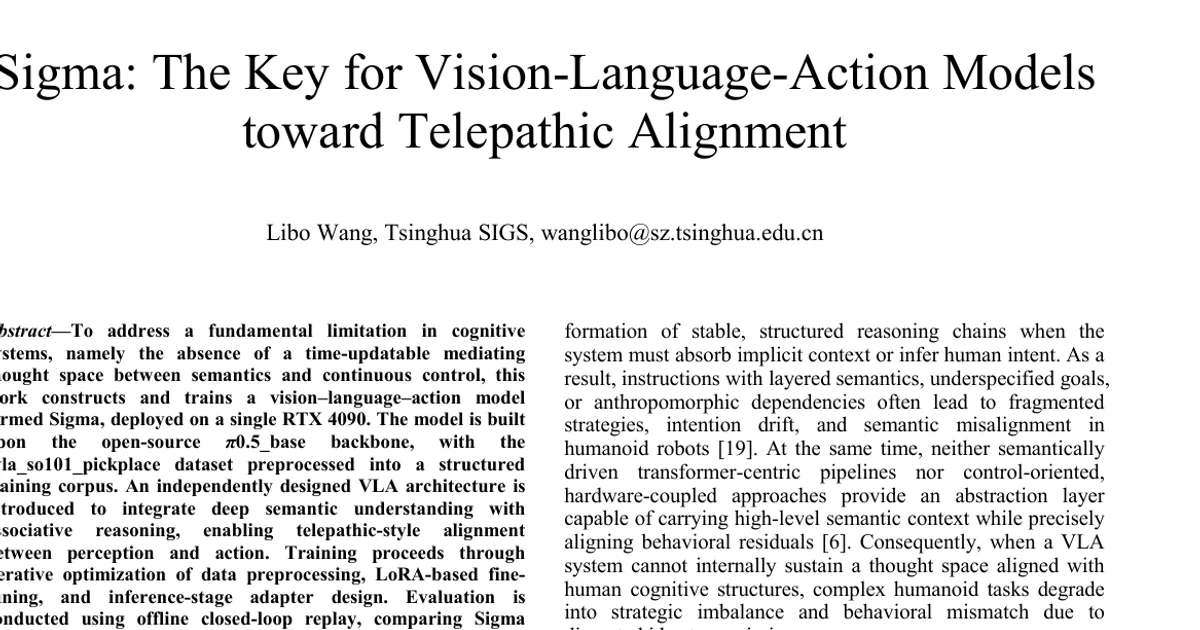
Authors’ abstract
To address a fundamental limitation in cognitive systems, namely the absence of a time-updatable mediating thought space between semantics and continuous control, this work constructs and trains a vision-language-action model termed Sigma, deployed on a single RTX 4090. The model is built upon the open-source pi0.5_base backbone, with the svla_so101_pickplace dataset preprocessed into a structured training corpus. An independently designed VLA architecture is introduced to integrate deep semantic understanding with associative reasoning, enabling telepathic-style alignment between perception and action. Training proceeds through iterative optimization of data preprocessing, LoRA-based fine-tuning, and inference-stage adapter design. Evaluation is conducted using offline closed-loop replay, comparing Sigma against the untuned pi0.5_base under identical data conditions. Experimental results indicate a consistent reduction in control MSE across vector-, fragment-, and trajectory-level scales, while preserving the stability of the telepathy norm and semantic-text alignment quality. These findings demonstrate that mind-responsive alignment control can be quantitatively achieved through semantic and associative architectural integration without retraining the base model, providing a reproducible pathway for semantic alignment and intention-driven behavior.