Research
Shortcut-Resistant CAM Distillation for Long-Tailed Recognition
Shortcut-Resistant CAM Distillation for Long-Tailed Recognition Overview Research area: Machine learning / computer vision — long-tailed visual recognition, interpretability (Class Activation Maps), a
- arXiv
- 2610.29508
- Published
- 2026-10-21
- Authors
- Wenhai Wan, Teng Zhang, Shao-Yuan Li, Xinrui Wang, Qiang-Sheng Hua, Songcan Chen
AI summary
Shortcut-Resistant CAM Distillation for Long-Tailed RecognitionOverview
Research area: Machine learning / computer vision — long-tailed visual recognition, interpretability (Class Activation Maps), and shortcut (spurious-correlation) learning.
Technical level: Advanced. The paper combines interpretability tooling (CAMs), energy-based weighting built on graph Laplacian smoothness and Hoyer-style sparsity, a plug-in distillation loss, and two theorems about attention-mass contraction. Readers need comfort with softmax/entropy arguments and gradient-flow reasoning.
Scope (one sentence): The paper diagnoses why tail classes in long-tailed datasets latch onto non-semantic shortcuts and proposes a plug-and-play distillation scheme that transfers object-focused spatial evidence from head classes to tail classes in CAM space, with theory and experiments across five long-tailed benchmarks and both from-scratch and foundation-model fine-tuning settings.
What This Paper Is About
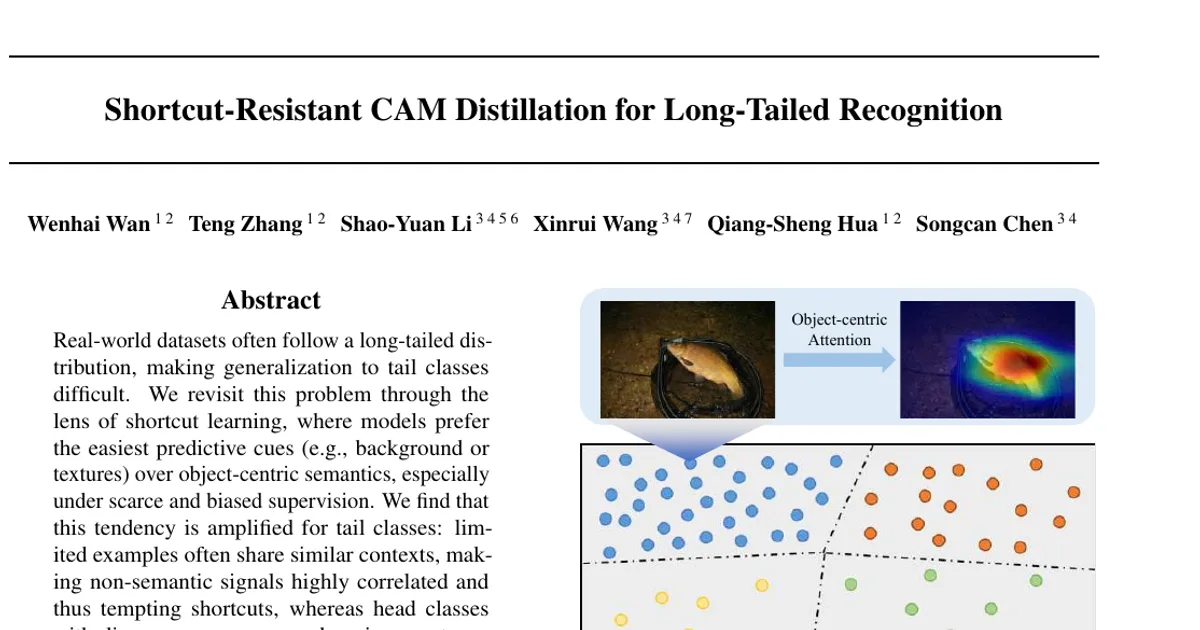
Deep models trained on long-tailed data generalize poorly to rare (tail) classes. The authors argue this is partly a shortcut learning problem: with only a handful of tail examples that often share similar contexts (e.g., a boat always photographed on the ocean), background or texture becomes an unusually reliable predictor, and the model learns it instead of the object. The goal is to stop tail predictions from being driven by such cues by borrowing the more object-centric spatial explanations that head classes learn from abundant, diverse data.
Key Contributions
-
A shortcut-learning reframing of long-tailed recognition. The authors use Class Activation Maps to show a systematic head–tail gap: CAMs from a long-tailed model align closely with those from a balanced reference model on head classes, but the alignment drops substantially on tail classes. They also show that CAMs computed from the most probable head class for a tail example align better with the balanced reference than the tail class's own CAM.
-
SRCD, a plug-and-play CAM distillation framework. For each tail sample, the method selects the top-K most probable head classes, weights their CAMs by an energy score combining spatial coherence (a graph-Laplacian energy) and evidence concentration (a normalized L1/L2 sparsity score), forms a "shortcut-resistant teacher" CAM, and distills it into the ground-truth tail-class CAM with an L2 loss scaled by a class-dependent coefficient γ_y = n_thres/n_y, using a stop-gradient on the teacher.
-
Theory quantifying shortcut suppression. Shortcut reliance is formalized as the CAM mass falling inside a shortcut/background region, A_sc. Theorem 4.1 shows the softmax energy weights uniquely maximize an entropy-regularized utility (so the teacher construction is principled, not ad hoc). Theorem 4.2 shows that L2 distillation follows a closed-form gradient flow in which shortcut mass contracts exponentially toward the teacher's value, decreasing monotonically whenever the teacher's shortcut mass is lower at the start.
-
Broad empirical validation as a drop-in component. SRCD is integrated into seven from-scratch baselines (BCL, GCL, FCC, GLMC, H2T, BNS, Focal-SAM) and three foundation-model fine-tuning baselines (Decoder, PECEL, LIFT) across CIFAR-10-LT, CIFAR-100-LT, ImageNet-LT, iNaturalist 2018, and Places-LT.
Main Findings
-
Head–tail shortcut gap is measurable. Cosine similarity between long-tailed and balanced-model CAMs is high for head classes and drops substantially for tail classes; the head-proxy CAM (computed with the most confident predicted head class) shows notably higher similarity on tail examples than the tail class's own CAM, which motivates the whole design.
-
Consistent gains on CIFAR-LT from scratch. On CIFAR100-LT at IR=100: BCL 51.76 → 53.64 (+1.88), GLMC 53.91 → 55.26 (+1.35), CE+FCC 40.20 → 42.38 (+2.18), CE+H2T 42.27 → 44.53 (+2.26), BNS 52.40 → 53.88 (+1.48), Focal-SAM 50.70 → 52.54 (+1.84). At IR=50, GLMC improves 58.87 → 60.43 (+1.56); at IR=10, CE+H2T improves 58.24 → 60.07 (+1.83).
-
Improvements are not universal on CIFAR. Several entries decline: BCL on CIFAR10-LT at IR=100 drops 83.61 → 82.97 (−0.64); GCL on CIFAR100-LT at IR=10 drops 61.79 → 60.23 (−1.56); CE+H2T on CIFAR100-LT at IR=50 drops 47.58 → 46.97 (−0.61); GLMC and BNS show small drops on CIFAR10-LT at IR=10 and IR=50 respectively (−0.38 and −0.24).
-
Largest gains land on Medium/Tail splits at scale. On ImageNet-LT (from scratch), BCL improves All 55.67 → 57.00 (+1.33) with Tail 36.27 → 39.56 (+3.29); GLMC improves Tail 30.41 → 34.22 (+3.81) with All 56.17 → 56.76 (+0.59). On iNaturalist, GCL improves All 70.76 → 72.58 (+1.82) and BCL improves 70.80 → 71.89 (+1.09).
-
Works in foundation-model fine-tuning. With CLIP ViT-B/16: Decoder on ImageNet-LT 73.2 → 74.2 and on iNaturalist 59.2 → 61.3 (+2.1 overall, with Head 55.1 → 58.7, +3.6); PECEL 78.3 → 78.8 and 80.5 → 81.2; LIFT 77.1 → 78.4 and 79.7 → 80.3. Reported gains appear alongside stable or improved Head accuracy rather than a head-for-tail trade-off.
-
Both weighting cues matter. On ImageNet-LT with FCC, coherence only gives 54.02, concentration only gives 53.64, and both together give 55.95 — the best of the three.
-
Distillation strength and proxy count. Accuracy shows a significant and stable improvement once β exceeds 0.6; K = 3 head-class proxies already captures most of the gain, with further increases giving stable but marginal improvements.
-
Beats simpler alternatives. Energy-based aggregation yields higher CAM similarity to the balanced reference than plain averaging of head-proxy CAMs. Replacing the head-proxy teacher with a fixed center mask degrades performance, especially on the Tail split, indicating the gain is not from a trivial center prior.
Methodology in Plain English
The approach has three moving parts.
1. See where the model is looking. A Class Activation Map turns a prediction into a heat map over image locations, normalized so the values sum to one — effectively "what fraction of the evidence for this class came from each pixel." The authors compare such maps from a model trained on balanced CIFAR100 against one trained on the long-tailed CIFAR100-LT, using cosine similarity. Tail-class maps drift away from the balanced reference; head-class maps do not.
2. Build a trustworthy teacher from head classes. For a tail training image, the model ranks the head classes it considers most likely (top-K). Each of those head classes supplies a candidate heat map. Not all candidates are good, so each is scored on two properties: coherence (does the evidence form one smooth blob, measured by a Laplacian energy over a 4-neighbor pixel grid — lower is better) and concentration (is the evidence compact rather than smeared over the whole image, measured by a normalized L1/L2 norm ratio between 0 and 1 — higher is better). These scores are turned into softmax weights with temperature τ, and the weighted average becomes the teacher map. The softmax form is exactly the solution to maximizing average utility minus an entropy penalty, so it avoids putting all the weight on one possibly-noisy candidate.
3. Pull the tail map toward the teacher. The ground-truth tail-class CAM is pushed toward the teacher map with a squared-error loss, with the teacher held fixed (stop-gradient) and the loss multiplied by γ_y = n_thres/n_y, so rarer classes get stronger regularization. The total objective is the ordinary classification/re-balancing loss plus this term, applied only to classes below the head–tail threshold of n_thres = 100 and only in the late training stage, when head-class explanations are reliable.
Setup details: ResNet-32 trained for 200 epochs on CIFAR-LT; ResNet-50 on ImageNet-LT and iNaturalist with the same schedule; CLIP ViT-B/16 image encoder fine-tuned for 20 epochs following the LIFT protocol. Evaluation uses a balanced test distribution, with Head/Med/Tail splits defined as more than 100, 20–100, and fewer than 20 training samples.
Why This Matters
Research impact. The paper moves long-tailed recognition from re-weighting and re-sampling toward explanation-level intervention. Prior head-to-tail transfer (FASA, LTA, CMO, H2T) works in sample, feature, or statistics space; SRCD works in evidence space. It also brings the shortcut-learning literature — largely studied on balanced benchmarks with known spurious attributes — into the long-tailed regime, and gives an explicit mass-based quantity (shortcut-region CAM mass) with a contraction guarantee. Because the method attaches to any re-balancing loss as a plug-in, it is easy to test against new baselines.
Real-world applications.
- Rare-disease and rare-finding medical imaging, where a few examples often come from one scanner, site, or acquisition protocol and the model may key on that context rather than pathology.
- Wildlife and biodiversity monitoring, where rare species are photographed in a narrow set of habitats and background vegetation can substitute for the animal.
- Industrial defect inspection, where rare defect types appear only on specific product batches or production lines, making lighting and jig cues spuriously predictive.
- Long-tail product or content classification in retail and recommendation, where rare categories are logged in limited, self-similar contexts.
Industry relevance. The method is architecture-agnostic, adds a lightweight CAM-and-weighting branch rather than a second network, is only active in late training, and applies unchanged to both from-scratch training and CLIP-style foundation-model fine-tuning — the two settings most production vision teams operate in. The finding that it improves Head/Med/Tail balance without sacrificing head accuracy matters practically, since head-class regressions are often the reason tail-focused methods get rejected in deployment.
Future Directions
-
Reliability of head proxies when the classifier is confidently wrong. The teacher is built from the model's top-K head predictions; the paper's own discussion defers questions about this selection to an appendix, leaving open what happens when tail images have no semantically related head class among the candidates.
-
Richer teacher evidence than single-class CAMs. The current teacher is a weighted average of whole-image-class CAMs with no part-level decomposition; part-aware or segmentation-guided teachers could sharpen the object-centric target.
-
Beyond image classification. Extending the evidence-level intervention to detection and segmentation, where the "shortcut region" is not a fixed background mask over an H×W grid, is a natural but unresolved step.
-
Theory beyond the L2 gradient-flow idealization. Theorem 4.2 assumes a plain gradient flow onto a fixed teacher; how the contraction behaves under stochastic optimization, a moving teacher, and the finite K used in practice is not established.
-
Systematic characterization of when it fails. SRCD shows small drops on several CIFAR entries (e.g., GCL at CIFAR100-LT IR=10, −1.56), and the paper does not offer a predictive account of which baseline/regime combinations will regress.
Target Audience
Graduate students and researchers working on long-tailed or imbalanced recognition who want a method that composes with existing re-balancing losses; interpretability researchers interested in using CAMs as a training signal rather than only a diagnostic; and applied ML engineers adapting foundation models (CLIP-style) to skewed production data, who will find the fine-tuning results and the plug-and-play design most directly useful. Readers without background in CAMs, Laplacian energies, or entropy-regularized weighting should expect a steep but manageable climb.
Authors’ abstract
Real-world datasets often follow a long-tailed distribution, making generalization to tail classes difficult. We revisit this problem through the lens of shortcut learning, where models prefer the easiest predictive cues (e.g., background or textures) over object-centric semantics, especially under scarce and biased supervision. We find that this tendency is amplified for tail classes: limited examples often share similar contexts, making non-semantic signals highly correlated and thus tempting shortcuts, whereas head classes with diverse appearances and environments encourage more stable object-focused representations. Motivated by this observation, we propose Shortcut-Resistant CAM Distillation (SRCD), a plug-and-play framework that transfers object-focused explanations from head to tail classes. SRCD operates in the Class Activation Map (CAM) space, where a CAM provides a class-specific spatial evidence map for a prediction. SRCD aggregates CAMs from a small set of head-class candidates into a shortcut-resistant teacher using an energy-model weighting based on coherence and concentration, and distills it to the tail-class CAM. We provide a theoretical analysis that quantifies shortcut reliance as shortcut-region evidence mass in CAM space and shows that SRCD suppresses tail shortcuts. Extensive experiments on long-tailed benchmarks consistently improve strong baselines. The code is available at https://github.com/Haifeng3/SRCD.