Research
SGF+: Decoupling Gradient Flows for Autoregressive Video Generation
Overview Research area: Autoregressive video diffusion models and long-horizon video generation (computer vision, generative modeling). Technical level: Advanced. The paper assumes familiarity with di
- arXiv
- 2610.10429
- Published
- 2026-10-07
- Authors
- Zihan Su, Junhao Zhuang, Yaowei Li, Siwen Lu, Haoran Li, Lingen Li, Haoyu Wu, Weiyang Jin, Songchun Zhang, Haoyang Huang, Chun Yuan, Zeyue Xue, Nan Duan
AI summary
Overview
Research area: Autoregressive video diffusion models and long-horizon video generation (computer vision, generative modeling).
Technical level: Advanced. The paper assumes familiarity with diffusion models, key-value (KV) caches, few-step distillation objectives such as DMD, and gradient analysis.
Scope: The paper diagnoses a gradient conflict between the two roles an autoregressive video diffusion model plays — denoising current frames and writing context for future frames — and proposes assigning them separate parameters.
What This Paper Is About
Autoregressive video generators denoise each new block of frames and then encode those frames into key-value (KV) representations that condition future predictions. Normally both jobs use the same model weights, so their gradients are added together on shared parameters. The authors measure these gradients and find they point in systematically opposing directions, which limits how well visual quality and temporal consistency can be optimized at once. The paper's goal is to show that giving context writing and denoising their own parameters — without adding loss terms, extra video training data, or longer training — improves both quality and consistency over long rollouts.
Key Contributions
- The authors identify distinct, even conflicting, gradients for context writing and denoising under a single generation objective, exposing an optimization limitation of shared parameters in Self Gradient Forcing (SGF).
- They introduce Self Gradient Forcing Plus (SGF+), a role-specific parameterization for autoregressive video diffusion that jointly trains a context writer and a denoiser using only the original generation objective, with no auxiliary losses, no additional video training data, and no long-horizon fine-tuning.
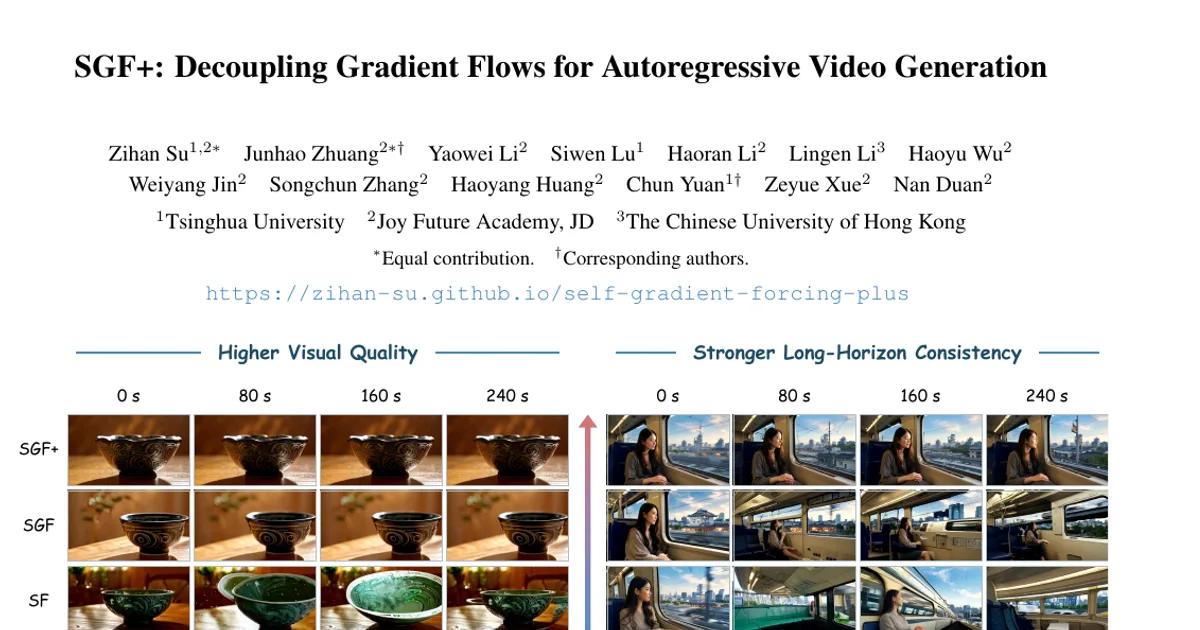
- They demonstrate improved visual quality and long-horizon consistency across framewise and chunkwise generation, and report native long-horizon extrapolation to 24-hour continuous videos from 5s training rollouts.
- They provide ablations of where the parameter separation is applied (Attention only, FFN only, full model), efficiency measurements, and a local theoretical analysis of why role separation helps under gradient conflict.
Main Findings
- Gradient conflict between roles: In SGF, angular-distance t-SNE over 128 prompts and 4 denoising timesteps shows clearly separated context-writing and denoising gradient distributions in both Attention and FFN, with the context at timestep 0 and denoising at timesteps 250, 500, 750, and 1000.
- Large mean angular separation: Aggregated mean gradient directions differ by 104.2 degrees in Attention and 106.3 degrees in FFN, both exceeding 90 degrees, indicating negative alignment.
- Systematic negative alignment: All 512 paired cosine similarities between denoising and context-writing gradients are negative in both module families.
- Conflict exists before training: At teacher-forcing (TF) initialization, mean role-gradient angles already exceed 90 degrees, measured at 95.1 degrees in Attention and 105.1 degrees in FFN using 128 real videos and a 50-step diffusion schedule, with a sharp directional change between timestep indices 0 and 1 (clean-context writing to noisy denoising).
- Long-horizon quantitative gains: On the 60s and 240s horizons, SGF+ outperforms Self Forcing and SGF on most quality and consistency metrics. For example, at the 240s framewise setting, SGF+ reaches Subject Consistency 98.74, Background Consistency 97.81, Temporal Flickering 98.24, Motion Smoothness 98.94, Aesthetic Quality 63.95, and Imaging Quality 70.90, versus Self Forcing at 96.36, 96.42, 96.73, 98.01, 61.36, and 70.71.
- Dynamic Degree is the exception: Self Forcing or SGF sometimes score higher on Dynamic Degree (for example, 93.46 for Self Forcing versus 63.93 for SGF+ in the 60s chunkwise setting). The authors argue that scene jumps, object deformation, subject disappearance, or extra people appearing can inflate this metric with large but incoherent apparent motion, so a lower score does not imply worse generation.
- Partial separation is insufficient: Ablating parameter separation to Attention only or FFN only underperforms full separation on quality and consistency metrics, indicating an MoE-style design putting role experts only in FFN cannot fully remove the conflict. Attention-only separation achieves the highest Dynamic Degree but scores substantially lower on most other metrics.
- Modest efficiency cost: SGF+ doubles generator parameters from 1.4B to 2.8B while keeping SGF's call schedule. For the evaluated 81-frame workload, inference time is nearly unchanged at 4.969 seconds versus 4.962 seconds for SGF, with inference memory rising from 24.85 GB to 27.96 GB. Training peak and stable memory rise from 97.83 GB to 98.15 GB and from 70.06 GB to 73.60 GB, and time per step rises from 11.79 to 12.76 seconds, roughly an 8.2 percent increase.
- Native long-horizon extrapolation: Trained only on 5s video windows, SGF+ supports continuous generation for up to 24 hours without long-video fine-tuning.
- Layer-level anomaly: In the layer-wise analysis of FFN gradients, block 29 has zero context-writing gradients for all 512 prompt–timestep pairs.
Methodology in Plain English
The starting point is SGF's two-pass training procedure. Pass 1 runs an ordinary autoregressive rollout with no gradient tracking; it records the clean latent estimates for each block and the noisy target latents at a sampled denoising exit. Pass 2 replays that computation in a single parallel forward pass under a causal reconstruction mask. The sampled latents stay detached, but the context KV states are recomputed with gradient tracking, so the future-generation loss can reach the context-writing path without backpropagating through the whole rollout.
The authors then split the parameter-level contributions inside that Pass-2 computation. For a shared weight matrix, they separate the gradient into a context-writing term and a denoising term, and measure the cosine similarity between them. Because the shared gradient is simply the sum of the two, opposing components partially cancel.
SGF+ replaces the single parameter set with two: a context writer and a denoiser, both initialized from the same autoregressive diffusion model. Pass 1 still runs without gradients, with the denoiser generating blocks and the context writer filling the cache. In Pass 2, the future-generation objective reaches the writer's parameters through the differentiable KV states and the denoiser's parameters through target denoising. The two roles stay forward-coupled and jointly trained, but their updates no longer accumulate on the same weights. The paper notes this can be implemented with either two separate LoRA adapters or two full parameter sets, and uses the latter.
Experiments use teacher-forcing initialization with weights released by Causal Forcing and train on 5s video windows with filtered and expanded prompts from VidProM. All models use a causal video diffusion student based on Wan2.1-T2V-1.3B, a frozen Wan2.1-T2V-14B teacher, and a separately trained fake-score network initialized from Wan2.1-T2V-1.3B. The 5s evaluation uses standard VBench; the 60s evaluation uses VBench-Long prompts and the 240s evaluation uses 128 MovieGen prompts. Both long horizons are 12x and 48x the training window. Optimization uses AdamW with beta1 of 0 and beta2 of 0.999, learning rates of 2e-6 for the generator and 4e-7 for the critic, one generator update per five critic updates, and four denoising steps. Within each generation mode, methods share the same sink-plus-FIFO context policy: framewise uses 4 sink latents, 16 recent latents in the FIFO cache, and 1 current latent (a window of 21); chunkwise uses 3 sink latents, 6 recent latents, and a current chunk of 3 latents (a window of 12).
Appendix G adds a local optimization analysis. It fixes the replay latents and supervision, defines the surrogate objective over separate writer and denoiser parameters, and compares the maximum first-order decrease achievable under an independent-update budget versus a tied (shared-parameter) budget. The gap between the two is proportional to the squared norm of the difference between the two role gradients, formalized in Proposition G.1.
Why This Matters
Impact on research. The paper reframes a design choice that most autoregressive video methods share — one parameter set doing both context writing and denoising — as an optimization problem rather than a neutral convenience. It also reports that role-specific gradient differences are already visible at teacher-forcing initialization, which suggests the issue is not an artifact of SGF training. The work is complementary to research on history construction, context management, spectral correction, positional adaptation, and longer-horizon training, since it intervenes on parameter sharing rather than on those dimensions.
Real-world applications (as directions the paper's framing supports):
- Low-latency streaming video generation where inference extends beyond the training horizon.
- Interactive world modeling, where historical context links past outputs to future predictions.
- Interactive video editing, which the paper lists among applications of SGF-style differentiable context reconstruction.
- Audio-video generation, also listed among those applications.
Industry relevance. The method is described as requiring no additional video training data, no auxiliary losses, and no long-video fine-tuning, and it preserves the existing denoising and context-writing call schedule. The reported cost is an approximately 8.2 percent increase in training time per step, a small inference memory increase from 24.85 GB to 27.96 GB, and nearly unchanged inference latency on the evaluated 81-frame workload. That combination matters for production systems that serve long or continuous video streams, where long-horizon fine-tuning data is expensive and latency budgets are tight.
Future Directions
- Beyond parameter separation, the authors point to model merging as another way to coordinate the optimization of different roles, and explicitly leave this for future work.
- They suggest investigating role-specific parameterization from the TF stage, including its potential extension to world action models (WAMs) trained with teacher forcing, which use context KV representations for action prediction.
- The paper notes that an MoE-style design introducing role experts only in FFN cannot fully eliminate the conflict, since conflicting gradients also arise in Attention; how best to structure partial separation remains open.
- The reported behavior at teacher-forcing initialization motivates role-aware parameterization throughout autoregressive video training, raising the question of where else the writer/denoiser distinction should be applied.
Target Audience
Researchers and engineers working on autoregressive video diffusion, video world models, and streaming or long-horizon video generation. It is most useful to readers already comfortable with KV caching, few-step distillation objectives, and gradient-level analysis of transformer training, and to practitioners who need continuous generation beyond the training window without collecting long-video fine-tuning data.
Authors’ abstract
Autoregressive video generation requires denoising the current frames while writing their key-value representations as context for future predictions. However, these two roles typically share parameters, and we find that their gradients exhibit distinct patterns and systematic negative alignment, hindering the joint optimization of visual quality and temporal consistency. We introduce Self Gradient Forcing Plus (SGF+), which assigns separate parameters to context writing and denoising while preserving their interaction through causal attention. Both roles are jointly optimized using the original generation objective without auxiliary losses, with context writing supervised through its contribution to future predictions. This simple change improves visual quality and long-horizon consistency over the evaluated baselines in both framewise and chunkwise generation, without additional video training data or a longer training horizon. Trained on only 5s rollouts, SGF+ supports continuous generation for up to 24 hours without long-video fine-tuning. These results highlight role-specific parameterization as an effective design principle for high-quality autoregressive video generation and native long-horizon extrapolation.