Research
SentiMaithili: A Benchmark Dataset for Sentiment and Reason Generation for the Low-Resource Maithili Language
Overview Research area: Natural Language Processing — low-resource language resources, sentiment analysis, and explainable AI. Technical level: Intermediate. The paper is readable without deep NLP bac
- arXiv
- 2510.22160
- Published
- 2025-10-25
- Authors
- Rahul Ranjan, Mahendra Kumar Gurve, Anuj, Nitin, Yamuna Prasad
AI summary
Overview
Research area: Natural Language Processing — low-resource language resources, sentiment analysis, and explainable AI.
Technical level: Intermediate. The paper is readable without deep NLP background, though familiarity with sentiment analysis and transformer models helps.
Scope: This paper introduces SentiMaithili, the first benchmark dataset for sentiment analysis in Maithili that pairs sentiment labels with natural-language justifications written in Maithili, and reports experiments using classical and transformer-based models.
What This Paper Is About
Maithili, an Indo-Aryan language spoken by more than 13 million people, has very little computational language support. Building datasets for such languages is hard because native expert annotators are scarce and annotation is slow and expensive, and the few existing resources tend to use coarse labels without explaining why a sentiment was assigned. This paper addresses that gap by releasing a curated, expert-validated Maithili dataset whose annotations include reasons, and by testing whether standard and modern models can make effective use of it.
Key Contributions
-
A new Maithili sentiment dataset. The authors introduce a dataset of 3,221 Maithili sentences annotated for sentiment polarity.
-
Natural-language justifications in Maithili. Each annotation is accompanied by a written explanation for the sentiment label, and these justifications are written in Maithili rather than a pivot language such as English.
-
Expert curation and validation. The dataset was carefully curated and validated by linguistic experts to support both label reliability and contextual fidelity.
-
A first-of-its-kind benchmark. The work is presented as the first benchmark for explainable affective computing in Maithili, aimed at advancing multilingual NLP and explainable AI.
Main Findings
-
The dataset is a viable benchmark for interpretable sentiment analysis. The authors report that extensive experiments with both classical machine learning and state-of-the-art transformer architectures demonstrate the dataset's effectiveness for this task.
-
Explainability is built into the data, not added afterward. Because justifications are collected alongside polarity labels, the resource supports interpretation grounded in Maithili-language reasoning rather than only post-hoc explanation.
-
Cultural grounding is treated as a design goal. Writing the justifications in Maithili is intended to promote culturally grounded interpretation and to improve the explainability of sentiment models, rather than forcing explanations through another language.
-
Details of results are not in the abstract. The abstract does not report accuracy, F1 scores, model comparisons, baseline names, or dataset splits, so no specific performance figures can be stated here.
Methodology in Plain English
The researchers identified that Maithili lacks usable sentiment resources, particularly ones that explain their labels. They built a dataset of 3,221 Maithili sentences, labeling each with a sentiment polarity and adding a written justification for that label — the justification itself being in Maithili. To keep quality high given how scarce native expertise is, they had linguistic experts curate and validate the annotations. They then ran experiments on the dataset with two families of approaches: classical machine learning methods and modern transformer models, to check whether the resource actually supports interpretable sentiment analysis. The abstract states that these experiments demonstrate the dataset's effectiveness, but it does not describe the experimental setup, evaluation metrics, or specific outcomes.
Why This Matters
For research: It adds a benchmark to a language that is largely absent from NLP, and it targets explainable sentiment rather than polarity alone — a combination that is rare for low-resource settings. It also offers a template for building expert-validated, justification-carrying datasets where annotation budgets and native expertise are limited.
Real-world applications (implied by the work):
- Analyzing public opinion, feedback, or social media text produced in Maithili-speaking regions of the Purvanchal area.
- Monitoring customer or citizen sentiment in local-language content where English-centric tools would fail or distort meaning.
- Supporting culturally grounded content moderation and community research that requires understanding of local expression, not just a polarity tag.
- Providing explainable outputs so that a label can be traced to a stated reason, which matters where decisions affect people and need to be justified.
Industry relevance: Organizations serving Maithili-speaking audiences — media, telecom, e-commerce, public services, and social platforms — currently lack language-specific sentiment tools. A benchmark plus justification data gives model builders something to train and evaluate against, and the emphasis on explanations aligns with a broader industry push toward interpretable AI systems.
Future Directions
- Expanding the resource. The dataset covers 3,221 sentences; enlarging it and broadening the domains and text types it samples would strengthen its coverage and generalizability.
- Extending beyond polarity. The abstract frames current low-resource resources as often restricted to coarse-grained annotations, which suggests finer-grained or multi-dimensional annotation as a natural next step.
- Generating justifications automatically. A key open question is how well models can produce Maithili-language reasons, not just consume them — a generation task distinct from classification.
- Cross-lingual and cross-domain study. It remains open how models trained on this benchmark transfer to related Indo-Aryan languages or to text from unfamiliar domains.
Target Audience
Researchers and practitioners working on low-resource and multilingual NLP, especially those in Indic languages; groups building explainable or interpretable sentiment systems; linguists and language-technology teams interested in Maithili; and dataset curators looking for a model of how to construct expert-validated, explanation-bearing resources when annotator time and native expertise are constrained.
Authors’ abstract
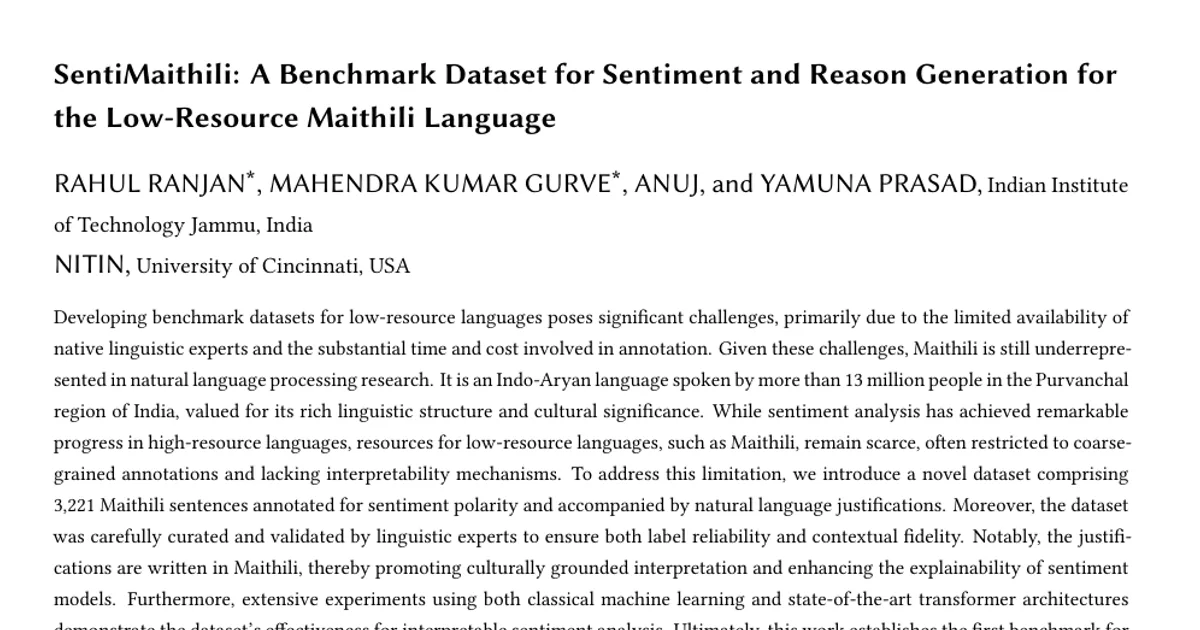
Developing benchmark datasets for low-resource languages poses significant challenges, primarily due to the limited availability of native linguistic experts and the substantial time and cost involved in annotation. Given these challenges, Maithili is still underrepresented in natural language processing research. It is an Indo-Aryan language spoken by more than 13 million people in the Purvanchal region of India, valued for its rich linguistic structure and cultural significance. While sentiment analysis has achieved remarkable progress in high-resource languages, resources for low-resource languages, such as Maithili, remain scarce, often restricted to coarse-grained annotations and lacking interpretability mechanisms. To address this limitation, we introduce a novel dataset comprising 3,221 Maithili sentences annotated for sentiment polarity and accompanied by natural language justifications. Moreover, the dataset is carefully curated and validated by linguistic experts to ensure both label reliability and contextual fidelity. Notably, the justifications are written in Maithili, thereby promoting culturally grounded interpretation and enhancing the explainability of sentiment models. Furthermore, extensive experiments using both classical machine learning and state-of-the-art transformer architectures demonstrate the dataset's effectiveness for interpretable sentiment analysis. Ultimately, this work establishes the first benchmark for explainable affective computing in Maithili, thus contributing a valuable resource to the broader advancement of multilingual NLP and explainable AI.