Research
SDUM: A Scalable Deep Unrolled Model for Universal MRI Reconstruction
Overview Research area: Medical image reconstruction — accelerated MRI reconstruction using deep unrolled neural networks, with a focus on cardiac MRI (CMR) and cross-anatomy generalization. Technical
- arXiv
- 2512.17137
- Published
- 2025-12-19
- Authors
- Puyang Wang, Pengfei Guo, Keyi Chai, Jinyuan Zhou, Daguang Xu, Shanshan Jiang
AI summary
Overview
Research area: Medical image reconstruction — accelerated MRI reconstruction using deep unrolled neural networks, with a focus on cardiac MRI (CMR) and cross-anatomy generalization.
Technical level: Advanced. The paper assumes familiarity with MRI physics (k-space, coil sensitivity maps, sampling trajectories, acceleration factors), deep unrolled optimization (proximal-gradient unrolling, data consistency), and transformer architectures.
Scope: The paper introduces SDUM, a single conditional deep unrolled model that reconstructs heterogeneous cardiac MRI acquisitions without per-protocol fine-tuning, and reports the authors' claim of the first empirical scaling analysis of an unrolled CMR reconstruction model across cascade depth and training-data volume.
What This Paper Is About
Clinical cardiac MRI routinely acquires many different sequences (cine, T1/T2 mapping, LGE, perfusion, flow, tagging) using different sampling trajectories (Cartesian, radial, spiral, kt-space), acceleration factors from 4x to 24x, scanner field strengths (1.5T, 3T, emerging 5T), and patient populations. Most deep learning reconstruction methods are trained for one specific protocol and degrade when the acquisition changes, which makes deployment across multi-site clinical settings difficult. The paper's goal is a single model that handles this heterogeneity without task-specific retraining, and that can also be scaled predictably by adding depth or data.
Key Contributions
-
A single universal reconstruction framework (SDUM) combining five components: a Restormer-based per-cascade reconstructor, learned per-cascade coil sensitivity map estimation (CSME), sampling-aware weighted data consistency (SWDC), universal conditioning (UC) on cascade index and acquisition metadata, and progressive cascade expansion training.
-
Sampling-aware weighted data consistency (SWDC), which replaces the conventional scalar data-consistency weight with learned spatially varying k-space weight maps conditioned on the sampling pattern, unifying Cartesian and non-Cartesian trajectories in one learnable module.
-
State-of-the-art results from one model across all four CMRxRecon2025 tracks (multi-center, multi-disease, 5T, pediatric) without task-specific fine-tuning, plus gains over the winning CMRxRecon2024 method PromptMR+ of +0.55 dB.
-
A scaling analysis for CMR reconstruction, sweeping unrolled depth from T=1 to T=18 and training-data fractions from 40% to 100%, reporting near-logarithmic PSNR gains with model size (r=0.986, R²=0.973) and diminishing but non-saturating gains with data.
Main Findings
-
CMRxRecon2025, one model, all tracks: A single SDUM (T=18) achieves the highest SSIM and PSNR across all four subtasks. Regular Task 1 (multi-center): 0.895 SSIM, 33.179 dB PSNR, 0.014 NMSE, versus PromptMR+ at 0.891 / 32.919 / 0.014 — an absolute gain of +0.26 dB over the second-best method. Regular Task 2 (multi-disease): 0.880 / 33.538 / 0.014 versus PromptMR+ 0.879 / 33.422 / 0.014. Special Task 1 (5T): 0.901 / 34.225 / 0.015 versus PromptMR+ 0.895 / 33.824 / 0.016. Special Task 2 (pediatric): 0.905 / 33.478 / 0.020, the highest SSIM among the reported methods (the next-best listed SSIM is Shen et al. at 0.887). The paper states SDUM exceeds specialized baselines by up to +1.0 dB on the special tracks.
-
CMRxRecon2024: SDUM (T=18) beats the 2024 winner PromptMR+ (32 cascades) by 0.55 dB in Task 1, reaching 0.931 SSIM / 35.700 dB / 0.016 NMSE versus 0.921 / 35.152 / 0.018. In Task 2 it reaches 0.911 / 33.948 / 0.025 versus 0.907 / 33.812 / 0.026. A paired-case analysis shows SDUM beats PromptMR+ in 90.3% of Task 1 cases and 93.9% of Task 2 cases, with mean gains of +1.091 dB and +1.060 dB respectively.
-
Depth scaling: Increasing cascades from 1 to 18 (42M to 759M parameters) improves PSNR monotonically, following an approximately linear relationship with log(# parameters), with r=0.986 and R²=0.973.
-
Width versus depth: Fixing T=1 and scaling width from 7.2M to 78.7M parameters gives 27.605 dB, 28.271 dB, 28.728 dB, and 28.978 dB PSNR; performance improves steadily up to about 42M parameters and then saturates, which the authors interpret as depth being a more efficient axis for capacity scaling than width.
-
Data scaling: Training on 40%, 80%, and 100% of the training data on CMRxRecon2025 Regular Task 1 yields 0.882 / 32.72 / 0.016, 0.890 / 33.05 / 0.015, and 0.895 / 33.18 / 0.014. Gains are monotonic but not uniform: +0.33 dB from 40% to 80%, and +0.13 dB from 80% to 100%, indicating diminishing marginal returns without saturation.
-
Zero-shot CEST MRI: Applied without adaptation to in-house CEST MRI from brain-tumor patients on a 3T Philips scanner with retrospective 4x undersampling — a vendor, pulse sequence, and contrast absent from training — SDUM reaches 43.57 dB PSNR and 0.9769 SSIM against the fully sampled reference while preserving APTw-map fidelity.
-
Cross-anatomy transfer (fastMRI brain): A separately trained SDUM (T=6) reaches 0.979 SSIM / 42.6 dB at 4x and 0.973 / 40.8 dB at 6x, exceeding the fastMRI-winner recurrent baseline PC-RNN (0.971 / 40.8 and 0.962 / 38.9) by +1.8 dB PSNR.
-
Ablation highlights: Restormer is the best backbone at T=6 (32.090 dB) versus U-Net (28.734), DiT (29.542), and TAU (31.597). Two downsampling layers are optimal (32.090 dB; one layer failed to train). Per-cascade CSME improves PSNR by +0.51 dB over a single shared CSME. SWDC outperforms a simple learnable DC by +0.43 dB and a non-sampling-aware weighted DC by +0.30 dB. Universal conditioning adds +0.38 dB. Three cascades with one iteration outperform one cascade with three iterations at similar compute (30.205 dB vs 30.071 dB).
-
Inference efficiency: On a single NVIDIA H100 GPU, the full T=18 model completes inference in approximately 1.0 s using approximately 6 GB of memory at 256x256, and under 4 s with approximately 11 GB peak memory at 328x768.
-
Progressive expansion schedule: Training grows depth as T = 6 → 10 → 18 by keeping first and last cascades fixed and duplicating only interior cascades, warm-starting all parameters from the previous stage; the paper reports this is more stable than one-shot training at T=18.
Methodology in Plain English
MRI scanners collect raw measurements in k-space, and accelerated scans deliberately skip parts of that k-space, which creates aliasing artifacts. Reconstruction means recovering the image from those incomplete measurements. Classical approaches iterate between enforcing agreement with the measured data (data consistency) and applying a regularizer; deep unrolled models learn that alternation as a fixed sequence of network "cascades."
SDUM builds on this idea with several modifications. Each cascade contains a Restormer transformer block, which the authors chose because its attention operates over channels rather than over all pixel pairs, keeping memory cost manageable while still capturing long-range structure, and because a shallow two-stage pyramid preserves fine detail. A small complex-valued U-Net estimates coil sensitivity maps at each cascade instead of using precomputed ones, so sensitivity errors from motion or field inhomogeneity can be corrected progressively. Rather than subtracting the data-consistency residual with a single scalar weight, SDUM learns a spatially varying weight map in k-space that is specific to the sampling pattern — the paper shows the learned maps differ for uniform, Gaussian, and radial masks — and initializes these weights at full resolution before center-cropping them to match the measurement.
To let one model serve many protocols, the cascade index and a discrete protocol label (mask type, acquisition type, acceleration) are encoded with sinusoidal embeddings, passed through small MLPs, summed into one conditioning vector, and injected as an additive broadcast bias into every transformer block. Training uses a curriculum: start with 6 cascades, then expand to 10 and then 18 by doubling only the interior cascades while freezing the endpoints, warm-starting weights at each transition. Experiments cover CMRxRecon2024 and CMRxRecon2025 for cardiac MRI, fastMRI multi-coil brain at 4x and 6x for cross-anatomy validation, and in-house CEST MRI for zero-shot testing. Metrics are SSIM, PSNR, and NMSE on official validation splits or challenge leaderboards.
Why This Matters
Impact on research. The paper argues that MRI reconstruction has lacked the scaling analyses that guide design decisions in NLP and vision, leaving practitioners to guess whether to invest in wider backbones, deeper unrolling, or more data. Its finding that PSNR tracks log(parameters) linearly up to 18 cascades, and that depth beats width beyond roughly 42M parameters, gives the field a concrete empirical reference point. The demonstration that a single conditioned model can span multi-center, multi-disease, multi-field-strength, and multi-population cardiac MRI also challenges the assumption that protocol-specific models are necessary.
Real-world applications:
- Multi-site clinical deployment: a hospital network with different scanner vendors, field strengths, and protocols could use one reconstruction model rather than maintaining separate models per site or protocol.
- Pediatric and 5T imaging: the model generalizes to pediatric cohorts and 5T field strength, both absent from training data, which matters for populations where training data are scarce.
- Underserved contrasts and modalities: zero-shot CEST MRI reconstruction at 43.57 dB PSNR and 0.9769 SSIM suggests a model trained elsewhere can be applied to a protocol it has never seen, relevant for specialized or rare acquisitions.
- Near-real-time scanning: roughly 1.0 s inference at 256x256 on an H100 makes the T=18 model practical for clinical workflows with tighter time budgets.
Industry relevance. The code and model weights are released (github.com/NVIDIA-Medtech/NV-Raw2insights-MRI and huggingface.co/nvidia/NV-Raw2insights-MRI), and the work is a Johns Hopkins University and NVIDIA collaboration, positioning universal reconstruction as a product-relevant capability for scanner and imaging-software vendors. The scaling results also inform where compute budgets should go for organizations training reconstruction foundation models: toward cascade depth and data diversity rather than width alone.
Future Directions
- Resolution-adaptive SWDC: the authors note that SWDC weight maps are not yet resolution-adaptive at inference, leaving a gap between how weights are initialized and how they are used.
- Cheaper deep scaling: training deeper variants is described as computationally expensive, and the scaling analysis does not fully characterize compute-optimal trade-offs, so the paper calls for work on compute-efficient scaling.
- Diversity-aware data selection: because gains from added data diminish (40% to 80% gave +0.33 dB; 80% to 100% gave +0.13 dB), the authors argue that scaling should emphasize data diversity — vendors, trajectories, pathologies, field strengths, age groups — rather than volume within already-dominant distributions.
- Broader evaluation and standardization: the discussion calls for standardized conditioning metadata and evaluation protocols that include downstream clinical consistency, robustness, and uncertainty calibration; establishing a genuinely anatomy-agnostic reconstruction model is stated to require further validation beyond the preliminary cross-anatomy fastMRI and zero-shot CEST results.
Target Audience
MRI reconstruction and medical imaging researchers, particularly those working on deep unrolled models, multi-contrast or multi-trajectory cardiac MRI, and cross-domain generalization. Also useful for machine learning engineers interested in conditional transformer architectures and empirical scaling laws outside NLP and vision, and for clinical translation teams or industry groups evaluating whether a single reconstruction model can replace protocol-specific pipelines. Readers without background in MRI physics or unrolled optimization will find the methods section demanding, since the paper assumes familiarity with k-space, coil sensitivity maps, and proximal-gradient unrolling.
Authors’ abstract
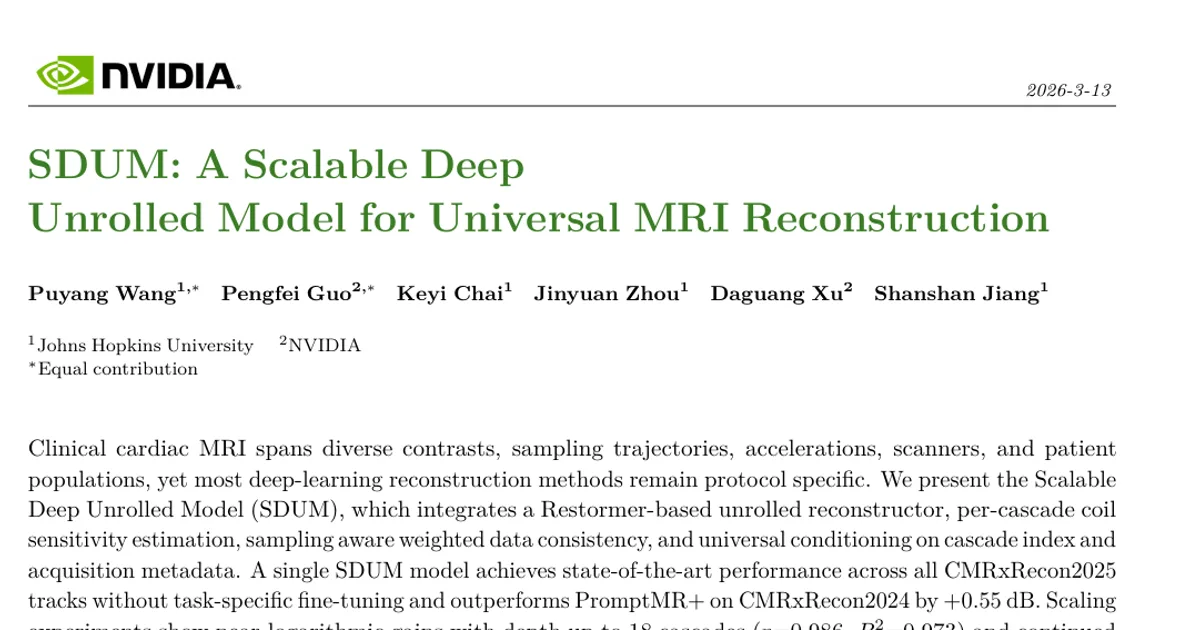
Clinical MRI encompasses diverse imaging protocols--spanning anatomical targets (cardiac, brain, knee), contrasts (T1, T2, mapping), sampling patterns (Cartesian, radial, spiral, kt-space), and acceleration factors--yet current deep learning reconstructions are typically protocol-specific, hindering generalization and deployment. We introduce Scalable Deep Unrolled Model (SDUM), a universal framework combining a Restormer-based reconstructor, a learned coil sensitivity map estimator (CSME), sampling-aware weighted data consistency (SWDC), universal conditioning (UC) on cascade index and protocol metadata, and progressive cascade expansion training. SDUM exhibits foundation-model-like scaling behavior: reconstruction quality follows PSNR ${\sim}$ log(parameters) with correlation $r{=}0.986$ ($R^2{=}0.973$) up to 18 cascades, demonstrating predictable performance gains with model depth. A single SDUM trained on heterogeneous data achieves state-of-the-art results across all four CMRxRecon2025 challenge tracks--multi-center, multi-disease, 5T, and pediatric--without task-specific fine-tuning, surpassing specialized baselines by up to ${+}1.0$~dB. On CMRxRecon2024, SDUM outperforms the winning method PromptMR+ by ${+}0.55$~dB; on fastMRI brain, it exceeds PC-RNN by ${+}1.8$~dB. Ablations validate each component: SWDC ${+}0.43$~dB over standard DC, per-cascade CSME ${+}0.51$~dB, UC ${+}0.38$~dB. These results establish SDUM as a practical path toward universal, scalable MRI reconstruction.