Research
ScaLoRA: Optimally Scaled Low-Rank Adaptation for Efficient High-Rank Fine-Tuning
Overview Research area: Machine learning, specifically parameter-efficient fine-tuning (PEFT) of large language models via low-rank adaptation (LoRA). Listed on arXiv under cs.LG. Technical level: Adv
- arXiv
- 2510.23818
- Published
- 2025-10-27
- Authors
- Yilang Zhang, Xiaodong Yang, Yiwei Cai, Georgios B. Giannakis
AI summary
Overview
Research area: Machine learning, specifically parameter-efficient fine-tuning (PEFT) of large language models via low-rank adaptation (LoRA). Listed on arXiv under cs.LG.
Technical level: Advanced. The paper states and proves theorems (Theorems 3.2, 3.5, 3.7), relies on a Lipschitz smoothness assumption, works with singular value decompositions of gradients, and prescribes solving a 2r × 2r linear system per update. It is written for readers comfortable with optimization theory.
Scope: The paper proposes ScaLoRA, a method that accumulates a high-rank weight update from a sequence of optimally rescaled low-rank adapter increments, and tests it against state-of-the-art LoRA variants on models up to 12 billion parameters.
What This Paper Is About
LoRA fine-tunes a large model by learning a low-rank weight update ABᵀ instead of revising every parameter, which saves memory and compute but confines the update to a fixed low-dimensional subspace. That restriction can reduce effectiveness and slow convergence relative to full fine-tuning, and the gap grows as the rank shrinks. ScaLoRA's goal is to recover an effectively high-rank update while keeping LoRA's efficiency, by identifying per iteration the low-rank adapters that most reduce the loss — an optimal choice the authors show can be formed by rescaling the columns of the original adapters.
Key Contributions
- A characterization of the optimal adapter, and why it is impractical. The authors prove a sufficient and necessary condition for the per-update optimal low-rank adapters (Theorem 3.2). It requires a truncated rank-2r SVD of the gradient, costing O(Smnr) time where S is the number of iterations, and it forces optimization to restart.
- Tractable scaled alternatives with analytical optima. Restricting the new adapters to structured transforms of the current ones yields closed-form global optima: an optimal scalar scaling solvable analytically in O((m+n)r²) time (Theorem 3.5), and an optimal column-wise scaling obtained from a 2r × 2r linear system in O((m+n+r)r²) time (Theorem 3.7).
- Seamless optimization without restarting. Lemmas 3.3 and 3.6 show that under scalar and column-wise scaling the first and second gradient moment estimators can be computed from those of the original adapters in O((m+n)r) time, so adaptive optimizers such as AdamW need not be reset and no learning-rate warm-up is required.
- Empirical validation on many models and tasks. Tests use DeBERTaV3-base, LLaMA-2-7B, LLaMA-3-8B, and Gemma-3-12B-pt across the GLUE benchmark, commonsense reasoning datasets, and mathematical problem solving (MetaMathQA, GSM8K, and MATH).
Main Findings
- High-rank update is accumulated progressively, not imposed structurally. On the RTE dataset with DeBERTaV3-base, ScaLoRA's cumulative weight update reaches an average rank of 54, while LoRA runs at r = 4. ScaLoRA's convergence matches LoRA run at r = 54, especially over the last 5 epochs. The rank's growth slows with epochs, which the authors interpret as confirming LoRA's premise that the optimal update lies on a low-rank manifold.
- Best average GLUE score among the compared methods. With DeBERTaV3-base at r = 4 and scaling coefficient 8, ScaLoRA averages 88.98, versus Full FT 88.25, LoRA 88.13, MoRA 88.35, and HiRA 88.46. The paper reports a 0.5%+ average performance gain, best performance on 7 of 8 datasets, and on the remaining dataset a result 0.09% below the highest.
- Commonsense reasoning (Table 2, partially shown). With r = 8 on LLaMA-2-7B, the visible averages are LoRA 73.63, ReLoRA 74.40, LoRA-GA 74.34, MoRA 73.82, and HiRA 73.95. ScaLoRA's row is truncated in the supplied content (visible entries: BoolQ 87.77 ± 0.57 and PIQA 82.43), so its average and its results on the mathematical tasks are not reported here.
- Synthetic linear regression confirms the mechanism. On a 64 × 64 weight matrix with the loss ½‖Y − WX‖_F², ScaLoRA and its intermittent variant converge faster than vanilla LoRA, and Figure 1(d) shows ScaLoRA minimizing the quadratic upper bound on the loss.
- The theoretical assumptions hold in practice. Figure 2(c) supports the requirement rank(∇ℓ(W_t)) ≥ 2r for all t in Theorem 3.2, and Figure 2(d) indicates that roughly 80% of LoRA layers in an LLM satisfy the non-negativity condition on v_t in Theorem 3.7 across iterations.
- Cost profile. ScaLoRA's time complexity is O(mnr + (m+n+r)r²) and its space overhead is O((m+n+r)r). HiRA has comparable O(mnr) time but an O(mn) memory footprint from backpropagating the Hadamard product. MoRA's overhead depends on the design of its compress and decompress mappings and typically exceeds LoRA's bilinear structure.
- An amortized variant. Because η is typically tiny and the optimal scaling is close to 1 after one update, the intermittent variant ScaLoRA-I applies the scaling every I iterations, amortizing per-step cost to O((mnr + (m+n+r)r²)/I). The authors note MoRA and HiRA impose their high-rank structure every step and cannot be amortized this way.
- Stated limitations. Escalated computational cost is described as the major limitation, confining scalability to increasingly large models; storage is a second limitation, because ScaLoRA stores the entire merged matrix W_t rather than only the low-dimensional adapters A_t and B_t, which the authors argue is acceptable since disk space is typically abundant relative to memory.
Methodology in Plain English
LoRA updates a frozen pre-trained weight by adding a low-rank product. ScaLoRA changes the bookkeeping: after each update it merges the current adapter product into the frozen weights, then factors out a different low-rank matrix that it will optimize next. Because the merged matrix changes every step, the low-rank increments no longer collapse into a single fixed subspace — they stack up into a high-rank update over time.
Deciding which replacement matrix to factor out is the crux. The authors first derive what the best possible choice would be: it requires a truncated singular value decomposition of the gradient, which is too slow and would require restarting the optimizer. They then restrict the candidate replacements to rescalings of the current adapters — first a single scalar on each of the two factors, then a per-column scaling vector on each. Under this restriction, the problem of minimizing the standard quadratic upper bound on the loss reduces to a small algebraic problem with a closed-form solution (a scalar formula, or a 2r × 2r linear system). Crucially, rescaling columns means the optimizer's running estimates of gradient first and second moments can be transformed rather than recomputed, so training continues without a warm-up. The final algorithm uses column-wise scaling when the linear system returns a non-negative solution, and falls back to scalar scaling otherwise; the Lipschitz constant L is treated as a hyperparameter and grid-searched.
Why This Matters
Impact on research. The paper connects two threads — methods that raise LoRA's effective rank (ReLoRA, MoRA, HiRA) and methods that refine adapter initialization (LoRA-GA, which the authors note arises as a special case of their Theorem 3.2). It offers an analytical account of why intermittently rescaling adapters produces a high-rank update, and provides the first (per the paper) provably optimal scaling in closed form with moment estimators that remain valid across the switch.
Real-world applications:
- Conversational agents and dialogue systems that must be adapted to a domain or policy without retraining the base model.
- Software development assistants that need task-specific fine-tuning on code or internal repositories.
- Text summarization systems tuned to a particular organization's documents and style.
- Educational tools fine-tuned on subject-specific or learner-specific material.
Industry relevance. The affiliations — Morgan Stanley, Visa Research, and the University of Minnesota — point to settings where compute and memory budgets are real constraints. The paper frames full fine-tuning as increasingly prohibitive, citing Llama 4 Behemoth at 2 trillion parameters and Llama 4 Scout at 109 billion parameters, where even half-precision full fine-tuning of the smaller model requires over 1 TB of GPU memory. A method that narrows the gap to full fine-tuning while retaining an adapter-sized optimization footprint is directly relevant to teams deploying models under those limits.
Future Directions
- Scaling beyond 12 billion parameters. The authors name escalated computational cost as ScaLoRA's major limitation and note that it "confines its scalability to increasingly large models." Whether the amortized ScaLoRA-I variant keeps quality at much larger model sizes is left open; the largest model tested here is Gemma-3-12B-pt.
- Reducing storage. ScaLoRA must save the entire merged matrix rather than the small adapters, a deviation from LoRA and other high-rank variants. A scheme that avoids storing the full merged matrix would widen its applicability.
- Other families of adapter transforms. The paper observes that moment estimators become intractable under row-wise scaling or left/right multiplication by a full matrix. Characterizing which transforms admit equivariant moment estimators is a natural generalization of Lemmas 3.3 and 3.6.
- Conditions under which the column-wise solution applies. Theorem 3.7 requires the 2r × 2r linear system to have a non-negative solution, and the empirical check reports roughly 80% of layers satisfying it. Understanding which layers fail, and whether a better fallback than scalar scaling exists, remains open.
Target Audience
Researchers and graduate students working on parameter-efficient fine-tuning, low-rank adaptation, or optimization for large models; engineers at organizations that fine-tune LLMs under tight GPU-memory and compute budgets; and readers interested in the theory of why LoRA variants close the gap to full fine-tuning. A working knowledge of LoRA, matrix factorization, and adaptive optimizers such as AdamW is assumed throughout.
Authors’ abstract
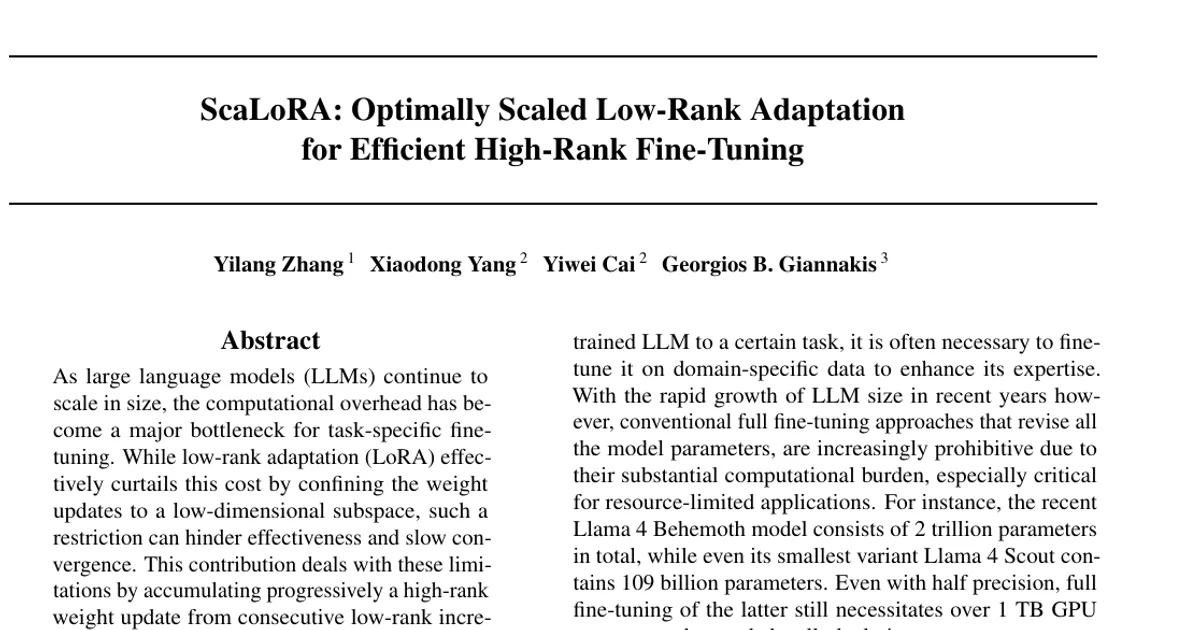
As large language models (LLMs) continue to scale in size, the computational overhead has become a major bottleneck for task-specific fine-tuning. While low-rank adaptation (LoRA) effectively curtails this cost by confining the weight updates to a low-dimensional subspace, such a restriction can hinder effectiveness and slow convergence. This contribution deals with these limitations by accumulating progressively a high-rank weight update from consecutive low-rank increments. Specifically, the per update optimal low-rank matrix is identified to minimize the loss function and closely approximate full fine-tuning. To endow efficient and seamless optimization without restarting, this optimal choice is formed by appropriately scaling the columns of the original low-rank matrix. Rigorous performance guarantees reveal that the optimal scaling can be found analytically. Extensive numerical tests with popular LLMs scaling up to 12 billion parameters demonstrate a consistent performance gain and fast convergence relative to state-of-the-art LoRA variants on diverse tasks including natural language understanding, commonsense reasoning, and mathematical problem solving.