Research
Scaling Automatic Research Agents via World Models
Scaling Automatic Research Agents via World Models Overview Research area: Reinforcement learning for LLM-based automatic research (AutoResearch) agents, model-based RL, and reward-signal correction.
- arXiv
- 2608.12564
- Published
- 2026-08-12
- Authors
- Xiyuan Yang, Sheikh Sarwar, Jingru Cheng, Zhan Shi, Duanshun Li, Huiyuan Chen, Haiyang Zhang, Xing Fan, Chenlei Guo, Jingrui He, Zhenyu Liao
AI summary
Scaling Automatic Research Agents via World ModelsOverview
Research area: Reinforcement learning for LLM-based automatic research (AutoResearch) agents, model-based RL, and reward-signal correction. arXiv:2608.12564v3 [cs.LG], published 2026-08-12 (v3 dated 10 Sep 2026), by authors at the University of Illinois Urbana-Champaign and Amazon.
Technical level: Advanced. The core idea is intuitive, but the paper pairs it with a full convergence analysis (two theorems, an appendix of proofs, and several auxiliary lemmas), so the theoretical sections assume familiarity with policy-gradient RL and optimization bounds.
Scope: The paper diagnoses why environment execution — not model generation — bottlenecks RL training for AutoResearch agents, proposes replacing execution with a learned world model plus two correction mechanisms (WMRL), and validates the method on Kaggle-style AutoResearch benchmarks and on embodied VLA post-training. Project page: https://xiyuanyang45.github.io/WMRL/
What This Paper Is About
An AutoResearch agent is a language model that is given a research question and then formulates an idea, implements an experiment, reads the outcome, and iterates. Post-training these agents with reinforcement learning requires enormous numbers of online trajectories, and each trajectory must be graded by actually running the candidate solution in an isolated sandbox on real GPUs.
The paper points out that the two halves of a trajectory scale very differently. Agent generation is served by batched inference backends such as vLLM and SGLang, so adding trajectories is nearly free; execution cannot be batched this way, since every solution needs its own sandbox and machine time, so its cost grows linearly with trajectory count. Execution therefore becomes the bottleneck. The goal is to replace that expensive signal with a fast, learned surrogate while keeping the final performance of full real-execution RL.
Key Contributions
-
Introducing a world model into the RL loop for AutoResearch agents. A language model with the same backbone as the agent predicts the execution outcome, so the pipeline runs unchanged but the grading step costs a few forward passes instead of a real sandbox run. The paper reports this accelerates training by 3–4 times.
-
Two correction mechanisms for an imperfect world model. Online Debiasing fits a monotone map over world-model/true-score pairs by isotonic regression to remove systematic bias, and Inverse-Variance Denoising fuses the anchored ground-truth gradient stream with the world-model stream using inverse-variance weights to lower update variance. Both are fed by a small "anchor signal" — in practice about 10% of groups graded by real execution.
-
A theoretical account of what the replacement costs. The paper proves that an imperfect world model adds two error terms to the convergence bound (an O(B²) bias term and an O(σ²) variance term), and that the two corrections each reduce one of those terms by a factor larger than one, yielding a strictly improved guarantee.
-
Empirical validation across domains and scales. WMRL is evaluated on MLE-Dojo (test) and DSBench at the 4B and 9B agent scales, and then transferred to LIBERO-Long VLA post-training with MiniVLA-1B, demonstrating the recipe is not specific to AutoResearch.
Main Findings
-
Large compute savings at no performance cost. WMRL cuts the training compute of real-execution GRPO by 3.1 times (4B) and 3.4 times (9B) — 883 to 286 GPU-hours and 1174 to 349 GPU-hours — while scoring higher on every benchmark, which the paper describes as gains of up to 3.1 points.
-
Small post-trained agents beat much larger open-weight agents. On the held-out benchmarks, the post-trained 4B agent (Qwen3.5-4B-Ours) surpasses the 48B Kimi-48B-A3B (28.8 vs. 17.3 on DSBench average; 16.4 vs. 8.1 on MLE-Dojo test average), and the 9B agent (Qwen3.5-9B-Ours) surpasses the 120B Nemotron-120B-A12B (32.8 vs. 31.7 on DSBench average; 21.6 vs. 20.5 on MLE-Dojo test average).
-
The raw world model alone is not enough. Training on pure predicted rewards (Qwen3.5-4B-WM, Qwen3.5-9B-WM) reaches only 12.9 and 16.1 on MLE-Dojo test average, below real-execution GRPO at 15.2 and 18.8 — which is why the correction mechanisms are needed.
-
Ablation shows the two corrections are complementary. Starting from an uncorrected mixture of both reward streams (4B: 13.5 MLE / 25.3 DS; 9B: 16.8 / 29.5), Inverse-Variance Denoising alone adds 0.9 to 1.7 points, Online Debiasing alone adds 2.2 to 2.8 points, and activating both lifts every column by 2.9 to 4.8 points.
-
The debiasing term matters more than the denoising term. Online Debiasing alone contributes a larger share, which the paper matches to its theory: the bias enters the bound at full size while the noise enters damped by the step size.
-
Transfer to embodied VLA post-training. On LIBERO-Long, RL on the sparse success outcome adds 0.9 points over the SFT baseline and RL on the raw Robometer world-model signal adds 1.8 points, while WMRL lifts the overall success rate by 3.8 points (41.2 overall vs. 38.3 for MiniVLA-1B-GRPO), with the largest margin on unseen initial states.
-
Graceful degradation to standard GRPO. When the world model cannot predict a stochastic outcome, the tracked calibration residual stays large, the anchor weight in the fusion rises, and WMRL falls back toward standard GRPO rather than learning from a corrupted signal — a consequence of the measurement rather than a hand-set mixing ratio.
Methodology in Plain English
Step 1: Formalize the standard loop. Each task gives the agent a research question plus data format and output requirements. The policy interacts with an environment (for example an isolated Docker container) over multiple turns, producing a trajectory τ whose final solution receives a score r(τ) in [0, 1]. Training uses GRPO: sample a group of n ≥ 2 trajectories per task, normalize their scores into advantages, and take the policy-gradient step.
Step 2: Swap the environment for a world model. A language model with the same backbone as the agent takes the task context and the agent's solution as input and predicts the execution outcome, from which an estimated score is read off. Because this interface is identical to the real environment's, the entire training pipeline runs unchanged — the parameters now ascend the surrogate objective rather than the true one. The same backbone is used deliberately: sharing it rules out external knowledge, so gains cannot come from implicitly distilling a stronger model. Only the research agent is updated; the world model stays frozen.
Step 3: Characterize the error. The world model's score is written as the true score plus a bias term b(τ) bounded by B and a zero-mean noise term ξ(τ) with standard deviation bounded by σ. The bias shifts the gradient's mean; the noise inflates its variance, specifically V_WM = (1 + c·σ²)·V_E with c = 4M²/(nV_E).
Step 4: Pay the bill with an anchor stream. A small fraction of groups (anchor groups, roughly 10% in practice) are graded by both the world model and real execution, producing score pairs. Online Debiasing fits a monotone map to these pairs by isotonic regression (solved as a least-squares problem) and refits it each step to track drift, then recasts all world-model scores through it. Inverse-Variance Denoising then fuses the two gradient streams with weights inversely proportional to their variances; in practice this reduces to a single rule ρ = 1 + η̂²/η̂²_cal with no free parameter, where η̂² is the mean squared residual between calibrated and true scores on the anchors.
Step 5: Prove and measure. The analysis holds under a regularity assumption (L-smoothness, a gradient-domination condition, and a bounded log-likelihood gradient) with step size γ ≤ 1/(8L). Experiments use identical A100 GPU allocations across runs, Qwen3.5-4B and Qwen3.5-9B as agent backbones, MiniVLA-1B for VLA tasks, Robometer as the VLA world model, avg@8 scoring, and leaderboard percentile as the AutoResearch metric.
Why This Matters
Impact on research. The paper identifies a scaling asymmetry that is easy to overlook: in agentic RL, generation amortizes through batching while execution does not. Naming execution as the binding constraint, rather than model capability or data volume, reframes where efficiency work should go. It also treats learned reward proxies not as a binary good-or-bad choice but as something with a measurable bias and variance whose effects can be written directly into a convergence bound and then cancelled.
Real-world applications:
- Machine-learning engineering agents that explore solution code and build training pipelines on real datasets, as in the Kaggle-style MLE-Dojo and DSBench settings evaluated here.
- Scientific discovery agents, including the chemical synthesis and reaction-condition design agents the paper cites, where proposals are ultimately validated by wet-lab experiments.
- Agentic data science, where agents curate data and run modeling workflows that are expensive to grade by execution.
- Embodied robotics, demonstrated directly on LIBERO-Long, where real robot rollouts are slow but learned simulators are cheap — the paper's VLA experiment shows the same recipe transferring across domains, agent architectures, and reward types (sparse success plus dense progress values).
Industry relevance. The authors are affiliated with Amazon, and the headline numbers are operational: training a 9B research agent drops from 1174 to 349 GPU-hours under the same A100 allocation. The paper also argues that model scale alone cannot replace post-training, since its 4B and 9B post-trained agents outperform off-the-shelf 48B and 120B open-weight agents on the held-out benchmarks.
Future Directions
- Widening the anchor budget. The paper fixes anchor groups at roughly 10% and proves that this marginal amount of real execution is sufficient; whether the same corrections hold at much smaller fractions, or how the optimal fraction varies with world-model quality, is not reported.
- Beyond the tested world models and backbones. The world model is instantiated with the same backbone as the agent, and the VLA transfer uses an off-the-shelf VLM (Robometer). How WMRL behaves with a world model that is much weaker than the agent, or one trained separately on execution logs, remains open.
- Determining the boundaries of transfer. The paper states the construction requires only that rewards be expensive to execute yet predictable from the artifacts the agent produces, with a small stream of ground truth available for anchoring. Verifying which further domains satisfy that condition — software engineering agents on real repositories are cited as sharing the execution-driven recipe but are not tested here — is a natural next step.
- Tightening the theory-to-practice gap. The bounds involve constants such as T₀ and the conversion constant c that are given in the appendix; the paper notes the remaining higher-order excess of its variance-ratio estimate "measures a few percent at most in our runs," which suggests room for tighter estimators.
Target Audience
This paper is most useful to researchers and engineers working on agentic RL systems, RL post-training of LLM agents, and model-based RL — particularly those whose training pipelines are bounded by environment
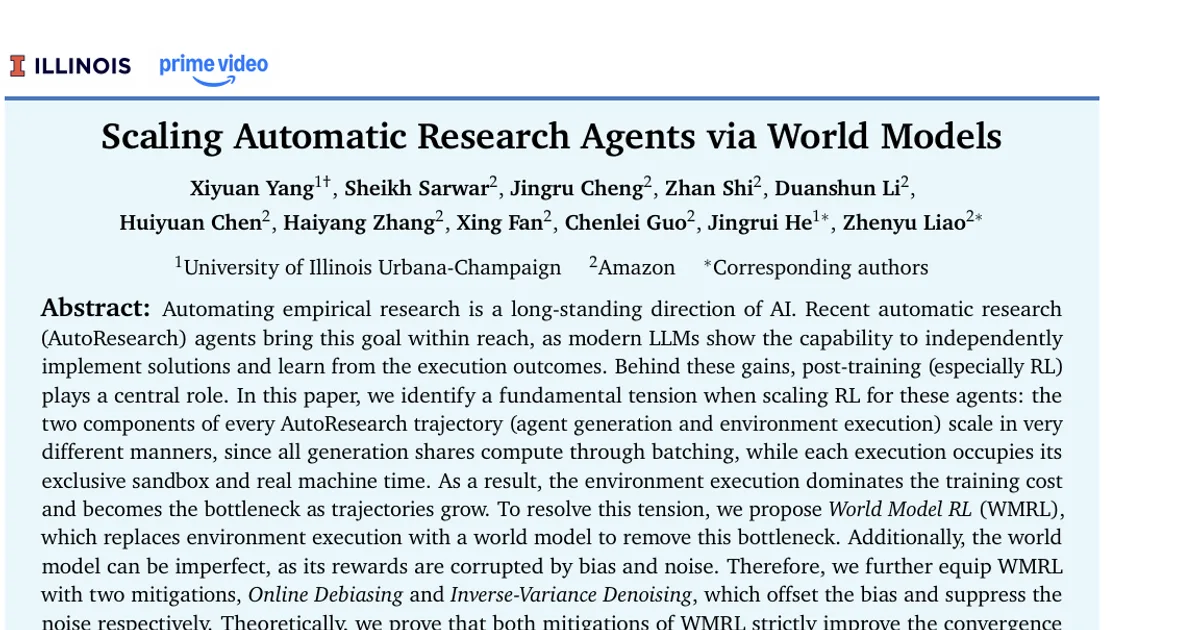
Authors’ abstract
Automating empirical research is a long-standing direction of AI. Recent automatic research (AutoResearch) agents bring this goal within reach, as modern LLMs show the capability to independently implement solutions and learn from the execution outcomes. Behind these gains, post-training (especially RL) plays a central role. In this paper, we identify a fundamental tension when scaling RL for these agents: the two components of every AutoResearch trajectory (agent generation and environment execution) scale in very different manners, since all generation shares compute through batching, while each execution occupies its exclusive sandbox and real machine time. As a result, the environment execution dominates the training cost and becomes the bottleneck as trajectories grow. To resolve this tension, we propose World Model RL (WMRL), which replaces environment execution with a world model to remove this bottleneck. Additionally, the world model can be imperfect, as its rewards are corrupted by bias and noise. Therefore, we further equip WMRL with two mitigations, Online Debiasing and Inverse-Variance Denoising, which offset the bias and suppress the noise respectively. Theoretically, we prove that both mitigations of WMRL strictly improve the convergence guarantee. Empirically, WMRL accelerates training by 3-4x on various tasks at different agent scales, while exceeding the performance of standard RL baselines. Moreover, our post-trained 4B and 9B agents outperform much larger open-weight agents of 48B and 120B on held-out benchmarks. Beyond AutoResearch, WMRL also transfers to post-training embodied VLA policies, which demonstrates the generalizability of our method.