Research
ScaleFree: Dynamic KDE for Multiscale Point Cloud Exploration in VR
Overview Research area: Human-Computer Interaction / immersive analytics — specifically GPU-accelerated density estimation for multiscale point cloud exploration in virtual reality. Technical level: A
- arXiv
- 2601.20758
- Published
- 2026-01-28
- Authors
- Lixiang Zhao, Fuqi Xie, Tobias Isenberg, Hai-Ning Liang, Lingyun Yu
AI summary
Overview
Research area: Human-Computer Interaction / immersive analytics — specifically GPU-accelerated density estimation for multiscale point cloud exploration in virtual reality.
Technical level: Advanced (combines GPU compute-kernel design, adaptive kernel density estimation mathematics, and VR interaction design).
Scope: The paper presents ScaleFree, a GPU-parallel adaptive kernel density estimation (KDE) pipeline that recomputes point cloud density fields on the fly so users can select, navigate, and explore massive multiscale datasets in VR without relying on precomputed density fields.
What This Paper Is About
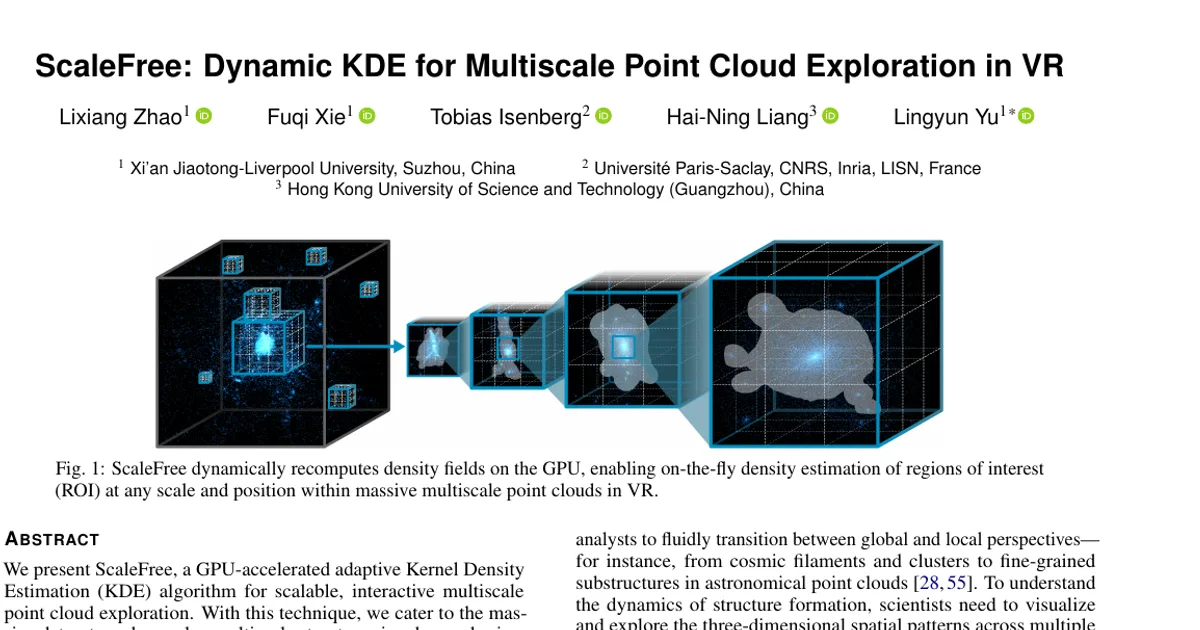
Large scientific simulations such as cosmological models produce billions of particles whose meaningful structures appear at wildly different scales. VR is well suited to exploring 3D spatial structure, but keeping a density field usable across scales is hard: precomputed density fields lock the interaction to a resolution chosen ahead of time and hide fine-scale detail, while computing density dynamically is normally too slow for real-time VR rendering. ScaleFree addresses this by computing adaptive density fields on the GPU fast enough to be recalculated whenever the user shifts focus or scale.
Key Contributions
-
Adaptive and smooth scale transitions: A dynamic KDE method that supports continuous movement across scales without disruptive visual artefacts or noticeable delay, demonstrated in both a selection scenario and a navigation scenario.
-
Stable viewpoint-driven exploration: Support for smooth, orientation-preserving transitions between overview and localized perspectives across scales when exploring complex datasets, demonstrated in the navigation scenario.
-
Fast and responsive computation: A GPU-parallel KDE implementation (pilot density estimation, adaptive smoothing length, and final density estimation kernels) that improves selection accuracy and efficiency under varying scales, validated through performance experiments and a user study.
-
Empirical validation of adaptive density estimation: A multi-layered evaluation combining a GPU-vs-CPU performance comparison with a controlled user study of 24 participants comparing three selection techniques — precomputed single-resolution density fields (PS), precomputed multi-resolution mipmap density fields (PM), and the dynamic ScaleFree approach.
Main Findings
-
GPU speedups are substantial: Through performance experiments, ScaleFree with the GPU-parallel implementation achieves orders-of-magnitude speedups over sequential and multi-core CPU baselines. (The paper content provided does not report exact timing or frame-rate figures.)
-
Complexity reduction via spatial indexing: Using a k-d tree for range queries reduces the KDE cost from O(MN) to O(M√N) for M nodes and N particles, with k-d tree search complexity of O(√N + K) where K is the number of neighbors returned.
-
Dynamic density fields beat precomputed ones for selection: In the controlled experiment, selections made with ScaleFree were faster and more accurate than those using precomputed density fields (both the single-resolution PS and mipmap PM variants).
-
Lower workload and higher preference: Participants reported lower workload and expressed a stronger preference for ScaleFree when conducting multiscale exploration tasks in VR.
-
Gather beats scatter: The pilot density kernel uses a gather approach (one thread per grid node collecting neighboring particles) rather than a scatter approach, avoiding costly atomic operations and improving performance and scalability for large particle datasets.
-
Hierarchical reduction reduces memory traffic: The adaptive smoothing length kernel uses a hierarchical computational method (HCM) with shared-memory parallel reduction within each thread group, writing per-group averages to a global
groupAveDenarray of N/ASL_tx entries, thereby reducing costly global memory accesses.
Methodology in Plain English
The pipeline follows a modified Breiman kernel density estimation (MBE) scheme with a finite-support adaptive Epanechnikov kernel. Each particle is treated as spreading its influence over a small ellipsoidal region, and summing these influences produces a smooth continuous density field instead of a set of discrete points.
The workflow has three stages:
-
Preprocessing on the CPU. The dataset or region of interest is enclosed in a bounding box B and discretized into a uniform grid (for example 128³ grid nodes). An initial smoothing length ℓ_k is computed per axis from the 80th and 20th percentiles of particle coordinates divided by log N. A k-d tree spatial index is built to accelerate neighborhood queries, and the k-d tree, smoothing length, particle positions, grid node positions, grid resolution, and node spacing are uploaded to GPU global memory.
-
Three dispatched compute kernels. The pilot density estimation (PDE) kernel assigns one thread per grid node; each thread performs a spherical range query on the k-d tree with radius equal to the largest kernel semi-axis, accumulates Epanechnikov contributions from the returned neighbors, and writes a pilot density. The adaptive smoothing length (ASL) kernel assigns one thread per particle; each thread trilinearly interpolates the pilot density at its particle position, the group cooperatively reduces these values in shared memory to get an average, and each particle's smoothing length is then rescaled by (aveDen/pDen)^(1/3), capped at 5·s_k where s_k is the node spacing. The final density estimation (FDE) kernel recomputes the density field at all grid nodes using the per-particle adaptive smoothing lengths.
-
Evaluation in two parts. First, performance experiments compare the GPU implementation against sequential and multi-core CPU baselines to establish real-time feasibility. Second, two data exploration tasks — adaptive selection and progressive navigation — are demonstrated, followed by a controlled user study with 24 participants comparing PS, PM, and ScaleFree selection techniques on accuracy, efficiency, and workload.
Why This Matters
Impact on research: Prior density-based selection techniques for point cloud exploration focused on the selection interaction itself and relied on precomputed, single-scale density fields, which constrained selection accuracy to an a priori resolution and left finer-scale structures unrepresented. ScaleFree shows that adaptive KDE is fast enough to be recomputed during interaction, which reframes density fields from a static preprocessing artefact into a live, viewpoint-responsive component of immersive analytics. This matters especially in VR, where navigation, selection, and scale transitions are tightly coupled with head and body movement and where stereoscopic rendering imposes strict real-time constraints.
Real-world applications:
- Cosmological and astronomical analysis: Exploring simulation outputs containing billions of particles, moving between cosmic filaments and clusters and fine-grained substructures.
- Additive manufacturing: Inspecting objects with dense, homogeneous internal structures where hierarchical scale levels are not explicitly available.
- Scientific visualization generally: Feature detection, region-of-interest selection, and spatial selection in any large unstructured 3D point cloud.
- VR/AR/MR analytics tools: Any head-mounted-display workflow that needs responsive density-based selection or progressive refinement of dense spatial data (the paper's keywords include multiscale visualization, interactive data selection, interactive data navigation, and VR/AR/MR).
Industry relevance: The technique targets a concrete engineering bottleneck — making adaptive kernel density estimation run inside a real-time rendering budget on commodity GPUs. The HLSL-based compute-kernel design, k-d tree queries, and thread-group reduction pattern are directly transferable to commercial visualization, digital-twin, and engineering-analysis software that must serve interactive frame rates over large point datasets.
Future Directions
-
Extending adaptive transitions beyond the demonstrated scenarios: The paper demonstrates ScaleFree through adaptive selection and progressive navigation; generalizing it to other interaction modes in unstructured data with no predefined hierarchy remains open.
-
Handling datasets without meaningful hierarchies: The authors note that label-based and hierarchical approaches depend on well-defined targets and hierarchical algorithms, which astronomical point clouds and similar unstructured data often lack — flexible navigation and interaction at arbitrary scales is still a live problem.
-
Further performance headroom: The reported comparison is against sequential and multi-core CPU baselines only. The exact speedup figures, frame rates, and scaling behavior at the largest tested dataset sizes are not reported in the provided content, leaving room for deeper characterization against other GPU baselines.
-
Broadening empirical validation: The user study covered 24 participants and three selection techniques (PS, PM, ScaleFree). Whether these workload and preference effects generalize across other tasks, datasets, and head-mounted display hardware is an open question.
Target Audience
This paper is most valuable to researchers and practitioners at the intersection of immersive analytics, scientific visualization, and high-performance GPU computing — particularly those working with large unstructured point clouds such as cosmological simulations. It is also relevant to VR interaction designers interested in selection and navigation techniques for multiscale data, and to graphics/compute engineers looking for a concrete GPU-parallel KDE pipeline (gather-based accumulation, k-d tree range queries, shared-memory parallel reduction) that fits a real-time rendering budget. Readers need some background in density estimation and GPU programming to follow the algorithmic details, though the motivation and study results are accessible to HCI researchers generally.
Authors’ abstract
We present ScaleFree, a GPU-accelerated adaptive Kernel Density Estimation (KDE) algorithm for scalable, interactive multiscale point cloud exploration. With this technique, we cater to the massive datasets and complex multiscale structures in advanced scientific computing, such as cosmological simulations with billions of particles. Effective exploration of such data requires a full 3D understanding of spatial structures, a capability for which immersive environments such as VR are particularly well suited. However, simultaneously supporting global multiscale context and fine-grained local detail remains a significant challenge. A key difficulty lies in dynamically generating continuous density fields from point clouds to facilitate the seamless scale transitions: while KDE is widely used, precomputed fields restrict the accuracy of interaction and omit fine-scale structures, while dynamic computation is often too costly for real-time VR interaction. We address this challenge by leveraging GPU acceleration with k-d-tree-based spatial queries and parallel reduction within a thread group for on-the-fly density estimation. With this approach, we can recalculate scalar fields dynamically as users shift their focus across scales. We demonstrate the benefits of adaptive density estimation through two data exploration tasks: adaptive selection and progressive navigation. Through performance experiments, we demonstrate that ScaleFree with GPU-parallel implementation achieves orders-of-magnitude speedups over sequential and multi-core CPU baselines. In a controlled experiment, we further confirm that our adaptive selection technique improves accuracy and efficiency in multiscale selection tasks.