Research
Sample-Optimal Estimation of the Fréchet Inception Distance
Sample-Optimal Estimation of the Fréchet Inception Distance Overview Research area: Statistical machine learning and generative model evaluation, specifically the sample complexity of estimating the F
- arXiv
- 2610.07114
- Published
- 2026-10-05
- Authors
- Ziyun Chen, Jerry Li, Kevin Tian, Yusong Zhu
AI summary
Sample-Optimal Estimation of the Fréchet Inception DistanceOverview
Research area: Statistical machine learning and generative model evaluation, specifically the sample complexity of estimating the Fréchet Inception Distance (FID) between high-dimensional Gaussian distributions.
Technical level: Advanced. The paper is a theoretical statistics and algorithm design contribution with non-asymptotic minimax bounds, matrix analysis (resolvent expansions, Wishart bounds, multilinear forms), and U-statistics-inspired debiasing, accompanied by an empirical validation section.
Scope: The paper characterizes the finite-sample bias, variance, and optimal sample complexity of FID estimation when one Gaussian distribution is known, and introduces two new estimators (FID-VALE and FID-RTD) that improve on the standard empirical plug-in estimator and on the prior FID-infinity estimator.
What This Paper Is About
FID is the standard metric for judging the quality of generative image models, but it is computed from a finite set of samples and its usual plug-in estimator is badly biased in high dimensions. The paper asks a precise question: how many samples are necessary and sufficient to estimate FID between two Gaussian image-embedding distributions to a given additive error, when one distribution's statistics are known. In answering this, the authors prove matching upper and lower bounds for existing estimators and design new, provably sample-optimal estimators.
Key Contributions
-
Tight finite-sample rates for the empirical plug-in estimator. The authors establish a Θ(d²/n) bias bound and a Θ(d/n + d²/n²) variance bound, showing the plug-in estimator needs roughly d² samples to reach constant error. These come with matching lower bounds.
-
A generalization of FID-infinity to arbitrary extrapolation order, called FID-VALE. They prove tight bias of Θ(d^{k+2}/n^{k+1}) and variance of Θ(d/n + d²/n²) for any order-k extrapolation in their framework, and show a variance-aware choice of extrapolation weights matters in practice.
-
A new sample-optimal estimator, Relative Taylor Debiasing (FID-RTD). Using debiasing ideas inspired by U-statistics, RTD achieves O(d/ε²) sample complexity, which the authors prove is optimal via an information-theoretic lower bound.
-
Empirical validation on synthetic Gaussians and ImageNet. The experiments confirm the predicted residual bias, show RTD attains the lowest mean estimation error at the standard 50K sample budget, and show that FID-VALE at order 2 uses only 10K samples to match FID-infinity at 50K samples.
Main Findings
-
The plug-in estimator's problem is bias, not variance. Its variance is approximately d/n, which already matches the lower bound, but its worst-case bias is approximately d²/n, so convergence requires n ≳ d² samples (Theorem 1). The bias has an explicit expansion in powers of 1/n, with a leading coefficient a₁/n plus higher-order terms.
-
FID-infinity cuts the requirement to O(d^{3/2}) samples for constant error, but at a cost: for fixed N, its error scales as Θ(d³) with the dimension, versus Θ(d²) for the plug-in estimator (Corollary 1).
-
FID-VALE generalizes this tradeoff. For any integer k ≥ 1, variance-aware order-k extrapolation reaches constant error with Θ(d^{(k+2)/(k+1)}) samples (Theorem 2). The bias expansion is truncated at order k, with weights chosen by a variance-aware regression that depends only on the relative subsample sizes and can be precomputed.
-
FID-RTD is provably optimal. It attains n = Θ(dε^{-2}) sample complexity (Theorem 3), matching the information-theoretic lower bound in Proposition 1: for all d ≥ 1 and ε ∈ (0, 1/8), no estimator solves the problem when n < d/(128ε²).
-
RTD uses O(d) pilot samples to get a rough spectral approximation, truncates the expansion at degree L = Θ(log(d/ε)), and estimates each high-order term using independent sample batches to form unbiased estimators of the symmetric multilinear forms. Runtime is O(d^{ω+γ}/ε^{2+γ}) for any fixed γ > 0, where ω < 2.373 is the matrix multiplication exponent.
-
A convenient tensor structure makes RTD computable. The relevant multilinear form can be evaluated on repeated input H^{⊗k} in O(k²d^ω) time (Lemma 12), which avoids the super-polynomial cost of writing down the full order-k tensor.
-
The lower bound is not just asymptotic. Proposition 1 gives a finite-sample lower bound over Model 1 and Assumption 1, so RTD's rate cannot be improved in general.
-
On ImageNet with Inception embeddings, RTD achieves the lowest mean estimation error at the standard 50K sample budget, and the second-order variance-aware extrapolation estimator (VALE₂) uses only 10K samples to achieve accuracy comparable to FID-infinity at 50K samples.
-
The d³ factor in FID-infinity's rate is visible experimentally. In synthetic Gaussian experiments with Haar log-uniform covariances at N = 50,000, RTD shows substantially milder dimension dependence than FID-infinity. However, FID-VALE at order 2 performs comparably to RTD in both the Gaussian and real-data examples, despite its theoretically worse convergence rate.
-
Real-data evaluation setup. Seven generator checkpoints were evaluated with three embeddings (Inception, DINOv2, and CLIP ViT-L/14), at n ∈ {10K, 20K, 30K, 40K, 50K} samples against proxies computed with n = 300K samples. In some settings the plug-in proxy at 300K samples remained noticeably higher than the debiased estimates, so the authors also compared against FID-infinity and FID-RTD proxies at 300K samples, which agree closely at large n.
-
Conclusion at the standard budget. At 50K samples, either FID-VALE at order k = 2 or FID-RTD achieves the lowest mean error for each embedding and reference proxy (Table 3).
-
A large-dimensional failure example motivates the problem. Prior work ([4]) constructed a 2048-dimensional, exactly Gaussian example in which FID estimates using 50,000 samples consistently give the wrong ordering between distributions.
Methodology in Plain English
The authors reduce FID estimation to a clean parametric problem: one distribution (the reference) has known mean and covariance, the other is Gaussian with unknown mean and covariance, and the goal is to estimate a single number to within additive error ε with constant failure probability. They normalize the problem so covariances are bounded between zero and the identity and the mean gap is at most one.
The technical obstacle is the matrix square root inside the FID formula's Bures-Wasserstein term. The authors handle it by writing the empirical covariance as a perturbation of the true covariance and expanding the square root as an infinite series via a resolvent representation. This turns the estimation error into a linear term in the perturbation plus higher-order corrections, which they can bound using standard facts about Wishart matrices. The same expansion reveals that the plug-in estimator's bias is a clean power series in 1/n, which is what makes debiasing possible.
FID-infinity exploits this by combining estimates computed on different subsample sizes — for instance, taking N samples, splitting into N/3 and 2N/3, and computing twice the large-subsample estimate minus the small-subsample one. The coefficients cancel the 1/n bias term regardless of its unknown value. FID-VALE extends the idea to cancel the first k terms using k+1 or more subsamples, with weights picked by a variance-aware regression rather than arbitrarily.
FID-RTD takes a different route: it directly estimates each higher-order correction term using independent batches of samples, the way U-statistics estimate symmetric functions of independent variables. Because estimating term k requires k independent estimates of the perturbation, RTD reuses batches across levels to avoid a log d factor in sample cost — creating correlation that the authors control with weighted Cauchy-Schwarz arguments. A recursive structure in the matrix square root, combined with the polarization identity, keeps the computation polynomial.
Why This Matters
Impact on research. This is the first work to give tight non-asymptotic lower bounds for FID estimation and to identify the exact sample complexity achieved by an optimal estimator. It closes a gap left by prior work on FID-infinity, which proposed a debiasing heuristic but proved no finite-sample guarantees. It also separates the roles of bias and variance in the plug-in estimator, explaining cleanly why the standard estimator fails in high dimension.
Real-world applications:
- Generative model benchmarking. Anyone comparing image generators at a fixed compute or sample budget can choose an estimator whose error is known to be near-optimal rather than comparing biased numbers.
- Reducing evaluation cost during development. Since VALE₂ matches FID-infinity at 50K using only 10K samples, repeated evaluation during model development can use a fraction of the generated images.
- Embedding-agnostic evaluation pipelines. The estimators are evaluated with Inception, DINOv2, and CLIP ViT-L/14 embeddings, so they apply to evaluation pipelines that have moved away from Inception features.
- Correct ordering of models. The cited 2048-dimensional example shows that biased estimators can reverse the ranking of two generators; debiased estimators reduce that risk.
Industry relevance. FID is a ubiquitous reported metric in generative modeling papers, model cards, and product evaluations. When FID numbers drive decisions about which model to ship or which architecture to scale, systematic finite-sample bias translates into real resource misallocation. An estimator with a proven optimal sample complexity makes reported metrics comparable across labs that use different sample sizes.
Future Directions
- Close the gap between theory and practice for VALE. FID-VALE at order 2 matches or beats RTD empirically but has a worse theoretical rate, so a sharper analysis of variance-aware extrapolation is a natural next step.
- Extend beyond the one-sided, exactly Gaussian model. The paper assumes the reference statistics are known and both distributions are Gaussian; the two-sided model and non-Gaussian embeddings are left open.
- Address the Gaussian assumption directly. Prior work shows Inception feature distributions are multimodal and violate Gaussianity, and that FID can be manipulated; whether these debiasing ideas transfer to kernel-based alternatives such as KID and CMMD is unexplored.
- Reduce RTD's runtime. The current bound of O(d^{ω+γ}/ε^{2+γ}) and the 2^L blowup from the polarization identity suggest room for a faster sample-optimal algorithm.
Target Audience
This paper is most useful to theoretically minded machine learning researchers working on statistical estimation, optimal transport distances, or high-dimensional statistics, and to generative modeling practitioners who need to know how many samples an FID comparison actually requires. It will also interest readers following the U-statistics and higher-order debiasing literature, and engineers maintaining evaluation infrastructure for image generators who want a principled alternative to the plug-in estimator. A background in matrix analysis and non-asymptotic statistics is helpful; the empirical sections are accessible on their own.
Authors’ abstract
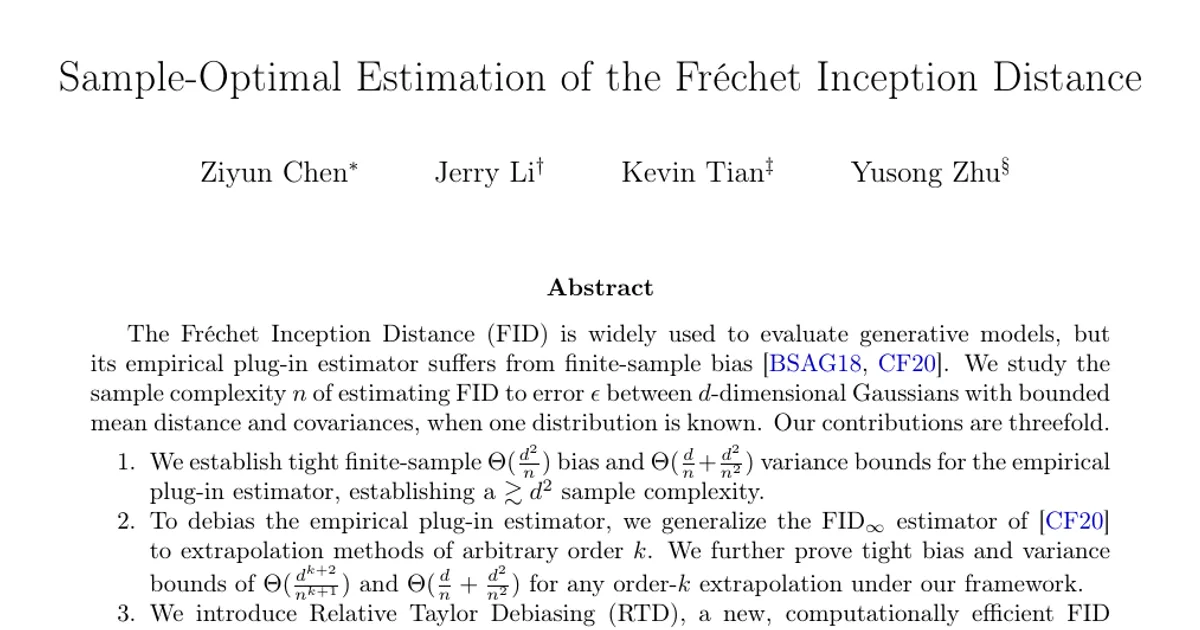
The Fréchet Inception Distance (FID) is widely used to evaluate generative models, but its empirical plug-in estimator suffers from finite-sample bias [BSAG18, CF20]. We study the sample complexity $n$ of estimating FID to error $ε$ between $d$-dimensional Gaussians with bounded mean distance and covariances, when one distribution is known. Our contributions are threefold. (1) We establish tight finite-sample $Θ(\frac{d^2}{n})$ bias and $Θ(\frac{d}{n} + \frac {d^2} {n^2})$ variance bounds for the empirical plug-in estimator, establishing a $\gtrsim d^2$ sample complexity. (2) To debias the empirical plug-in estimator, we generalize the ${\rm FID}_\infty$ estimator of [CF20] to extrapolation methods of arbitrary order $k$. We further prove tight bias and variance bounds of $Θ(\frac{d^{k + 2}}{n^{k + 1}})$ and $Θ(\frac d n + \frac{d^2}{n^2})$ for any order-$k$ extrapolation under our framework. (3) We introduce Relative Taylor Debiasing (RTD), a new, computationally efficient FID estimation algorithm using debiasing techniques inspired by U-statistics. We show that RTD achieves an $O(\frac d {ε^2})$ sample complexity, and prove that this is optimal. We provide a complementary empirical evaluation of our new estimators. Our experiments on synthetic Gaussians validate the predicted residual bias and support the tightness of our bounds. On ImageNet with Inception embeddings, RTD achieves the lowest mean estimation error at the standard 50K sample budget, while our second-order variance-aware extrapolation estimator (VALE$_2$) uses only 10K samples to achieve accuracy comparable to FID$_\infty$ at 50K samples.