Research
Robustness of Mixtures of Experts to Feature Noise
Overview Research area: Machine learning theory — specifically the theoretical analysis of Mixture-of-Experts (MoE) architectures, activation sparsity, and robustness to noisy features (related to err
- arXiv
- 2601.14792
- Published
- 2026-01-21
- Authors
- Dong Sun, Rahul Nittala, Rebekka Burkholz
AI summary
Overview
Research area: Machine learning theory — specifically the theoretical analysis of Mixture-of-Experts (MoE) architectures, activation sparsity, and robustness to noisy features (related to errors-in-variables regression).
Technical level: Advanced. The paper is a theoretical contribution built on Bayesian linear regression, asymptotic random matrix theory (singular value limits, aspect ratios), and gradient-descent convergence-rate analysis. The plain-language intuitions are accessible, but the formal results and proofs are not beginner material.
Scope in one sentence: The paper proves, under a strict parameter-matched ("iso-parameter") comparison, that a sparse, expert-routed estimator can generalize better, converge faster, and be more robust to feature noise than an equally sized dense estimator, and it supports those claims with synthetic experiments, MiniMind language-model training runs, and linear probing on frozen T5-small and Llama-2-7B activations.
What This Paper Is About
MoE models such as Mixtral 8×7B can match or beat much larger dense models while activating only a fraction of their parameters, but existing theory explains this mostly by pointing to extra total capacity — an unfair comparison. This paper asks a sharper question: when the MoE and the dense model have exactly the same total number of parameters, and the input features contain a latent block-diagonal (modular) structure but arrive corrupted by feature noise, why would the MoE still win? The authors' answer is that sparse expert activation behaves as a noise filter: by routing each input to a small relevant block, the MoE suppresses noise from irrelevant feature blocks that the dense model is forced to integrate over.
Key Contributions
-
A new mechanism for MoE advantage: The paper identifies robustness to feature noise — not just expressiveness or raw capacity — as a reason MoEs can outperform dense models of matched total parameter count.
-
Beyond generalization error: In contrast to prior MoE theory, the analysis covers robustness to certain input perturbations (Theorems 4.3 and 4.4), faster training convergence under gradient descent (Theorem 4.7), and a hypothesis about sample complexity of excess risk.
-
An iso-parameter, modular-data framework: The authors build a linear model with a block-diagonal design matrix, feature noise E with entries drawn from N(0, σ²), and derive Bayes optimal dense and sparse estimators whose generalization errors are directly comparable.
-
Empirical instantiation via linear probing: MoEs are interpreted as a set of routed linear predictors, and MoE-based probes on frozen LLM activations are shown to be more robust to feature noise than global linear baselines (Lasso, Ridge, Elastic Net).
Main Findings
-
Sparse estimators generalize at least as well as dense ones: Theorem 4.2 gives closed-form generalization errors for the Bayes optimal dense and sparse estimators (Eq. 4). Because 0 < p_i ≤ 1 and Σ_i is positive semi-definite, each term in the sparse error is bounded by the corresponding dense term, giving R(β^Bayes_Sparse) ≤ R(β^Bayes_Dense).
-
Robustness holds when routing survives perturbation: Theorem 4.3 models input perturbations as Gaussian noise with variance σ_o². Sparse estimators can satisfy R_Sparse(σ_o²) ≤ R_Dense(σ_o²), particularly when σ_o² > σ². A stated sufficient condition is λ_min(Σ_i) > 4σ² (high per-expert signal-to-noise ratio) together with σ_o² > σ².
-
Mis-routing can reverse the advantage: Theorem 4.4 analyzes a perturbation η·x_j (with η > 1) that pushes an input to the wrong expert. Remark 4.5 states that in certain regimes — for example when p_r = 0 for all r ≠ i, j — the dense estimator can handle such perturbations better than a sparse estimator forced to use a highly specialized but incorrect expert. The authors frame this as a trade-off: specialization helps when routing is correct and hurts when it fails badly.
-
Routing can be treated as a tractable clustering/classification problem: Theorem 4.1 (informal) states that a Quadratic Discriminant Analysis (QDA) router achieves an excess risk below ε with high probability for n ≥ O(poly(d, log(1/δ))) samples, decoupling routing accuracy from expert performance. The formal statement and proof are in Appendix A.7.
-
Sparse estimators converge faster in gradient descent: Under Assumption 4.6 (each X_i is n/k × d/k, aspect ratio c = lim d/n > 1, singular values converge, and λ_ij > √c·σ²), Theorem 4.7 gives per-iteration error-reduction factors ρ_Sparse,i and ρ_Dense (Eq. 5). Typically ρ_Sparse,i ≤ ρ_Dense, so sparse estimators converge faster; at most one sparse estimator matches the dense rate.
-
Sample efficiency favors sparsity, with the same decay order: On the synthetic modular dataset, both estimators' excess risk decays approximately as O(n⁻²), but the sparse estimator has a much more favorable constant factor and reaches low risk considerably faster. The authors note this same-order decay is precisely why a clean rate-based theoretical separation is difficult, and offer a bias-variance intuition instead: a sparse expert's ground truth lies in an s-dimensional subspace (s < d), so the dense estimator incurs larger bias from the d − s extraneous dimensions and larger variance from noise in the full d-dimensional space.
-
Modular structure appears in real LLM activations: Figure 1 shows block-diagonal structure in the input activations to the up_proj layer within the MLP block of layer-0 of Llama-2-7B, revealed with TEAL (Liu et al., 2025) under uniform magnitude pruning, for WikiText2 tokens. Panels show activation percentiles after pruning at 0%, 40%, and 70% uniform activation sparsity thresholds; percentiles are plotted because activation distributions are skewed by outlier activations.
-
From-scratch MoE training shows comparable or better convergence: Figure 2 reports training a Dense Baseline and a MoE from scratch with the MiniMind architecture (Gong, 2024). The MoE uses a "Shared Expert + Routed Experts" design with 4 routed experts and 1 shared expert, each token selecting K = 2 routed experts, and each expert FFN having intermediate dimension 1024. The dense FFN's intermediate dimension is set to 5 × 1024 = 5120 so total FFN parameters match exactly. Despite having fewer active parameters per forward pass (∼60% of the dense model), the MoE's training-loss trajectory closely tracks and often surpasses the dense baseline's convergence speed, particularly in early phases.
-
Better sample efficiency in language-model pretraining: Figure 3 shows the MoE model reaching lower validation loss faster (i.e., with fewer training samples) than the Dense Baseline under the same controlled-total-capacity configuration. Implementation details are in Appendix B.4.
-
Non-linear settings show the same pattern: Appendix B.5 reports controlled experiments on a synthetic dataset with a non-linear, two-layer ReLU MoE network, for both regression and classification under noisy conditions. The paper states results in Table 8 and Table 9 consistently show non-linear MoEs are more robust to noise than dense counterparts.
-
Linear probing results (partially reported): The paper evaluates MoE-based linear probes against dense baselines (Lasso, Ridge, Elastic Net) on T5-small activations to test whether MoE probes are more robust to feature noise. The specific numerical results are not available in the provided text, which is truncated mid-sentence within Section 5.
Methodology in Plain English
The authors deliberately start with a simplified linear model rather than a full transformer, because a linear setting makes the noise-filtering mechanism analytically tractable while still connecting to real practice through the linear representation hypothesis and linear probing of frozen LLMs.
The data model is a block-diagonal design: a ground-truth parameter vector β* is split into k blocks corresponding to k experts, and the noiseless design matrix X is block-diagonal, so each block of features maps to its own expert. In practice only a noisy version X̄ = X + E is observed, where each noise entry is Gaussian with variance σ². This noise is explicitly interpreted as a proxy for interference or blurred modularity in real network activations.
Two estimators are then compared. The "dense estimator" uses the entire noisy matrix X̄ as a single least-squares/minimum-norm problem, mirroring one dense model trying to learn all specializations at once. The "sparse" (MoE-like) estimator assumes a perfect gate and solves a separate regression per expert block, mirroring specialized experts.
Because directly analyzing minimum-norm estimators under noise is hard, the authors first analyze Bayes optimal counterparts — assuming access to the data distribution and infinite data — to characterize performance limits, then separately show via gradient-descent analysis that the sparse estimator reaches the optimum faster. A separate theorem argues that the router itself is easy to learn when the modular structure is geometrically separated, so the analysis can decouple routing from expert quality.
Empirically, they (a) visualize block structure in Llama-2-7B layer-0 up_proj activations on WikiText2 using TEAL pruning, (b) train MiniMind dense and MoE models from scratch at matched total FFN parameter count, (c) run a synthetic modular-data study with curve fitting of excess-risk decay, (d) test non-linear two-layer ReLU MoE versus dense networks, and (e) run MoE-based linear probing versus Lasso, Ridge, and Elastic Net on frozen T5-small activations.
Why This Matters
Impact on research. The paper shifts the theoretical conversation about MoEs away from "more parameters means more capacity" toward a concrete architectural property: activation sparsity filters out-of-block noise. It also gives a theoretical rationale for dense-to-sparse conversion methods such as MoEfication (Zhang et al., 2022) and LLaMA-MoE (Zhu et al., 2024), and it connects MoE theory to the errors-in-variables regression literature. A notable secondary message is that fast convergence and identical asymptotic excess-risk decay orders can obscure a real, constant-factor advantage — a caution for how robustness comparisons are framed.
Real-world applications (implications drawn from the paper's results):
- Serving large language models where per-token inference cost matters, since the MoE in Figure 2 uses roughly 60% of the dense model's active parameters per forward pass while matching or exceeding its convergence trajectory.
- Pretraining efficiency: the Figure 3 result suggests a matched-capacity MoE can reach a target validation loss with fewer training samples, which matters for compute budgets.
- Interpretability and monitoring of frozen LLM representations, via MoE-based linear probes that are more robust to noisy activations than global linear probes.
- Dense-to-sparse conversion pipelines that prune dense LLMs into expert-structured models — the theory predicts when this conversion should pay off (high per-expert signal-to-noise, i.e., λ_min(Σ_i) > 4σ²) and when it may backfire (frequent mis-routing).
Industry relevance. Organizations deploying MoE architectures such as the cited Mixtral 8×7B, or converting dense checkpoints into expert-sparse ones, get a principled account of why sparse routing can be worth the engineering complexity — and an explicit caveat that the benefit depends on router reliability and on how noisy the internal features actually are.
Future Directions
-
Rigorous sample-complexity theory. The paper explicitly leaves the sample-complexity claim as a hypothesis: both estimators decay at roughly O(n⁻²) on the synthetic task, so standard rate-comparison arguments do not apply, and the authors argue only from bias-variance intuition. Deriving a formal constant-factor separation is an open problem they raise.
-
Routing reliability under realistic noise. Theorem 4.4 and Remark 4.5 show mis-routing can flip the advantage. Quantifying how much perturbation a practical router tolerates before robustness gains disappear — and how that interacts with expert granularity k — is a natural follow-up.
-
From the linear model to genuinely non-linear, joint training. The paper's main theory is linear, with non-linear evidence confined to Appendix B.5 and a discussion in Section 4.1 that invokes prior work (Liao and Kyrillidis, 2026) suggesting experts' recovery leads the router's. Extending the formal analysis to jointly trained, non-ReLU MoEs remains open.
-
Broader activation-sparsity instantiations. The paper positions itself relative to CATS and TEAL, which induce or exploit sparsity in modern SwiGLU/GeGLU models. Testing whether the predicted noise-filtering advantage holds across different LLM families and activation functions, and across probe tasks beyond those in Section 5/Appendix B.3, is a direct next step.
Target Audience
Machine learning theorists and MoE architecture researchers who want a parameter-matched reason for MoE advantages beyond scaling; interpretability and linear-probing practitioners working with frozen LLM activations; and engineers involved in sparse-model deployment or dense-to-sparse conversion who need to know when expert specialization helps — and when mis-routing makes it a liability. Readers who want practical hyperparameter guidance rather than mechanism-level theory will find the paper's specific numeric results depend on details deferred to its appendices, and the Section 5 experiment numbers are not available in the portion of the text provided here.
Authors’ abstract
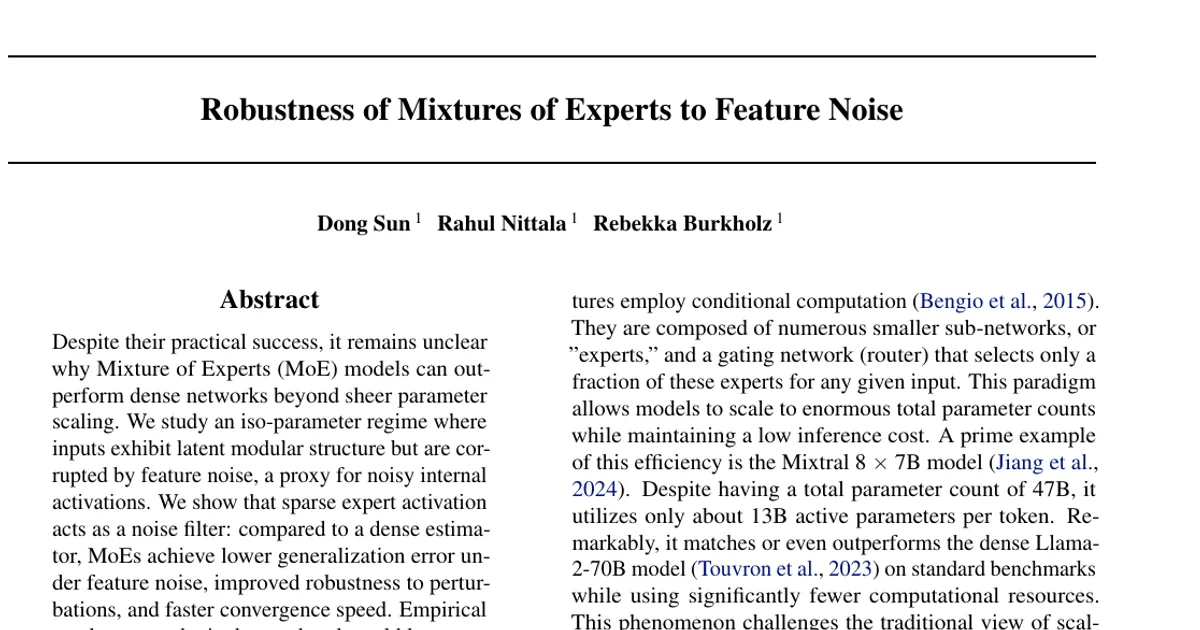
Despite their practical success, it remains unclear why Mixture of Experts (MoE) models can outperform dense networks beyond sheer parameter scaling. We study an iso-parameter regime where inputs exhibit latent modular structure but are corrupted by feature noise, a proxy for noisy internal activations. We show that sparse expert activation acts as a noise filter: compared to a dense estimator, MoEs achieve lower generalization error under feature noise, improved robustness to perturbations, and faster convergence speed. Empirical results on synthetic data and real-world language tasks corroborate the theoretical insights, demonstrating consistent robustness and efficiency gains from sparse modular computation.