Research
Robust Evacuation for Multi-Drone Failure in Drone Light Shows
Overview Research area: Robotics / multi-agent systems safety — specifically autonomous drone light shows, trajectory prediction with deep learning, and collision-avoidance motion planning. Technical
- arXiv
- 2601.06728
- Published
- 2026-01-11
- Authors
- Minhyuk Park, Aloysius K. Mok, Tsz-Chiu Au
AI summary
Overview
Research area: Robotics / multi-agent systems safety — specifically autonomous drone light shows, trajectory prediction with deep learning, and collision-avoidance motion planning.
Technical level: Advanced. The paper assumes familiarity with space-time discretization, occupancy grids, rapidly exploring random trees (RRT), directed acyclic graph shortest-path algorithms (Bellman-Ford or topological-sort relaxation), and LSTM-based trajectory forecasting.
One-sentence scope: The paper proposes a "drone parking" algorithm that predicts where failing drones will fall using a Social LSTM with attention, evacuates surviving drones along near-optimal collision-minimizing paths, and then restores the show using hidden LED-off drones.
What This Paper Is About
When multiple drones in a light show fail at once, they can fall from the sky and strike nearby drones, triggering cascading failures that the base station cannot reliably predict or coordinate against — existing autopilot failsafes act on individual drones but do not help the swarm avoid a falling neighbor. The authors address this by treating the airspace as a 3D grid over time, using a learned model to estimate the probability that each grid cell at each time step will be hit by a falling drone, and then routing the surviving drones out of harm's way into a designated "parking space." Once the incident is over, drones that were kept hidden with their LEDs off are sent to fill the gaps so the show can resume.
Key Contributions
-
First formulation of drone evacuation during drone-dropping incidents. The authors state that, to the best of their knowledge, they are the first to consider drone evacuation during drone dropping incidents in the literature.
-
A learned fall-trajectory predictor. They train a Social LSTM model augmented with the attention mechanism from Vemula et al. (2018) to predict the trajectories of falling drones from the sequence of poses observed in the few time steps before the incident, without labeling which of three failure modes (dropping, landing, returning to the launch site) occurred.
-
A probabilistic parking algorithm. They define the parking problem and give an optimization version (maximizing a weighted sum of collision-free probabilities), then solve it by building an RRT-based random graph, weighting each edge by the negative log collision-free probability of the tiles it occupies, and extracting a shortest path to the parking space — yielding a plan whose collision-free probability is the maximum attainable within that graph.
-
A recovery mode using hidden drones. After the incident end time, the system selects a subset of hidden drones near the vacant positions and computes a recovery formation plan so those drones can illuminate their LEDs and take over the missing drones' assigned trajectories, letting the show continue.
Main Findings
-
Evacuation is framed as probability maximization, not just collision avoidance. The cost of an edge from position p1 to p2 is W(p1,p2) = −log(Pr_safe(T_{p1,p2})), so the total path cost satisfies C* = −log(Pr_safe(T_{E*})), and the optimal path's collision-free probability is e^(−C*).
-
Occupancy probabilities combine across fallen drones. Individual per-drone probabilities are merged as Pr(τ) = 1 − ∏_{υ∈V_fallen}(1 − Pr_υ(τ)), and the collision-free probability of a set of tiles is the product of per-tile collision-free probabilities.
-
The training data came from an in-house simulator. Real drone data was used to calibrate the drones' behavior; a drone was instantiated on a typical light-show trajectory, one of three failure modes was randomly triggered, and the resulting fall trajectory was recorded. Failure-mode labels were deliberately not used.
-
The approach is reported to outperform baselines. The authors state that their preliminary experimental results showed the approach outperforms baseline strategies and increases the chance of recovery from multi-drone failures. No quantitative benchmark numbers, dataset sizes, or comparison figures are reported in the provided content.
-
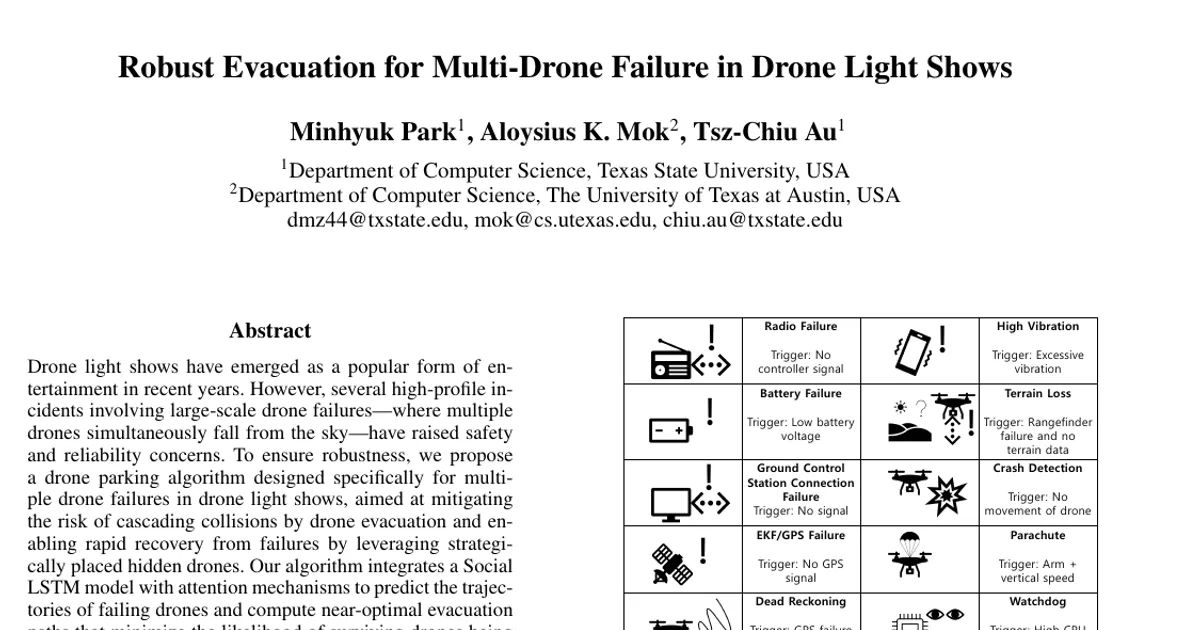
Existing systems are insufficient for simultaneous multi-drone failure. The authors note that autopilots such as Ardupilot and PX4 offer per-drone failure detection and mitigation (for example, GNSS position-loss handling), and Skybrush adds swarm-level features like geofence enforcement, pre-flight trajectory visualization, inter-drone distance monitoring, and maximum velocity constraints — but these provide limited mitigation when multiple drones fail at once.
Methodology in Plain English
The show airspace, called the stage, is divided into a 3D grid of small cubic cells, and time is divided into steps; a cell at a time step is called a tile. A drone "occupies" a set of tiles at any moment depending on where its body is, which lets the authors define collisions precisely: two drones collide at time t if their occupied tile sets overlap.
Before an incident, occupancy probability is simply 1 on the tiles the assigned plans cover and 0 elsewhere. When an incident is reported at time t0, the model takes the failing drone's recent poses and runs N random rollouts (N being a large positive integer) to produce N predicted fall trajectories. Counting how often each tile after t0 is hit and dividing by N gives that drone's occupancy probability. The union of all non-zero-probability tiles across all fallen drones is the hit zone; everything else is the safe zone, and cells whose tiles always lie in the safe zone form the parking space.
For each drone that needs evacuating, the algorithm grows a space-filling random tree (RRT) outward from its current position toward the parking space, where edges connect positions reachable in one time step and are weighted by how likely that move is to avoid the predicted fall zone. Because the graph is a directed acyclic graph, a shortest path can be found with Bellman-Ford or with topological sorting plus single-pass relaxation. The path with the lowest accumulated cost — equivalently, the highest collision-free probability — is chosen, the drones' individual plans are combined into a collision-free formation using an existing collision-avoidance strategy, and the drones hover in the parking space until the incident end time. Then hidden drones are dispatched to the vacant spots and lit up to resume the show.
Why This Matters
Impact on research: The paper connects deep-learning trajectory prediction to safety-critical swarm motion planning, offering a probabilistic formulation (occupancy probability over a space-time grid) that turns uncertain fall prediction into a well-defined optimization problem. It also identifies a gap in the literature: prior fault-tolerance work addresses losing individual agents or maintaining task completion, not evacuating a dense swarm from an unpredictable falling object.
Real-world applications:
- Drone light shows at festivals and sporting events, where mass drone drops have been documented in Victoria Harbor (Hong Kong, 2018), Taichung City (Taiwan, 2020), SeaTac, Washington (2024), and Ho Chi Minh City (Vietnam, 2025).
- Any dense, coordinated drone swarm operating over crowds, where a fallen vehicle endangers both people and neighboring aircraft.
- Recovery and continuity planning for commercial drone displays, reducing the cost of aborting a paid performance.
- General multi-robot systems that need graceful degradation when several agents fail simultaneously, especially where failures are unpredictable and unlabeled.
Industry relevance: Show operators currently rely on per-drone failsafes and swarm-level constraints such as geofencing and velocity limits, which the authors argue give limited mitigation under simultaneous failures. A system that both evacuates survivors and restores the formation with spare hidden drones directly targets operational uptime and public-safety concerns that have drawn media attention.
Future Directions
- Refining trajectory prediction. The authors explicitly state that improving the trajectory prediction is the way to improve the system.
- Validating against quantitative baselines. The provided content reports only that the approach outperforms baselines; publishing measured collision rates, recovery rates, and scenario scales would establish how large the improvement is.
- Scaling to larger simultaneous failures. The current formulation takes the maximum end time across all fallen drones, so how the algorithm behaves as the number of simultaneously failing drones grows remains an open question.
- Tighter integration of the two phases. Evacuated drones park and go dark until the incident ends, while recovery depends on hidden drones being positioned near the vacant slots; coordinating parking placement with recovery needs is a natural next step.
Target Audience
Researchers and engineers working on multi-agent robotics safety, swarm motion planning, and trajectory forecasting, particularly those applying deep learning to safety-critical autonomy. It will also be useful to drone light show operators and autopilot/simulation developers interested in failure mitigation and recovery, and to graduate students studying RRT-based planning with probabilistic cost functions.
Authors’ abstract
Drone light shows have emerged as a popular form of entertainment in recent years. However, several high-profile incidents involving large-scale drone failures -- where multiple drones simultaneously fall from the sky -- have raised safety and reliability concerns. To ensure robustness, we propose a drone parking algorithm designed specifically for multiple drone failures in drone light shows, aimed at mitigating the risk of cascading collisions by drone evacuation and enabling rapid recovery from failures by leveraging strategically placed hidden drones. Our algorithm integrates a Social LSTM model with attention mechanisms to predict the trajectories of failing drones and compute near-optimal evacuation paths that minimize the likelihood of surviving drones being hit by fallen drones. In the recovery node, our system deploys hidden drones (operating with their LED lights turned off) to replace failed drones so that the drone light show can continue. Our experiments showed that our approach can greatly increase the robustness of a multi-drone system by leveraging deep learning to predict the trajectories of fallen drones.