Research
RiskChainBench: A Benchmark for Obfuscated Platform Message Restoration and Evidence-Grounded Web Investigation
Overview Research area: Natural Language Processing, specifically platform content moderation, obfuscated-text restoration, and VLM-driven web-agent evaluation for online risk investigation. Technical
- arXiv
- 2609.16900
- Published
- 2026-09-15
- Authors
- ZhuoXin Liu, Zhiming Ma, Ying Zhang, Mengzheng Yang, Yifan Wang, Zhengqi Huang, Yanhan Zhou, Zekun Lin, Jun Zhang, Shun Zhang, Yue Chen, Qiao Zhao, Peng Chen
AI summary
Overview
Research area: Natural Language Processing, specifically platform content moderation, obfuscated-text restoration, and VLM-driven web-agent evaluation for online risk investigation.
Technical level: Advanced. The paper assumes familiarity with LLM benchmarking, multimodal web agents, browser-based sandboxes, and evidence-attribution scoring protocols.
Scope: RiskChainBench is a two-stage benchmark that links restoration of deliberately obfuscated platform messages to evidence-grounded investigation of the websites those messages point to, evaluated over ten models on 3,600 message variants and 600 human-labeled local web environments.
What This Paper Is About
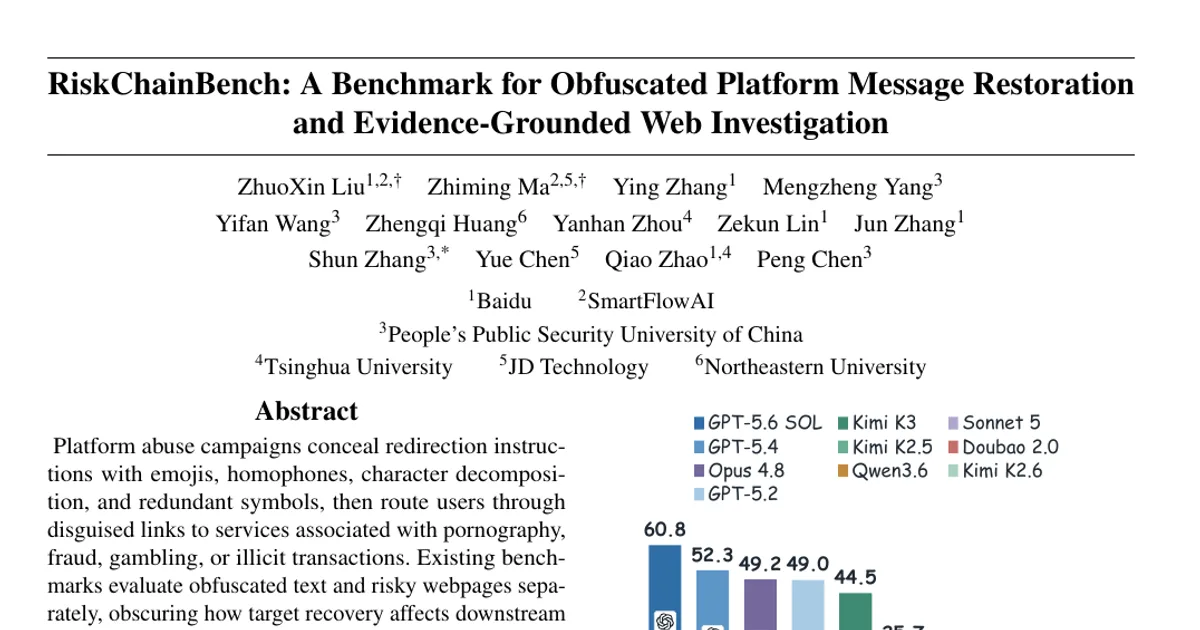
Platform abuse campaigns hide their intent using emojis, homophones, character decomposition, and redundant symbols, then redirect users through disguised links to sites tied to pornography, fraud, gambling, or illicit transactions. Existing benchmarks test obfuscated text and risky webpages separately, so they cannot show how a small mistake in recovering a destination changes what gets investigated downstream. RiskChainBench joins the two stages by destination identity: a model must first restore the message and rank its entry, and the top-ranked entry then acts as a gate determining whether that model's frozen website investigation counts as an end-to-end success.
Key Contributions
-
The paper formulates cross-channel platform risk investigation as an entry-linked process spanning message restoration, target identification, web exploration, and evidence-grounded risk judgment, rather than as two independent tasks.
-
It constructs 3,600 synthetic token-text restoration inputs drawn from 600 source sessions (six variants each) paired with 600 human-labeled local web environments built from a frozen pool of 2,500 unique offline websites.
-
It establishes two-stage baselines for the same ten underlying models in a text-only restoration setting and a VLM-driven web-agent setting, and localizes failures in obfuscation recovery, web execution, risk judgment, and fine-grained violation typing.
-
It releases the benchmark, evaluation protocol, and a resettable local sandbox, which the authors state also supports subsequent agent-training research.
Main Findings
-
Entry recovery spans a wide range: Across the same ten models on all 3,600 messages, Entry Top-1 ranges from 35.19% (Kimi K2.6) to 95.22% (GPT-5.4).
-
Full reconstruction is much harder than entry recovery: The best full reconstruction score is 73.31% (GPT-5.6 SOL), which leads the metric and has the lowest character error rate at 1.11, while its Entry Top-1 is 94.31%.
-
Character-level accuracy does not substitute for entry accuracy: Kimi K3 combines a low CER of 1.59 with a lower Entry Top-1 of 84.58%, which the authors cite as evidence that character-level recovery cannot replace a separate evaluation of actionable-entry recovery.
-
Website decisions vary substantially: Task 2 three-way decision accuracy ranges from 26.3% (Claude Sonnet 5) to 62.8% (GPT-5.6 SOL); hierarchical exact match ranges from 26.2% to 61.0%.
-
Different systems lead different metrics: GPT-5.6 SOL leads decision accuracy, hierarchical exact match, and decision macro-F1 (59.3), while Kimi K2.5 leads violation-type macro-F1 at 48.1 on the 394 gold-violation websites.
-
The entry gate creates large downstream losses for some models: Gated end-to-end accuracy ranges from 16.7% to 60.8%, with losses of 0.7 to 32.3 percentage points relative to the same frozen web-only results. The largest losses are Qwen3.6 Plus (32.3 points), Kimi K2.5 (29.5), and Kimi K2.6 (24.8), while GPT-5.6 SOL loses 2.0 and Claude Opus 4.8 loses 0.7.
-
Execution, not risk judgment, is the main bottleneck: First-failure attribution over all 600 runs per model shows execution failures account for 31.9%, whereas post-decision type errors account for only 0.9%.
-
Human labels are stable but not perfectly unanimous: Four trained annotators produced first-pass decision and joint-label agreement of 82.50% and 80.17%, with nominal Krippendorff's alpha of 0.6553 and 0.7425; hidden repeats yielded 97.9% decision agreement and 95.8% joint decision-type agreement.
-
The frozen gold is class-imbalanced: It contains 394 violating, 181 non-violating, and 25 insufficient-evidence websites, and only six of the nine violation types have nonzero support.
-
One system is unranked on the web task: Gemini 3.6 Flash is unranked in Task 2 because it was absent from the frozen report and judge batches.
Methodology in Plain English
The benchmark is built around the website, not the message. Each of the 600 website instances bundles a local web environment, a set of messages pointing to it, and a human annotation of whether it violates policy and, if so, what type.
Website selection starts from a frozen pool of 2,500 unique offline websites, from which 600 usable scenarios are chosen by a deterministic mixed-integer program using exact quotas for presentation form, visible topic, and language, with bounded constraints on interaction depth, engineering difficulty, source stratum, and host-family concentration. The selected set spans 339 host families with at most eight sites per family; 595 sites support click replay and 333 support stateful replay.
Messages are fully synthetic and no messages are collected from social platforms. Each of the 600 source sessions contains a reserved-domain entry and produces six token-text variants generated by a deterministic pipeline that composes phonetic or visual substitutions, character decomposition, redundant platform-token insertion, and entry alteration while preserving intended meaning and destination. The six recipes separately stress composite restoration, phonetic substitutions, entry confusables, mixed lexical and platform-token corruption, few-line entry layouts, and grapheme-safe vertical entry layouts. Every edit is stored in a reversible trace. One composite variant is fixed before evaluation for cross-stage scoring; the other five evaluate restoration only.
In Task 1, a model sees only the obfuscated text and must output a canonical message, an operational intent, and a ranked list of entry candidates. It has no access to webpages or domain-reputation services, and its restoration is frozen before any browsing occurs. Ranking is primarily by Entry Top-1 exact-match rate, with full reconstruction requiring the canonical message, intent, and top-ranked entry all to be correct.
In Task 2, the same tested model acts as a web agent inside a local environment. It receives a common instruction and a controller-generated, label-free action-class scaffold that describes high-level interaction coverage but contains no risk label, selector, target text or value, expected state, or mandatory action order. The source message, its restoration, the original domain, and resolver output are all withheld, so the model cannot revise its committed restoration or exploit domain-reputation shortcuts. BrowserGym and Playwright present observations, the agent selects allowlisted actions, and the alternating observations and actions form a bounded trajectory under a 30-action and 600-second budget, with immediate termination after an early valid report. The model then produces a frozen decision, rationale, and evidence citations pointing to trajectory steps, without rerunning the browser.
Scoring separates the two views. The web-only view uses the correct website association. The gated end-to-end view reuses that same frozen result and admits it only if the top-ranked entry from the fixed primary variant resolves to the website; lower-ranked candidates do not repair the gate, and no automatic correction reroutes an incorrect entry to another benchmark website. Task correctness is judged against human labels, while a fixed multimodal evidence judge separately scores evidence faithfulness, sufficiency, completeness, and consistency, with its four components averaged into a compact diagnostic only. A deterministic validator checks that actions stay inside the permitted environment and that citations resolve to observed content, but it does not infer webpage risk. Primary metrics use central 95% intervals from 2,000 website-level bootstrap resamples, which the authors note quantify website-composition uncertainty rather than rerun variance. The human evidence audit is described as a validation-only branch that is not used in the reported routine scores, and no four-dimensional human-audit result is claimed.
Why This Matters
Impact on research. The paper isolates a failure mode that separate text and web benchmarks hide: an upstream restoration error silently redirects or voids downstream investigation. By composing the stages offline through a frozen entry gate, it turns a cross-stage loss into a measurable quantity, which the authors denote as the difference between web-only and gated decision accuracy in percentage points. It also supplies a reusable protocol for evaluating web agents where website conclusions must rest on observed evidence rather than message-side cues or domain reputation.
Real-world applications:
-
Platform content moderation pipelines that must decide what a disguised message actually points to and whether the destination is safe to act on.
-
Trust-and-safety triage and escalation, where knowing that execution failures dominate over judgment errors tells reviewers where automation breaks down.
-
Risk-report generation for external webpages that cites specific observed steps rather than reputation shortcuts.
-
Safety evaluation of autonomous browsing agents, using the isolated, resettable sandbox with synthetic non-routable entries that avoid contact with live services.
Industry relevance. The benchmark is co-authored by researchers from Baidu, SmartFlowAI, JD Technology, the People's Public Security University of China, Tsinghua University, and Northeastern University, indicating direct interest from platform operators and security-facing institutions. For companies deploying browsing agents or moderation models, the finding that execution failures account for 31.9% of web runs while type errors account for 0.9% reframes reliability engineering: stable exploration, not risk classification, is the prerequisite capability. The evidence judge design also matters for regulated settings, since it separates task correctness from evidential support and keeps automated evidence scores as coverage-conditioned diagnostics rather than substitute ground truth.
Future Directions
-
Measuring rerun variance. The results use one trajectory per model–website pair, so the reported intervals do not estimate variance across repeated runs.
-
Broadening underrepresented risk types and languages. Only six of the nine violation types have nonzero support in the frozen gold, and the authors flag sparse violation types as a limitation.
-
Validating the evidence rubric through a frozen human trajectory audit within the same isolated environments, since the human evidence audit is currently a validation-only branch and no four-dimensional human-audit result is claimed.
-
Using the released sandbox for agent-training research, given that the protocol isolates message-side semantics and domain reputation and the paper attributes the dominant failure mode to unstable exploration.
Target Audience
This paper is most useful to researchers and engineers working on platform trust and safety, content moderation, and LLM or VLM web agents, particularly those building or auditing browser-based agents that must justify conclusions from observed evidence. It also suits benchmark designers interested in cross-stage evaluation protocols, and policy-adjacent technical teams who need to understand how failure propagates from message de-obfuscation into downstream risk decisions. Readers should be comfortable with benchmark metrics, bootstrap intervals, and agent trajectory evaluation; the annotation protocol and metric definitions are the main entry points for those less familiar with web-agent infrastructure.
Authors’ abstract
Platform abuse campaigns conceal redirection instructions with emojis, homophones, character decomposition, and redundant symbols, then route users through disguised links to services associated with pornography, fraud, gambling, or illicit transactions. Existing benchmarks evaluate obfuscated text and risky webpages separately, obscuring how target recovery affects downstream evidence acquisition. We introduce RiskChainBench, pairing 3,600 synthetic token-text restoration inputs from 600 source sessions with 600 corresponding human-labeled local web environments. A model first restores the message, operational intent, and destination; the same underlying model then acts as a VLM-driven web agent that investigates the correctly associated website and produces a frozen, evidence-cited risk report without message-side semantics or domain-reputation cues. We score restoration and correct-routing web investigation separately and compose them offline by applying the frozen primary-entry prediction as a gate to the same Task 2 result. Human labels determine task correctness, while a fixed multimodal evidence judge assesses faithfulness, sufficiency, completeness, and consistency. Across ten models, Entry Top-1 ranges from 35.2% to 95.2% and web decision accuracy from 26.3% to 62.8%; the leading systems differ across entry recovery, full reconstruction, website decisions, and fine-grained typing. Execution failures account for 31.9% of web runs, whereas post-decision type errors account for only 0.9%, identifying stable exploration and risk judgment as the principal bottlenecks. We release the benchmark, protocol, and resettable local sandbox.