Research
Risk-Calibrated Proposal Transport for Finite-Particle Diffusion Steering
Overview Research area: Machine learning — specifically inference-time steering of diffusion models, sequential Monte Carlo (SMC), and Feynman-Kac correctors for generative modeling (stat.ML). Technic
- arXiv
- 2610.04171
- Published
- 2026-10-03
- Authors
- Ziseok Lee, Jaehyeon Kim, Seungwon Kim, Seunghyun Moon, Haneul Choi, Wooyeol Lee, Donghyun Koh, Minhyeong Lee, Kyungsu Kim
AI summary
Overview
Research area: Machine learning — specifically inference-time steering of diffusion models, sequential Monte Carlo (SMC), and Feynman-Kac correctors for generative modeling (stat.ML).
Technical level: Advanced. The paper assumes familiarity with diffusion/score-based generative models, importance weighting, sequential Monte Carlo, Feynman-Kac representations, and Wasserstein-based error analysis.
Scope (one sentence): The paper diagnoses a finite-particle failure mode in variance-controlling guidance for diffusion steering, provides a theoretical account of it, and proposes a leave-one-out risk-calibration method (RCPT) that keeps the update from harming unweighted generation.
What This Paper Is About
Inference-time steering lets practitioners redirect a pretrained diffusion model — toward a reward, an expert, or a different target distribution — by modifying the sampling dynamics rather than retraining. The standard way to correct the mismatch between the steering proposal and the intended target is a Feynman-Kac correction implemented with importance-weighted sequential Monte Carlo. That correction only behaves well if the proposal is good, and with a finite number of particles the quality of the proposal matters even more.
The paper's core problem is that a proposal-improvement method (variance-controlling guidance, VCG) that looks optimal in the infinite-particle limit can be actively harmful when particles are few: it can drive its own fitting residual close to zero while making the residual risk on previously unseen states much worse. The goal is to understand why this happens and to build a variant that detects and defuses such harmful updates.
Key Contributions
-
Identification of a finite-particle pathology in VCG. The authors show that VCG's population-level guarantee (its optimum cannot worsen residual variance) does not carry over to the finite-particle regime, where fitting residual can be nearly eliminated while out-of-fit residual risk grows by orders of magnitude, degrading unweighted generation or accelerating particle collapse.
-
A theoretical characterization of the Feynman-Kac rate. The centered Feynman-Kac rate is shown to equal the normalized transport residual, and the expected out-of-fit benefit of a fitted update is shown to decompose exactly into population headroom minus a coefficient-estimation penalty.
-
A Wasserstein error bound. Under regularity assumptions, the analysis bounds the terminal error of the unweighted proposal in terms of this residual — connecting the weight-space diagnostic to the quality of the generated samples themselves.
-
Risk-Calibrated Proposal Transport (RCPT). A method that uses deletion leave-one-out residuals to calibrate how much of the VCG update to retain, adding no extra model calls and only small linear-algebra overhead. It is evaluated on 2D checker distributions, scaffold decoration, molecular property optimization, and class-conditional CIFAR-10 generation.
Main Findings
-
Population guarantees do not survive finite-particle fitting. VCG's claimed population optimum is real, but the finite-particle version of the method can drive its fitting residual toward zero while increasing residual risk on new states by orders of magnitude — the empirical fit becomes misleading rather than protective.
-
The centered Feynman-Kac rate has a concrete interpretation. It equals the normalized transport residual, giving a quantity that is not merely a diagnostic of weight variance but a direct measure of how far transport has drifted.
-
Out-of-fit benefit splits cleanly into two terms. The expected benefit of applying a fitted update equals population headroom minus a coefficient-estimation penalty — so a gain that is real at the population level can be outweighed by the cost of estimating its coefficients from finite particles.
-
Terminal error is controllable by the residual. Under regularity assumptions, a Wasserstein analysis bounds the unweighted proposal's terminal error using the residual, which is the justification for using residual-based calibration as a safeguard.
-
Calibration recovers from harmful updates. Experiments show RCPT recovering from fitted updates that would otherwise be damaging, with the abstract reporting that across molecular and image domains RCPT mitigates harmful fitted updates and improves a broad range of terminal metrics relative to uncalibrated VCG.
-
The fix is cheap. RCPT requires no additional model calls, only small linear-algebra overhead, which the abstract presents as a practical selling point. Specific wall-clock or memory figures are not given in the abstract.
Methodology in Plain English
The authors start from an existing steering technique that tries to improve the proposal distribution used inside an importance-weighted particle sampler. That technique fits a simple linear correction to the model's drift so that the variation in the importance weights is as small as possible. In theory, making weight variation smaller should only help.
Their observation is that with a limited number of particles, "making the weights look uniform on the states you observed" can be achieved by a correction that behaves badly on states you did not observe. The fit looks perfect, but the update has learned something that does not generalize, and the weighted sampler can then push all particles toward a small region or degrade the plain, unweighted generation path.
To understand this, they analyze the quantity that regulates the sampler — the centered Feynman-Kac rate — and show it is the same thing as a normalized measure of transport residual. They then derive how much a fitted update can be expected to help: the gain available if coefficients were known perfectly, minus the cost of having estimated those coefficients from finite data. They also connect the residual to sample quality through a Wasserstein-style bound under regularity assumptions.
The proposed remedy, RCPT, is a calibration layer rather than a new steering algorithm. It computes deletion leave-one-out residuals — effectively asking how the fitted correction would behave on points held out of its own fit — and uses those residuals to decide what fraction of the VCG update to keep. If the update looks like it will not generalize, less of it is retained. Because the residuals are computed by linear algebra on quantities already available, the method does not require additional calls to the diffusion model or the reward. The evaluation covers synthetic 2D checkerboard distributions, scaffold decoration, molecular property optimization, and class-conditional CIFAR-10 generation.
Why This Matters
Impact on research. The paper is a cautionary result about evaluating proposal-improvement methods in particle-based inference on their own fitting objective. It argues that a diagnostic (residual on fitted states) can be anti-correlated with what actually matters (error on new states), and it supplies a theoretical bridge — via the normalized transport residual and a Wasserstein bound — between weight-space quantities and the terminal error of the unweighted proposal. That reframing is likely to be relevant to anyone using Feynman-Kac correctors, twisted proposals, or SMC-based diffusion guidance, and it suggests that leave-one-out calibration is a general-purpose guardrail rather than a one-off patch.
Real-world applications (as suggested by the evaluation domains named in the abstract):
- Molecular design and property optimization — steering generative models toward molecules with desired properties without retraining, where a collapse of particle diversity would silently destroy the value of the generated candidates.
- Scaffold decoration in drug discovery — generating molecules that preserve a desired core scaffold while adding substituents, a task where a harmful fitted update could corrupt the very structural constraints the method is meant to respect.
- Conditional image generation — class-conditional synthesis where steering should sharpen adherence to a condition without degrading sample quality on the unweighted generation path.
- General inference-time reward or expert composition — combining pretrained diffusion experts or reward models at sampling time, a pattern that recurs across scientific and creative generation pipelines.
Industry relevance. Steering without retraining is attractive because it avoids the cost of fine-tuning large generative models and lets a single pretrained checkpoint serve many objectives. A failure mode in which the steering mechanism quietly harms the base generator's output is a deployment risk: it wastes inference compute, degrades outputs, and can be hard to notice because the fitting diagnostic looks excellent. A calibration step that adds no model calls and only small linear-algebra overhead fits the cost profile of production inference systems.
Future Directions
- Extending the analysis beyond the regularity assumptions. The Wasserstein bound on terminal error holds under stated regularity conditions; how far these can be relaxed, and which practical reward or expert targets violate them, is left open.
- Calibration beyond a single retained fraction. RCPT calibrates the retained fraction of the VCG update; whether richer, per-state or per-step calibration schemes yield further gains is not addressed in the abstract.
- Applicability to other proposal-improvement and twisting schemes. The diagnostics (centered Feynman-Kac rate as normalized transport residual, leave-one-out residual calibration) are presented in the VCG setting; their usefulness for other learned or fitted proposals in particle-based diffusion sampling is an open question.
- Behavior at very small particle counts. Since the pathology is specifically a finite-particle effect, characterizing how RCPT degrades as the number of particles becomes extremely small — and whether it trades off against particle diversity — would clarify its operating envelope.
Target Audience
Researchers and advanced practitioners working on diffusion and score-based generative models, sequential Monte Carlo, importance-weighted inference, and inference-time steering or guidance. It will be most useful to readers who already understand Feynman-Kac representations of diffusion samplers and importance weight variance, and to applied scientists in molecular generation or conditional image synthesis who deploy sampling-time steering and need it not to silently damage the base model's outputs. Readers seeking a beginner-level introduction to diffusion guidance should look elsewhere first; the abstract presumes substantial background.
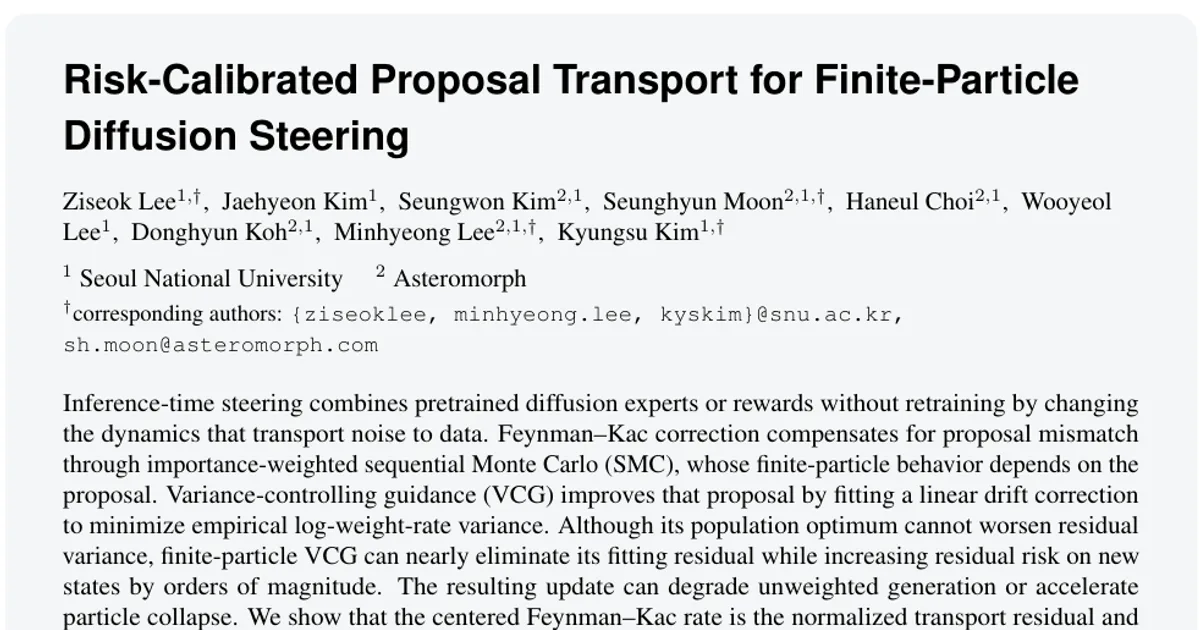
Authors’ abstract
Inference-time steering combines pretrained diffusion experts or rewards without retraining by changing the dynamics that transport noise to data. Feynman-Kac correction compensates for proposal mismatch through importance-weighted sequential Monte Carlo (SMC), whose finite-particle behavior depends on the proposal. Variance-controlling guidance (VCG) improves that proposal by fitting a linear drift correction to minimize empirical log-weight-rate variance. Although its population optimum cannot worsen residual variance, finite-particle VCG can nearly eliminate its fitting residual while increasing residual risk on new states by orders of magnitude. The resulting update can degrade unweighted generation or accelerate particle collapse. We show that the centered Feynman-Kac rate is the normalized transport residual and that expected out-of-fit benefit is exactly population headroom minus coefficient-estimation penalty. Under regularity assumptions, a Wasserstein analysis bounds the unweighted proposal's terminal error using this residual. These results motivate Risk-Calibrated Proposal Transport (RCPT), which uses deletion leave-one-out residuals to calibrate the retained fraction of the VCG update, adding no model calls and only small linear-algebra overhead. Experiments on 2D checker distributions, scaffold decoration, molecular property optimization, and class-conditional CIFAR-10 generation demonstrate recovery from harmful fitted updates. Across molecular and image domains, RCPT mitigates harmful fitted updates and improves a broad range of terminal metrics relative to uncalibrated VCG.