Research
Rethinking the Trust Region in LLM Reinforcement Learning
Rethinking the Trust Region in LLM Reinforcement Learning Overview Research area: Reinforcement learning for fine-tuning large language models (LLMs), specifically the trust-region / policy-constraint
- arXiv
- 2602.04879
- Published
- 2026-02-04
- Authors
- Penghui Qi, Xiangxin Zhou, Zichen Liu, Tianyu Pang, Chao Du, Min Lin, Wee Sun Lee
AI summary
Rethinking the Trust Region in LLM Reinforcement LearningOverview
Research area: Reinforcement learning for fine-tuning large language models (LLMs), specifically the trust-region / policy-constraint mechanisms underlying Proximal Policy Optimization (PPO) and its variants such as GRPO.
Technical level: Advanced. The paper derives policy-improvement bounds for a finite-horizon, undiscounted MDP, and assumes familiarity with PPO, TRPO, importance ratios, and TV/KL divergence.
Scope: The paper argues that PPO's ratio-clipping rule is structurally mismatched to LLM-scale vocabularies, replaces it with a direct divergence-based constraint (DPPO), and empirically studies training stability and efficiency when fine-tuning 1.5B–1.7B models (with a numerical analysis on Qwen3-30B-A3B-Base).
What This Paper Is About
PPO keeps policy updates inside a "trust region" by clipping the probability ratio of each sampled token, but that ratio is only a noisy single-sample estimate of the actual policy divergence. The authors show this causes two opposite failures at once: low-probability tokens get aggressively over-penalized (slowing learning), while high-probability tokens can shift large amounts of probability mass without being constrained (risking instability). The goal is to replace the ratio heuristic with a principled, cheaply computable measure of distribution shift, and to characterize when and where a trust region is actually necessary.
Key Contributions
-
Theory tailored to LLM generation. The paper derives a performance-difference identity (Theorem 3.1) and two policy-improvement lower bounds (Theorem 3.2, Equations 7 and 8) for the finite-horizon, undiscounted (γ = 1) episodic setting of LLM generation, where the standard discounted bound (Theorem 2.1) is ill-defined because the 1/(1−γ) term diverges. The bounds use a max-divergence form and an average token-level TV divergence form.
-
A diagnosis of PPO's clipping failure mode. The paper formalizes PPO's clip condition |r_t − 1| ≤ ε as constraining a single-sample Monte Carlo estimate of D_TV, and shows with concrete probability examples that clipping is biased by the token's base probability rather than by the true divergence.
-
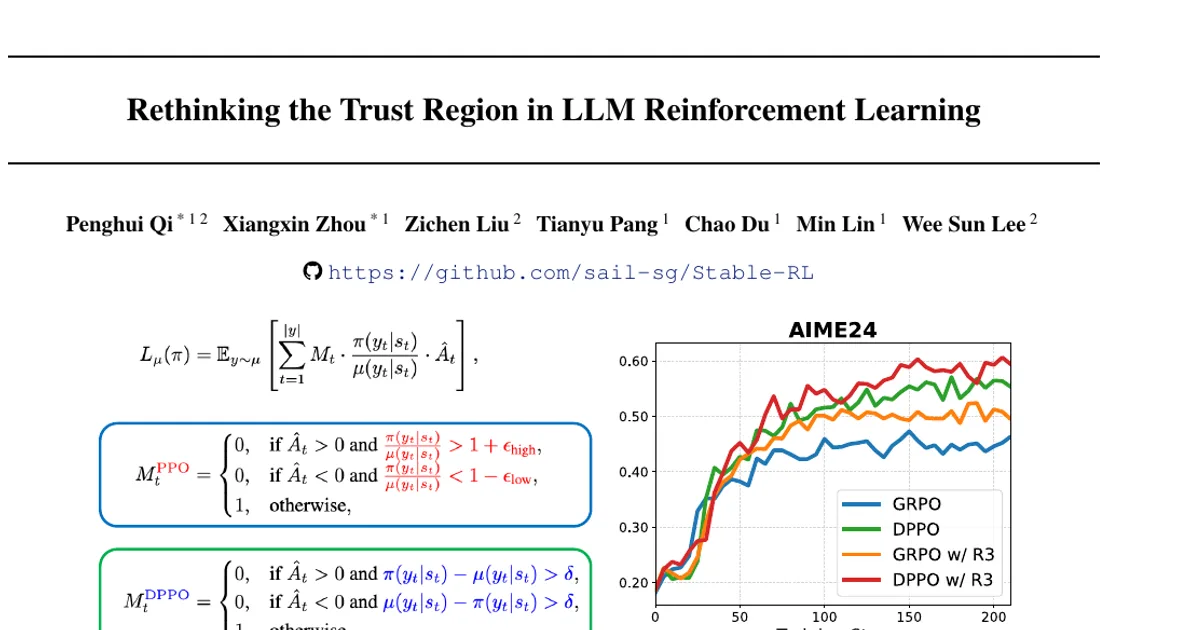
Divergence Proximal Policy Optimization (DPPO). A mask-based objective that blocks an update only when it both moves away from the trust region and when the measured divergence D (TV or KL) exceeds a threshold δ. Two memory-efficient approximations are introduced: a Binary approximation (collapsing the vocabulary into "sampled token" vs. "everything else") and a Top-K approximation (explicitly tracking the K highest-probability tokens under the behavior policy plus the sampled token, with the remainder pooled into an "other" category).
-
Empirical dissection of stability and efficiency. A controlled study isolating (a) whether a trust region is needed, (b) what it should be anchored to, and (c) which updates cause collapse, plus a second study on relaxations of clipping for low-probability tokens.
Main Findings
-
The ratio is the wrong quantity. With a behavior policy μ and trainer policy π, the paper's example gives μ(a_low|s) = 10⁻⁴ → π(a_low|s) = 10⁻², a ratio of 100 that would be clipped for ε = 0.2 despite moving almost no probability mass, while μ(a_high|s) = 0.99 → π(a_high|s) = 0.80 gives a ratio of ≈ 0.808 that can stay inside the clip range even though it removes 0.19 probability mass. The introduction gives an analogous example moving a rare token from 10⁻⁵ to 10⁻³ (ratio 100) and a high-probability token from 0.99 to 0.8.
-
Training-inference mismatch amplifies the problem. Figure 2, computed on Qwen3-30B-A3B-Base with identical parameters across training and inference engines, shows the token-level probability ratio is highly volatile for low-probability tokens while token-level TV divergence is stable.
-
A trust region is necessary even at tiny learning rates. On DeepSeek-R1-Distill-Qwen-1.5B fine-tuned on 1,460 MATH problems, the unconstrained methods PG-IS and PG-TIS (CISPO) show growing training-inference mismatch and eventual collapse, while DPPO variants (binary KL or TV divergence anchored to the rollout distribution) maintain low mismatch and reach near-perfect final rewards. The paper explicitly frames the question around learning rates such as 10⁻⁶.
-
The trust region must be anchored to the rollout policy. A decoupled objective (Hilton et al., 2022), where the region is enforced relative to a recomputed policy π_θ′, corrupts stable training: MiniRL fails to control mismatch and collapses, and a decoupled version of the stable DPPO-KL grows mismatch and collapses in Figure 4. The paper notes this also removes the need for recomputation, reducing training costs by approximately 25% (citing Qi et al., 2024).
-
Instability comes from a very small number of negative-sample updates. Starting from unstable PG-IS, a minimal mask blocking only negative-advantage updates where μ_θ′(y_t|s_t) − π_θ(y_t|s_t) ≥ δ with δ = 0.5 is sufficient to stabilize training, whereas δ = 0.8 or a recomputed-distribution mask ("Mask-0.5-Recompute") both collapse. These "bad updates" are at most 0.5% of updates, yet their percentage correlates with reward fluctuation.
-
Truncated importance sampling (TIS) hurts stability. PG-TIS (CISPO) and MiniRL-TIS collapse prematurely and substantially underperform their untruncated counterparts, which the paper attributes to truncation systematically down-weighting low-probability tokens that naturally produce high-variance ratios, introducing bias.
-
Relaxing clipping on low-probability tokens improves efficiency. Fine-tuning Qwen3-1.7B-Base on the DAPO dataset with GRPO + Clip-Higher as the baseline, setting ε to infinity for tokens with μ(y_t|s_t) < α and α = 0.1 gives a substantial efficiency improvement over the α = 0 baseline. Clipped tokens in the baseline are predominantly low-probability (typically below 0.15) and frequently high-entropy, consistent with Wang et al. (2025a)'s claim that RL is driven mainly by high-entropy tokens.
-
DPPO generalizes PPO. As noted by Chen et al. (2025) and Zheng et al. (2025), the DPPO objective recovers the original PPO objective when the divergence D is replaced by |r_t − 1|, which the paper describes as replacing the heuristic with a direct distributional measure.
Methodology in Plain English
The authors first rebuild the theory from scratch for the LLM case. Standard trust-region theory assumes an infinite-horizon, discounted problem, but LLM generation is an undiscounted, finite-horizon task with sequence-level rewards, so the usual bound breaks down. They derive a new performance-difference identity and two lower bounds that replace the effective horizon 1/(1−γ) with the response length T.
They then reframe PPO's clipping as an implicit constraint on a one-sample estimate of TV divergence, and use concrete token-probability examples to argue this estimate is biased by the token's own probability. DPPO keeps PPO's asymmetric structure — it never blocks an update that moves the ratio toward 1 — but gates the update on a measured divergence D between the full rollout distribution μ(·|s_t) and the trainer distribution π(·|s_t): the update is masked out only when it moves away from the trust region and D > δ.
Because computing full-vocabulary divergence is memory-prohibitive, they propose two approximations. The Binary version reduces each distribution to two outcomes (the sampled token vs. all others) and uses |μ(a_t|s_t) − π(a_t|s_t)| as the TV divergence or the corresponding two-outcome KL. The Top-K version keeps the K most probable tokens under the behavior policy plus the sampled token, pools the rest into "other," and computes TV/KL over that reduced support.
For experiments, the paper uses a sanity-test setup: fine-tune DeepSeek-R1-Distill-Qwen-1.5B on 1,460 MATH problems known to be solvable by the initial model, so a stable algorithm should reach 100% training accuracy. It compares PG-IS, PG-TIS (CISPO), GRPO with Clip-Higher, MiniRL and MiniRL-TIS (which clip against a recomputed ratio π_θ/π_θ′), and DPPO with binary KL or TV divergence. A separate efficiency study fine-tunes Qwen3-1.7B-Base on the DAPO dataset with GRPO + Clip-Higher as baseline, selectively removing the clip bound for tokens below a probability threshold α.
Why This Matters
Impact on research. The paper challenges a near-universal default in LLM RL — that clipping the token probability ratio is a sound trust-region surrogate — and offers a replacement that is still first-order and cheap. It also provides theory that matches the actual LLM setting (finite horizon, undiscounted, sequence-level rewards) rather than borrowing bounds from discounted classical RL. Its finding that the trust region must be anchored to the behavior policy gives a concrete, testable rule that contradicts a common open-source design choice.
Real-world applications.
- RL fine-tuning pipelines for reasoning models, where training-inference mismatch is a known source of collapse.
- Decoupled inference/trainer system architectures, where the paper's anchoring result implies that skipping recomputation is not only cheaper (approximately 25% reduction in training cost, per the cited figure) but also more stable.
- Alignment and preference-tuning pipelines where negative-advantage updates dominate the instability risk.
- Long-chain-of-thought training, where the average-divergence bound is described as tighter for long responses and matches per-token control.
Industry relevance. The main cost of LLM RL is rollout and update throughput. DPPO's approximations are described as adding negligible overhead, and its ability to let informative low-probability/high-entropy tokens update more freely targets exactly the tokens the paper argues drive learning — a direct efficiency argument for teams running large-scale RL post-training.
Future Directions
- Which divergence and which approximation to use. The paper presents Binary and Top-K variants of both TV and KL but the truncated content does not report a definitive ranking among them; choosing the best default (and the sensitivity to K and δ) remains open.
- Directional clip relaxation. The content cuts off exactly as the authors begin generalizing the directional clip-relaxation experiment with fixed α = 0.1; those results are not reported in the available text.
- Scaling beyond small models. The stability experiments use a 1.5B model and the efficiency experiments a 1.7B model, with a separate numerical mismatch study on Qwen3-30B-A3B-Base; whether the conclusions hold at larger scales and on non-math tasks is not established here.
- Reconciling with heuristic fixes. Clip-Higher and CISPO are described as identifying the symptom but not the root cause; whether a divergence-based constraint can be layered onto those implementations, and what it would cost, is left open.
Target Audience
Researchers and engineers working on RL post-training for LLMs, particularly those implementing PPO/GRPO-style trainers in decoupled inference–training systems. It is also relevant to RL theorists interested in trust-region derivations for finite-horizon, undiscounted problems and to practitioners debugging training collapse and inference-trainer mismatch. Readers without a background in policy-gradient methods and divergence measures will find the theoretical sections demanding.
Authors’ abstract
Reinforcement learning (RL) has become a cornerstone for fine-tuning Large Language Models (LLMs), with Proximal Policy Optimization (PPO) serving as the de facto standard algorithm. Despite its ubiquity, we argue that the core ratio clipping mechanism in PPO is structurally ill-suited for the large vocabularies inherent to LLMs. PPO constrains policy updates based on the probability ratio of sampled tokens, which serves as a noisy single-sample Monte Carlo estimate of the true policy divergence. This creates a sub-optimal learning dynamic: updates to low-probability tokens are aggressively over-penalized, while potentially catastrophic shifts in high-probability tokens are under-constrained, leading to training inefficiency and instability. To address this, we propose Divergence Proximal Policy Optimization (DPPO), which substitutes heuristic clipping with a more principled constraint based on a direct estimate of policy divergence (e.g., Total Variation or KL). To avoid huge memory footprint, we introduce the efficient Binary and Top-K approximations to capture the essential divergence with negligible overhead. Extensive empirical evaluations demonstrate that DPPO achieves superior training stability and efficiency compared to existing methods, offering a more robust foundation for RL-based LLM fine-tuning. Our code is available at https://github.com/sail-sg/Stable-RL.