Research
Rethinking Sparse-View 3D Gaussian Splatting: A Few-Shot Learning Perspective on Overfitting Prevention
Overview Research area: 3D computer vision — sparse-view novel view synthesis (NVS) with 3D Gaussian Splatting (3DGS), reframed through deep-learning regularization theory. Technical level: Advanced (
- arXiv
- 2610.25887
- Published
- 2026-10-19
- Authors
- Lejia Ye, Bin Wu, Jingjing Gao, Yiyang Wu, Xiaohu Zhang
AI summary
Overview
Research area: 3D computer vision — sparse-view novel view synthesis (NVS) with 3D Gaussian Splatting (3DGS), reframed through deep-learning regularization theory. Technical level: Advanced (assumes familiarity with 3DGS, differentiable rendering, optical flow, and standard deep-learning regularization). Scope: The paper proposes a unified few-shot-learning framing of sparse-view 3DGS, instantiates it as two components (Supervision Enhancement and Training Regularization), and reports results on the SIGGRAPH Asia 2025 Volumetric Video Challenge sparse-view track dataset, where the system placed first.
What This Paper Is About
3D Gaussian Splatting reconstructs scenes well when many input photos are available, but with only a handful of viewpoints it memorizes the training views — geometry degrades and renders become unstable and artifact-prone. Existing fixes (pseudo-views, extra depth supervision, training regularization) are applied piecemeal, with no shared framework explaining why they should work. The authors argue that each Gaussian primitive can be treated as a "neuron," so the mature toolkit for preventing overfitting in deep learning applies directly to sparse-view 3DGS.
Key Contributions
- A principled reframing of sparse-view 3DGS as a few-shot learning problem, treating each Gaussian primitive as a computational unit and mapping the three classic causes of overfitting (noisy data, excessive model capacity, insufficient data) onto sparse-view reconstruction failures (camera miscalibration, excessive/entangled Gaussians, too few viewpoints).
- A Supervision Enhancement component combining optical-flow-guided pseudo-view synthesis (depth plus horizontal/vertical flow, warped back and constrained by a Charbonnier photometric consistency loss) with adaptive joint camera–scene optimization triggered by reprojection error.
- A Training Regularization component coupling motion-aware dropout — applied only to Gaussians in static regions, identified by comparing a PDCNet point cloud against an OpenMVS point cloud — with validation-selected early stopping.
- Experiments on the SIGGRAPH Asia 2025 sparse-view dataset showing gains over both optimization-based and feed-forward baselines, and a first-place result in the sparse-view track of that challenge.
Main Findings
- Lead on both validation sequences: On Seq. 012 the method reaches PSNR 26.55, SSIM 0.923, LPIPS 0.137 versus the strongest baseline Binocular3DGS at 24.68 / 0.908 / 0.151. On Seq. 001 it reaches 27.13 / 0.924 / 0.143 versus Binocular3DGS at 25.77 / 0.909 / 0.175 and SparseGS* at 25.24 / 0.896 / 0.189.
- All four baselines trail on every metric: 3DGS* (24.36 / 0.893 / 0.167 and 25.87 / 0.898 / 0.193), GPS-Gaussian (24.40 / 0.896 / 0.149 and 24.54 / 0.890 / 0.170), and SparseGS* (24.27 / 0.901 / 0.155 and 25.24 / 0.896 / 0.189) are all below the proposed method on PSNR, SSIM and LPIPS for both sequences.
- Early stopping fires far earlier than the nominal schedule: although the schedule budgets 30k optimization steps, the validation-monitored stop point is consistently around step 5k, with training taking roughly three minutes per run on a single NVIDIA A100 40GB (preprocessing excluded).
- Qualitative gains concentrate in dynamic regions: on sequences with fast human motion the method produces more stable, artifact-free reconstructions than the baselines, which the authors attribute to restricting dropout to static Gaussians.
- Challenge result: the system won first place in the sparse-view track of the SIGGRAPH Asia 2025 challenge; test sequences were reserved for submission and all reported quantitative comparisons use the two validation sequences.
- Not reported: the supplied content contains no ablation study isolating the contribution of individual components, no per-component timing breakdown, and no comparison against methods beyond the four listed baselines.
Methodology in Plain English
The authors start from a simple analogy: in a neural network, overfitting comes from noisy data, an oversized model, and too little data. Sparse-view 3DGS suffers from exactly the same three things — badly calibrated cameras (noise), too many tangled Gaussians (capacity), and too few photos (data). So they apply the corresponding deep-learning remedies in two groups.
Adding more and cleaner supervision. For each training image they use a predicted depth map to work out how pixels would shift if the camera moved slightly sideways or up/down — the same arithmetic that produces optical flow. They render that slightly shifted viewpoint, warp it back to the original camera position, and penalize any mismatch with the real photo. Total-variation smoothing on depth and flow, plus an edge-aware term, keeps this stable. Separately, for sequences whose camera calibration looks suspicious (reprojection error above 1.0), they let the camera poses themselves be refined alongside the scene, turning the optimizer on at step 3,000 and freezing it at step 4,000 so it cannot drift.
Regularizing training. Dropout normally assumes that dropping any subset of units gives comparable results — an assumption that breaks when people move quickly. So they first label each Gaussian as static or dynamic: they build one point cloud with PDCNet (which covers static and dynamic regions) and another with OpenMVS (which, relying on multi-view consistency, mostly captures static structure), then call a point static if it lies close to the OpenMVS cloud. Dropout with factor 0.1 is applied only to static Gaussians. Finally, they track PSNR, SSIM and LPIPS on a held-out validation sequence and stop at the checkpoint with the lowest average rank across all three.
Putting it together. The total loss is a weighted sum of a rendering loss (ℓ1 at weight 0.8 plus SSIM at 0.2), the geometric objective (λ_geo = 0.8, depth-TV 0.05, flow-TV 0.1, edge 0.05), and a camera regularization term that keeps refined poses near their starting values. Training runs 5,000 epochs on a progressive schedule — 3,000 at half resolution, 2,000 at full.
Why This Matters
Impact on research. The paper's main intellectual move is organizational rather than architectural: it supplies a vocabulary that connects graphics-side tricks (pseudo-views, depth priors, densification control) to standard generalization theory. If the mapping holds, it gives researchers a principled way to decide which sparse-view intervention to add next, and a shared language between the 3D reconstruction and machine learning communities.
Real-world applications:
- AR/VR content capture, where a user should be able to scan a scene from a few angles rather than a dense camera rig.
- Real-time immersive communication (the application the authors cite), where volumetric video of a person must be reconstructed from a small number of cameras at a remote site.
- Telepresence and remote collaboration with volumetric participants.
- Volumetric video production for entertainment, where multi-camera capture is expensive and reducing camera count directly cuts cost.
Industry relevance. The method is designed around a commodity single-GPU budget — roughly three minutes of training per run on an A100 40GB, excluding preprocessing — and a challenge dataset built around 8-camera capture, which mirrors practical deployment constraints. Early stopping at roughly step 5k also means the approach spends far less compute than the nominal 30k-step schedule it is configured with.
Future Directions
- Handling extreme motion. The pseudo-view synthesis assumes moderate motion; the authors state that very rapid human dynamics violate this and propose explicit motion compensation or learned pose priors as remedies.
- Validating the framework more broadly. The supplied content reports no component ablation, so the individual and combined value of optical-flow pseudo-views, camera refinement, motion-aware dropout and early stopping is an open empirical question.
- Testing beyond the challenge benchmark. All quantitative comparisons use the two 16-view validation sequences of one dataset, evaluated on foreground regions over the first 50 frames; generalization to other sparse-view datasets and to outdoor or non-human scenes is untested here.
- Tighter coupling of the two pillars. Whether supervision enrichment and training regularization interact synergistically or redundantly is not established, and would inform whether the framework can be simplified.
Target Audience
Graduate students and researchers in 3D vision, neural rendering and volumetric video who already understand 3DGS and want a conceptual framework for sparse-view robustness; practitioners building AR/VR or real-time volumetric capture systems who need a compact, single-GPU pipeline; and machine learning researchers interested in how classical regularization theory transfers to graphics optimization problems. Readers seeking detailed ablation evidence or a broad benchmark sweep will not find it in this paper as supplied.
Authors’ abstract
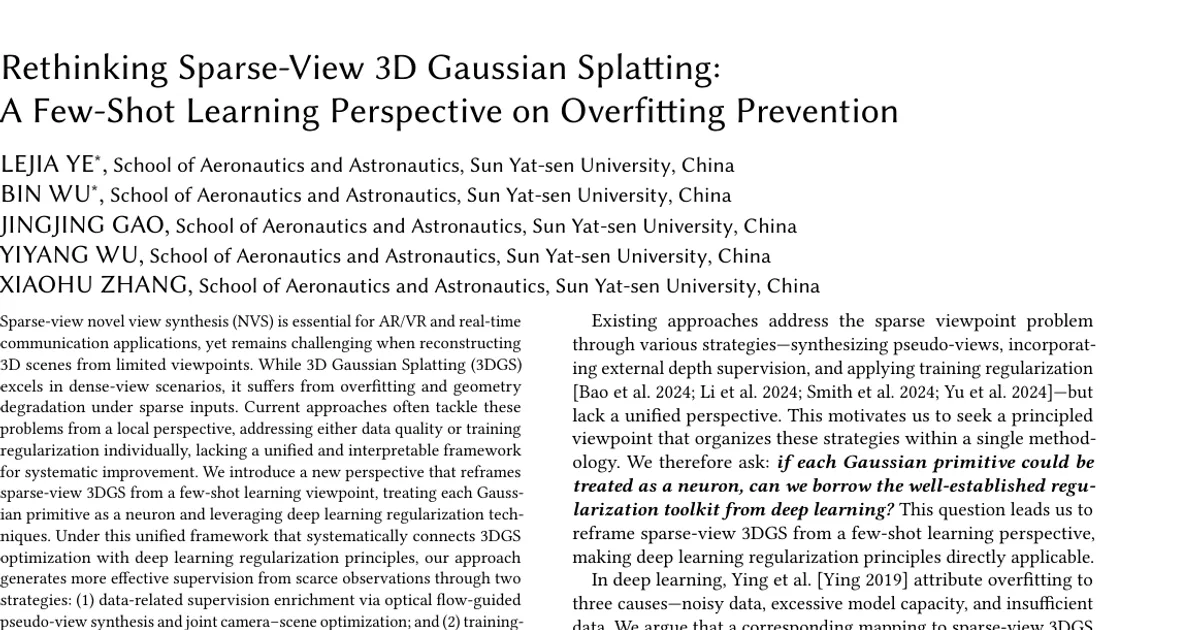
Sparse-view novel view synthesis (NVS) is essential for AR/VR and real-time communication applications, yet remains challenging when reconstructing 3D scenes from limited viewpoints. While 3D Gaussian Splatting (3DGS) excels in dense-view scenarios, it suffers from overfitting and geometry degradation under sparse inputs. Current approaches often tackle these problems from a local perspective, addressing either data quality or training regularization individually, lacking a unified and interpretable framework for systematic improvement. We introduce a new perspective that reframes sparse-view 3DGS from a few-shot learning viewpoint, treating each Gaussian primitive as a neuron and leveraging deep learning regularization techniques. Under this unified framework, our approach generates more effective supervision from scarce observations through two strategies: (1) data-related supervision enrichment via optical flow-guided pseudo-view synthesis and joint camera-scene optimization; and (2) training-time regularization via motion-aware dropout and early stopping, which suppress overfitting while preserving dynamic-scene stability. Extensive experiments on the SIGGRAPH Asia 2025 volumetric video challenge sparse-view dataset demonstrate significant improvements over state-of-the-art optimization-based and feed-forward baselines. Our system won first place in the sparse-view track of the SIGGRAPH Asia 2025 challenge.