Research
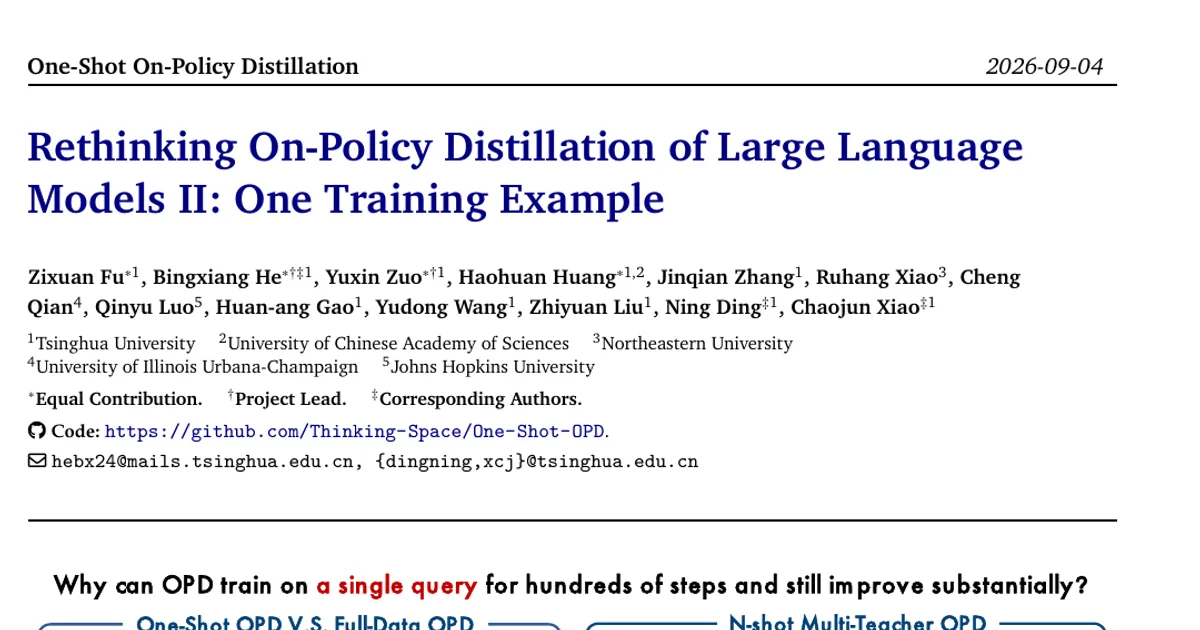
Rethinking On-Policy Distillation of Large Language Models II: One Training Example
Overview Research area: Large language model post-training, specifically on-policy distillation (OPD) and the role that training data plays in it. Technical level: Intermediate. The paper uses KL-dive
- arXiv
- 2609.04172
- Published
- 2026-09-03
- Authors
- Zixuan Fu, Bingxiang He, Yuxin Zuo, Haohuan Huang, Jinqian Zhang, Ruhang Xiao, Cheng Qian, Qinyu Luo, Huan-ang Gao, Yudong Wang, Zhiyuan Liu, Ning Ding, Chaojun Xiao
AI summary
Overview
Research area: Large language model post-training, specifically on-policy distillation (OPD) and the role that training data plays in it.
Technical level: Intermediate. The paper uses KL-divergence objectives and alignment metrics, but its central argument is stated in plain terms (data supply versus algorithmic absorption speed) and the main results are validation-accuracy curves.
Scope: A controlled, data-minimal study of OPD that trains a student on a single query to isolate how much supervision one example supplies and how quickly the student can absorb it.
What This Paper Is About
On-policy distillation trains a student model on its own generated responses while a teacher supplies dense token-level supervision at every visited prefix. Prior work has studied how the algorithm behaves, but not what role the training data plays. This paper reduces the data supply to its minimum — one query — and finds that the student still improves for hundreds of steps and recovers most of the gain that full-data OPD achieves, then explains why.
Key Contributions
-
Demonstrates the one-shot OPD phenomenon. Training on a single query produces learning curves that keep improving for hundreds of steps and recover most of full-data OPD's gain across four task domains (mathematics, code generation, instruction following, agentic tool use) and three model families.
-
Introduces state coverage as the metric that explains data value. Rather than counting queries, the paper clusters the states (prefixes) that full-data OPD visits and measures what fraction a given query set reaches. One query reaches 71.5%; 16 semantically diverse queries reach 98.9% and match full-data training.
-
Separates the data limit from the algorithm limit. The paper measures an absorption rate — the proportion of the remaining teacher–student gap that one update closes — and shows it declines at similar pace whether training uses one query or the whole dataset, and that a fixed set of states still takes hundreds of steps to absorb.
-
Extends the result to multi-teacher OPD and stresses the content assumption. 16 semantically diverse queries per domain match full-data MOPD, and content-light templates plus off-domain WildChat queries approach the real-query baseline.
Main Findings
-
One query recovers most of full-data OPD's gain in mathematics. At step 300, one-shot OPD averages 68.5 against 69.8 for full-data OPD across MATH-500, AIME 2025, and AMC 2023, recovering 69% of the teacher–student gap and 87% of full-data OPD's gain. Beyond step 300 both curves stay within a band of about 3 points, and the recovered fraction ranges from 62% to 89% through step 1000, where one-shot OPD reaches 68.4 against 72.1 and recovers 72% of full-data OPD's gain.
-
The effect holds across model families. Averaged final-checkpoint scores rise from 77.1, 28.2, and 70.8 for the R1-Distill-1.5B, Llama-3B-It, and OLMo-7B-It-DPO baselines to 85.5, 40.2, and 82.4 respectively.
-
The effect holds across task domains. One-shot OPD recovers 73% of the teacher–student gap on code generation, 66% on instruction following, and 64% on agentic tool use.
-
Difficulty, length, and temperature do not matter much. One-shot OPD works on easy, medium, and hard queries (initial pass rates 8/8, 4/8, and 0/8 over 8 rollouts), even though the hard query is never solved. Tightening the response-length cap and lowering rollout temperature both preserve the gain.
-
Data value is state coverage. The medium query reaches 71.5% state coverage by step 300, with 65.9% by step 100 and only 5.6 percentage points added over the next 200 steps. Its validation accuracy rises from 59.1 to 66.9, against 70.8 for full-data OPD at step 300.
-
Diversity, not count, closes the gap. Semantically distinct queries raise coverage and accuracy together, until 16 queries reach 98.9% coverage and match full-data OPD. A control holding the count at 16 but drawing queries from 16 semantic clusters rather than one raises coverage and accuracy sharply; the order in which the student trains on a fixed query set does not matter.
-
Alignment slows down, and query count does not change that. Runs on 1, 4, 16, and all DAPO-Math-17k queries each remove 78% to 84% of their step-30 distance by step 300, and all four slow by a similar factor. The distance falls throughout the run, so the student is never stuck — the absorption rate is what declines.
-
A fixed set of states still takes hundreds of steps. An always-off-policy run that reuses 64 trajectories sampled once from the initial student gains accuracy steadily for about 200 steps before stopping, and its top-16 token overlap and overlap-token advantage also move only over hundreds of steps.
-
16 diverse queries per domain match full-data MOPD. Full-data MOPD raises average validation accuracy from 43.5 to 52.8, recovering 79% of the teacher–student gap, versus 53.8 for three separate full-data OPD runs (a 1.0-point difference). Going from 1 to 16 queries per domain raises accuracy from 50.1 to 52.9, which is 101% of full-data MOPD's gain. Broken out, that is 93% for mathematics, 136% for code generation, and 109% for instruction following.
-
Task content is not the only source of signal. An empty user turn ending in
<think>, a domain system-prompt template, and general-domain WildChat queries (192,824 predominantly English queries, of which heuristics label 0.17% as mathematics-related and 2.63% as code-related) all track the real-query baseline, which lifts the three-benchmark average from 59.1 to 69.8 — and all three reach that level on a third to a half of its rollout tokens. Explicit domain content changes final performance by about one point. A scaffold that closes the block at once (<think>\n</think>\n) collapses into short meta-level replies the authors report they cannot train on. -
OPD extracts more from the same query than RLVR. On the same medium query over 1000 steps, OPD closes 72% of its gap to the teacher, and its gain in validation accuracy is more than twice that of RLVR. The RLVR signal weakens as its rollout groups become nearly unanimous, leaving no GRPO advantage, whereas OPD keeps learning from local teacher–student gaps.
Methodology in Plain English
The authors take a controlled-experiment approach in the spirit of one-shot RLVR. They pick a single training query and run ordinary OPD on it repeatedly, then compare the resulting curve against full-data OPD trained on DAPO-Math-17K. To check generality, they repeat this on code generation (Open-R1 Codeforces), instruction following (a sampled subset of UltraData-SFT-2605), and agentic tool use (xLAM-function-calling-60K), and with several student–teacher pairs including Llama and OLMo families.
To explain the result, they introduce state coverage. Every generated token creates a distinct prefix, called a state, at which the teacher provides a target distribution. They represent each state by the teacher's final-layer hidden vector, pool states from full-data OPD, run PCA followed by K-means with K = 200 clusters, and then measure what fraction of those clusters any given query set's rollouts reach. Three of every five collected rollouts define the pool; the other two form a held-out split that defines the 100% ceiling.
For the algorithm side, they track two quantities on the states the student actually visits: distance, the average absolute per-token difference between teacher and student log-probabilities, and absorption rate, the fraction of that distance one update removes. They then compare these curves across runs trained on 1, 4, 16, and all queries, and add an off-policy ablation where the same 64 trajectories are reused for every update. Training uses veRL, batches of 64 rollouts, AdamW at a learning rate of 1e-6, rollout temperature 1.0, and gradient clip norm 1.0, with the top-k advantage (k = 16) for mathematics and the sampled-token advantage elsewhere.
Why This Matters
The paper reframes what data curation in distillation should optimize. If a single query already reaches 71.5% of the state space that full-data OPD visits, and 16 diverse queries reach 98.9%, then the relevant question is no longer how many problems to collect but which regions of reasoning state an input induces. That has direct implications for how frontier post-training pipelines — the paper notes OPD is used in Qwen3, MiMo, GLM-5, DeepSeek-V4, and Kimi K3 alongside supervised fine-tuning and reinforcement learning — allocate data and compute.
Real-world applications:
- Cheaper post-training pipelines. If a few dozen well-chosen queries can substitute for tens of thousands, teams can cut data curation and annotation cost in distillation runs.
- Data selection tools that score prompts by induced states. Selection could rank candidate prompts by the state clusters their rollouts reach rather than by difficulty or topic coverage.
- Synthetic and content-light prompt generation. Since templates with no problem statement still approach the real-query baseline in these experiments, prompt generation for distillation may not need carefully authored domain problems.
- Multi-domain model training. For systems that route queries to several specialist teachers, 16 diverse queries per domain matched full-data MOPD in this study, which simplifies how per-domain data budgets are set.
Industry relevance: the finding that OPD is data-overfed but algorithm-starved suggests the bottleneck in current post-training budgets is step efficiency — how fast a student absorbs dense teacher supervision — rather than data volume. That redirects engineering effort toward optimizer, schedule, and objective design.
Future Directions
-
Improving step efficiency. The paper explicitly hopes its findings direct future work toward the step efficiency of OPD, since the absorption rate declines regardless of training-set size and even a fixed set of states takes hundreds of steps to absorb.
-
Selecting queries by induced states. The state-level view suggests selecting training inputs by the state regions they cover rather than by problem count or difficulty, which the authors propose as a direction for data curation.
-
Testing the limits of content-free inputs. The template and WildChat results are a stress test, not a general claim; the authors state these results do not imply task content is generally dispensable, and a template that closes the thinking block immediately failed. How far content can be removed remains open.
-
Raising the absorption rate. The paper isolates the algorithm as the limiter and contrasts OPD's teacher-matching ceiling with RLVR's teacher-free ceiling, leaving open whether the slow absorption is intrinsic to on-policy distillation or a property of current optimization.
Target Audience
Researchers and engineers working on LLM post-training, distillation, and data selection will get the most from this paper, particularly those building multi-teacher pipelines or deciding how much training data to collect. It is also useful for readers interested in training-dynamics analysis, since the state-coverage construction and the distance/absorption-rate metrics are reusable diagnostics. Readers without a distillation background can follow the argument through the accuracy curves and the coverage numbers, though the objective definitions in the preliminaries will require some familiarity with KL divergence and token-level supervision.
Authors’ abstract
On-policy distillation (OPD) combines student-generated rollouts with dense token-level supervision from a teacher. Existing work has mainly studied its algorithmic behavior, leaving the role of training data unclear. We examine this role at the data-minimal limit by training on a single query. One-shot OPD keeps improving for hundreds of steps and recovers most of full-data OPD's gain across task domains and model families. We explain this result through the states visited during training and the rate at which the student aligns with the teacher. We measure \emph{state coverage}, the fraction of the states full-data OPD visits that a query set's rollouts reach. A single query already reaches \(71.5\%\), most of it within the first 100 steps. Adding semantically distinct queries raises coverage and validation accuracy together, until 16 queries reach \(98.9\%\) and match full-data training. Yet alignment slows at a similar pace whether OPD trains on one query or the whole dataset, and even a fixed set of states takes hundreds of steps to absorb. OPD is therefore data-overfed but algorithm-starved. Its rollouts quickly expose broad supervision, while the student absorbs that supervision increasingly slowly. The state-coverage result extends to multi-teacher OPD, where 16 semantically diverse queries per domain match full-data MOPD. As a further stress test, content-light templates and off-domain WildChat queries also approach the real-query baseline. Task content and induced state coverage can therefore come apart. We hope these findings direct future work toward the step efficiency of OPD, and prompt a re-examination of the data and the mechanisms behind its recent successes in frontier post-training.