Research
Rethinking Message Passing Neural Networks with Diffusion Distance-guided Stress Majorization
Overview Research area: Graph machine learning, specifically message passing neural networks (MPNNs) and the optimization objectives that drive their message passing operations. Technical level: Advan
- arXiv
- 2511.19984
- Published
- 2025-11-25
- Authors
- Haoran Zheng, Renchi Yang, Yubo Zhou, Jianliang Xu
AI summary
Overview
Research area: Graph machine learning, specifically message passing neural networks (MPNNs) and the optimization objectives that drive their message passing operations.
Technical level: Advanced. The paper is heavily theoretical, combining spectral graph theory, graph drawing (stress majorization), random walk diffusion distances, and optimization derivations.
Scope: The paper diagnoses why standard MPNNs degrade as layers increase, then proposes DDSM (Diffusion Distance-guided Stress Majorization), a new MPNN whose message passing operations are derived from a diffusion-distance-aware stress majorization objective with orthogonal regularization, evaluated on supervised node classification across 11 benchmark datasets against 15 baselines.
What This Paper Is About
Most MPNNs implicitly minimize the Dirichlet energy of node representations, which pulls the features of connected nodes together. The authors show this single objective causes node representations to become indistinguishable (global over-smoothing), over-mixes nodes joined by noisy or cross-class links (heterophilic over-smoothing), and makes feature dimensions highly correlated (over-correlation). DDSM replaces that objective with a stress majorization formulation in which every edge is assigned a desired distance taken from a diffusion distance metric, plus an explicit orthogonal regularization, and derives the resulting message passing operations in closed form.
Key Contributions
-
A unified diagnosis of MPNN failure modes. The authors unify most MPNNs as optimizing a Dirichlet energy term plus a secondary term, and prove that this objective produces both node-wise problems (global over-smoothing, heterophilic over-smoothing) and feature-wise problems (feature dimension over-correlation and feature space over-correlation). They support the analysis with a new metric, HOS, that measures smoothing specifically over heterophilic links, alongside the existing SMV and Corr metrics.
-
A new optimization framework and message passing scheme. DDSM substitutes a stress majorization loss (Eq. 7) for the Dirichlet energy term and adds an orthogonal regularization term, then mixes these with a fitting term and a residual connection. Setting the derivative of the combined objective to zero yields a new aggregation rule whose extra term pushes apart adjacent nodes with large diffusion distance or small embedding distance.
-
A reasoned choice of diffusion distance as the desired edge distance. The authors compare shortest path, Jaccard, resistance, biharmonic, and learnable distances against three diffusion distances (VDD, PRDD, HKDD) across ten properties including non-negativity, finiteness, symmetry, triangle inequality, edge weights, local and global structure preservation, structural similarity, and range. They prove boundedness for the diffusion distances and prove stability under small graph perturbations.
-
A fast, theoretically grounded distance computation. Using the eigendecomposition of the normalized adjacency or normalized Laplacian, the authors show that VDD, PRDD, and HKDD all reduce to the Euclidean distance between n-dimensional node embeddings of the form Z_i = (U_i / sqrt(d_i)) · f(Λ), enabling approximation via truncated spectral decomposition instead of materializing dense matrices or summing infinite series.
Main Findings
-
Over-smoothing has a heterophilic component. The homophily ratio of a graph satisfies h(G) = 1 − D(D^(1/2) Y)/m, linking the Dirichlet energy objective directly to label homophily. For the Chameleon Wikipedia network, the homophily ratio is only 0.23, meaning roughly 77% of edges connect nodes with different labels.
-
Message passing collapses representations in a specific, provable way. As layers increase, stacked normalized adjacency powers converge to a rank-one outer product ππ^T, so node embeddings become the same up to a degree-based scaling factor; the Gram matrix H^T H likewise evolves toward a rank-one matrix, so feature dimensions become linearly dependent.
-
Empirical layer-wise degradation. On CiteSeer, WikiCS, and Chameleon, accuracy, SMV, and HOS all decrease as the layer count k rises from 1 to 20, while Corr grows. For small layer counts in the range 1 to 6, changes in accuracy track HOS and Corr more closely than they track SMV, and HOS is substantially lower than SMV even after a few layers, indicating that cross-label neighbors are mapped very close together.
-
Diffusion distances are the only compared metrics that are simultaneously bounded, finite, symmetric, and structure-aware. VDD is bounded in [0, sqrt(2)/d_min], PRDD in [0, sqrt(2)/((1−γ)d_min)], and HKDD in [0, sqrt(2)], whereas shortest path distance is either 1 or infinite, Jaccard ranges over [2/n, 1], resistance distance reaches +infinity, and biharmonic distance is undefined for directed graphs.
-
Diffusion distances are robust to graph noise. Theorem 5.1 bounds the change in a node pair's diffusion distance under perturbations of the normalized adjacency (Frobenius norm at most ε_a) and of node degrees (at most ε_d), with the bound depending on 1/d̃^(3/2) and 1/d̃^(1/2) terms.
-
DDSM outperforms strong baselines. The authors report that DDSM consistently and considerably outperforms 15 strong baselines on both homophilic and heterophilic graphs across 11 benchmark datasets for supervised node classification. Per-dataset accuracy figures are not included in the available content.
Methodology in Plain English
The authors start from an analogy to graph drawing. If you lay out nodes by only pulling connected nodes together — as the Dirichlet energy does — everything collapses into a single clump. Graph drawing software avoids this by specifying a desired distance for each pair of points and penalizing deviations from it, an approach called stress majorization. DDSM borrows that idea: for every edge it defines a target distance between the two node embeddings and penalizes the difference between the actual embedding distance and that target. Because the target comes from a diffusion distance, which summarizes how similarly two nodes are reached by random walks across the whole graph, two nodes joined by a single noisy or cross-class edge still get pushed apart if their overall connectivity patterns differ.
To the same objective the authors add a term that forces the columns of the representation matrix to be orthogonal, directly counteracting the rank-one collapse they proved. Mixing in a term that keeps representations close to their initial features, plus a residual connection to the input, gives the full objective. Differentiating this objective with respect to each node's representation and setting it to zero produces the new update rule: the usual neighbor average, plus a term that pushes a node away from neighbors whose diffusion distance is large relative to their embedding distance, plus the orthogonalization correction, plus the residual.
Because computing exact diffusion distances requires dense n-by-n matrices or infinite series, the authors instead diagonalize the relevant graph operator once and express each distance as an ordinary Euclidean distance between derived node vectors. Truncating the spectrum then gives a practical approximation.
Why This Matters
Impact on research. The paper reframes a widely used design pattern — the Dirichlet energy objective underlying GCN, SGC, APPNP, and others — as the root cause of several separate pathologies rather than treating each with an isolated patch. It also supplies a principled criterion for picking a distance metric inside stress-based GNNs, which prior work approached with learnable distances that can be unstable or range-unconstrained.
Real-world applications:
- Social network analysis, where node representations feed downstream prediction tasks and where graphs often contain noisy or adversarial edges.
- Recommendation systems, where user-item interaction graphs mix connections across different preference groups.
- Bioinformatics, where graph-structured biological data can be sparse, noisy, and far from homophilic.
- Graph visualization and layout, the domain the stress majorization objective is borrowed from, where the attractive/repulsive balance is the central design concern.
Industry relevance. Any pipeline that stacks many graph convolution layers and hits the depth ceiling can in principle swap in the DDSM aggregation, since the update rule keeps the same neighbor-aggregation form as standard MPNNs and is derived rather than hand-tuned. The spectral precomputation of diffusion distances is a one-time cost, which matters for repeated training runs on a fixed graph.
Future Directions
- Scalability of the approximation. The paper states that exact diffusion distance computation is prohibitive for medium and large graphs and resorts to truncated spectral decomposition; how the truncation error and runtime behave on much larger graphs than the 11 benchmarks used remains open from the available content.
- Choosing among VDD, PRDD, and HKDD. All three satisfy the desired properties, and the paper does not identify a single winner; the conditions under which each is preferable for a given graph are unresolved.
- Hyperparameter sensitivity. DDSM introduces α (fitting), β (orthogonality), η (distance scaling), γ (heat constant / teleportation), and t (walk length); how sensitive results are to these and whether they transfer across homophilic and heterophilic graphs is not reported in the available content.
- Beyond node classification. The evaluation is limited to supervised node classification, so applicability to link prediction, graph-level tasks, and other learning settings is untested here.
Target Audience
Researchers and graduate students working on graph neural networks, graph signal processing, and spectral methods who want a theoretical account of why deep MPNNs fail and a concrete alternative objective; practitioners building GNN pipelines who need models that stay accurate as depth increases; and readers interested in the intersection of graph drawing, diffusion geometry, and machine learning on graphs. A background in linear algebra, spectral graph theory, and standard GNN formulations is assumed by the paper's derivations.
Authors’ abstract
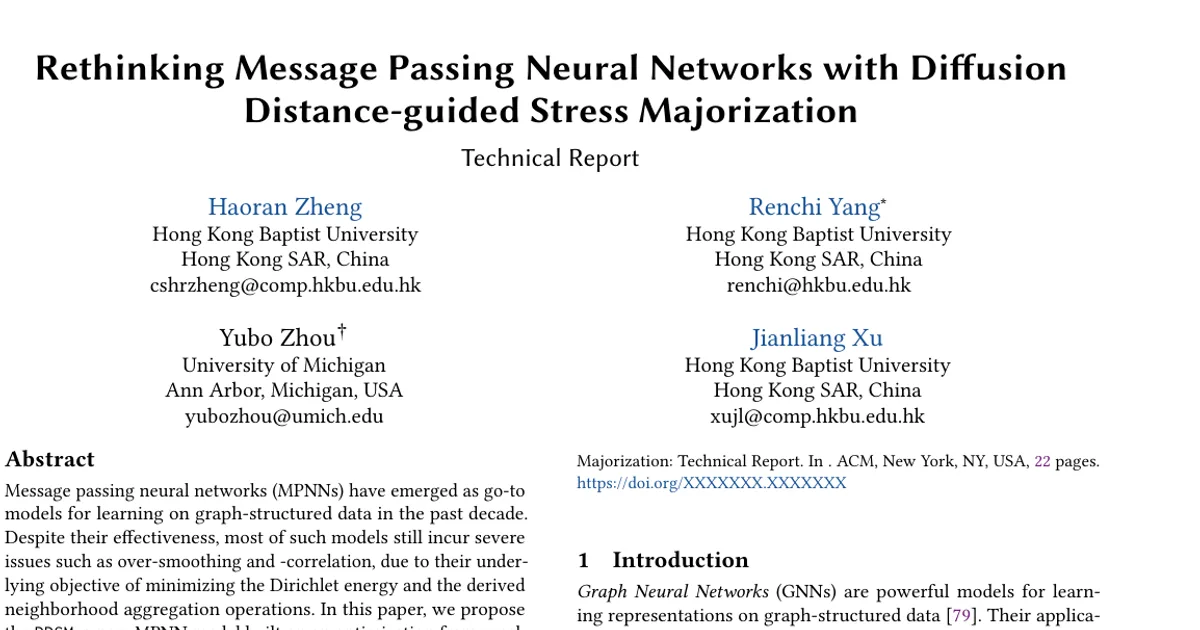
Message passing neural networks (MPNNs) have emerged as go-to models for learning on graph-structured data in the past decade. Despite their effectiveness, most of such models still incur severe issues such as over-smoothing and -correlation, due to their underlying objective of minimizing the Dirichlet energy and the derived neighborhood aggregation operations. In this paper, we propose the DDSM, a new MPNN model built on an optimization framework that includes the stress majorization and orthogonal regularization for overcoming the above issues. Further, we introduce the diffusion distances for nodes into the framework to guide the new message passing operations and develop efficient algorithms for distance approximations, both backed by rigorous theoretical analyses. Our comprehensive experiments showcase that DDSM consistently and considerably outperforms 15 strong baselines on both homophilic and heterophilic graphs.