Research
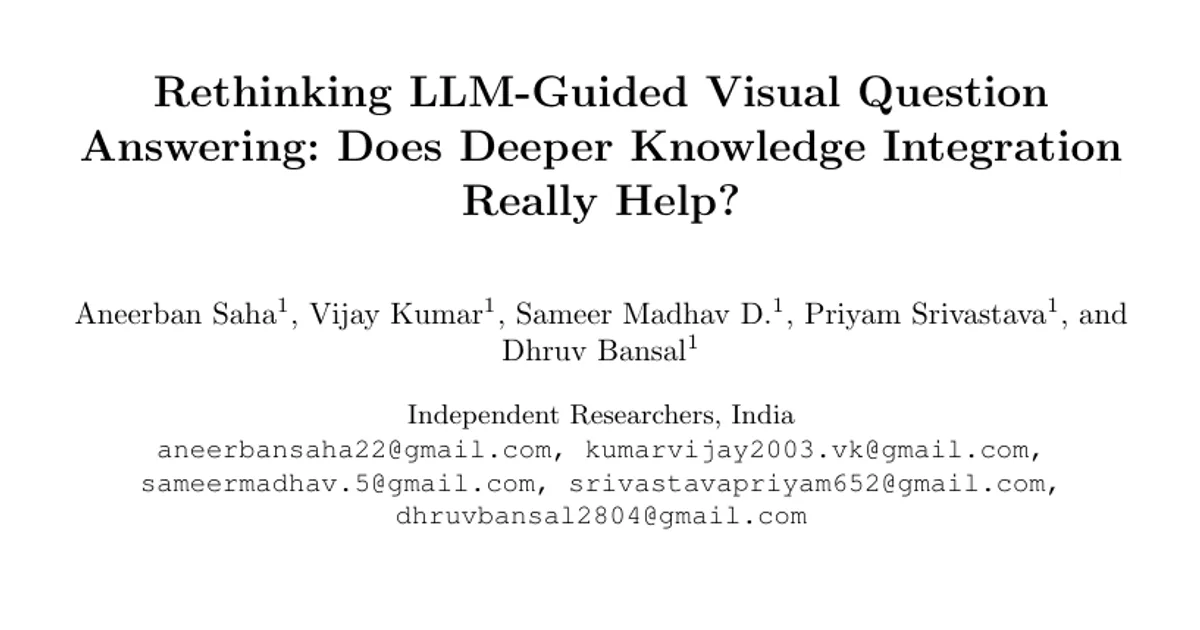
Rethinking LLM-Guided Visual Question Answering: Does Deeper Knowledge Integration Really Help?
Overview Research area: Computer Vision / Multimodal Vision-Language Models — specifically knowledge-based Visual Question Answering (VQA) and how to integrate LLM-generated knowledge into a vision-la
- arXiv
- 2610.17079
- Published
- 2026-10-12
- Authors
- Aneerban Saha, Vijay Kumar, Sameer Madhav D., Priyam Srivastava, Dhruv Bansal
AI summary
Overview
Research area: Computer Vision / Multimodal Vision-Language Models — specifically knowledge-based Visual Question Answering (VQA) and how to integrate LLM-generated knowledge into a vision-language architecture.
Technical level: Intermediate. The paper assumes familiarity with transformers, ViT, FLAN-T5, CLIP and attention mechanisms, but its central question and conclusions are stated plainly enough for a reader with general deep-learning background.
Scope: A systematic comparison of two ways of injecting Llama 3.3 70B-generated structured guidance (shallow decision-level late fusion versus deep attention-matrix injection) into an identical frozen ViT + FLAN-T5 framework on a data-scarce subset of OK-VQA.
What This Paper Is About
Knowledge-based VQA asks questions that cannot be answered from the image alone (e.g., "How old do you have to be in Canada to do this?" over a photo of adults drinking wine), so a model needs outside commonsense and factual knowledge. Recent work uses LLMs as knowledge sources but generally assumes that fusing that knowledge more deeply into the architecture is better. This paper tests that assumption directly by generating structured LLM guidance for every OK-VQA sample and comparing a shallow fusion strategy against a deep attention-modification strategy under identical, deliberately data-scarce fine-tuning conditions.
Key Contributions
- A pipeline that converts LLM reasoning into machine-consumable guidance. Llama 3.3 70B produces structured JSON per sample containing
visual_focusconcepts,ignore(distractor) elements, andknowledgefacts; this is encoded with a frozen CLIP text encoder and injected into a compact trainable VQA architecture rather than prompting a frozen billion-parameter LLM at inference time. - A controlled comparison of integration depth. Shallow decision-level late fusion and deep attention-matrix injection are evaluated inside the same frozen ViT + FLAN-T5 backbone with identical guidance and data, isolating integration depth as the only variable.
- A contrarian empirical finding. Shallow late fusion outperforms deep attention modification on all metrics (exact match 39.44 vs. 31.80; token F1 41.34 vs. 33.33), contradicting the prevailing assumption that deeper fusion is superior.
- An LLM-based augmentation pipeline. Question paraphrasing (image and answer held fixed) expands the filtered training set from 3,144 to approximately 36,000 samples, more than tenfold, with shard-based caching, crash recovery and deduplicated merging.
Main Findings
- Late fusion wins on every metric: Late fusion reaches 39.44 EM, 48.97 Edit Similarity, 41.34 token F1 and 92.14 BERTScore, versus 29.44 EM, 40.57 Edit Sim, 30.97 token F1 and 91.21 BERTScore for the no-guidance baseline, a gain of +10.0 EM and +10.4 token F1.
- Deep injection barely helps: Attention-matrix injection reaches 31.80 EM, 42.66 Edit Sim, 33.33 token F1 and 91.00 BERTScore, only +2.4 EM over baseline, with BERTScore marginally below baseline (−0.2).
- The gap between strategies is 7.6 EM points, which the authors argue contradicts the deeper-is-better premise implicit in recent work such as MAIL and KV-KBVQA.
- Question-type breakdown: Late fusion improves over baseline in every category, with the largest gains on "What is", "Other" and "Color" questions. Attention injection is the best of the three on "Where" questions (35.3) but collapses on "Who" (10.0 vs. baseline 25.4) and "Yes/No" (45.6 vs. 65.2). Counting remains uniformly hard at roughly 6% for all strategies.
- Error reduction: Late fusion cuts the completely-wrong prediction fraction from 63.1% (baseline) to 53.2%; attention injection only reduces it to 60.5%.
- Three explanations for shallow-beats-deep: (1) late fusion leaves pretrained ViT representations untouched, while attention injection perturbs queries and keys in six of twelve layers and unfreezes them, requiring re-stabilization with only about 29k samples; (2) granularity mismatch, since the guidance vector is a single global direction broadcast to every patch token and cannot express which region a concept refers to; (3) optimization burden, as attention injection adds per-layer projections, gates and scaling factors that must be learned jointly with unfrozen ViT layers, whereas late fusion trains a single linear fusion.
- Data regime is the governing variable: The authors conclude that integration depth must be matched to the data regime, not that deep integration is inherently inferior.
Methodology in Plain English
The authors start from OK-VQA (14,055 image-question pairs over MS COCO images) and normalize the multiple human answers per question, choosing the majority-vote answer as the training target. To fight the long-tailed answer distribution, they keep only the 500 most frequent answers, which leaves 3,144 training samples across 500 answer classes, about six samples per class.
For each sample, a BLIP captioning model writes a caption, and Llama 3.3 70B is prompted with the question plus caption to output a structured JSON object listing which visual concepts to focus on, which elements to ignore, and which external facts are needed. Generation runs once offline at temperature 0.2 and is cached, so no LLM call happens at training or inference time. The same LLM also paraphrases questions (image and answer fixed) to grow the dataset to roughly 36,000 samples.
The guidance text (focus plus knowledge) is encoded by a frozen CLIP text encoder, mean-pooled into a 512-dimensional vector, and projected to 768 dimensions. All model variants share a frozen ViT-Base image encoder (using the 768-dimensional CLS token) and FLAN-T5 as the text-to-text decoder. The baseline prepends a projected CLS token as a single prefix to the T5 input. Late fusion concatenates the CLS token with the guidance vector and fuses them with one linear layer before prepending. Attention injection instead pushes the guidance into the query and key projections of the last six ViT layers, adding a per-sample gated shift to every token's queries and keys, unfreezing those layers, and using a learnable scaling factor initialized to 5.0.
Training uses Adam at learning rate 3×10⁻⁵, batch size 8–16, up to 15 epochs with early stopping (patience 3–4) on validation exact match, gradient clipping at norm 1.0, and an image-level 80/20 train/validation split with zero image overlap, all on a single NVIDIA GPU with 8–16 GB VRAM in a Colab environment.
Why This Matters
The paper supplies a negative result against a widely held design assumption: adding more elaborate fusion machinery is not automatically better, and under scarce data it can actively hurt. This gives researchers a reason to benchmark fusion depth against data scale rather than assuming monotonic improvement, and it offers a concrete diagnosis (representation preservation, granularity mismatch, optimization burden) for why.
Real-world applications:
- Accessibility tools that answer questions about images for blind and low-vision users, where questions often require world knowledge rather than just object recognition.
- Educational and museum or field-guide assistants that answer "why/what is" questions about a depicted object using external facts.
- E-commerce and product support where a photo plus a question (compatibility, usage, safety) needs catalog or regulatory knowledge.
- Assistive consumer applications on constrained hardware, since the offline guidance cache removes any billion-parameter LLM from the inference path and the backbone runs on 8–16 GB of VRAM.
For industry, the practical takeaway is cost: guidance can be generated once offline and injected with a single linear layer, avoiding per-query LLM calls and avoiding unstable fine-tuning of pretrained vision layers — attractive when labeled data and compute are limited.
Future Directions
- Concept-level guidance with spatial correspondence. The authors propose giving deep integration regional signals so the guidance can say which image region a concept refers to, rather than broadcasting one global direction to all patches.
- Repeat the comparison at larger data scales to chart where the shallow-to-deep crossover occurs, since the current study is confined to a six-samples-per-class regime.
- Extend the guidance schema with numeric fields to address counting questions, which all three strategies handle at roughly 6% exact match because the guidance concepts carry no numeric signal.
- Evaluate on the official OK-VQA protocol for leaderboard comparability, since the present results are on a top-500-filtered, augmented subset with a custom validation split.
Target Audience
Graduate students and researchers working on multimodal vision-language models and knowledge-based VQA who are deciding how to fuse external knowledge; practitioners building LLM-assisted VQA systems under limited labeled data and modest GPU budgets; and anyone evaluating claims that deeper cross-modal fusion is intrinsically superior, who will find a useful counterexample plus a checklist of mechanisms (representation preservation, guidance granularity, optimization burden) to test in their own architectures.
Authors’ abstract
Knowledge-based Visual Question Answering (VQA) requires reasoning that extends beyond visible image content, demanding external commonsense and factual knowledge. While recent work leverages Large Language Models (LLMs) as knowledge sources, the question of how deeply such guidance should be integrated into a vision language architecture remains underexplored. In this work, we generate structured reasoning guidance, visual focus concepts, distractor elements and external knowledge using Llama~3.3~70B and systematically compare two integration strategies within a unified frozen ViT + FLAN-T5 framework on the OK-VQA benchmark: decision level late fusion and attention-matrix injection. Contrary to the prevailing assumption that deeper integration is superior, we find that shallow late fusion achieves the strongest results (39.4% exact match, +10.0 over the no guidance baseline), outperforming deep attention modification (31.8%) under data scarce fine-tuning. We further contribute an LLM based augmentation pipeline that expands training data more than tenfold via question paraphrasing. Our findings indicate that integration depth must be matched to the data regime.