Research
RENEW: Risk- and Energy-Aware Navigation in Dynamic Waterways
Overview Research area: Robotics — global path planning for Autonomous Surface Vehicles (ASVs) in environments with external disturbances such as water currents. Technical level: Advanced. The paper a
- arXiv
- 2601.16424
- Published
- 2026-01-23
- Authors
- Mingi Jeong, Alberto Quattrini Li
AI summary
Overview
Research area: Robotics — global path planning for Autonomous Surface Vehicles (ASVs) in environments with external disturbances such as water currents.
Technical level: Advanced. The paper assumes familiarity with non-holonomic vehicle kinematics, Inevitable Collision States (ICS), constrained Delaunay triangulation, homotopy classes, and trajectory optimization.
Scope: The paper presents RENEW, a hierarchical global planner that combines adaptive, risk-based padding of no-go zones with energy-based selection among topologically distinct (homotopic) paths, validated in a custom 4-gyre scenario and in real-world current fields.
The paper appears as arXiv:2601.16424v1 [cs.RO], dated 23 Jan 2026, by Mingi Jeong (Virginia Tech, Department of Aerospace and Ocean Engineering) and Alberto Quattrini Li (Dartmouth College, Department of Computer Science). Code is listed at https://github.com/dartmouthrobotics/RENEW.git.
What This Paper Is About
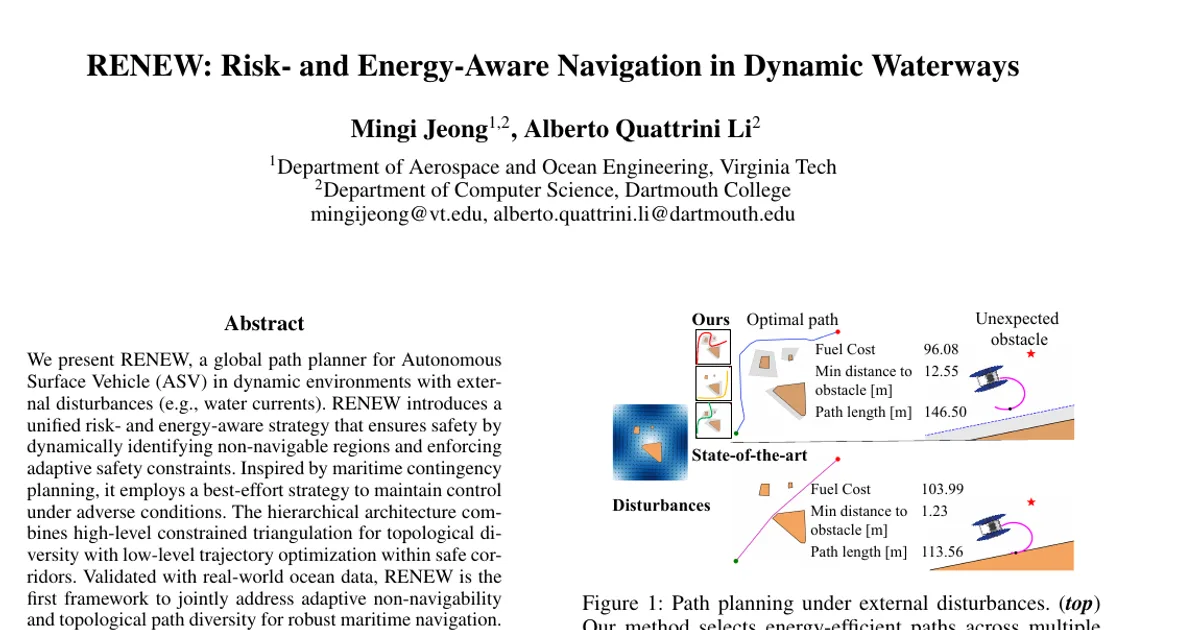
An ASV must plan a route through water where currents push it around: those currents change which areas are actually safe to enter and which routes burn the least fuel. Existing planners either treat safety margins as a fixed distance or find only one route, ignoring that several topologically distinct routes may exist and that the best one depends on the current.
RENEW's goal is a single global planner that (1) dynamically decides which regions are effectively non-navigable, (2) preserves a "best effort" contingency maneuver so the vehicle never enters an Inevitable Collision State, and (3) chooses among multiple homotopically distinct, kinematically feasible paths by fuel cost.
Key Contributions
-
A safety framework based on best-effort turning under uncertainty. It accounts for irregular, current-dependent maneuverability of a non-holonomic ASV and for no-go areas that shift with the disturbance field, using probabilistic collision bounds derived from hard-over turns.
-
An efficient hierarchical planner using constrained triangulation. A high-level stage finds topologically distinct (homotopic) channels via Constrained Delaunay Triangulation, and a low-level stage optimizes within the chosen channel for energy efficiency and kinematic feasibility.
-
Extensive validation via ablation studies and simulations, including a custom realistic 4-gyre environment and real-world current scenarios (Hansando, Far East Asian waters, Palawan Passage), compared against grid A*, RRT, RRT*, PRM, and their Dubins-constrained variants.
-
A first-of-its-kind unification, described by the authors as the first risk-aware global planner to unify dynamic external forces with topological guarantees for improved safety and efficiency, and the first framework to jointly
Authors’ abstract
We present RENEW, a global path planner for Autonomous Surface Vehicle (ASV) in dynamic environments with external disturbances (e.g., water currents). RENEW introduces a unified risk- and energy-aware strategy that ensures safety by dynamically identifying non-navigable regions and enforcing adaptive safety constraints. Inspired by maritime contingency planning, it employs a best-effort strategy to maintain control under adverse conditions. The hierarchical architecture combines high-level constrained triangulation for topological diversity with low-level trajectory optimization within safe corridors. Validated with real-world ocean data, RENEW is the first framework to jointly address adaptive non-navigability and topological path diversity for robust maritime navigation.