Research
ReMoMask-2: Latent Retrieval-Augmented Masked Motion Generation
Overview Research area: Computer Vision, specifically text-to-motion (T2M) generation — the task of turning a natural language description into a sequence of human joint movements — with a focus on re
- arXiv
- 2609.08365
- Published
- 2026-09-08
- Authors
- Yiran Wang, Zeyu Zhang, Ling Shao, Hao Tang
AI summary
Overview
Research area: Computer Vision, specifically text-to-motion (T2M) generation — the task of turning a natural language description into a sequence of human joint movements — with a focus on retrieval-augmented generation (RAG-T2M).
Technical level: Advanced. The paper assumes familiarity with contrastive learning (InfoNCE), momentum encoders, residual vector-quantized VAEs (RVQ-VAE), masked generative transformers, and knowledge distillation. The methodology section is written for readers already working in motion synthesis or retrieval-augmented generation.
Scope: The paper presents ReMoMask, a structure-aware retrieval-augmented masked motion generation framework, and ReMoMask-2, an extension that moves the retrieval database into the generator's own pre-quantization latent space so a single generative stage suffices.
What This Paper Is About
Retrieval-augmented text-to-motion models retrieve motion–text pairs from an external database and inject them into a generator, which helps most on uncommon or complex descriptions. The authors argue these models have two weaknesses: retrieval and fusion ignore the hierarchical, part-level and spatial–temporal structure of human motion, and retrieved evidence lives in a contrastive semantic space that is learned separately from the latents the generator actually manipulates, creating a representation gap. The goal is to remove both problems — first by making alignment and fusion structurally consistent with motion topology (ReMoMask), and then by rebuilding retrieval inside the generator's own latent space (ReMoMask-2).
Key Contributions
- ReMoMask (conference version, ECCV 2026): a retrieval-augmented masked generative framework that enforces structural consistency along two axes — alignment granularity and fusion compatibility — by coupling Hierarchical Bidirectional Momentum (HBM) alignment, Semantic Spatial-Temporal Attention (SSTA), and Topology Structured Masking (TSM).
- HBM: a structured contrastive framework that jointly supervises instance-level (global) and part-level bidirectional text–motion correspondence under a momentum-based paradigm, using a queue of momentum embeddings as negative keys.
- SSTA and TSM: a topology-aware cross-attention module with an asymmetric Query/Key/Value design over 2D spatial–temporal motion tokens, plus a training strategy that adaptively masks motion tokens according to part-level semantic relevance.
- ReMoMask-2: an extension along a third axis — representation consistency — that rebuilds the retrieval database in the frozen RVQ-VAE's pre-quantization latent space $z_e$ and aligns text queries to it with a lightweight projector (~1.57M parameters) distilled from the HBM retriever. The residual-refinement transformer of the conference version is removed, yielding a single-stage system.
Main Findings
- State-of-the-art retrieval: on HumanML3D the HBM retriever reaches R@1 of 18.49 in text-to-motion retrieval, against 11.00 for the next best (ReMoGPT, reproduced by the authors). It is reported as state-of-the-art on all three benchmarks (HumanML3D, KIT-ML, SnapMoGen).
- KIT-ML and SnapMoGen retrieval: HBM achieves text-to-motion R@1 of 16.75 and 12.43, and motion-to-text R@1 of 12.14 and 11.62, respectively. Median ranks (MedR) are 8.50 (KIT-ML) and 16.50 (SnapMoGen) for text-to-motion.
- Generation fidelity: ReMoMask-2 is reported as the strongest retrieval-augmented generator on all three benchmarks, with the lowest FID among all compared methods on KIT-ML (0.138) and SnapMoGen (13.174).
- Single stage beats two stages: on HumanML3D, ReMoMask-2 with only a mask transformer achieves FID 0.042 versus 0.046 for the two-stage MoMask pipeline, and Top-1 0.528 versus 0.521.
- Large gains over the conference version: under a unified 20-repeat protocol, ReMoMask-2 improves FID by 65.9% on HumanML3D (0.123 to 0.042) and 75.4% on KIT-ML (0.562 to 0.138) relative to ReMoMask, while per-sample inference time drops from roughly 0.14s to 0.05s.
- The residual stage actively hurts: reattaching the residual-refinement transformer raises FID from 0.042 to 0.068 (a +0.026 gap, described as far exceeding the 95% confidence intervals of either configuration).
- 2D latent plus cross-attention is the best fusion design: in the pilot study on a MoMask backbone, 2D latent with cross-attention gives FID 0.036 ± .005 and Top-1 0.536 ± .002, compared with 1D with concatenation at 0.057 ± .013 and 0.511 ± .003, 1D with cross-attention at 0.043 ± .004 and 0.525 ± .003, and 2D with concatenation at 0.049 ± .007 and 0.518 ± .003. This result directly motivates SSTA.
- Retrieval database scale: the latent-aligned database $\mathcal{D}$ contains M = 66,912 entries covering 23,384 training clips (mirrored copies counted as separate entries), with keys pooled over a grid of $T' = T/4$ temporal steps and $J' = 6$ spatial positions at channel dimension $d_e = 1024$.
- Table completeness caveat: the generation results table in the provided content is truncated. The visible rows show LaMP with FID 0.032 ± .002, Top-1 0.557 ± .003, Top-2 0.751 ± .002, Top-3 0.843 ± .001 on HumanML3D, but the full per-method comparison including ReMoMask-2's own row is not present in the supplied text, so those figures cannot be verified here.
Methodology in Plain English
The framework has two layers of design. The first layer is about structure. Human motion is naturally hierarchical — arms, legs, backbone, root — so the authors decompose each motion into K = 6 semantic parts (right arm, left arm, right leg, left leg, backbone, root) and encode each part with a shared part encoder. A momentum-based contrastive scheme (HBM) then aligns text with both the whole motion (instance-level) and each part (part-level), in both directions, using an InfoNCE loss with a queue of momentum embeddings supplying extra negatives. The overall loss is $\mathcal{L}{\text{HBM}} = \mathcal{L}{\text{Inst}} + \lambda_P \mathcal{L}_{\text{Part}}$.
The second layer is about how retrieved evidence enters the generator. In SSTA, motion is kept as a 2D joint-by-time token grid rather than flattened into a 1D sequence. The Query comes only from the current motion latents; the Key concatenates motion latents with a single compressed semantic token built from the prompt, retrieved text, and retrieved motion, so semantics decide where to attend without overwriting the motion; the Value concatenates motion latents with the retrieved motion, deciding what content to synthesize. Textual signals were originally excluded from the Value path to avoid domain mismatch. TSM complements this by computing part-level relevance weights from text–part similarity and setting each part's masking probability to $\pi_{\text{base}} \cdot (1 - \alpha_{i,k})$, so semantically important parts are preserved as anchors while less relevant parts are masked aggressively.
The extension, ReMoMask-2, attacks the representation gap. Instead of retrieving in an HBM contrastive space $\mathcal{S}$ and forcing the fusion modules to implicitly learn a translation $\psi: \mathcal{S} \rightarrow \mathcal{Z}$ into the RVQ-VAE latent space $\mathcal{Z}$, the authors build keys directly from the frozen encoder's pre-quantization latents $z_e$, average-pool them over the grid, and $\ell_2$-normalize them, making retrieval plain cosine similarity. A small projector $\phi$ maps the 512-d CLIP ViT-B/32 text embedding into that same key space. Rather than regressing onto a single paired key, the projector is trained by knowledge distillation: the HBM teacher ranks the top $\kappa = 256$ database entries, and the student minimizes the KL divergence between teacher and student similarity distributions at temperature $\tau = 0.07$, for 200 epochs with batch size 128, while the RVQ-VAE, teacher, and CLIP encoder stay frozen. At generation time, retrieved motions and retrieved text are pushed through two linear adapters ($\mathbb{R}^{d_e} \rightarrow \mathbb{R}^{d}$) before entering SSTA, and because $R_t$ now lives in the generator's geometry, it is admitted into the Value pathway alongside $R_m$.
Why This Matters
Impact on research. The paper reframes retrieval-augmented motion generation as a question of representation consistency rather than module strength. Its ablation logic — showing that 2D latents with cross-attention beat 1D alternatives in a controlled pilot, and that aligning the retrieval space to the generative space makes a residual stage redundant — gives the field a concrete design principle: retrieved evidence should arrive in the representation the generator already consumes.
Real-world applications (drawn from the paper's own framing):
- Gaming, where articulated character motion must be produced on demand from scripted or typed descriptions.
- Film production, where manual animation cost is the bottleneck the paper says these methods aim to reduce.
- Virtual reality, where motion is needed interactively from user text input.
- Robotics, where natural language commands must be grounded in physical movement sequences.
Industry relevance. Inference speed is often the binding constraint in production. The reported reduction from roughly 0.14s to 0.05s per sample, achieved by both removing a generative stage and using a lighter retrieval front end, matters for interactive and real-time deployment, not just for benchmark scores.
Future Directions
- Generalization beyond the three benchmarks. The paper evaluates on HumanML3D, KIT-ML, and SnapMoGen. Whether latent-aligned retrieval transfers to other motion datasets, motion capture pipelines, or non-human articulated bodies is not reported.
- Reconciling retrieval-augmented models with the strongest non-retrieval baselines. The abstract claims the lowest FID among all compared methods only for KIT-ML and SnapMoGen, not for HumanML3D, where the visible table rows show LaMP at FID 0.032 ± .002. Understanding why retrieval augmentation does not dominate on HumanML3D is an open question the paper does not resolve in the provided content.
- When does an extra refinement stage help? The authors report that reattaching residual refinement raises FID from 0.042 to 0.068 and hypothesize the retrieval-conditioned mask transformer already absorbs the correction. Whether this holds under different retrieval qualities, database sizes, or masking ratios is not established.
- Database construction and cost. The database uses 66,912 entries over 23,384 training clips and depends on a frozen RVQ-VAE encoder. How retrieval quality and latency scale with database size, and whether the pipeline can be maintained as new motions arrive, are not reported.
Target Audience
Researchers and graduate students working on text-to-motion generation, retrieval-augmented generation, or multimodal contrastive learning, who want to understand how aligning the retrieval space with the generative latent space changes system design. Practitioners building motion synthesis tools for games, film, VR, or robotics will benefit most from the single-stage deployment result and the inference-time comparison. Readers need a working background in vector quantization, masked generative transformers, and contrastive objectives to follow the methodology in detail.
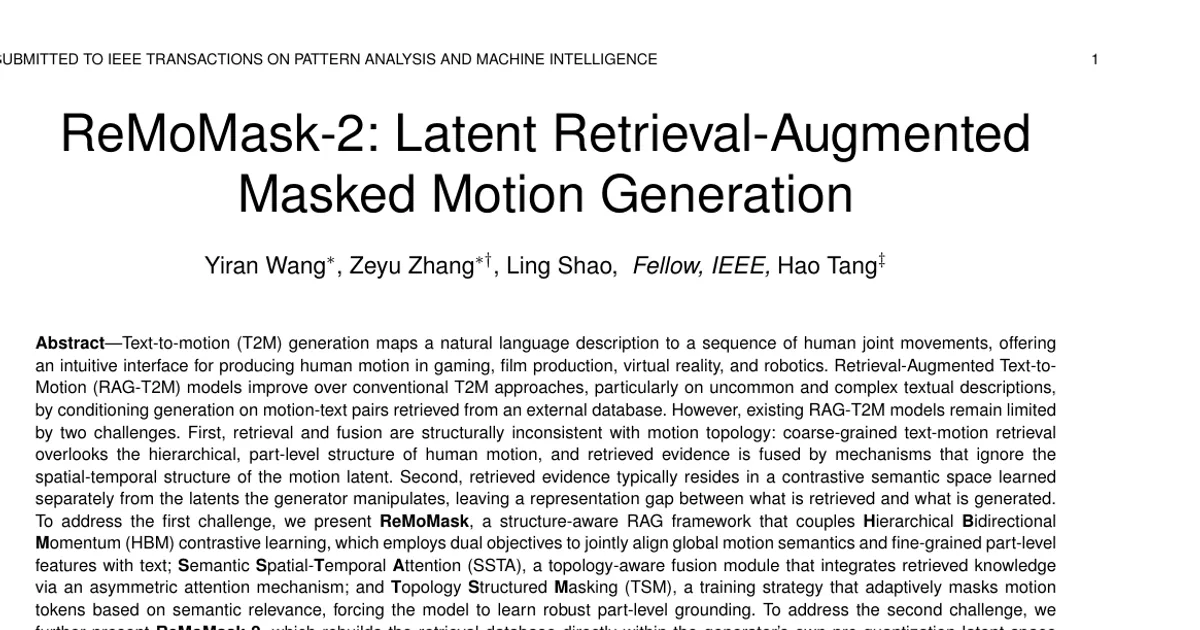
Authors’ abstract
Text-to-motion (T2M) generation maps natural language to human joint movements, aiding gaming, VR, and robotics. Retrieval-Augmented Text-to-Motion (RAG-T2M) improves generation on complex descriptions by conditioning on retrieved motion-text pairs. However, existing RAG-T2M models face two challenges: coarse-grained retrieval and fusion mechanisms overlook the hierarchical, spatial-temporal topology of human motion, and a representation gap exists because retrieved evidence resides in a semantic space separate from the generator's latents. To address the first, we present ReMoMask, a structure-aware RAG framework coupling Hierarchical Bidirectional Momentum (HBM) contrastive learning to align global and part-level features with text; Semantic Spatial-Temporal Attention (SSTA) for topology-aware fusion; and Topology Structured Masking (TSM) to force robust part-level grounding via adaptive masking. To address the second, we introduce ReMoMask-2, which rebuilds the retrieval database directly within the generator's pre-quantization latent space and aligns text queries via a distilled lightweight projector, allowing the generator to directly consume the retrieved motion's semantic content. Extensive experiments on HumanML3D, KIT-ML, and SnapMoGen demonstrate our retriever achieves state-of-the-art accuracy, while ReMoMask-2 attains the lowest FID on KIT-ML and SnapMoGen; notably, its single mask-transformer stage surpasses ReMoMask's full two-stage pipeline and delivers the fastest inference.