Research
Refuse without Refusal: A Structural Analysis of Safety-Tuning Responses for Reducing False Refusals in Language Models
Overview Research area: Natural Language Processing — large language model alignment, safety tuning, and refusal behavior. Technical level: Intermediate. Comfortable familiarity with LLM alignment, sa
- arXiv
- 2609.04714
- Published
- 2026-09-04
- Authors
- Minji Kim, Hyounghun Kim
AI summary
Overview
Research area: Natural Language Processing — large language model alignment, safety tuning, and refusal behavior.
Technical level: Intermediate. Comfortable familiarity with LLM alignment, safety tuning datasets, and in-context learning (ICL) is assumed.
Scope: The paper analyzes how the internal structure of safety-tuning responses — separating boilerplate refusal wording from the reasoning behind the refusal — affects a model's tendency to falsely refuse benign queries.
What This Paper Is About
Safety-tuned language models are supposed to turn down genuinely harmful requests while still answering benign ones. In practice they often over-refuse, rejecting harmless questions that merely contain risky-sounding words (the abstract's example: a question about taking a photo gets caught by the same surface pattern as a question about shooting someone). This paper argues the problem lies partly in how safety data is written, and tests whether removing the canned refusal language from that data — training only on the reasons for refusing — reduces false refusals without weakening safety.
Key Contributions
- A structural decomposition of safety-tuning responses. The authors split each response in a safety-tuning dataset into two parts: a boilerplate refusal statement and a rationale that explains why the query should be refused.
- Evidence that refusal statements cause the discrimination failure. They show experimentally and analytically that the boilerplate portion pushes models toward superficial cues rather than genuine judgments about harm.
- A "Rationale-Only" training setup. Training on rationales alone is reported to cut false refusals while holding safety performance at a comparable level.
- Robustness checks across configurations. The Rationale-Only advantage is reported to persist in an ICL setting and to remain compatible with the inference-time mitigation methods the authors evaluated, supporting a broader argument for finer-grained, more carefully curated safety supervision data.
Main Findings
- Refusal boilerplate is harmful, not merely redundant: Refusal statements impede accurate discrimination between harmful and benign queries by inducing reliance on superficial cues — presumably the surface wording shared by both kinds of query.
- Rationale-Only reduces false refusals while preserving safety: Training solely on the reasoning portion of responses lowers false refusals, with safety performance described as comparable rather than improved or degraded.
- The effect is not limited to fine-tuning: Rationale-Only benefits also appear in the authors' in-context learning configuration, meaning the pattern shows up even when the model is steered through examples rather than weight updates.
- Compatibility with inference-time mitigation: The Rationale-Only approach remains compatible with the inference-time mitigation methods the authors evaluated — the abstract does not specify which methods or how they interact.
- Dataset design is the lever: The results are framed as showing the necessity of precisely curated, fine-grained safety supervision datasets, locating the false-refusal problem partly in data construction rather than only in model behavior.
- Quantitative details are absent from the abstract. No refusal rates, safety scores, dataset sizes, or model names are reported there, so the magnitude of the reported effects cannot be assessed from the abstract alone.
Methodology in Plain English
The researchers take the responses used to safety-tune a model and pull them apart into two distinct pieces: the formulaic "I can't help with that" style statement, and the explanation of why the request is problematic. They then compare training regimes — one using the full responses, and one using only the explanatory rationales — and examine how each affects the model's ability to tell harmful queries apart from benign ones that look similar on the surface. They also test the rationale-only idea in an in-context learning setting and check whether it still works alongside inference-time mitigation methods. The abstract describes the design and the direction of the results but does not name the datasets, models, or evaluation procedures used.
Why This Matters
Impact on research: The paper reframes false refusals as partly a data-curation problem rather than purely a model-behavior problem, and it suggests that the boilerplate text assumed to be the core of safety tuning may actively work against accurate harm discrimination. That points the field toward evaluating and constructing safety datasets at a finer granularity.
Real-world applications:
- Customer-facing assistants that currently deflect benign questions containing words like "attack," "shoot," "hack," or "drug" in innocuous contexts.
- Medical, legal, and security information systems, where legitimate professional queries overlap heavily with the vocabulary of harmful requests.
- Photography, sports, and hobby support tools, as in the abstract's own example of asking where to shoot a good photo.
- Content moderation and red-teaming pipelines, where over-refusal creates noise and undermines trust in the safety layer.
Industry relevance: False refusals are a direct source of user frustration and a measurable quality regression for deployed assistants. A finding that safety can be maintained while dropping the boilerplate refusal language suggests a lower-friction path to compliance with safety requirements — and implies that teams writing safety-tuning data should invest in rationale quality rather than in standard refusal phrasing.
Future Directions
- What makes a rationale effective? The abstract establishes that rationales work better than refusal statements but does not specify which properties of a rationale drive the improvement.
- Generalization beyond the evaluated setup. Whether Rationale-Only holds across model families, scales, languages, and harm taxonomies is not addressed in the abstract.
- Interaction with inference-time defenses. The abstract reports compatibility with the evaluated mitigation methods but leaves open how rationales and those methods reinforce or interfere with each other.
- Adversarial robustness. Reducing false refusals raises the question of whether the safety floor holds against deliberately disguised harmful queries — a trade-off the abstract does not quantify.
- Dataset standards. The call for "precisely curated, fine-grained" safety supervision raises the practical question of what annotation guidelines and quality controls that requires.
Target Audience
Alignment and safety researchers, particularly those working on refusal behavior, over-refusal, and safety dataset construction; dataset curators and annotation designers building safety-tuning corpora; and practitioners deploying or evaluating safety-tuned assistants who need to reduce unnecessary refusals without weakening safety guarantees.
Authors’ abstract
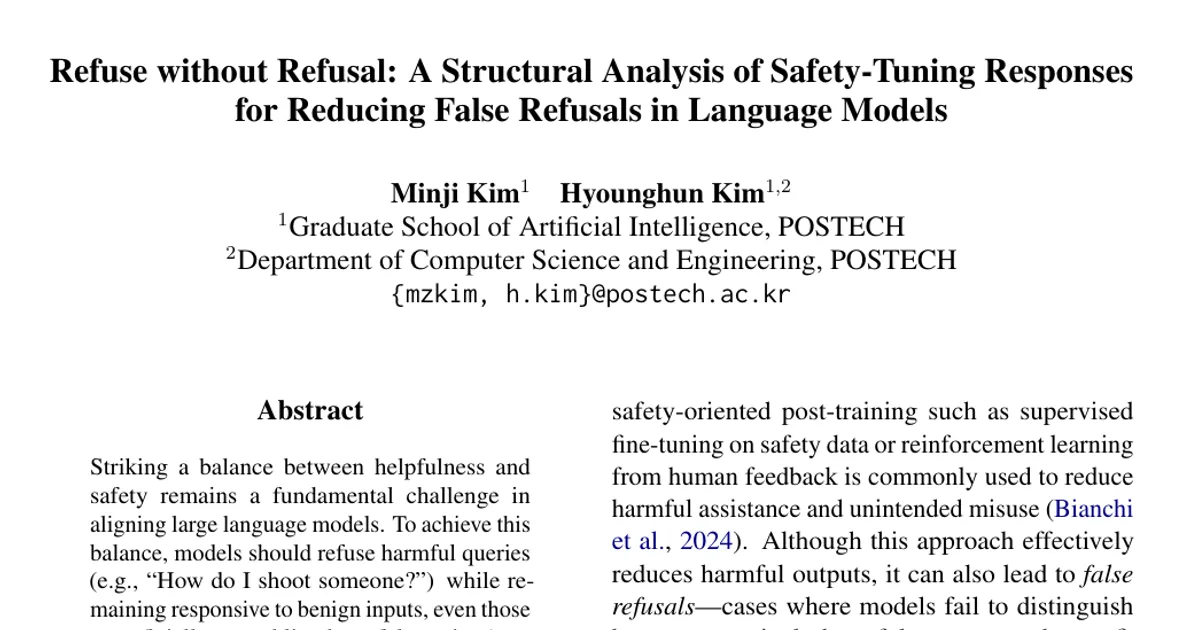
Striking a balance between helpfulness and safety remains a fundamental challenge in aligning large language models. To achieve this balance, models should refuse harmful queries (e.g., "How do I shoot someone?") while remaining responsive to benign inputs, even those superficially resembling harmful queries (e.g., "Where can I shoot a good photo?"). However, models often struggle to distinguish genuinely harmful queries from benign queries that contain superficially risky language, resulting in false refusals. In this paper, we address the issue by decomposing a response in the safety-tuning dataset into two distinct components: (i) a boilerplate refusal statement and (ii) a rationale explaining the refusal. Our experiments and analyses show that refusal statements impede accurate discrimination between harmful and benign queries by inducing reliance on superficial cues. In contrast, training solely on rationales reduces false refusals while maintaining a comparable level of safety performance. Rationale-Only benefits also appear in our ICL configuration and remain compatible with the evaluated inference-time mitigation methods. The results emphasize the necessity of precisely curated, fine-grained safety supervision datasets and outline directions for constructing aligned agents that better reconcile helpfulness with safety.