Research
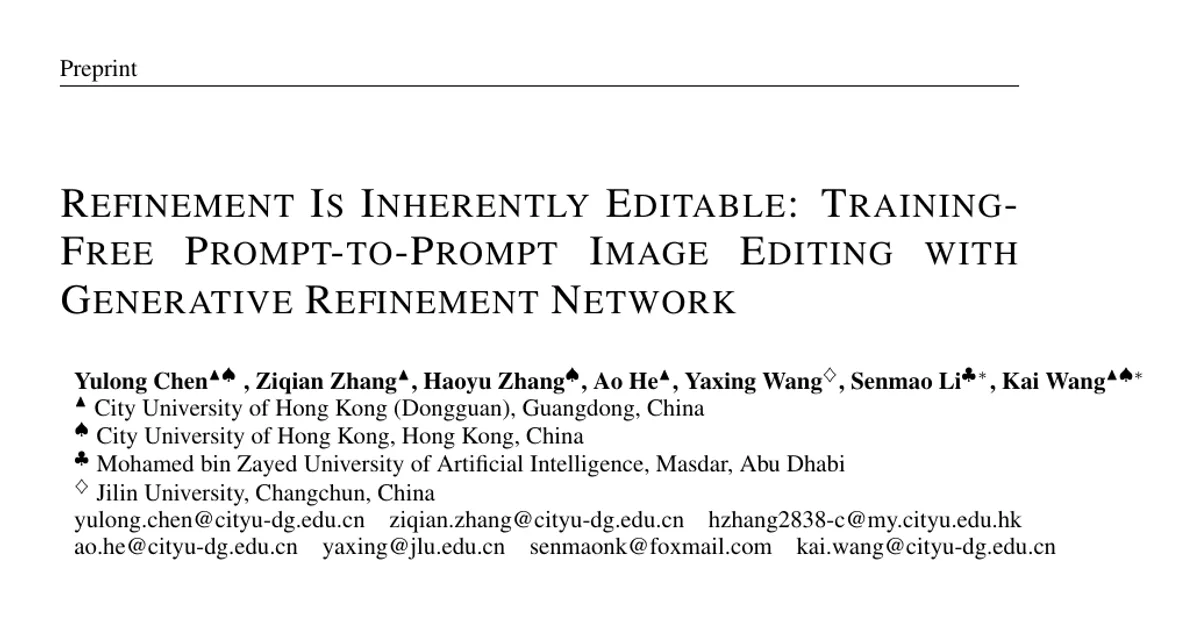
Refinement Is Inherently Editable: Training-Free Prompt-to-Prompt Image Editing with Generative Refinement Network
RefineEdit: Refinement Is Inherently Editable Overview Research area: Computer Vision — training-free text-guided image editing with generative models (specifically, edits performed on a Generative Re
- arXiv
- 2609.20633
- Published
- 2026-09-17
- Authors
- Yulong Chen, Ziqian Zhang, Haoyu Zhang, Ao He, Yaxing Wang, Senmao Li, Kai Wang
AI summary
RefineEdit: Refinement Is Inherently EditableOverview
Research area: Computer Vision — training-free text-guided image editing with generative models (specifically, edits performed on a Generative Refinement Network, or GRN).
Technical level: Advanced. The paper assumes familiarity with autoregressive and diffusion image generation, binary visual tokenizers, and prompt-to-prompt editing.
Scope: The paper introduces RefineEdit, a training-free framework that edits images by selectively routing binary code updates between a source branch and an editing branch inside a pretrained GRN, and evaluates it on nine editing categories of PIE-Bench plus EditEval v2.
What This Paper Is About
Text-guided image editing must change what the user asks for while leaving everything else alone, and most training-free editors do this by imposing some form of spatial control (masks, attention maps, or injected features). The accuracy of that control decides whether edits end up incomplete or whether they leak into unrelated regions — and in causal autoregressive models, decisions made early in decoding are hard to revise later.
The authors observe that the Generative Refinement Network (GRN) updates every binary coordinate repeatedly rather than committing to a fixed order, so intermediate states contain reusable spatial structure and per-bit probability differences between a source prompt and an editing prompt become usable editing evidence. RefineEdit exploits this to let edit localization and content generation evolve together, without additional training, external masks, or attention control.
Key Contributions
-
The observation that refinement is inherently editable, and the resulting RefineEdit framework — described as the first training-free prompt-to-prompt image editing framework built on the GRN. It couples edit localization with content generation so editing evidence can be revised as the image evolves.
-
Source-anchored bit routing, which uses signed probability differences between the source and editing branches to select editable spatial positions and bits, while anchoring all remaining coordinates to the evolving source trajectory.
-
Two stabilization mechanisms: adaptive spatial freezing (AdaSF), which freezes spatial selection at the switch step when the initial editing response is strong enough to limit unnecessary expansion of the editing region; and finite bit locking (FBL), which retains editing permission for recently selected bits over a short window so temporary probability fluctuations do not interrupt their refinement.
-
An empirical demonstration across nine editing categories of PIE-Bench, showing best-in-class background preservation on PSNR, LPIPS, MSE, and SSIM together with the highest whole-image and edited-region CLIP scores among the evaluated methods, plus ablation studies isolating the roles of AdaSF and FBL.
Main Findings
-
Best background preservation across nine PIE-Bench editing categories. RefineEdit (GRN backbone) records PSNR 30.36, LPIPS 0.032, MSE 0.0045, and SSIM 0.950, the best scores on all four preservation metrics among the compared methods.
-
Best semantic alignment. It reports the highest whole-image and edited-region CLIP scores among the evaluated methods (26.59 and 23.44 respectively). Its edited-region CLIP exceeds LEDits++ by 0.15.
-
Large PSNR gain over the strongest flow baseline. Compared with FlowEdit, RefineEdit improves PSNR by 5.33 dB.
-
Not uniformly ahead. The paper states that the gains in MSE and CLIP are modest, and that FlowEdit remains stronger in Structure Distance (FlowEdit 0.0162 versus RefineEdit 0.0266). RefineEdit's Structure Distance of 0.0266 matches ChordEdit's.
-
Runtime is competitive. At 1024 × 1024 resolution on a single NVIDIA A100 GPU, RefineEdit takes 26.77 seconds per edit on average over ten runs excluding I/O. This is comparable to FlowEdit (27.15 s) and lower than RF-Inversion (32.05 s), with approximately threefold speedup over PnP (79.70 s) and PnP-DirectInv (79.65 s).
-
The two stabilization mechanisms are complementary. On the object-replacement subset, removing FBL improves background preservation (PSNR 31.04, LPIPS 0.041, SSIM 0.938) but lowers both CLIP scores (26.34 whole, 23.01 edited). Removing AdaSF improves CLIP scores (26.59, 23.44) at the cost of background preservation and structural consistency (PSNR 28.76, LPIPS 0.050, SSIM 0.920, Structure Distance 0.033). The full model records 0.028, 30.04, 0.044, 0.932, 26.48, and 23.17.
-
Thresholds trade scope against strength. Increasing the spatial threshold τ_spa restricts the selected region and improves background preservation but lowers edited-region CLIP; increasing the bitwise threshold τ_pow restricts the bits eligible for editing, improving all reported background metrics while lowering both CLIP scores.
-
Switch step controls editability. Branching too early lets target semantics spread into the background; branching too late preserves source structure but leaves the intended transformation incomplete. In the qualitative comparison, t_s = 18 balances editability and preservation. The authors note that because the endpoint is fixed, changing t_s alters both the inherited source state and the number of remaining editing iterations, and their results do not isolate either factor as the sole cause.
-
Human preference favors the method. A user study with 20 participants, covering 20 sets of editing results (400 votes in total) randomly sampled across all editing categories, found RefineEdit received a higher proportion of preference votes than LEDits++, FlowEdit, and ChordEdit.
-
Cross-dataset behavior. On EditEval v2, RefineEdit achieves strong content preservation and competitive alignment with editing prompts, using the same settings from PIE-Bench without retuning.
Methodology in Plain English
RefineEdit starts by letting the GRN generate a source image under the source prompt. The GRN represents images as binary codes (via Hierarchical Binary Quantization), where each spatial position holds many bits, and it repeatedly re-predicts all of these codes across 50 refinement iterations rather than locking them in.
At a chosen "switch step," the method clones the current source state to create an editing branch. Both branches then keep refining, one under the source prompt and one under the editing prompt, sharing the same initial random code and schedule.
At every step, the two branches assign probabilities to the same bits. The signed difference between those probabilities — how much less the editing branch likes the source-sampled bit — serves as evidence for where editing should be allowed. Averaging these differences across the bits at a position produces a spatial score, and thresholding it yields a spatial mask of editable positions; thresholding the per-bit differences inside those positions yields a bitwise mask.
Routing then works simply: coordinates selected by the mask take the editing branch's proposed values, and everything else copies the source branch's state at the same step. Because the source branch keeps evolving, unselected content is anchored to an evolving trajectory rather than to a frozen snapshot.
Two stabilizers keep these decisions from flickering. Adaptive spatial freezing computes the average margin by which selected positions exceed the spatial threshold at the switch step; if that response is at least twice the spatial threshold, the spatial mask is frozen there for the rest of the run. Finite bit locking keeps a bit editable if it passed the bitwise test at any point in the latest K = 4 steps, so brief probability dips do not cut an edit short. The final step routes sampled predictions from both branches and decodes the resulting binary code, without mixing in the initial random code.
Evaluation uses 560 prompt pairs across nine PIE-Bench categories, with source images generated by GRN at 1024 × 1024. Baselines edit the same source image; because they produce 512 × 512 outputs in this setup, both source images and results are resized to 512 × 512 before evaluation. Grounded-SAM provides foreground masks for regional scoring, and these evaluation masks are separate from the dynamic masks RefineEdit predicts.
Why This Matters
Impact on research. The paper reframes edit localization as something that can emerge from the generation process itself rather than being imposed by an external control signal. Because GRN reconsiders every binary coordinate repeatedly, the method sidesteps the fixed-decoding-order limitation the authors attribute to causal autoregressive editors, and shows that per-coordinate probability contrast between prompts is a usable, training-free editing signal. It also extends GRN's original applications beyond image generation and training-based video editing into a new task.
Potential real-world applications:
- Iterative creative workflows where a user revises a generated image with a short text prompt instead of regenerating from scratch.
- Localized product or marketing image adjustments, such as changing an object or its color while keeping the surrounding scene and composition intact.
- Photo retouching tasks that require removing or adding a single element — the paper's examples include removing sunglasses while retaining a car interior and adding a goat while preserving a mountain scene.
- Style transfer pipelines where the surrounding composition must remain recognizable.
Industry relevance. The method needs no additional training, no external masks, and no attention control, so it can be layered on top of an existing frozen pretrained generator. At 26.77 seconds per edit at 1024 × 1024 on a single A100, it is competitive with flow-based editing (FlowEdit at 27.15 s) and roughly three times faster than the PnP and PnP-DirectInv diffusion baselines measured in the paper, which matters for interactive or production-scale use.
Future Directions
- Extending the insight beyond GRN. The conclusion explicitly raises exploring "refinement is inherently editable" outside GRN as a direction for training-free image editing.
- Isolating what the switch step actually controls. The authors note their switch-step comparison changes both the inherited source state and the number of remaining editing iterations, and does not isolate either factor as the sole cause.
- Closing the remaining metric gaps. The paper reports that MSE and CLIP gains are modest and that FlowEdit remains stronger in Structure Distance, leaving room for improvement.
- Removing per-category tuning. RefineEdit selects the switch step, spatial threshold, and bitwise threshold by editing category; the paper does not report a single unified configuration across all nine categories.
Target Audience
Researchers and engineers working on training-free image editing, diffusion and autoregressive generative models, and discrete visual tokenization. It is most useful to readers already comfortable with attention control, mask-based editing, and binary code representations, since the core mechanism is expressed through per-bit probability differences inside a refinement network. Practitioners building prompt-based image revision tools will find the runtime and no-training-required properties relevant, while the ablation and hyperparameter tables will mainly interest those comparing editing methods on standardized benchmarks.
Authors’ abstract
Text-guided image editing must introduce the requested changes while preserving unrelated source content. In training-free editing, diffusion editors often use spatial controls whose inaccuracies can leave edits incomplete or alter unrelated regions. Causal autoregressive editors face a further constraint: their fixed decoding order limits revision of earlier decisions. As the first to explore training-free image editing with Generative Refinement Networks (GRN), we observe that its refinement process is inherently suitable for editing and offers a promising way to address these limitations. Motivated by this observation, we introduce RefineEdit, a training-free prompt-to-prompt image editing framework built on the GRN. Our key idea is to couple edit localization with content generation through the global refinement of binary image codes, allowing editing evidence to be revised as the image evolves. More specifically, RefineEdit combines bit routing with two stabilization mechanisms: adaptive spatial freezing and finite bit locking. Bit routing starts from an intermediate source state and uses signed probability differences between the two branches to identify editable positions and bits. It directs selected bits toward editing refinement while anchoring the rest to the evolving source trajectory. Adaptive spatial freezing limits unnecessary expansion of the editing region, while finite bit locking maintains recent bit activations to support continued editing. The overall framework requires no additional training, external masks, or attention control. Across nine editing categories of PIE-Bench, RefineEdit achieves the best background-preservation scores in PSNR, LPIPS, MSE, and SSIM, together with the highest whole-image and edited-region CLIP scores among the evaluated methods. Code is available at https://github.com/mura1n/RefineEdit.