Research
Recoverability Has a Law: The ERR Measure for Tool-Augmented Agents
Overview Research area: Machine learning for tool-augmented language model agents, specifically execution-level robustness and failure recovery in multi-step tool use. Technical level: Advanced. The p
- arXiv
- 2601.22352
- Published
- 2026-01-29
- Authors
- Sri Vatsa Vuddanti, Satwik Kumar Chittiprolu
AI summary
Overview
Research area: Machine learning for tool-augmented language model agents, specifically execution-level robustness and failure recovery in multi-step tool use.
Technical level: Advanced. The paper derives regret bounds in a discounted Markov decision process framework and states a theorem on surrogate uniqueness, though the central result is a simple algebraic relationship that non-specialists can follow.
Scope in one sentence: The paper proposes and empirically tests a first-order law relating an observable "Efficiency Score" (ES) to an expected recovery regret (ERR) for language model agents that must recover from failed tool calls under stochastic execution noise.
What This Paper Is About
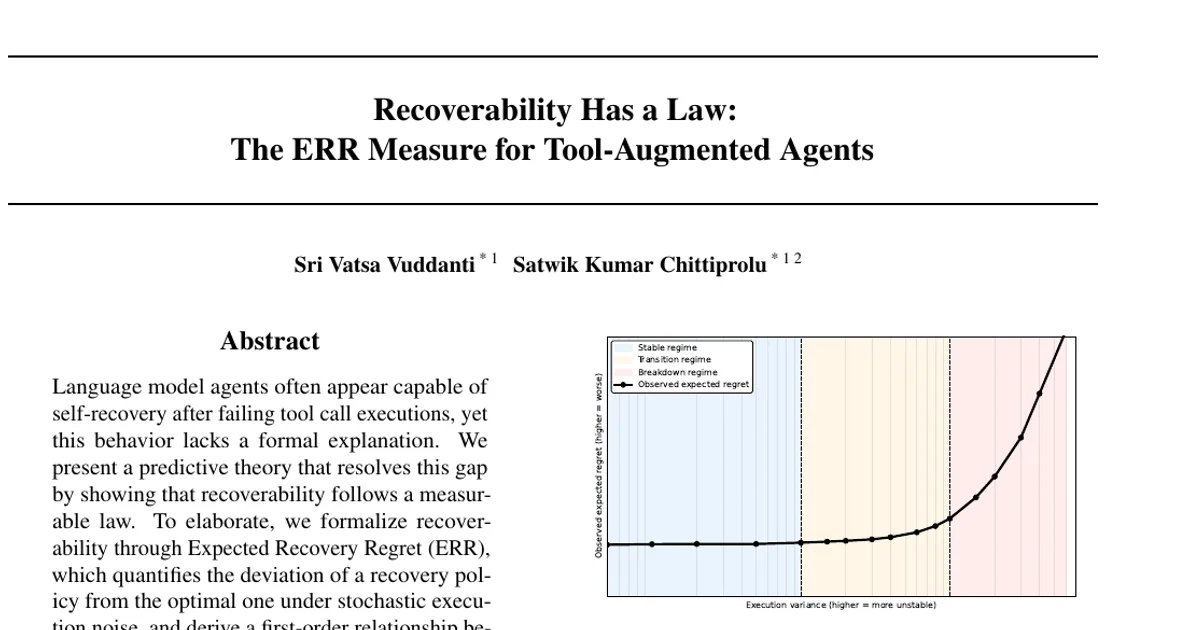
Tool-using language model agents often appear to recover after a tool call fails, but there has been no formal, predictive account of when recovery succeeds, when it fails, or how errors compound over a trajectory. The authors define recoverability through Expected Recovery Regret (ERR) — the excess loss of a recovery policy relative to an optimal one under the same stochastic execution noise — and derive a first-order relationship between ERR and an observable quantity, the Efficiency Score (ES). They then test whether this ERR–ES relationship predicts measured post-failure regret across models, benchmarks, and perturbation regimes.
Key Contributions
-
A formal definition of execution-level recoverability. The paper defines Expected Recovery Regret (ERR) as the expected gap between a recovery policy's discounted loss and that of the optimal recovery policy under a stochastic perturbation process, moving robustness analysis from static input perturbations to trajectory-level execution dynamics.
-
A falsifiable first-order recovery law. The authors derive the bound ERR(π) ≤ (1/(1−γ))(1−ES) + O(λ c_max), where ES = RR / (1 + λC/C_max), RR is recovery rate, and C is normalized cumulative cost, yielding the empirical predictor ERR̂_law = (1/(1−γ))(1−ES) with γ = 0.9.
-
A uniqueness result for the efficiency surrogate. Theorem 3.1 states that any scalar surrogate S(RR, C) whose complement is affine-equivalent to ERR in the bounded-cost regime must take the form S = RR/(1 + λC) up to positive affine rescaling, so ES is not a design choice but the only surrogate compatible with the linearized regret.
-
Empirical validation across models, benchmarks, and perturbation regimes. The authors report that predicted regret matches observed post-failure regret within Δ_norm ≤ 0.05 across five tool-use benchmarks, four open-weight backbones, and multiple recovery policies.
Main Findings
-
Diverse recovery strategies collapse onto a shared efficiency–regret structure. In Table 1, observed ERR decreases monotonically as ES rises across five recovery configurations: Vanilla (14B) RR 38.2%, CSR 35.4%, ES 0.312, observed ERR 7.02±0.10; ToolBench RR 61.5%, CSR 56.6%, ES 0.504, observed ERR 4.98±0.09; ToolReflect RR 69.9%, CSR 62.2%, ES 0.577, observed ERR 4.25±0.09; CRITIC RR 78.7%, CSR 67.9%, ES 0.661, observed ERR 3.41±0.08; FORTIFY RR 94.7%, CSR 85.1%, ES 0.814, observed ERR 1.78±0.07.
-
The geometry is mechanism-invariant. Table 2 shows that removing retrieval conditioning drops ES to 0.725 and raises predicted ERR by 0.47, and removing recovery weighting drops ES to 0.707 and raises predicted ERR by 0.52, relative to the full system at ES 0.814. Both mechanisms move systems along the same curve rather than creating new regimes.
-
Scale reduces variance rather than altering the law's form. Table 3 reports Thinking V1 32B at RR 96.0%, ES 0.823, predicted ERR 1.69; Qwen 2.5 14B at RR 94.7%, ES 0.814, predicted ERR 1.78; Gemma 3 12B at RR 92.4%, ES 0.797, predicted ERR 1.96; and Llama 3 8B at RR 88.5%, ES 0.755, predicted ERR 2.47. Larger models show smoother recovery and tighter adherence.
-
Early-step efficiency dominates long-horizon stability. Table 4 reports per-step stability from S1 to S6. Vanilla 14B falls from 34.8 at S1 to 0.0 at S6, while FORTIFY falls from 78.3 at S1 to 59.5 at S6. The paper calls this early-step dominance: small early improvements geometrically suppress downstream error cascades.
-
Predictions match observations across models and environments. Table 5 reports Δ_norm values of 0.024 (Vanilla), 0.008 (ToolBench), 0.014 (ToolReflect), 0.012 (CRITIC), and 0.051 (FORTIFY). Table 6 reports ES between 0.813 and 0.816 and Δ_norm between 0.016 and 0.017 across PaladinEval, API–Bank, WikidataLive, and ToolReflectEval.
-
The law holds within a defined regime. Section 7 identifies three boundary conditions: non-stationary tool semantics (API schema changes raise loss without changing ES), high-retrial and low-cost regimes (e.g., up to fifteen retries with near-zero penalty), and non-ergodic interaction loops (caches, in-context memory, adaptive patches) where the law remains locally predictive but cannot govern global accumulation.
-
Benchmark and seed reporting varies within the paper. Section 5.2 names FortifyEval, ToolReflectEval, API–Bank, Wikidata, and three production APIs (finance, travel, weather) as the five settings; Section 5.2 also says the settings span five environments. Section 6 instead lists PaladinEval, ToolReflectEval, API–Bank, and WikidataLive as four execution-level benchmarks. Section 5.4 states 200 Monte-Carlo rollouts over five random seeds, while Section 6 states metrics are averaged over three seeds.
Methodology in Plain English
The authors model a tool-using agent as a policy that repeatedly observes a state, issues an action, and receives an outcome perturbed by stochastic execution noise such as latency, schema drift, or malformed output. They assume bounded per-step cost, Lipschitz-continuous loss in the perturbation, stationary perturbations, and a discounted horizon with γ = 0.9. Under these assumptions they linearize the per-step loss gap as approximately proportional to cost times failure probability, sum it over the discounted horizon, and simplify to an upper bound in terms of a single observable called the Efficiency Score. The appendix states that with λ = 0.5 and token-normalized costs c_max ≤ 0.1, the product λ c_max ≤ 0.05, which justifies the first-order approximation. Because the optimal recovery policy is unobservable, they approximate it with a supervised recovery prior trained on synthetic failure trajectories and, at inference time, optionally augment it with retrieval of K semantically similar failure–recovery exemplars. They then run rollouts with perturbations sampled from the noise process, compute RR, CSR, and ES from trajectories, and compare observed regret against the law's prediction using the deviation metric Δ_pred = |ERR_obs − (1/(1−γ))(1−ES)|. Reported predicted ERR values use the first-order law with β = 0, and no fitted or calibrated terms are used in the main validation. Experiments ran on 8× A100 80GB GPUs with deterministic sampling.
Why This Matters
The paper reframes robustness for tool-augmented agents as a measurable property of interaction dynamics rather than an emergent byproduct of model scale or architecture. If the ERR–ES relationship holds, it connects classical regret bounds in robust MDPs and risk-sensitive control to quantities that can be measured from ordinary execution logs.
Real-world applications:
- Recovery-aware gating in agent pipelines. A controller can estimate whether a plan lies in a recoverable regime before executing it, then defer or reject plans outside viable recovery bounds.
- Corrective budget allocation. Since ES couples success and cost, teams can allocate retry and repair budgets where the expected regret reduction per unit cost is highest.
- Curriculum design for agent training. The authors suggest tasks with high expected regret but bounded recoverability could serve as effective adaptation anchors.
- Risk monitoring in high-stakes pipelines. Deviations from the efficiency–regret manifold are proposed as a quantitative risk indicator for finance, travel, or weather API integrations.
Industry relevance: Any organization deploying language model agents over APIs, databases, or multi-step workflows needs to predict failure cascades rather than observe them post hoc. A law that requires only success rate and normalized cost — both cheaply observable at runtime — offers a practical diagnostic layer for agents operating in stochastic tool environments, without needing to simulate full rollouts or estimate ERR directly.
Future Directions
-
Extending the law beyond stationarity. The paper states that non-stationary tool semantics cause ERR to grow while ES stays unchanged, systematically underestimating regret. Handling semantic drift is explicitly named as a natural direction for future theoretical work.
-
Handling unbounded retries and high-variance cost regimes. When λ approaches 0 or budgets become unbounded, the linearized excess-loss approximation becomes loose and ES stops tracking meaningful efficiency. A theory covering brute-force search regimes is left open.
-
Non-ergodic interaction loops. Because autonomous agents accumulate internal state over days or weeks through caches, in-context memory, and adaptive patches, ERR–ES is currently limited to local prediction. Global accumulation under persistent state change is unresolved.
-
Integration with adaptive priors, shift estimators, and hierarchical planners. The outlook section proposes shaping agent behavior to preserve stable recoverability over time, and asks whether recoverability could serve as a primitive for interactive intelligence analogous to generalization in static prediction.
Target Audience
This paper is most useful to researchers working on agent robustness, tool-use evaluation, or the theory of language model control, and to practitioners designing recovery mechanisms or safety gates for multi-step API workflows. Readers with a background in reinforcement learning, robust MDPs, or scaling-law methodology will get the most from the derivations in Section 3 and Appendix A; readers focused on applied agent engineering will find Tables 1 through 6 and the failure-mode taxonomy in Section 7 the most actionable parts.
Authors’ abstract
Language model agents often appear capable of self-recovery after failing tool call executions, yet this behavior lacks a formal explanation. We present a predictive theory that resolves this gap by showing that recoverability follows a measurable law. To elaborate, we formalize recoverability through Expected Recovery Regret (ERR), which quantifies the deviation of a recovery policy from the optimal one under stochastic execution noise, and derive a first-order relationship between ERR and an empirical observable quantity, the Efficiency Score (ES). This yields a falsifiable first-order quantitative law of recovery dynamics in tool-using agents. We empirically validate the law across five tool-use benchmarks spanning controlled perturbations, diagnostic reasoning, and real-world APIs. Across model scales, perturbation regimes, and recovery horizons, predicted regret under the ERR-ES law closely matched observed post-failure regret measured from Monte Carlo rollouts, within delta less than or equal to 0.05. Our results reveal that recoverability is not an artifact of model scale or architecture, but a governed property of interaction dynamics, providing a theoretical foundation for execution-level robustness in language agents.