Research
RECAP-Forcing: Retaining Content Appearances for Long Video Generation
RECAP-Forcing: Retaining Content Appearances for Long Video Generation Overview Research area: Computer vision / generative video — specifically long-horizon autoregressive video diffusion and the mem
- arXiv
- 2608.26671
- Published
- 2026-08-27
- Authors
- Haiyang Xu, Zheng Ding, Zhuowen Tu
AI summary
RECAP-Forcing: Retaining Content Appearances for Long Video GenerationOverview
- Research area: Computer vision / generative video — specifically long-horizon autoregressive video diffusion and the memory (KV cache) management that makes minute-scale generation possible.
- Technical level: Intermediate. The high-level idea is intuitive (remember what appeared, not when it appeared), but understanding the mechanism requires familiarity with autoregressive video diffusion, attention sinks, KV caches, and rotary positional embeddings.
- Scope: A single paper proposing a training-free inference-time memory scheme that reorganizes a causal video model's finite KV cache by appearance novelty rather than recency, validated across four base models and three competing training-free memory methods.
What This Paper Is About
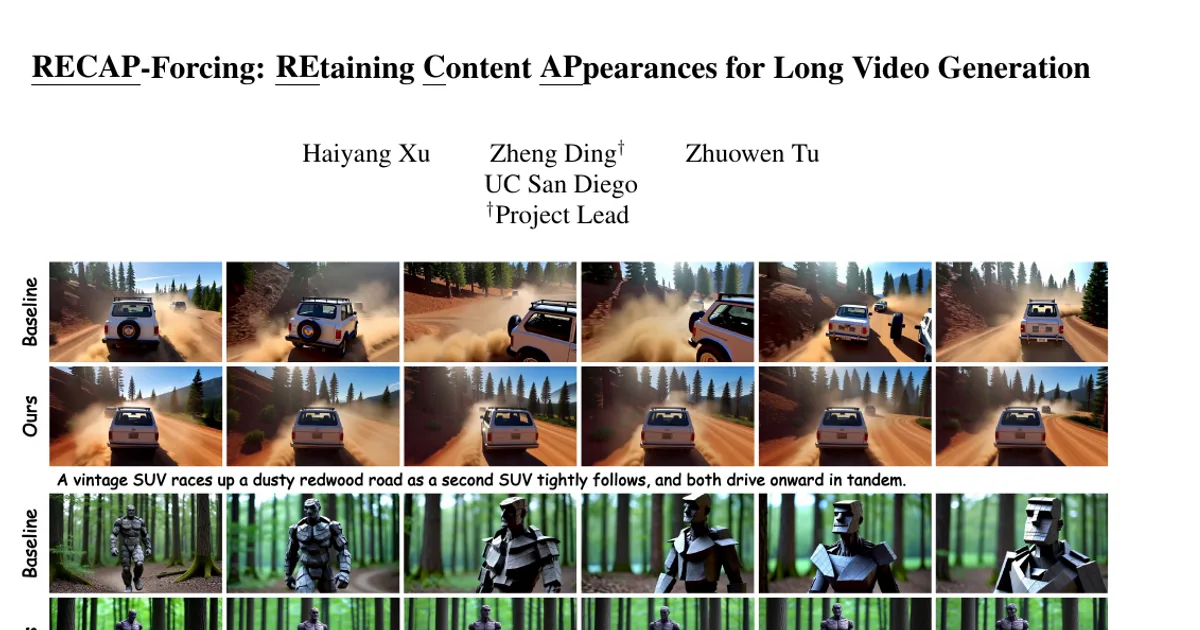
Autoregressive video generators produce video block by block under a fixed attention window, so they must constantly decide which pieces of an ever-growing history to keep, compress, or throw away. Existing methods answer this question along the axis of time: keep the recent frames, compress or discard the old ones. The authors argue this premise is wrong, because a long video does not need its timeline — it needs its cast. RECAP-Forcing instead stores content at the moment it first becomes visible (entering subjects, disoccluded regions, newly revealed viewpoints), so memory grows with the amount of new content rather than with video duration.
Key Contributions
-
A new organizing axis for long-video memory: appearance novelty instead of recency. Content is recorded at its "novel appearance events" — its entrance and later novel observations such as new viewpoints or newly revealed regions — so each subject accumulates a sparse set of appearance anchors rather than a compressed timeline. The authors argue this eases the tension between long-range identity drift and motion freeze.
-
RECAP-Forcing, a training-free mechanism with no learnable parameters. It unifies two components under one principle: a reinforced attention sink that is reinterpreted as "first-impression memory" of the opening scene, and an optical-flow-based novelty bank that extends the same principle to content introduced later in the video.
-
Broad validation across base models and against existing memory strategies. The same training-free inference hook is applied to Self-Forcing, Infinite-Forcing, LongLive, and Helios, and is compared against Deep Forcing, MemRoPE, and Rolling Sink on VBench-Long.
-
A human perceptual study with 9 participants performing 24 blind pairwise comparisons each (216 judgments total) across Consistency, Motion, and Overall quality.
Main Findings
-
Self-Forcing baseline improves substantially. Adding RECAP-Forcing raises the Total VBench-Long score from 75.9 to 79.5 and more than doubles Dynamic Degree from 27.5 to 58.1. A plain, unreinforced sink (λ=1) on the same baseline only reaches a Total of 76.8 with Dynamic Degree 30.4, so most of the motion gain comes from the full method.
-
Gains hold on a backbone whose sink is already strong. On Infinite-Forcing, whose sink already lifts Dynamic Degree to 61.3, RECAP-Forcing further raises it to 71.3 (+10.0) and improves Total from 78.3 to 79.7.
-
Works on both small and large backbones. LongLive (1.3B) improves from 78.1 to 78.5; Helios (14B) improves from 70.3 to 76.3, with large jumps in Object Class (36.1 to 83.7) and Multiple Objects (8.9 to 28.5).
-
The two components play a temporal division of labor (ablation on Infinite-Forcing). The reinforced sink alone anchors early content and improves consistency but over-constrains later evolution — Dynamic Degree drops from 61.3 to 41.6. The memory bank alone strongly increases dynamics — Dynamic Degree rises from 61.3 to 78.2 — with only minor consistency and quality losses. Used together they achieve the best Total, 79.7.
-
Beats competing training-free memory methods on the same evaluation. On Self-Forcing, Deep Forcing reaches Dynamic Degree 32.0, MemRoPE 41.2, and Rolling Sink 23.0, versus 58.1 for RECAP-Forcing. RECAP-Forcing also attains the best overall score among these methods (79.5), versus 76.2, 78.7, and 78.9.
-
Bank capacity and sink strength are both saturating knobs. Increasing bank capacity beyond one frame's worth of tokens (f=1, i.e. K=1,560) yields only marginal Total gains: 79.6 at f=1/4, 79.7 at f=1/2 and f=1, 79.8 at f=2 and f=4, and a drop to 79.3 at f=8. For sink reinforcement, Total rises from 78.8 at λ=1 to 79.7 at λ=5, then degrades to 79.2, 78.9, and 78.6 at λ=8, 10, and 12.
-
Sink attention is measurable. At λ=5, roughly 24% of attention lands on the sink. Subject Consistency saturates early while Dynamic Degree erodes past λ≈8.
-
Humans prefer the outputs. Aggregated over all 216 judgments, RECAP-Forcing wins 81.3% on Consistency (35 ties), 74.5% on Motion (22 ties), and 79.2% on Overall (16 ties). Against Self-Forcing specifically: 85.2% Consistency, 76.9% Motion, 84.3% Overall.
-
Appearance memory survives long absences of time. Over a five-minute rollout, the recency baseline's DINOv2 CLS identity retention decays from 1.00 to 0.61, while RECAP-Forcing stops decaying after the first minute and holds flat at 0.81. Over 60 seconds, the comparison is 1.00/0.70/0.62 versus 1.00/0.87/0.88.
-
Subject identity improves on continuous-visibility prompts. Over 20 prompts × 5 seeds, frame-level DINOv2 CLS similarity between an early window (2–8 s) and the final 10 s rises from 0.745 to 0.850 (76% pairwise wins); on a detected subject crop it rises from 0.642 to 0.696 (64% wins).
-
Benefit grows with length. Across durations from 5 to 60 seconds, Dynamic Degree gains reach +10.1 points at 60 s while Subject Consistency stays comparable to the baseline.
-
Acknowledged failure mode. Because novelty detection depends on optical-flow correspondence, stochastic textures such as rain, spray, or rippling water may be repeatedly marked as novel, consuming memory slots without adding meaningful information.
Methodology in Plain English
The starting point is a causal video generator that denoises one block of frames at a time, attending only to a bounded sliding cache of the most recent frames. Once a token scrolls out of that window it is gone forever, so the model gradually loses access to the visual evidence that established what things look like.
Step 1 — Reinforce the opening frame. The very first frame is, by construction, entirely new content. Some backbones already keep it permanently as an attention sink; on backbones that lack one, the plug-in instantiates one. The authors observe that under default attention weights this sink mostly anchors coarse style — color tone, background, overall look — while subject identity still drifts. So they multiply the sink keys' pre-softmax logits by a fixed factor λ (implemented as adding ln λ before the softmax). This keeps the distribution normalized and remains compatible with fused attention kernels. The setting λ=5 is used everywhere.
Step 2 — Detect what is genuinely new in every later frame. For each newly decoded frame, RAFT optical flow is run against the previous frame. A pixel counts as newly appeared when its backtrace finds no reliable antecedent: the forward–backward cycle residual exceeds τ_cyc (2 px), the photometric residual exceeds τ_pho (0.2), or the backtrace falls outside the frame. These residuals are combined into a per-pixel novelty score with weight α=0.5, max-pooled onto the patch grid, and normalized per temporal block by the 90th percentile of positive scores so brief bursts of large motion cannot dominate the budget. A "claimed novelty" map is propagated by flow, so continuously traceable content fires only once — the moment it first appears.
Step 3 — Store and keep by novelty. For each selected patch, the exact key/value vectors that token wrote in every attention layer are copied into a fixed bank of K=1,560 slots (one frame's worth of tokens) with temporal rotary phase reset to zero but spatial phase preserved. The bank keeps the top-K by frozen novelty score using a simple top-K rule. Admission is query-agnostic: no entity grouping, no re-identification, no learned controller, no explicit recency term.
Evaluation. All experiments use VBench-Long's sixteen long-video metrics, averaged over 128 prompts and 5 seeds, on 60-second videos (240 latent frames). The primary baseline is Self-Forcing, a DMD-distilled causal model built on Wan2.1-T2V-1.3B generating 832×480 video with 3 latent frames per block; each latent frame is a 30×52 grid of 1,560 tokens, and the attention window covers 6 latent frames (one persistent sink, two prior, three current). A 60-second video spans 240 latent frames, or 80 blocks. RAFT-small is run at half resolution with 12 refinement iterations. The same hyperparameter set is used across all backbones, video lengths, and prompt sets.
Why This Matters
Impact on research. The paper reframes a memory-management problem as a content-indexing problem. Rather than asking how much of the timeline to keep and how aggressively to compress it, it asks which appearance events are worth anchoring. This suggests the drift–freeze trade-off commonly described in long-video diffusion may be partly an artifact of indexing memory by time. Because the method is training-free, parameter-free, and attaches as a single inference hook, it is orthogonal to and composable with training-based approaches that extend rollout horizons or supervise KV-cache content. The paper explicitly notes this complementarity.
Real-world applications (implied by the method; the paper does not enumerate these explicitly):
- Long-form AI video generation for film, advertising, and social media, where characters, props, and sets must remain visually identical across a minute or more of generated footage.
- Interactive world models and simulated environments, where newly revealed regions of a scene must stay consistent as a viewer moves through it.
- Virtual production and previz, where a generated shot is iterated on and a subject introduced early must still match when re-rendered later.
- Any streaming or chunked generation pipeline with a fixed compute budget, since the per-block cost stays constant.
Industry relevance. The method requires no fine-tuning and no additional learnable parameters, and it is deployed on open checkpoints (Self-Forcing, Infinite-Forcing, LongLive, Helios) with their public inference code unchanged. That makes it cheap to adopt for anyone already serving a distilled causal video model. The memory bank's capacity is an explicit, configurable budget rather than an architectural constant, so a serving system can trade memory for fidelity directly.
Future Directions
- Richer notions of novelty. The authors state that their results motivate novelty definitions beyond the local optical-flow correspondence used here, suggesting longer-range correspondence or higher-level semantic grouping could enable more selective and persistent memory allocation over extended generation.
- Handling stochastic textures. The acknowledged limitation is that optical-flow novelty detection may repeatedly flag rain, spray, or rippling water as novel, consuming budget without adding meaningful information — a direct target for a semantic or statistical filter.
- Controlled reappearance. The supplementary material states that a prompt-only reappearance benchmark — where a subject exits, stays absent beyond the local attention window, and returns with the same identity — is difficult to construct reliably with current backbones, and the paper reports an incomplete attempt; better evaluation protocols for this case remain open.
- Scaling the budget with novel-appearance rate. The authors note that longer videos, or videos with more frequent novel appearances, can naturally allocate additional slots — but the policy for doing so adaptively is left to future work.
Target Audience
Researchers and engineers working on autoregressive or causal video diffusion, long-horizon video generation, and KV-cache management for streaming transformers. It is also useful for practitioners who want an inference-time quality boost on an existing distilled video model without retraining, and for students interested in how memory architecture choices — not just model scale — determine what a generative model can stay consistent about over time. Readers should be comfortable with attention, KV caches, rotary positional embeddings, and optical flow; the conceptual argument itself is accessible without that background.
Authors’ abstract
Long autoregressive video generation faces a fundamental memory challenge: with a finite attention window, a model must decide which information from an ever-expanding history to retain. Existing methods organize memory temporally, preserving recent frames while compressing or discarding older ones. We instead propose RECAP-Forcing, organizing memory by appearance novelty. A long video is not merely a sequence of frames, but an evolving cast of subjects, objects, and scenes whose identities must remain consistent over time. We organize memory by retaining the KV cache associated with newly appearing content--such as entering subjects, disoccluded regions, and newly introduced scenes--at the moment it first becomes visible, prioritizing novelty over recency. Memory should scale with the amount of newly introduced content, rather than with video length. This appearance-indexed memory makes long-range consistency an explicit property of the memory structure. Our framework unifies two mechanisms under this single principle. At the beginning of a video, when all visible content is novel, an attention sink preserves the initial scene. As the video evolves, an optical-flow-based novelty bank extends the same principle by selectively retaining newly revealed content. As a training-free inference method with no additional learnable parameters, RECAP-Forcing consistently improves visual quality and semantic fidelity across multiple strong baselines and outperforms existing memory methods.