Research
ReasonEdit: Editing Vision-Language Models using Human Reasoning
Overview Research area: Computer vision / vision-language models (VLMs), specifically model editing — making targeted corrections to a pretrained model without retraining it or damaging unrelated beha
- arXiv
- 2602.02408
- Published
- 2026-02-02
- Authors
- Jiaxing Qiu, Kaihua Hou, Roxana Daneshjou, Ahmed Alaa, Thomas Hartvigsen
AI summary
Overview
Research area: Computer vision / vision-language models (VLMs), specifically model editing — making targeted corrections to a pretrained model without retraining it or damaging unrelated behavior.
Technical level: Advanced. The paper assumes familiarity with model editing, retrieval-based editing, VLM layer structure, and draws on network-science concepts (Newman's modularity) to select embeddings.
One-sentence scope: ReasonEdit is a retrieval-based VLM editor that lets a user supply their own step-by-step reasoning when correcting a model error, stores that reasoning in a codebook keyed by a "topology-balanced" multimodal embedding, and retrieves the relevant facts at inference time to generalize the correction.
What This Paper Is About
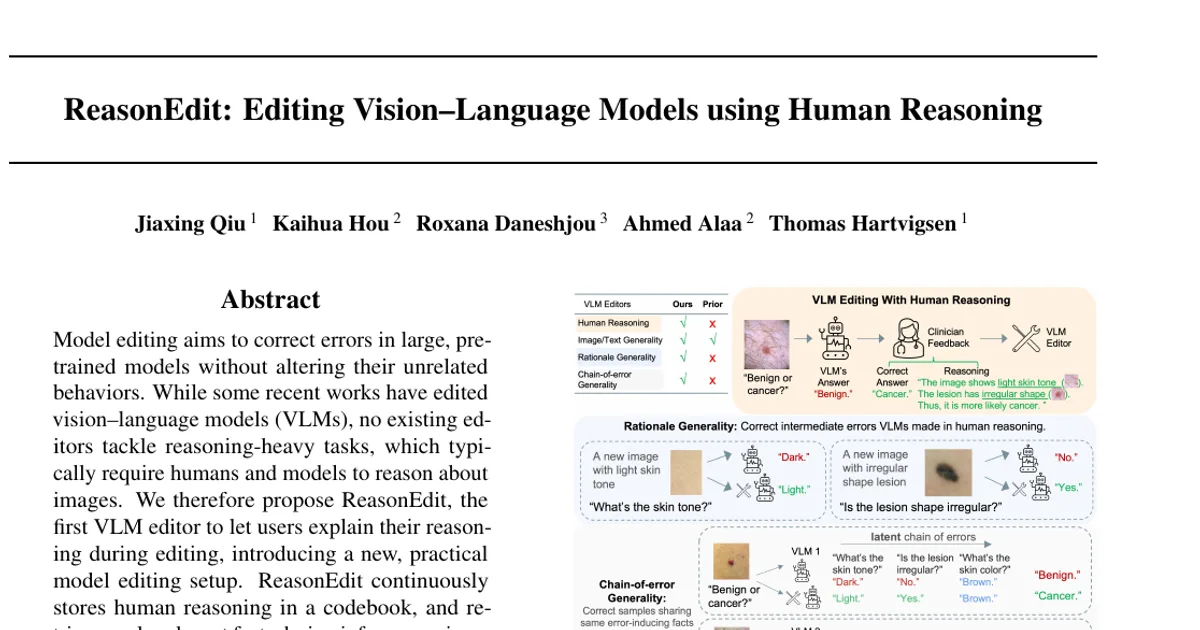
VLMs make mistakes as data and user needs change, and existing editors mainly support simple label correction rather than reasoning-heavy visual question answering. The authors introduce a new editing setup in which a user, after seeing a wrong answer, explains the chain of factual statements that leads to the correct answer, and the editor uses that reasoning plus the image-text query to fix the model. The goal is a new VLM that (1) answers the edit correctly, (2) generalizes to sufficiently similar queries, and (3) leaves unrelated predictions untouched.
Key Contributions
-
The first reasoning-enhanced model editor, designed for VLMs. ReasonEdit is described as the first model editing method to let users provide human reasoning during editing, and the first VLM editor to support reasoning-heavy tasks rather than only renaming or relabeling objects.
-
A codebook design that pairs reasoning statements with visual evidence. Each reasoning fact is tied to image patches (user-provided or VLM-approximated), and both answer entries and reasoning entries are stored as key-value pairs and merged over time to control codebook growth.
-
A principled, topology-aware multimodal embedding method. The paper introduces five network-science metrics — vision modularity, language modularity, bimodal modularity, vision bias, and language bias — to evaluate and select embeddings, then builds a dual embedding by concatenating a chosen vision layer with a pretrained sentence-transformer text embedding.
-
Two new evaluation criteria for reasoning-enabled generalization. The authors define rationale generality (R-Gen) and chain-of-error generality (CoE-Gen) in addition to conventional reliability, locality, text generality, and image generality, and evaluate across four VLMs on two rationale-based VQA datasets.
Main Findings
-
State-of-the-art editing across four VLMs and two datasets. On FVQA and A-OKVQA, ReasonEdit outperforms weight-updating editors (FT, MEND, BalancEdit) and retrieval-based editors (IKE, GRACE), including their reasoning-enabled "COT" variants. For example, on FVQA with LLaVA-1.5-7B, ReasonEdit reaches Acc 1.00, T-Gen 0.97, I-Gen 0.95, CoE-Gen 0.97, R-Gen 0.87, and Loc 0.91.
-
Reasoning entries drive reasoning-level generalization. The comparison editors' COT variants show only small gains in R-Gen and CoE-Gen and remain close to the unedited model, which the authors use to argue that adding reasoning supervision alone is insufficient — retrieving the right human reasoning is what matters.
-
Reasoning statements are the source of R-Gen and CoE-Gen. In ablation, keeping only answer entries brings performance close to the ceiling where the ground-truth answer is prompted directly, but leaves R-Gen and CoE-Gen lower. Keeping only reasoning entries brings performance close to the ceiling where ground-truth human reasoning is prompted (e.g., LLaVA-1.5-7B: 0.81 Acc, 0.80 T-Gen, 0.87 R-Gen, 0.82 CoE-Gen, versus ceilings of 0.85, 0.80, 0.92, 0.89).
-
Single-layer embeddings are modality-biased; the dual embedding fixes this. Using a single vision layer yields good text generality but poor image generality, and a single language layer yields the reverse. The topology-balanced dual embedding improves both.
-
Stable sequential editing and efficiency. In sequential editing on A-OKVQA (over 5,000 edits for all VLMs), evaluated every 200 edits on a random batch of 50 accumulated edits, ReasonEdit maintains consistently higher reliability and generality while weight-updating editors (FT, MEND, BalancEdit) decline, indicating catastrophic degradation. GRACE shows the best locality over edits. ReasonEdit takes roughly the same time as the non-COT editors and is significantly faster than their COT extensions.
-
Robust to injected noisy reasoning. Injecting 10%, 30%, and 50% irrelevant random statements leaves performance close to the noise-free setting. Replacing 10%, 30%, and 50% of real reasoning facts with noise degrades R-Gen and CoE-Gen as expected, since the codebook no longer holds all relevant facts.
-
Topology-aware selection is data-agnostic. Selecting the vision layer and the weighting parameter w using three different datasets — COCO, ImageNet, and Flickr30k — gave the same selection, suggesting the strategy is not tied to one dataset.
Methodology in Plain English
When a user finds a wrong answer, they write a chain of factual statements explaining the correct reasoning. ReasonEdit turns each statement into a codebook entry: the statement's text becomes the "value," and its key is an embedding of a matching region of the image plus that statement. If the user does not crop the relevant region themselves, the system proposes candidate patches at multiple spatial scales, asks the VLM whether each patch shows the statement, and scores patches by how likely the VLM is to describe the patch with that statement — keeping the overall best patch and the best among the smallest candidates, to balance relevance and precision. A separate "answer entry" stores a templated sentence linking the question to the correct answer.
Because a naive embedding from one layer of a VLM tends to cluster things by image alone or by text alone, the authors treat image-text embeddings as nodes in a graph and measure how well the embedding network's communities match the intended grouping (by image, by text, or by image-text pair). They use these measurements to pick which vision layer to use and to set the balance between the visual and textual parts of the concatenated embedding, choosing the weight that maximizes the harmonic mean of vision and language modularity. The text half comes from a pretrained sentence encoder (paraphrase-mpnet-base-v2).
At inference, a new image-question pair is embedded and compared by L2 distance to the codebook keys. If the closest key is farther than the p = 1 percentile of pairwise key distances, nothing is retrieved. Otherwise the K = 5 nearest keys' unique sentences are collected and prepended to the question as context. Modularity is estimated by Monte Carlo over B = 10 sample networks, each built from n = 10 image-text pairs sampled from a combined COCO and ImageNet pool. Keys are merged when their estimated neighborhoods overlap heavily — requiring an intersection-over-total-area above 90% for both regions and center distance below 10% of both radii — after which keys are averaged and value sentences concatenated.
Why This Matters
Research impact. The paper reframes model editing from label correction to reasoning correction, and adds two new generalization metrics (R-Gen, CoE-Gen) that measure whether an edit transfers to samples sharing the same underlying reasoning or the same error-inducing facts. It also argues that the common practice of picking which layer to edit by post hoc ablation is ad hoc, and offers a data-agnostic, network-science-grounded alternative.
Real-world applications (as motivated or implied by the paper):
- Clinical decision support: the paper's opening example is a dermatology task where visual features and domain knowledge combine to indicate a diagnosis, and a clinician would supply reasoning alongside a correction.
- Any reasoning-heavy visual question answering deployment where a domain expert reviews an incorrect answer and explains why.
- User-facing assistants where corrections should transfer to analogous cases rather than only to the exact input that was flagged.
- Systems requiring continuous, real-time updates from human feedback, where sequential editing must not degrade the model or incur large computational cost.
Industry relevance. Because ReasonEdit does not update model weights and runs in roughly the same time as non-reasoning editors, it is presented as usable for real-time editing with human feedback. The sequential-editing results argue against weight-updating editors for long editing streams, since FT, MEND, and BalancEdit degrade across many edits while ReasonEdit stays stable.
Future Directions
-
Reducing dependence on accurate human reasoning. The robustness experiments show that injecting noise is tolerated, but replacing real facts with noise degrades R-Gen and CoE-Gen. Handling incomplete or incorrect user reasoning more gracefully remains open.
-
Automating visual evidence selection further. The current patchification uses the VLM as an approximation when the user supplies no crop; how good that approximation is in harder domains, and whether better grounding is possible, is a natural follow-up.
-
Extending beyond the evaluated scope. Results cover four VLMs (Qwen3-VL-4B-Instruct, Qwen3-VL-8B-Instruct, InstructBLIP-7B, LLaVA-1.5-7B), two rationale-VQA datasets (A-OKVQA, FVQA), and multiple-choice answer selection; broader task types and answer formats are not tested.
-
Scaling and codebook management. Key merging is governed by fixed thresholds (90% overlap, 10% radius), and whether these settings hold for much larger edit streams or for domains with denser overlapping facts is not reported.
Target Audience
Researchers and practitioners working on model editing, VLM adaptation, and retrieval-augmented multimodal systems; engineers building deployed VLM applications that need continuous correction from expert feedback; and anyone studying how human reasoning can be used as supervision for multimodal models. The paper is most useful to readers already comfortable with model editing baselines such as MEND, ROME-derived methods, GRACE, and IKE.
Authors’ abstract
Model editing aims to correct errors in large, pretrained models without altering unrelated behaviors. While some recent works have edited vision-language models (VLMs), no existing editors tackle reasoning-heavy tasks, which typically require humans and models to reason about images. We therefore propose ReasonEdit, the first VLM editor to let users explain their reasoning during editing, introducing a new, practical model editing setup. ReasonEdit continuously stores human reasoning in a codebook, and retrieves only relevant facts during inference using a novel topology-balanced multimodal embedding method inspired by network science. Across four VLMs on multiple rationale-based visual question answering datasets, ReasonEdit achieves state-of-the-art editing performance, ultimately showing that using human reasoning during editing greatly improves edit generalization.