Research
RealMe: Immersive Volumetric Video from Minimal Captures
Overview Research area: Computer vision and graphics — specifically volumetric (free-viewpoint) video reconstruction from sparse, low-quality multi-view captures, combining 4D Gaussian splatting with
- arXiv
- 2610.30023
- Published
- 2026-10-21
- Authors
- Chenxu Zhou, Zhiyuan Yu, Yudong Jin, Yinji Shentu, Yu Zhang, Jiaming Sun, Xiaowei Zhou
AI summary
Overview
Research area: Computer vision and graphics — specifically volumetric (free-viewpoint) video reconstruction from sparse, low-quality multi-view captures, combining 4D Gaussian splatting with generative video diffusion.
Technical level: Advanced. The paper assumes familiarity with diffusion models, rectified/flow-matching training, rotary positional embeddings, attention factorization, and 4D Gaussian splatting.
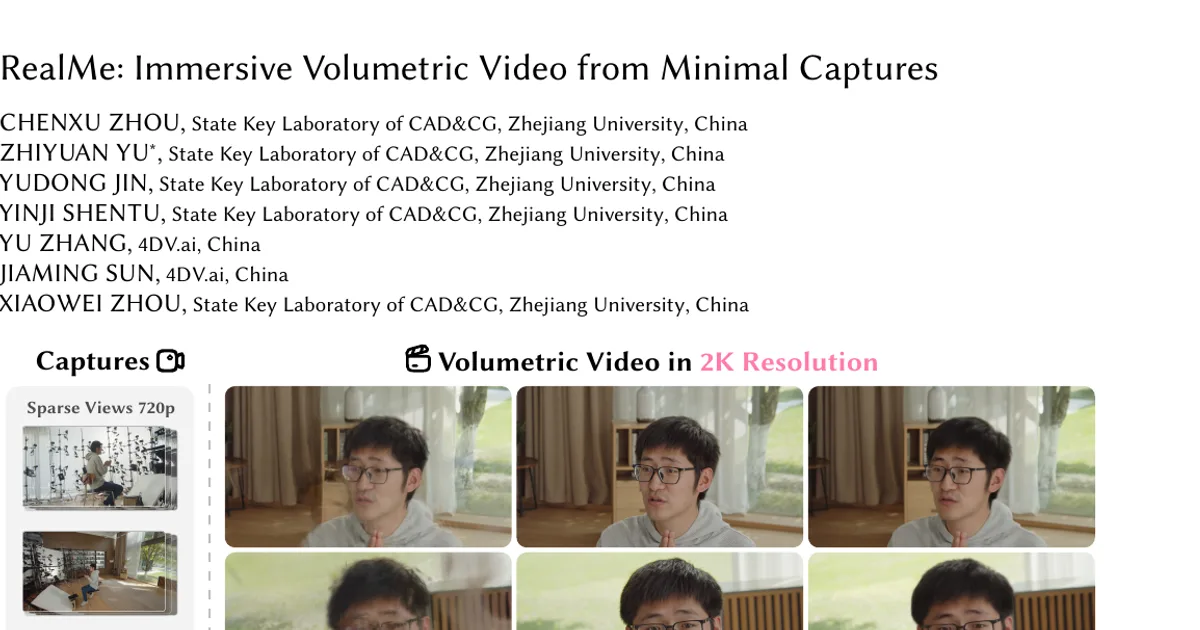
Scope: The paper proposes RealMe, a framework that uses a repurposed high-resolution image diffusion model to turn sparse and degraded multi-view captures into 2K, 4D-consistent videos that are then used to reconstruct immersive volumetric video.
What This Paper Is About
Producing free-viewpoint volumetric video normally requires dense, expensive, well-controlled multi-camera rigs. When only a few cameras or low-quality videos are available, existing reconstruction methods degrade badly and existing generative fixes either work per-view (breaking multi-view consistency) or are capped at resolutions below 1K.
RealMe's goal is to bridge that gap: given sparse, low-resolution captures, generate high-resolution (2K), temporally and multi-view consistent videos that serve as extra supervision for a 4D Gaussian splatting reconstruction, so that immersive volumetric video becomes possible from minimal capture resources.
Key Contributions
-
A unified high-resolution 4D enhancement framework. RealMe reduces capture requirements for volumetric video by chaining auxiliary-data construction, video diffusion enhancement, and 4DGS reconstruction into a single pipeline that outputs 2K volumetric video.
-
Layout-aware adaptation of a pretrained high-resolution image diffusion model. The authors take FLUX.1 [dev] (a 14B model, per the implementation section) and adapt it to 4D enhancement using four-axis layout-aware positional embeddings (frame, view, and two latent-grid axes) and factorized spatio-temporal attention over sampled video groups.
-
A latent frequency loss. Frequency-domain supervision applied in latent space (low- and high-frequency FFT magnitude terms with timestep-dependent weights) narrows the data gap between generated videos and real captures, and is reported to be preferable to image-space frequency supervision.
-
The RealVV dataset. A self-captured multi-view video dataset with diverse scenes, actors, performances, and both short- and long-focus cameras, including real and synthetic degradations, intended for release to the community.
Main Findings
-
Best visual quality on both benchmarks. On RealVV, RealMe reaches PSNR 27.2706 / SSIM 0.9393 / LPIPS 0.1621, versus FTGS (19.0491 / 0.8142 / 0.2492), DIFIX3D+ (22.6373 / 0.8267 / 0.2890), and Diffuman4D (24.4387 / 0.9113 / 0.2105). On DNA-Rendering it reaches 25.5956 / 0.8979 / 0.1261, versus FTGS 20.6439 / 0.7986 / 0.2158, DIFIX3D+ 21.9532 / 0.7920 / 0.1666, and Diffuman4D 23.2704 / 0.7822 / 0.1427.
-
Strong under a four-camera setting. With four input views on RealVV, RealMe scores 24.9304 / 0.8735 / 0.2278, compared with 4C4D at 19.0405 / 0.8682 / 0.3716 and 4K4D at 15.6413 / 0.8181 / 0.5090.
-
Better downstream 4D consistency. When a 4DGS is optimized from the enhanced videos, RealMe's consistency metrics are PSNR-c 28.0756 / SSIM-c 0.9246 / LPIPS-c 0.1385, versus Diffuman4D's 26.7098 / 0.8437 / 0.1913.
-
Temporal stability close to the optimization baseline. Temporal Warping Error is 0.00551 for RealMe, 0.00299 for FTGS, 0.03170 for Diffuman4D, and 0.04533 for DIFIX3D+. The authors note TWE is a complementary stability metric, since temporal smoothing can also lower it.
-
Detail enhancement beats video super-resolution baselines. Against STAR and FlashVSR at 2K, the paper reports that the baselines leave over-smoothed faces, softened hair boundaries, or artificial local textures, while RealMe recovers finer facial, hair, and clothing detail.
-
Eight input views is a practical sweet spot. PSNR rises from 24.0490 at 4 views to 27.2706 at 8 views, then only to 27.3614 at 16 views.
-
Both architectural components matter. Removing layout-aware positional embedding drops PSNR-c to 25.2596; replacing factorized attention with full attention drops it to 25.8435; the full model reaches 27.2688 (in the ablation setting, where PSNR is 24.8924 / SSIM 0.9226 / LPIPS 0.1383).
-
Latent-space frequency loss is more memory-efficient than image-space. Without it: PSNR 22.6017, LPIPS-c 0.3113, 72.4 GB VRAM. With image-space loss: 24.7123 / 0.2849, but out of memory at 2K (metrics computed at 1K). With latent-space loss: 24.9641 / 0.2201 at 73.5 GB.
Methodology in Plain English
RealMe runs in three stages.
1. Build "helper" videos from the poor captures. From the sparse input videos and their camera poses, the system first fits a rough 4D Gaussian splatting model, which is bad-looking but geometrically self-consistent. It then invents smooth camera paths between the real cameras, renders novel-view videos from the rough model, and separately crops the original inputs around detected regions of interest. These novel-view and cropped videos become the conditioning inputs — two separate condition types rather than one concatenated stream, since they have different spatial coverage.
2. Enhance them with an adapted image diffusion model. The base is FLUX, an image generator, which would normally treat each frame or view independently and cause flicker over time and mismatch across views. The authors make two changes. First, they extend the model's positional identifiers from three axes to four — frame index, view index, and the two latent-grid coordinates — using rotary positional encoding, so tokens at the same pixel position in different frames or views are no longer confused. Second, they split attention into a temporal pattern and a spatial pattern (where the "spatial" axis indexes viewpoints, not image patches), replacing full attention over a flattened token sequence. A ControlNet branch, initialized from pretrained DiT weights, injects the conditioning signals; only the ControlNet and LoRA adapters are trained, with the VAE, text encoder, and the rest of the DiT frozen.
3. Train with paired data and reconstruct. Training pairs are made by degrading high-resolution videos three ways: rendering from a sparse or deliberately underfit 4DGS, cropping/resizing/downsampling, and adding noise, compression artifacts, defocus blur, and motion blur following the Real-ESRGAN strategy. The objective combines flow matching with the latent frequency loss (weight 0.1). Finally, the enhanced novel-view and ROI videos are mapped back into full-frame camera coordinates and used alongside the eight original views to optimize a single 4DGS via FTGS, supervised per sequence by eight original views and 40 generated views.
Why This Matters
Research impact. The paper reframes sparse-view 4D reconstruction as a data enhancement problem rather than a pure reconstruction problem: instead of adding geometric priors to a per-scene optimizer, it upgrades the input observations themselves while preserving the capture layout. It also demonstrates that a 14B image diffusion model can be retargeted to multi-view 4D tasks with lightweight positional and attention surgery, which is a reusable recipe.
Real-world applications:
- Telepresence and immersive conferencing, where users have a handful of consumer cameras rather than a studio rig.
- VR/AR and gaming content pipelines that need free-viewpoint characters and scenes at high resolution.
- Film and broadcast previsualization or archival capture, where production settings can trade more views for quality while outdoor shoots use fewer.
- Metaverse and volumetric social media, where low-cost capture hardware is the practical constraint.
Industry relevance. The method targets a genuine cost bottleneck: dense multi-camera capture domes are expensive and studio-bound. A pipeline that gets 2K volumetric video from eight spatially distributed views is directly relevant to companies building consumer volumetric capture, and the RealVV dataset plus the 4DGS/EasyVolcap implementation suggest an intent to be reproducible.
Future Directions
- Scaling training data and generalization. The authors explicitly flag scarce high-quality multi-view data as a limitation, with limited generalization to large scenes and complex camera settings.
- Robustness when the coarse 4DGS fails. The pipeline depends on a valid coarse initialization; the paper states the method may fail when inputs give insufficient geometric cues, so a fallback or joint initialization scheme is an open question.
- Accelerating high-resolution inference and training. The conclusion raises how to "accelerate high-re[solution]" processing — relevant given 96 hours on 8 H100 GPUs and the out-of-memory failure of image-space frequency loss at 2K.
- Frequency-loss design beyond latent space. Since the image-space variant could only be evaluated at 1K due to memory, whether a memory-efficient image-space or hybrid frequency objective closes the gap further remains untested.
Target Audience
Researchers and practitioners in novel view synthesis, dynamic 4D reconstruction, and generative video who already understand diffusion models and Gaussian splatting. It is most valuable to those working on lowering capture requirements for volumetric video, to graphics engineers building production capture pipelines, and to readers interested in how large pretrained image diffusion models can be structurally adapted to multi-view, temporally consistent generation. Beginners will find the architecture section dense but the three-stage pipeline conceptually accessible.
Authors’ abstract
This paper addresses the problem of creating immersive volumetric videos from sparse and low-resolution capture resources. Conventional dense multi-view reconstruction methods can produce high-quality volumetric videos, but their reliance on costly capture setups makes them impractical in real-world scenarios. Recent approaches use generative models to relax capture requirements, but still suffer from limited resolution and 4D inconsistency. To overcome these constraints, we propose RealMe, a unified framework built around a high-resolution video diffusion model that enhances limited captures into high-resolution (2K), 4D-consistent videos for volumetric video reconstruction. Specifically, RealMe constructs auxiliary data from capture videos and encodes them into latents along with layout-aware positional embeddings. The video diffusion model adapts factorized spatio-temporal attention to the multi-view capture layout, denoises these latents across viewpoints and time, and decodes them into enhanced videos to refine the 4D representation. This adaptation helps the model capture temporal dynamics and multi-view relationships, leading to more 4D-consistent generation. To reduce the data gap between generated videos and real captures, we apply a latent frequency loss that provides frequency-domain supervision in latent space. Extensive experiments on the public DNA-Rendering benchmark and our self-captured RealVV dataset demonstrate that RealMe is able to create immersive volumetric videos and outperforms state-of-the-art methods in visual fidelity and 4D consistency.