Research
Real-Time Drivers' Drowsiness Detection and Analysis through Deep Learning
Overview Research area: Computer vision and deep learning applied to automotive safety, specifically real-time monitoring of driver fatigue. Technical level: Intermediate. The abstract describes a pip
- arXiv
- 2511.12438
- Published
- 2025-11-16
- Authors
- ANK Zaman, Prosenjit Chatterjee, Rajat Sharma
AI summary
Overview
Research area: Computer vision and deep learning applied to automotive safety, specifically real-time monitoring of driver fatigue.
Technical level: Intermediate. The abstract describes a pipeline built from established, widely used tools (deep convolutional neural networks and the OpenCV library) applied to a well-defined detection problem, rather than introducing a new theoretical framework.
Scope in one sentence: The paper presents and evaluates a non-invasive, camera-based system that reads a driver's face for fatigue cues and sounds an alarm when drowsiness is detected, reporting classification accuracy on two public datasets.
What This Paper Is About
Long-distance driving under tight deadlines pushes drivers to spend more hours behind the wheel than is safe, which can bring on drowsiness — a condition the abstract describes as life-threatening to the driver and to others on the road. The goal of this work is a real-time system that watches a driver's face through a live camera, recognizes signs of fatigue, and immediately alerts them before an accident can occur. The authors frame this as a non-invasive and low-cost alternative approach to detecting drowsiness.
Key Contributions
- A real-time drowsiness detection system built on deep convolutional neural networks (DCNNs) combined with OpenCV, designed to operate on live camera input rather than on stored footage.
- A facial-landmark-based fatigue signal, where the system examines features such as eye openings and yawn-like mouth movements to infer whether a driver is drowsy.
- A continuous real-time alert mechanism that triggers when drowsiness is identified, described as embedded within Smart Car technology.
- Evaluation on two public datasets — NTHU-DDD and Yawn-Eye-Dataset — with reported drowsiness detection classification accuracies of 99.6% and 97% respectively.
Main Findings
- High reported accuracy on NTHU-DDD: The implemented model is reported to achieve 99.6% drowsiness detection classification accuracy on the NTHU-DDD dataset.
- High reported accuracy on Yawn-Eye-Dataset: The same model is reported to achieve 97% classification accuracy on the Yawn-Eye-Dataset.
- Facial landmarks carry enough signal for detection: The abstract attributes the system's detection capability to analysis of visible landmarks such as sufficient eye openings and yawn-like mouth movements, processed through a pre-trained network.
- Immediate alerting is part of the design: Rather than only classifying fatigue, the system is described as issuing a continuous alert in real time, tied to Smart Car technology.
- Limited methodological detail in the abstract: The abstract does not report dataset sizes, train/test splits, comparison baselines, latency or frame-rate measurements, or ablation studies, so no further performance claims can be made here.
Methodology in Plain English
The system watches the driver through a live camera. Each captured facial image is processed with OpenCV, a widely used Python library for image handling, to locate facial landmarks — essentially finding the eyes and mouth and measuring whether the eyes are adequately open and whether the mouth is moving in a way that looks like a yawn. Those measurements are then fed into a deep convolutional neural network, a type of model that learns visual patterns directly from images, which uses a pre-trained model to decide whether the driver is drowsy. If the answer is yes, the system raises a continuous alert in real time. The approach is described as non-invasive because it relies on a camera rather than any sensor attached to the driver, and inexpensive because it uses commodity hardware and open-source software. The authors evaluated this pipeline on the NTHU-DDD and Yawn-Eye-Dataset collections.
Why This Matters
Impact on research: The paper sits in the applied end of driver-state monitoring, showing that a combination of off-the-shelf image processing and pre-trained deep networks can be assembled into a working real-time fatigue detector. Its value to the field is as evidence that facial-landmark cues plus DCNNs are a practical route to drowsiness classification, though the abstract offers no architectural or algorithmic novelty claim.
Real-world applications:
- Long-haul trucking and freight fleets, where multi-day schedules and rest pressure are the exact scenario the abstract describes.
- Ride-hailing and taxi services, where drivers work long shifts in dense traffic.
- Consumer vehicles with driver-facing cameras, where the alert could be delivered through an in-cabin or Smart Car system.
- Night-shift and emergency-vehicle operations, where fatigue risk is high and continuous monitoring could supplement rest policies.
Industry relevance: Automotive manufacturers, fleet operators, and telematics and insurance companies all have a stake in drowsiness detection, because fatigue-related crashes carry human and financial costs. A method that is described as non-invasive and low-cost lowers the barrier to fitting this kind of monitoring into vehicles, and the reported accuracies give a headline figure that product teams and fleet safety programs can point to.
Future Directions
- Independent, in-vehicle validation: The abstract reports results only on two academic datasets; testing the pipeline on live video under real driving conditions — changing light, sunglasses, head turns, and varied drivers — is the natural next step.
- Reporting operational metrics: Accuracy alone says little about usefulness. Frame rate, detection latency, false-alarm rate, and behavior on rare or ambiguous fatigue states are open questions the abstract does not address.
- Robustness across populations and conditions: It is unclear from the abstract how the model performs across different ages, skin tones, facial hair, eyewear, and nighttime infrared imagery.
- Integration and privacy: Real deployment inside Smart Car systems raises questions about how alerts are delivered to the driver, how they interact with other vehicle safety features, and how driver video is handled responsibly.
Target Audience
This paper is most useful to applied computer vision and machine learning practitioners building real-time detection systems, automotive and fleet-safety engineers evaluating driver-monitoring technology, and students or researchers looking for a concrete example of combining OpenCV with a pre-trained deep network for a safety-critical application. Readers looking for new network architectures or theoretical advances will find the contribution is primarily at the system and application level. Because only the abstract was available, readers needing implementation details, experimental setup, or error analysis should consult the full paper.
Authors’ abstract
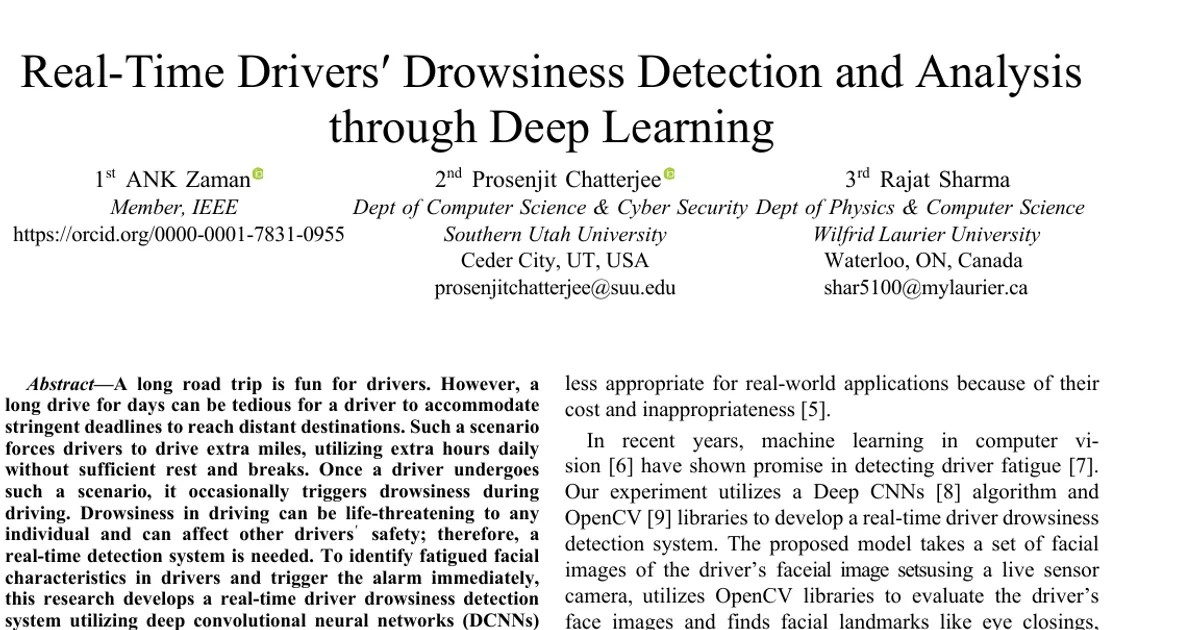
A long road trip is fun for drivers. However, a long drive for days can be tedious for a driver to accommodate stringent deadlines to reach distant destinations. Such a scenario forces drivers to drive extra miles, utilizing extra hours daily without sufficient rest and breaks. Once a driver undergoes such a scenario, it occasionally triggers drowsiness during driving. Drowsiness in driving can be life-threatening to any individual and can affect other drivers' safety; therefore, a real-time detection system is needed. To identify fatigued facial characteristics in drivers and trigger the alarm immediately, this research develops a real-time driver drowsiness detection system utilizing deep convolutional neural networks (DCNNs) and OpenCV.Our proposed and implemented model takes real- time facial images of a driver using a live camera and utilizes a Python-based library named OpenCV to examine the facial images for facial landmarks like sufficient eye openings and yawn-like mouth movements. The DCNNs framework then gathers the data and utilizes a per-trained model to detect the drowsiness of a driver using facial landmarks. If the driver is identified as drowsy, the system issues a continuous alert in real time, embedded in the Smart Car technology.By potentially saving innocent lives on the roadways, the proposed technique offers a non-invasive, inexpensive, and cost-effective way to identify drowsiness. Our proposed and implemented DCNNs embedded drowsiness detection model successfully react with NTHU-DDD dataset and Yawn-Eye-Dataset with drowsiness detection classification accuracy of 99.6% and 97% respectively.