Research
Real-Time 3D Object Detection with Inference-Aligned Learning
Real-Time 3D Object Detection with Inference-Aligned Learning Overview Research area: Computer vision — indoor 3D object detection from point clouds, with a focus on real-time (latency-aware) dense de
- arXiv
- 2511.16140
- Published
- 2025-11-20
- Authors
- Chenyu Zhao, Xianwei Zheng, Zimin Xia, Linwei Yue, Nan Xue
AI summary
Real-Time 3D Object Detection with Inference-Aligned LearningOverview
Research area: Computer vision — indoor 3D object detection from point clouds, with a focus on real-time (latency-aware) dense detection and the training/inference mismatch problem.
Technical level: Intermediate to Advanced. The paper assumes familiarity with anchor-based dense detection, optimal transport assignment, knowledge distillation, and the Average Precision (AP) evaluation protocol.
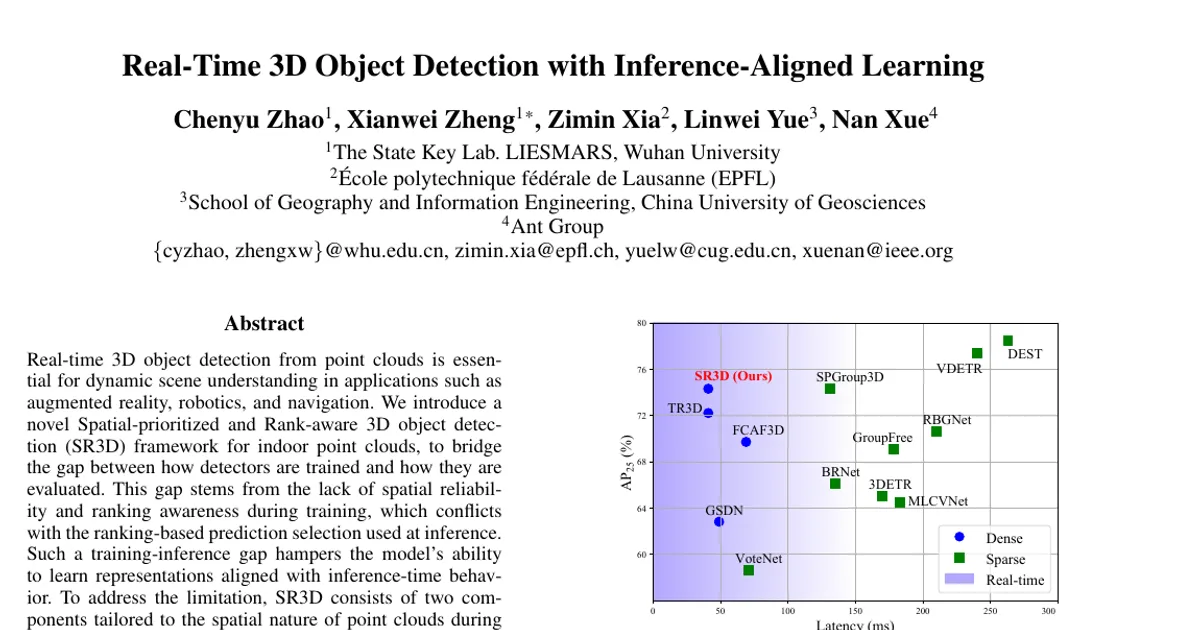
Scope (1 sentence): The paper proposes SR3D, a training-time framework combining spatial-prioritized label assignment and rank-aware self-distillation to close the gap between how dense indoor 3D detectors are trained and how they are evaluated, evaluated on ScanNet V2 and SUN RGB-D while keeping inference latency unchanged.
What This Paper Is About
Dense 3D object detectors are trained with supervision that does not match how they are actually scored at inference time. Label assignment relies on fixed heuristics (center priors, IoU thresholds) that ignore an anchor's real spatial reliability, and all positive samples receive identical, rank-agnostic supervision even though the evaluation metric (Average Precision) is inherently rank-sensitive.
SR3D's goal is to make training aware of both spatial reliability and relative ranking, so that the model's classification confidence better reflects its actual localization accuracy — without adding any learnable parameters or inference cost.
Key Contributions
-
SR3D framework. A detection framework for indoor 3D object detection that targets the training-inference gap. On ScanNet V2 and SUN RGB-D it improves dense detectors while preserving real-time inference speed (42ms on ScanNet V2, 36ms on SUN RGB-D).
-
Spatial-Prioritized Optimal Transport Assignment (SPOTA). A label assignment strategy that casts assignment as an optimal transport problem and matches anchor–ground-truth pairs using geometry-driven costs. It introduces a normalized vertex distance and a spatial-prioritized strategy that removes the classification cost term entirely, so assignment is driven by spatial alignment rather than semantic scores.
-
Rank-aware Adaptive Self-Distillation (RAS). A training scheme that injects ranking perception via self-knowledge distillation, guiding the classification branch with localization-aware soft targets and adaptively blending the distillation loss with the classification loss according to confidence ranking. It penalizes overconfident but poorly localized predictions.
-
Inference-alignment analysis. The paper introduces three diagnostic measures — Average Inconsistency Coefficient (AIC), confidence-vs-IoU scatter plots, and Prediction Consistency Error (PCE) — and shows SR3D's outputs are closer to the ideal diagonal where Confidence = IoU.
Main Findings
-
ScanNet V2 results: SR3D reaches 74.0 AP25 (73.2 average over 25 trials) and 59.7 AP50 (58.5 average) at 42ms latency. This is 1.1 AP25 better than the previous state of the art on the highest score.
-
SUN RGB-D results: SR3D reaches 68.1 AP25 (67.2 average) and 50.9 AP50 (50.5 average) at 36ms latency — a 1.0 AP25 improvement over the previous state of the art.
-
Highest-score gains are small at AP50 but average gains are larger. SR3D improves the highest AP50 by only 0.3 on ScanNet V2 and 0.5 on SUN RGB-D, but achieves substantial average gains of 1.1 and 0.9, which the authors interpret as more stable and reliable performance.
-
Ablation on components (ScanNet V2, average of 25 trials): Baseline 70.8 AP25 / 55.6 AP50 at 42ms; adding SPOTA alone gives 72.3 / 57.4; adding RAS alone gives 72.5 / 57.7; combining both gives 73.2 / 58.5 — a 2.4 AP25 absolute gain over the baseline at unchanged latency.
-
Removing classification cost from SPOTA helps. Reintroducing the classification loss into the cost matrix drops performance by 0.7 AP25 and 1.6 AP50 (to 72.5 / 56.9); removing the normalized vertex distance regularizer drops 0.5 AP25 and 0.7 AP50 (to 72.7 / 57.8).
-
SPOTA beats other OT-based assigners. simOTA scores 72.3 / 56.5 and AlignOTA 72.2 / 56.9, versus SPOTA's 73.2 / 58.5.
-
RAS beats quality-aware losses. QFL scores 71.9 / 57.7 and VFL 71.7 / 58.3. RAS surpasses QFL by 1.3 AP25 / 0.8 AP50 and VFL by 1.5 AP25 / 0.2 AP50. The authors attribute this to low 3D IoU values creating optimization conflicts when localization quality directly supervises classification.
-
Case study quantifies the ranking bottleneck. Replacing predicted classification scores with ground-truth IoU scores before NMS lifts the baseline from 70.8 AP25 / 55.6 AP50 to 91.8 AP25 / 87.7 AP50, whereas replacing with ground-truth centerness only adds about 0.1 AP25 / 0.3 AP50. The authors conclude missing ranking awareness — not centerness prediction — is the primary bottleneck.
-
Accuracy advantage over DLLA comes without extra parameters. SR3D and DLLA show comparable accuracy, but DLLA incurs higher computational overhead from its auxiliary branch and learnable parameters; SR3D adds none.
-
Training cost is nearly unchanged. Per-epoch training time is 12.6 minutes for SR3D versus 12.3 minutes for TR3D, both with 14.7M parameters — less than a 3% increase.
-
Default hyperparameters: k = 6 (positive candidates), μ = 1 (center prior scale), β = 1 (rank modulation), τ = 0.1 (soft rank temperature). Highest AP25 occurs at k = 6 and at τ = 0.1; highest AP50 occurs at k = 8 and at τ = 1.
-
Inference-alignment diagnostics. SR3D shows consistently lower training AIC than TR3D, a confidence-vs-IoU distribution closer to the ideal diagonal, and smaller PCE.
Methodology in Plain English
The detector is a dense, anchor-based pipeline: point clouds are voxelized, encoded by a sparse convolutional backbone (MinkResNet34, a sparse 3D convolutional variant of ResNet34) with an FPN built from generative sparse transposed convolutions, then passed to two task-specific heads that produce dense predictions. Both new components operate only during training; at inference, standard 3D-NMS runs as usual.
Step 1 — Rethink label assignment (SPOTA). The baseline assigns labels using fixed rules. SR3D instead treats assignment as a transportation problem: each ground-truth box is a supplier of positive labels and each anchor is a demander. The cost of pairing them is computed purely from geometry — a regression loss plus a normalized vertex distance measuring how far the predicted box corners are from the ground-truth corners, normalized by the diagonal of the smallest enclosing box. A center-prior term stabilizes early training. The classification term is removed entirely, on the reasoning that in point clouds semantic cues are already encoded in geometry, so keeping it would only push assignment toward semantic patterns. For each ground truth, the top k lowest-cost anchors become positives.
Step 2 — Make supervision rank-aware (RAS). Instead of supervising every positive identically, the method computes a soft rank for each positive based on its localization accuracy (IoU) and another based on its classification confidence, using a sigmoid-based soft ranking that preserves continuous gaps rather than collapsing them to ordinals. A self-distillation loss uses localization quality as a soft target for the classifier, modulated by the localization rank so poorly localized samples are penalized more. A rank-aware adaptive weighting then blends the standard Focal Loss with the distillation loss per sample: predictions with high confidence but poor localization receive stronger distillation supervision, forcing the model to recalibrate confidence against true localization accuracy.
Step 3 — Evaluate for consistency, not just accuracy. Beyond AP, the authors measure whether confidence actually tracks localization accuracy through AIC (mean L1 distance between classification score and localization quality over positives), confidence-vs-IoU scatter plots for the top-30 high-confidence predictions per class after NMS, and PCE (absolute errors between scores and IoUs).
Experimental protocol. ScanNet V2 (1,513 reconstructed 3D indoor scans, 18 object categories, 1,201 training / 312 validation) and SUN RGB-D (approximately 5,285 training / 5,050 validation point clouds, evaluated on 10 classes). Following the standard protocol, each model is trained five times and tested five times per training run — 25 evaluation runs — reporting both best and average AP at IoU thresholds 0.25 and 0.5.
Why This Matters
Impact on research. The paper reframes 3D detection improvement as a training-inference alignment problem rather than an architecture problem. Its case study — showing that perfect ranking information would lift AP25 from 70.8 to 91.8 — gives a concrete, quantified upper bound motivating future work on ranking-aware supervision. The SPOTA and RAS components are training-time only, so they are plug-compatible with existing dense detectors that share the same inference interface.
Real-world applications (as identified by the paper):
- Augmented reality — placing virtual content in indoor scenes requires fast, accurate box localization under tight latency budgets.
- Embodied robotics — robots must perceive and act on indoor objects in real time.
- Navigation — indoor agents need to localize obstacles and landmarks within strict time constraints for responsiveness and safety.
- Other real-time perception pipelines that consume point clouds on embedded or single-GPU hardware, where the paper's latency figures (42ms / 36ms) are the binding constraint.
Industry relevance. The work targets practical deployment: no added parameters (14.7M), no added inference latency, and under 3% additional training time. The affiliation with Ant Group, alongside Wuhan University, EPFL, and China University of Geosciences, suggests commercial interest in deployable real-time 3D perception. Code is publicly released at https://github.com/zhaocy-ai/sr3d.
Future Directions
-
Extend beyond indoor scenes. The paper explicitly restricts itself to indoor 3D object detection and excludes outdoor methods "which differ significantly." Whether SPOTA's geometry-only assignment cost and RAS transfer to outdoor LiDAR is untested.
-
Reduce the residual AP50 ranking gap. SR3D closes far less of the gap at IoU 0.5 (highest-score gains of just 0.3 and 0.5) than at 0.25, and the case study's 91.8/87.7 upper bound is not approached. Higher-quality localization supervision remains an open problem.
-
Address the low-3D-IoU optimization conflict. The authors show quality-aware losses (QFL, VFL) underperform in the 3D domain because low 3D IoU scores create optimization conflicts when used to supervise classification; their distillation alternative mitigates but does not eliminate this.
-
Investigate limitations and future work. The paper's supplementary Section F is described as discussing "the limitations of current frameworks and outlines directions for future work," but that section's content is not included in the truncated text available here.
-
Generalize to other dense 3D backbones. The ablations are conducted on one fully sparse convolutional dense detector; whether the 2.4 AP25 gain holds across other dense architectures is not reported.
Target Audience
Researchers and graduate students working on 3D point cloud perception, label assignment, and knowledge distillation; computer vision engineers building real-time indoor perception for AR, robotics, or navigation who need accuracy gains that cost no inference latency; and practitioners interested in evaluation-aligned training objectives, since the paper's AIC and PCE diagnostics and its "perfect ranking" case study are reusable analysis tools beyond this specific detector.
Authors’ abstract
Real-time 3D object detection from point clouds is essential for dynamic scene understanding in applications such as augmented reality, robotics and navigation. We introduce a novel Spatial-prioritized and Rank-aware 3D object detection (SR3D) framework for indoor point clouds, to bridge the gap between how detectors are trained and how they are evaluated. This gap stems from the lack of spatial reliability and ranking awareness during training, which conflicts with the ranking-based prediction selection used as inference. Such a training-inference gap hampers the model's ability to learn representations aligned with inference-time behavior. To address the limitation, SR3D consists of two components tailored to the spatial nature of point clouds during training: a novel spatial-prioritized optimal transport assignment that dynamically emphasizes well-located and spatially reliable samples, and a rank-aware adaptive self-distillation scheme that adaptively injects ranking perception via a self-distillation paradigm. Extensive experiments on ScanNet V2 and SUN RGB-D show that SR3D effectively bridges the training-inference gap and significantly outperforms prior methods in accuracy while maintaining real-time speed.