Research
RADRON: Cooperative Localization of Ionizing Radiation Sources by MAVs with Compton Cameras
Overview Research area: Aerial robotics and multi-robot systems applied to nuclear/radiological inspection — specifically cooperative localization and tracking of ionizing radiation sources using micr
- arXiv
- 2510.26018
- Published
- 2025-10-29
- Authors
- Petr Stibinger, Tomas Baca, Daniela Doubravova, Jan Rusnak, Jaroslav Solc, Jan Jakubek, Petr Stepan, Martin Saska
AI summary
Overview
Research area: Aerial robotics and multi-robot systems applied to nuclear/radiological inspection — specifically cooperative localization and tracking of ionizing radiation sources using micro aerial vehicles (MAVs) carrying miniature Compton cameras.
Technical level: Advanced. The paper combines Compton-scattering physics, a linear Kalman filter (LKF) for measurement fusion, decentralized flocking control, and model predictive control (MPC) trajectory tracking, and validates the system in both simulation and real-world flight.
Scope (one sentence): The paper introduces RADRON, a decentralized swarm of sub-3 kg MAVs each carrying a 40 g single-detector MiniPIX TPX3 Compton camera, that cooperatively estimates, and dynamically tracks, the position of a radioactive source in real time.
What This Paper Is About
Existing radiation-source localization with aerial robots relies on large, heavy UAVs carrying bulky scintillator detectors, which limits them to open areas and makes close approach impossible. The authors ask whether a team of small, agile MAVs with extremely lightweight Compton cameras can locate a radioactive source — and even follow one that is moving — by fusing sparse measurements taken simultaneously from multiple viewpoints. The paper's goal is to show that a tightly cooperating, self-organized swarm can localize and track a radiation source in real time in conditions where a single vehicle cannot.
Key Contributions
-
A decentralized multi-robot approach to ionizing radiation source localization that replaces conventional single, heavy platforms with a self-organized swarm of cooperating MAVs carrying the compact, extremely lightweight MiniPIX TPX3 Compton camera.
-
An extension of an existing Compton data fusion method from the single-robot case to the multi-robot domain, generalizing the filter so that an arbitrary number of detectors and robots can contribute measurements to a shared hypothesis.
-
A novel control law — "Compton-driven flocking" — that uses distributed radiation measurements processed in real time to dynamically drive the motion of the swarm, keeping the MAVs on a circle around the estimated source position with uniform angular spacing.
-
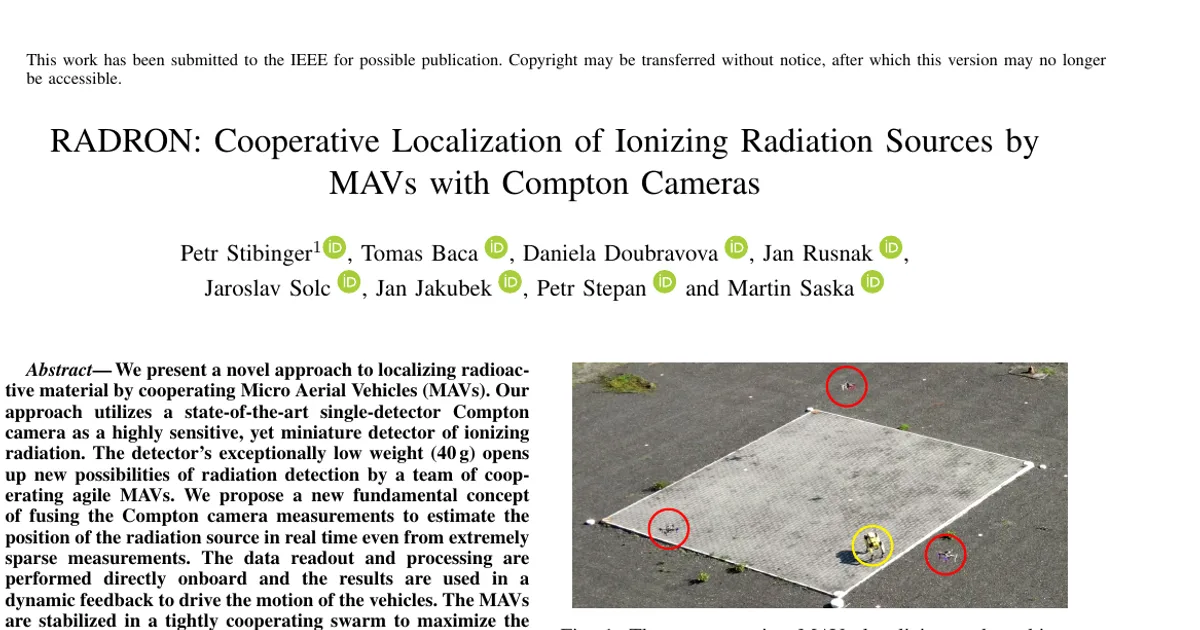
Empirical validation of all claimed capabilities in realistic simulations and in real-world experiments, including tracking a moving source carried by a legged robot.
Main Findings
-
Swarm initialization is far faster: In simulation over a 100 × 100 m area, the median time to acquire the initial hypothesis was 59.16 s with a 3-MAV swarm versus 329.63 s for a solo MAV with a static source, and 52.90 s versus 203.66 s for a moving source. The paper reports this as reducing initialization time to just 25% of the single-vehicle requirement.
-
Swarm tracking of a moving source is more accurate: With a moving source, the median estimation error was 20.34 m for a solo vehicle versus 6.70 m for the swarm — described in the paper as an improvement of nearly 300% and accurate enough to pinpoint a specific vehicle. For a static source the solo and swarm median errors were 2.59 m and 2.26 m respectively.
-
Single-vehicle tracking fails for moving sources: The solo MAV achieved only 44.50 s of average tracking time on a moving source (max 122.43 s), while the swarm reached 133.30 s average and 180 s maximum. The paper notes the solo vehicle's median error of over 20 m "significantly limits any practical use of this approach."
-
Flocking controller stabilizes under disturbance: With 5 MAVs starting in arbitrary positions and a static hypothesis shifted by 10 m every 60 s, all MAVs converged to the desired speed v and to a uniform angular spacing around the hypothesis.
-
Real-world localization performance (3 MAVs, Cesium-137): Median time to the initial hypothesis was 105.46 s for a 179 MBq source (max 115.88 s), 29.55 s for a 2 GBq source (max 34.80 s), and 45.88 s for a moving 2 GBq source (max 139.98 s). Median estimation errors were 2.65 m, 3.49 m, and 3.50 m respectively; average errors were 5.04 m, 4.89 m, and 6.24 m.
-
Tracking speed limit in reality: Using 3 MAVs, the system tracked the 2 GBq source up to a speed of 3 m s⁻¹. With only 1 or 2 MAVs, the system could not localize and follow a source moving at this speed in any attempt. The moving-source experiment was run 7 times, accumulating over 60 min of flight data from each device.
-
Initialization quality is critical: The authors report that a poor initial hypothesis may prevent the subsequent estimation and tracking from converging, because too few radiation events reach the Compton cameras.
Methodology in Plain English
Each MAV carries a MiniPIX TPX3 Compton camera, a single-detector device built on a 256 × 256 pixel grid on a 14 mm × 14 mm CdTe chip, with a detector thickness of only 2 mm along the axis where the third interaction coordinate is assumed to lie on the outer edge. When a high-energy photon Compton-scatters inside the detector, the recoiled electron and the scattered photon are both detected; their energies and pixel positions give a scattering angle via the Compton formula. Because the incoming photon energy is unknown, the measurement is a cone — a set of possible directions to the source rather than a fixed point.
Since a single cone gives only a direction, the authors gather cones from multiple positions and fuse them. Rather than building a 3D voxel map or a projection plane (which would need long stationary exposures), they use a linear Kalman filter in a track-by-detection formulation. The estimated source position, called the hypothesis, is corrected by projecting it onto the surface of each new cone — either to the cone's apex or to the orthogonal projection of the previous hypothesis, depending on the cone's orientation. Measurement covariance is shaped (using ρ and ρ·10⁴ on a rotated diagonal) so confidence increases only along the direction of that projection. Assumptions (A1)–(A3) let MAVs with heterogeneous positioning systems share measurements in their own coordinate frames.
The mission has two stages. First, the area is split into N segments with space-filling paths, one per MAV; each flies at fixed velocity while continuously changing heading to avoid blind spots. Once M cones have accumulated, the initial hypothesis is computed once by solving a non-linear least squares problem minimizing squared distance to all M cone surfaces. Second, the swarm switches to flocking: every MAV shares its Compton cones and position, each fuses the full set onboard, and each plans a circular trajectory of radius r at tangential speed v around the shared hypothesis, biased by an angle β to push neighbors toward uniform spacing of θ* = 2π/N. Trajectories are passed through an MPC tracker to respect the vehicle's dynamic limits. Because the swarm keeps moving, consecutive cones come from different viewpoints, which the authors argue is essential — even thousands of events from a stationary camera yield only a direction, and estimation can otherwise collapse to the camera's own position.
Why This Matters
Impact on research: This is, to the authors' knowledge, the first work to tackle cooperative localization and tracking of a moving ionizing radiation source. Prior literature treats MAVs as independent agents in a shared map, and simulation work suggests a single MAV can follow a moving source only under certain conditions, with a consensus that multiple networked sensors are needed. RADRON shows a concrete path to that capability and demonstrates that the swarm advantage is largest exactly where it matters most — tracking a source that moves.
Real-world applications:
- Emergency response after nuclear accidents or radiological incidents, where rapid localization reduces human exposure and where the terrain may be rugged or obstructed.
- Inspection and monitoring of the Fukushima Daiichi Nuclear Power Plant area and other contaminated sites, extending earlier robotic surveys.
- Environmental monitoring of uranium ore extraction and other mining sites.
- Repeated surveillance and hot-spot inspection inside structures such as building interiors, mine shafts, and nuclear power plants, where GNSS is unavailable and an MAV can approach closely where particle flux is densest.
Industry relevance: The system uses a commercially available miniature detector and off-the-shelf components (Pixhawk4 flight controller, LIDAR-Lite v3 rangefinder, NEO-M8N GNSS, Intel NUCi7 onboard computer, MRS UAV System on ROS 1 Noetic) on a modular hardware platform. The 40 g detector payload and sub-3 kg MAV class mean the approach is far cheaper and more deployable than the 90 kg, 94 kg, 16.8 kg, and 16-kg-payload platforms in prior work, and unlike a 639 g indoor-optimized MAV with under 6 min operation, it targets outdoor real-time tracking.
Future Directions
- Pushing the tracking envelope beyond 3 m s⁻¹ and characterizing exactly how swarm size trades off against source speed, given that 1 or 2 MAVs failed at that speed.
- Improving the initialization phase, which the authors identify as critical — a bad initial hypothesis can prevent convergence because of an insufficient rate of radiation events reaching the cameras.
- Generalizing beyond the assumptions used here: the radioactive object is treated as a point source on the environment surface with uniform spatial distribution, and flocking is planar at a single height above ground, so extension to 3D geometries and distributed contamination has not been addressed.
- Applying the approach to multiple simultaneous sources and to the spatially distributed radioactive fields (aerosols, dissolved nuclear material) that prior literature handles with Gaussian mixture models, maximum likelihood estimation, contour analysis, and gradient descent.
Target Audience
Researchers and engineers in aerial robotics, multi-robot systems, and nuclear or radiological inspection; practitioners working on GNSS-denied or hazardous-environment autonomy; and readers interested in sensor fusion, decentralized control, and the practical limits of miniature radiation detectors. The paper assumes familiarity with Kalman filtering, swarm control, and Compton scattering, so it is best suited to readers with a graduate-level or applied engineering background in these areas.
Authors’ abstract
We present a novel approach to localizing radioactive material by cooperating Micro Aerial Vehicles (MAVs). Our approach utilizes a state-of-the-art single-detector Compton camera as a highly sensitive, yet miniature detector of ionizing radiation. The detector's exceptionally low weight (40 g) opens up new possibilities of radiation detection by a team of cooperating agile MAVs. We propose a new fundamental concept of fusing the Compton camera measurements to estimate the position of the radiation source in real time even from extremely sparse measurements. The data readout and processing are performed directly onboard and the results are used in a dynamic feedback to drive the motion of the vehicles. The MAVs are stabilized in a tightly cooperating swarm to maximize the information gained by the Compton cameras, rapidly locate the radiation source, and even track a moving radiation source.