Research
Quantum Machine Learning for Image Classification: A Hybrid Model of Residual Network with Quantum Support Vector Machine
Overview Research area: Quantum machine learning applied to image classification, specifically a hybrid classical-quantum pipeline for plant disease detection. Technical level: Intermediate. The paper
- arXiv
- 2510.23659
- Published
- 2025-10-26
- Authors
- Md. Farhan Shahriyar, Gazi Tanbhir, Abdullah Md Raihan Chy
AI summary
Overview
Research area: Quantum machine learning applied to image classification, specifically a hybrid classical-quantum pipeline for plant disease detection.
Technical level: Intermediate. The paper assumes familiarity with transfer learning (ResNet-50), PCA, cross-validation, and basic quantum computing concepts such as feature maps, qubits, and quantum kernels, but it explains each stage step by step.
Scope: The paper builds and evaluates a ResNet-50 + Quantum Support Vector Machine (QSVM) pipeline that classifies potato images as healthy or affected by Soft Rot disease, and compares it against classical SVM and Random Forest baselines.
What This Paper Is About
Classical machine learning and deep learning models often struggle with high-dimensional, complex image data, and the authors argue that quantum computing may offer an alternative route to better classification. Their goal is to test whether a hybrid model—using a classical deep network (ResNet-50) purely for feature extraction and a quantum classifier (QSVM) for the final decision—can beat classical models at distinguishing healthy potatoes from potatoes with Soft Rot disease.
Key Contributions
- A hybrid ResNet-50 feature-extraction plus QSVM "Z-feature map" model for potato disease prediction, which the authors report outperforms classical machine learning algorithms on their dataset.
- A direct comparison of three quantum feature maps (ZZ, Z, and Pauli-X) inside the QSVM, evaluated across three PCA dimensionality settings (3, 6, and 9 components), to identify which encoding performs best.
- A head-to-head evaluation of the quantum model against two classical baselines—Support Vector Machine (with an RBF kernel) and Random Forest—using 5-fold stratified cross-validation so that class distribution is preserved in every fold.
- Application of an advanced deep learning feature extractor in conjunction with a quantum support vector machine to address the accuracy limitations the authors attribute to classical disease-classification systems.
Main Findings
- Best overall result: The Z-feature-map QSVM reached an accuracy of 0.9923 (99.23%), the highest reported in the paper, surpassing both ResNet-Random Forest and ResNet-SVM.
- Z-feature map is stable and strong: It scored 0.9923 at 3 PCA components, 0.9846 at 6 components, and 0.9923 at 9 components—the highest accuracy in Table I at every configuration except none (it is the top row value at 3 and 9, and top at 6 as well).
- ZZ-feature map degrades as components grow: Accuracy fell from 0.9615 at 3 components to 0.9154 at 6 components and 0.6662 at 9 components.
- Pauli-X feature map is flat and weak: It held a constant accuracy of 0.5658 across all three PCA configurations (3, 6, and 9 components).
- Classical SVM also sat flat at 0.5658: Under the same 5-fold cross-validation, SVM scored 0.5658 for 3, 6, and 9 components—identical to the Pauli-X result.
- Random Forest was competitive but lower than the Z-QSVM: It scored 0.9689 at 3 components, 0.9455 at 6 components, and 0.9766 at 9 components.
- Head-to-head at each PCA setting (Table II): At 3 components, SVM 0.5658 vs. RF 0.9689 vs. QSVM (Z) 0.9923; at 6 components, 0.5658 vs. 0.9455 vs. 0.9846; at 9 components, 0.5658 vs. 0.9766 vs. 0.9923.
- Experiment environment: Implemented on Google Colab using a CPU environment, with Qiskit for the quantum components and TensorFlow Keras for the ResNet component. The paper does not report GPU usage, training time, or real quantum hardware results.
- Metrics reported: The paper states it evaluated the framework "using several standard classification metrics," but the reported tables contain accuracy only; precision, recall, F1-score, and timing are not reported.
Methodology in Plain English
The authors started with a potato image dataset of 495 original images, drawn from a larger Mendeley collection that covers five classes: Healthy Potato, Blackspot Bruising, Soft Rot, Brown Rot, and Dry Rot. They narrowed the problem to a two-class task: Healthy Potato versus Soft Rot Disease (the "non-healthy" class).
The pipeline works in stages:
- Preprocessing. Each image is resized to 224x224 pixels (ResNet-50's standard input size), converted to a NumPy array via a Keras function, and normalized with the
preprocess_inputfunction. - Feature extraction. ResNet-50, pre-trained on ImageNet, is used without its classification top layer. It outputs a 2048-dimensional feature vector per image after average pooling; these vectors are flattened into 1D arrays.
- Dimensionality reduction. PCA shrinks those 2048 dimensions, tested at 3, 6, and 9 components, to reduce overfitting and computation. The PCA is fit on the training data, then applied to both training and test sets.
- Scaling. A MinMaxScaler rescales the reduced features into the range [-1, 1], a range compatible with encoding into qubits.
- Classical baselines. An SVM with an RBF kernel and a Random Forest with default estimators are trained on the PCA-reduced features.
- Quantum model. A Quantum Support Vector Classifier replaces the classical kernel with a quantum kernel built from a FidelityQuantumKernel, which computes fidelity between quantum states produced by a feature map. Classical data points are encoded into quantum states via a unitary transformation U_φ(x) applied to an initial |0⟩ state. Three feature maps are tested: ZZ (creates entanglement between features, good for feature interactions), Z (independent rotations per feature, no entanglement), and Pauli-X (rotation around the X-axis, an alternative encoding).
- Evaluation. Everything is assessed with 5-fold stratified cross-validation, which splits the data into five folds while keeping the two class proportions equal in each fold, training on four folds and testing on the fifth, across five iterations.
Why This Matters
Impact on research: The paper adds a concrete data point to the debate over whether quantum kernels provide practical advantages over classical kernels on realistic image tasks. Its most striking observation is the spread across feature maps—the Z map reaching 0.9923 while the Pauli-X map stalls at 0.5658—which suggests that encoding choice, not quantum computing per se, may drive much of the reported benefit. It also sits alongside prior hybrid work the authors survey, including QSVM studies on brain tumors (Brats 2015), Alzheimer's disease (ADNI), retinopathy of prematurity, skin lesions (HAM10000), and HTRU-1/MNIST/CIFAR-10.
Real-world applications:
- Early detection of Soft Rot in stored or harvested potato crops, where visual inspection is slow and error-prone.
- Broader crop disease screening systems for agriculture, using the same extract-then-quantum-classify template.
- Plant phenotyping and plant-life studies, which the introduction identifies as a domain rich in image data.
- Healthcare diagnostics and other high-dimensional image classification settings, which the introduction lists as a key motivation for improved classifiers.
Industry relevance: Agri-tech companies, food supply-chain operators, and agricultural extension services could plausibly use this class of pipeline for automated quality control. The paper notes practical constraints, however—current quantum hardware limits the number of usable qubits, and the experiments here ran on a cloud CPU simulator rather than quantum hardware, so deployment maturity is limited.
Future Directions
- Feature map optimization: Explore alternative quantum feature maps such as Pauli-Z, and investigate quantum computing strategies like inserting a single quantum layer to further improve classification performance.
- Scalability on quantum hardware: Move from cloud-based simulation on Google Colab to actual quantum hardware, where access to more qubits could improve accuracy.
- Hybrid quantum-classical ensembles: Combine quantum and classical models in ensemble methods to improve stability, performance, and generalization of the potato disease classifier.
- Broader generalization: The authors frame the work as a step toward quantum-assisted AI systems for complex prediction tasks generally, which raises the open question of whether these accuracy gaps between feature maps hold on other datasets and hardware.
Target Audience
Researchers and graduate students working at the intersection of quantum computing and machine learning, particularly those interested in hybrid quantum-classical pipelines. It is also useful for applied machine learning practitioners in agriculture or plant pathology who want to see a complete, reproducible-style workflow (transfer learning, PCA, cross-validation, quantum kernel) applied to a real disease-classification problem. Readers without a quantum computing background will need to consult supplementary material on feature maps and quantum kernels, since terms like ZZFeatureMap and FidelityQuantumKernel are used with only brief definitions.
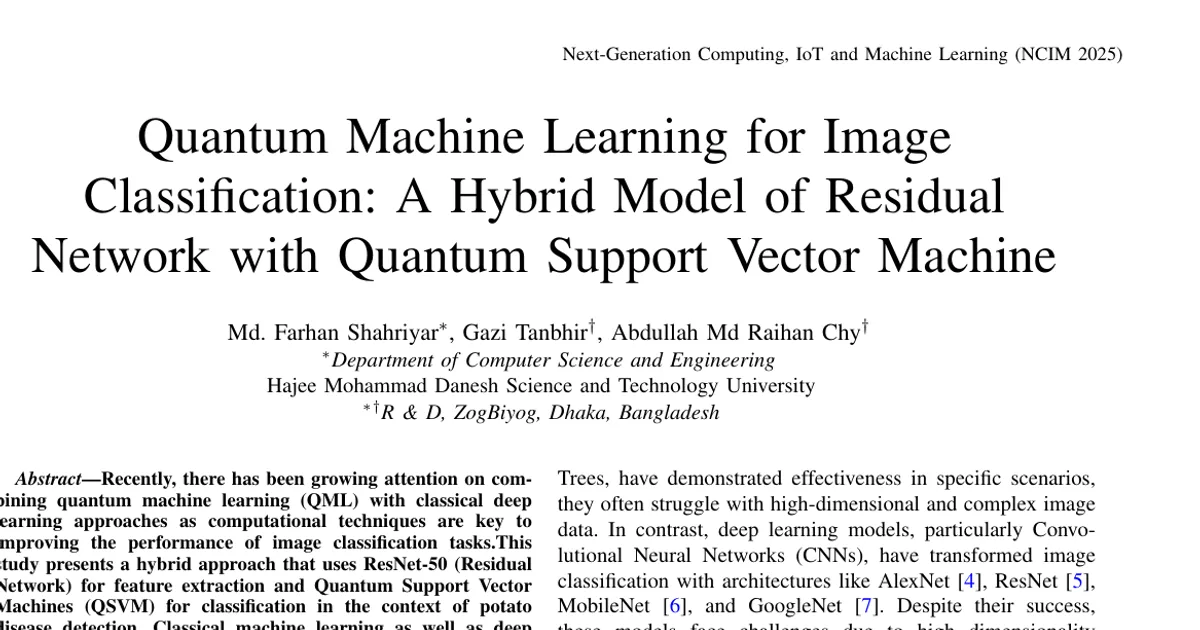
Authors’ abstract
Recently, there has been growing attention on combining quantum machine learning (QML) with classical deep learning approaches, as computational techniques are key to improving the performance of image classification tasks. This study presents a hybrid approach that uses ResNet-50 (Residual Network) for feature extraction and Quantum Support Vector Machines (QSVM) for classification in the context of potato disease detection. Classical machine learning as well as deep learning models often struggle with high-dimensional and complex datasets, necessitating advanced techniques like quantum computing to improve classification efficiency. In our research, we use ResNet-50 to extract deep feature representations from RGB images of potato diseases. These features are then subjected to dimensionality reduction using Principal Component Analysis (PCA). The resulting features are processed through QSVM models which apply various quantum feature maps such as ZZ, Z, and Pauli-X to transform classical data into quantum states. To assess the model performance, we compared it with classical machine learning algorithms such as Support Vector Machine (SVM) and Random Forest (RF) using five-fold stratified cross-validation for comprehensive evaluation. The experimental results demonstrate that the Z-feature map-based QSVM outperforms classical models, achieving an accuracy of 99.23 percent, surpassing both SVM and RF models. This research highlights the advantages of integrating quantum computing into image classification and provides a potential disease detection solution through hybrid quantum-classical modeling.