Research
Quantum-Enhanced Generative Models for Rare Event Prediction
Overview Research area: Quantum machine learning, specifically hybrid quantum–classical generative modeling applied to rare-event (tail) prediction. Technical level: Intermediate. Readers need working
- arXiv
- 2511.02042
- Published
- 2025-11-03
- Authors
- M. Z. Haider, M. U. Ghouri, Tayyaba Noreen, M. Salman
AI summary
Overview
- Research area: Quantum machine learning, specifically hybrid quantum–classical generative modeling applied to rare-event (tail) prediction.
- Technical level: Intermediate. Readers need working familiarity with deep generative models (GANs, VAEs, diffusion) and basic quantum circuit concepts such as qubits, ansätze, and expectation values.
- Scope: The paper proposes QEGM (Quantum-Enhanced Generative Model), a hybrid framework that replaces pseudo-random latent noise with quantum randomness and adds a tail-aware training objective, then evaluates it on synthetic Gaussian mixtures and real-world finance, climate, cybersecurity/protein datasets.
What This Paper Is About
Rare events such as financial crashes, climate extremes, and biological anomalies sit in the tails of probability distributions, and classical deep generative models tend to collapse those low-probability modes or produce badly calibrated uncertainty because they are biased toward frequent patterns. The paper asks whether embedding a variational quantum circuit into a classical latent-variable generative pipeline can better represent and sample from tail regions. The goal is a framework that improves tail fidelity, rare-event recall, and calibration over GAN, VAE, and diffusion baselines.
Key Contributions
- Rare-event prediction framed as a generative modeling problem with tail-sensitive loss functions designed to capture extreme distributions rather than average-case behavior.
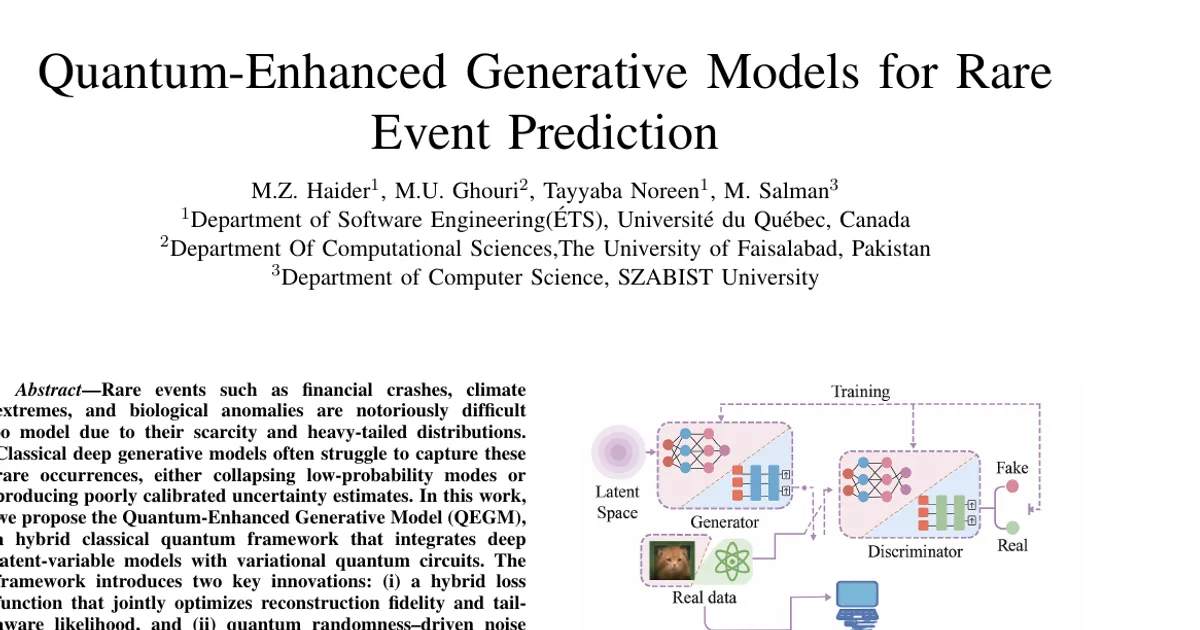
- A hybrid architecture protocol that embeds variational quantum circuits into diffusion-style sampling to improve coverage of low-probability states, built from four layers: an Input Layer, Latent Encoding, a Quantum Variational Layer, and Generative Decoding.
- Quantum-randomness-driven noise injection, where the variance of the latent Gaussian perturbation is modulated by a quantum random number generator outcome, replacing deterministic pseudo-random number generators (PRNGs).
- Empirical evidence on synthetic and real-world datasets, reporting higher tail recall and distributional coverage than GAN, VAE, and diffusion baselines.
Main Findings
- Synthetic Gaussian mixtures: On a toy dataset of three Gaussian components with means μ = {−3, 0, +3} and variances σ² = {1, 0.5, 1.5}, where the central mode holds 70% of samples and the remaining 30% form rare tail components, QEGM preserved fidelity across all three modes while classical baselines often collapsed one or more rare components. QEGM achieved nearly a 50% reduction in tail KL-divergence compared with Diffusion, the best-performing classical baseline, and improved recall on rare components from 0.74 to 0.88.
- Financial data: On daily log-returns of the S&P 500 from 1990 to 2022, with extreme negative returns below the 2.5th percentile treated as rare, QEGM reduced tail KL-divergence by 41% and improved rare-event recall from 0.62 (GAN) to 0.83. GAN and VAE baselines tended to oversmooth volatility clusters; Diffusion models captured broad seasonal trends but underestimated anomaly frequency.
- Protein structure data: Using AlphaFold-generated embeddings of proteins containing rare structural motifs, QEGM improved anomaly recall to 0.85 while preserving reconstruction quality on frequent motifs. VAEs detected common folds but failed to identify unusual conformations.
- Aggregate claim: The abstract reports that QEGM consistently reduces tail KL-divergence by up to 50% versus GAN, VAE, and Diffusion baselines while improving rare-event recall and coverage calibration.
- Calibration and FID: The paper states QEGM achieves better-calibrated coverage probabilities and remains competitive in global generative performance measured by Fréchet Inception Distance (FID); specific numerical FID or coverage values are not reported in the text.
- Climate and cybersecurity results: No numerical results are reported for the climate or cybersecurity domains, despite both being described in the methodology and abstract. The evaluation section presents quantitative results only for synthetic Gaussian mixtures, S&P 500 financial returns, and protein anomaly detection.
- Complexity: Total training complexity per epoch is O(N · d · h) + O(2 · L · n), where N is dataset size, d the latent dimension, h hidden-layer width, L circuit depth, and n qubits. The classical component dominates at large dataset sizes while quantum cost stays modest at NISQ scale (n ≤ 8, L ≤ 6). A circuit with n = 6 qubits and L = 5 layers requires approximately 30 rotation gates and 25 entangling gates per forward pass.
Methodology in Plain English
The approach keeps a standard classical autoencoder structure and inserts a quantum step in the middle.
- Encode: Domain data (finance, climate, cybersecurity features) is mapped by a neural encoder into a latent vector z, with Gaussian noise added, mirroring a variational autoencoder.
- Quantum encode: That latent vector is loaded into a variational quantum circuit, producing a quantum state whose probability amplitudes correspond to possible outputs. The idea is that amplitudes can hold both common and rare states simultaneously, so measurement sampling reaches rare regions more readily than a PRNG would. Amplitude encoding needs ⌈log₂ d⌉ qubits (d = 16 needs 4), though the authors also describe a rotation-based feature map, |ψ(z)⟩ = ⊗ᵢ R_y(zᵢ)|0⟩, that avoids exponential qubit growth.
- Decode: The decoder maps quantum-derived latent samples back into data space, and the resulting errors feed into the loss.
- Hybrid loss: Training minimizes L_hybrid = λ₁ L_rec + λ₂ L_tail, where the reconstruction term preserves overall structure and the tail term (scaled by λ, λ₁, λ₂) penalizes errors specifically on rare events.
- Hybrid optimization: Classical encoder/decoder weights are updated by ordinary backpropagation, while quantum circuit parameters are updated with the parameter-shift rule, which estimates gradients from two shifted circuit evaluations: ∂⟨O⟩/∂θ_k = ½ [⟨O⟩{θ_k+π/2} − ⟨O⟩{θ_k−π/2}].
- Quantum noise injection: Instead of pseudo-random noise, latent perturbation uses z̃ = z + ε with ε ~ N(0, σ²r), where r is drawn from a quantum random number generator, so the perturbation variance is modulated by physical quantum randomness.
- Circuit design: A hardware-efficient ansatz of alternating parameterized R_y and R_z rotations plus CNOT entangling gates, with depths between 3 and 6 in the experiments. Simulations ran on Qiskit Aer and PennyLane with an NVIDIA A100 GPU cluster, and 4-qubit circuits were validated on IBM Quantum's ibmq_toronto device to assess hardware noise.
- Data splitting and evaluation: Data was split 70% training, 15% validation, 15% testing with stratified sampling to preserve imbalance. Evaluation used three metrics: tail KL-divergence between the true and generated distributions restricted to the tail region, rare-event recall (TP/(TP+FN)) treating tail events as the positive class, and empirical coverage of predictive intervals compared against the nominal level α.
Why This Matters
The paper targets a genuine weakness in generative modeling: models that look good on average but fail precisely where stakes are highest. Its research impact lies in combining two trends—quantum circuit expressivity for representing probability amplitudes, and tail-aware loss design—into a single training loop, and in reporting results beyond toy distributions onto real financial and protein data.
Real-world applications discussed or implied by the paper:
- Financial risk: Anticipating sudden market downturns and extreme losses, using thresholds such as returns below the 2.5th percentile, for systemic financial stability.
- Climate adaptation: Modeling extreme environmental changes and extreme weather events defined as the upper 1% quantile of temperature and precipitation distributions.
- Cybersecurity: Intrusion detection and anomalous traffic identification, where rare events account for less than 2% of network records.
- Biomedical and protein research: Characterizing sparse biological anomalies and unusual protein conformations using AlphaFold-generated embeddings.
Industry relevance: Risk-sensitive sectors—finance, insurance, climate services, security operations—depend on calibrated tail estimates, and the framework's headline metrics (tail KL-divergence, rare-event recall, predictive-interval coverage) map directly onto how such systems are validated. The complexity analysis suggests the classical component dominates cost at scale while the quantum component stays modest at NISQ sizes, which matters for near-term feasibility.
Caution for readers: The listed Index Terms (blockchain scalability, sharding, LSTM, reinforcement learning, load balancing) and the Figure 2 caption ("Architecture of range-based sharding protocol") do not match the paper's subject matter, and the conclusion describes experiments on "finance, climate, and cybersecurity" while the results section reports protein structure instead—apparent copy-paste inconsistencies in the manuscript.
Future Directions
- Scaling to larger qubit systems: Moving beyond the NISQ-scale limits described (n ≤ 8, L ≤ 6) and the 4-qubit hardware validation toward circuits that can represent higher-dimensional tails.
- Quantum error correction: Reducing sensitivity to hardware noise, since noise effects were only assessed on a small 4-qubit circuit on ibmq_toronto.
- Multimodal rare events: Extending the framework to rare events that span multiple data modalities simultaneously.
- Decision-support integration: Embedding QEGM into domain-specific risk and decision-support systems to translate improved tail recall and calibration into operational value.
- Open question: The paper claims results across finance, climate, and cybersecurity, but only reports numbers for synthetic, financial, and protein data—fuller quantitative evaluation across all claimed domains, plus concrete FID and coverage figures, remains outstanding.
Target Audience
This paper suits machine learning researchers working on generative models and imbalanced or extreme-value problems, quantum machine learning researchers interested in practical hybrid pipelines, and quantitatively oriented risk practitioners in finance, climate science, cybersecurity, and computational biology who want to understand whether quantum-enhanced sampling offers measurable tail-modeling gains. It is not an introductory text: familiarity with variational autoencoders, diffusion sampling, and basic quantum circuit notation will substantially improve comprehension.
Authors’ abstract
Rare events such as financial crashes, climate extremes, and biological anomalies are notoriously difficult to model due to their scarcity and heavy-tailed distributions. Classical deep generative models often struggle to capture these rare occurrences, either collapsing low-probability modes or producing poorly calibrated uncertainty estimates. In this work, we propose the Quantum-Enhanced Generative Model (QEGM), a hybrid classical-quantum framework that integrates deep latent-variable models with variational quantum circuits. The framework introduces two key innovations: (1) a hybrid loss function that jointly optimizes reconstruction fidelity and tail-aware likelihood, and (2) quantum randomness-driven noise injection to enhance sample diversity and mitigate mode collapse. Training proceeds via a hybrid loop where classical parameters are updated through backpropagation while quantum parameters are optimized using parameter-shift gradients. We evaluate QEGM on synthetic Gaussian mixtures and real-world datasets spanning finance, climate, and protein structure. Results demonstrate that QEGM reduces tail KL divergence by up to 50 percent compared to state-of-the-art baselines (GAN, VAE, Diffusion), while improving rare-event recall and coverage calibration. These findings highlight the potential of QEGM as a principled approach for rare-event prediction, offering robustness beyond what is achievable with purely classical methods.