Research
qa-FLoRA: Data-free query-adaptive Fusion of LoRAs for LLMs
Overview Research area: Parameter-efficient fine-tuning and multi-adapter composition for large language models (natural language processing). Technical level: Intermediate — familiarity with LoRA ada
- arXiv
- 2512.11366
- Published
- 2025-12-12
- Authors
- Shreya Shukla, Aditya Sriram, Milinda Kuppur Narayanaswamy, Hiteshi Jain
AI summary
Overview
Research area: Parameter-efficient fine-tuning and multi-adapter composition for large language models (natural language processing). Technical level: Intermediate — familiarity with LoRA adapters and basic probability concepts (vocabulary distributions, KL divergence) helps, but the core idea is explained in this summary without heavy math. Scope: This paper proposes qa-FLoRA, a method for combining multiple domain-specific LoRA adapters at inference time by weighting each adapter per transformer layer using the divergence between the base model's and the adapter's next-token distributions.
What This Paper Is About
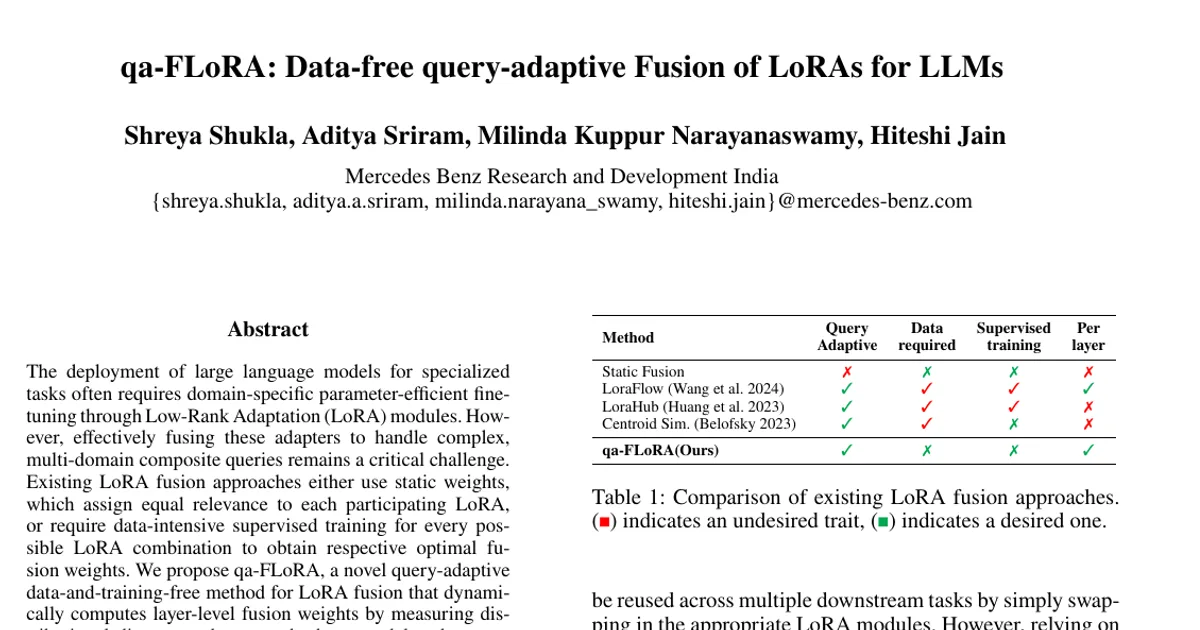
When a single query mixes several domains — for example, a math word problem written in Chinese, or a medical question in Russian — no single fine-tuned LoRA adapter handles it well, and training an adapter for every possible domain combination does not scale. The paper's goal is to combine a fixed collection of existing adapters on a per-query basis without collecting composite training data, without domain-representative samples for centroids, and without any training or optimization of fusion weights. The proposed method, qa-FLoRA, decides how much to weight each adapter by measuring how much that adapter shifts the model's predicted vocabulary distribution relative to the frozen base model, layer by layer.
Key Contributions
- qa-FLoRA itself: a data-free and training-free method for query-adaptive LoRA fusion that computes layer-level fusion weights from the semantic relevance of each adapter to the incoming query, measured as distributional divergence from the base model.
- Broad baseline comparison: the authors compare against static fusion, supervised fusion (LoRAFlow, LoRAHub), and training-free centroid-similarity fusion, reporting average improvements of approximately 5% over static fusion and approximately 7% over training-free baselines with LLaMA-2-7B, and approximately 6% and approximately 10% respectively with LLaMA-3-8B, while closing much of the gap with supervised methods.
- Nine composite-task evaluation: experiments span mathematics, coding, and medical question answering crossed with Chinese, Russian, and Spanish, showing that the method combines diverse domain expertise without additional training.
- Layer-level interpretability: divergence patterns across depth are visualized and analyzed, showing distinct roles for language adapters versus domain adapters at different processing stages.
The paper also states that, to the authors' knowledge, this is the first method in the "data and training free" paradigm.
Main Findings
- Outperforms static fusion: qa-FLoRA reaches an average of 25.8% across the three domains with LLaMA-2-7B versus 20.4% for static fusion (equal 0.5/0.5 weighting), and 44.2% versus 38.5% with LLaMA-3-8B — improvements of approximately 5% and approximately 6% respectively.
- Outperforms the training-free centroid baseline: overall average 25.8% versus 18.8% with LLaMA-2 and 44.2% versus 34.4% with LLaMA-3, i.e. approximately 7% and approximately 10% gains.
- Domain-specific gains vary: on mathematics, qa-FLoRA beats the centroid approach by approximately 16% with LLaMA-2 and approximately 18% with LLaMA-3; on medical, by approximately 6% and approximately 10%. On code, the two methods perform comparably because code queries contain both language cues and programming keywords, so both approaches produce similar weights.
- Narrows but does not eliminate the supervised gap: with LLaMA-2, LoRAFlow outperforms qa-FLoRA by 5.1% and LoRAHub by 0.6%. With LLaMA-3, the gap to LoRAFlow narrows to 1.9%. LoRAHub is not reported for LLaMA-3 in the results table.
- Example per-domain numbers (LLaMA-3-8B averages): qa-FLoRA scores 58.3 on math, 34.4 on code, and 39.9 on medical, for an overall 44.2%; LoRAFlow scores 62.1, 34.2, and 42.0 for 46.1%.
- Last token beats whole-query averaging: using only the final token's distribution for divergence computation gives 25.8% overall versus 23.5% for averaging across all query tokens, an approximately 2% gain, and also reduces computation.
- KL divergence is competitive as a relevance measure: with KL divergence the average is 25.8%, the same as cosine distance on hidden states (25.8%), and above Euclidean distance (24.0%).
- Distinct layer-wise patterns: divergence is near zero in the earliest layers for both language and domain adapters. In the Chinese-math task, the math adapter dominates middle layers (10–30) while the Chinese adapter gains weight in the final layer for fluent output. In Chinese-code, the Chinese adapter dominates layers 20–23 (interpreting the problem statement) before the code adapter takes over. In Chinese-medical, the medical adapter stays dominant throughout, especially in the final layers.
- Language-proximity effect: for Spanish and Russian math tasks, the math adapter stays dominant through middle and final layers, unlike the Chinese case, which the authors attribute to Spanish and Russian being closer to English, the base model's primary training language.
- Low runtime overhead: on 250 queries of the Chinese-math task with LLaMA-2-7B (queries averaging 154 tokens), fusion weight computation adds approximately 192ms per query per adapter, and this can be parallelized across adapters; generation time remains comparable to supervised LoRAFlow.
Methodology in Plain English
The setup is a frozen base LLM plus a set of LoRA adapters, each of which adds a small low-rank update to the base weights. For a given query, the method does the following at every transformer layer:
- Get each model version's hidden state. Run the query through the base model to get its hidden state at layer l, and through each adapter to get that adapter's hidden state at layer l.
- Turn hidden states into word predictions. Project each layer's hidden state onto the vocabulary using the model's existing output head (the LM head), then apply a softmax to get a probability distribution over the vocabulary. The paper notes that reusing the LM head on intermediate layers yields well-calibrated logits, following prior work.
- Measure how far each adapter moves the prediction. Compute the KL divergence between the base model's distribution and each adapter's distribution, using the last token of the query. A large divergence means the adapter is injecting task-specific information the base model lacks; a small divergence means the adapter adds little for this query.
- Convert divergences into weights. Normalize each adapter's divergence by the sum of all adapters' divergences at that layer, producing per-layer fusion weights.
- Fuse and generate. Combine the base weights with the weighted sum of adapter updates and run generation.
No gradients, no composite training data, and no domain-representative samples are used. Because KL is computed only for the last token, position-wise calculations are avoided.
Why This Matters
The work targets a practical bottleneck in deploying many specialized adapters: as adapter collections grow, the number of possible combinations explodes, and training a router or fusion weights for each combination is expensive and quickly outdated when adapters are added or swapped. qa-FLoRA sidesteps this entirely, which matters for research on modular, composable LLM systems and for interpretability, since its layer-wise weights expose which expertise is used where.
Real-world applications:
- Enterprise assistants serving mixed-domain requests, such as a worker asking a question that combines legal, technical, and local-language content, where separately trained adapters must be combined on the fly.
- Multilingual customer support, where a single inquiry mixes a non-English language with a specialized domain such as medical or financial content, and no composite training data exists for that pairing.
- Regulated or privacy-constrained settings where domain-representative sample data (needed for centroid methods) or composite training data (needed for supervised fusion) cannot be collected or shared.
- Rapidly evolving adapter libraries, where new adapters are added frequently and retraining a router for every new combination is impractical.
Industry relevance: the research comes from Mercedes Benz Research and Development India, and the method's pitch — zero training, negligible per-query overhead, immediate applicability to existing adapter collections — aligns with production constraints around cost, latency, and frequent model updates.
Future Directions
- Scaling to larger base models: the evaluation is limited to LLaMA-2-7B and LLaMA-3-8B due to computational constraints; the authors suggest validating on 13B and 70B variants.
- Closing the remaining supervised gap: performance still trails supervised fusion, particularly in domains requiring complex reasoning, motivating richer relevance measures beyond KL divergence.
- Adaptive choice of relevance measure: selecting among different divergence or distance measures based on query characteristics is proposed as a way to further close the gap while remaining training-free.
- Broader adapter and domain coverage: the paper studies six adapters across three languages and three domains; how the approach behaves with much larger, more heterogeneous adapter collections, or with more layers of domain overlap, is not reported.
Target Audience
Researchers and engineers working on parameter-efficient fine-tuning, multi-adapter serving infrastructure, and modular or mixture-of-experts style LLM systems will benefit most. It is also useful for practitioners who maintain collections of domain LoRA adapters and need a way to combine them without collecting composite data, and for readers interested in layer-wise interpretability of adapter behavior in transformers.
Authors’ abstract
The deployment of large language models for specialized tasks often requires domain-specific parameter-efficient finetuning through Low-Rank Adaptation (LoRA) modules. However, effectively fusing these adapters to handle complex, multi-domain composite queries remains a critical challenge. Existing LoRA fusion approaches either use static weights, which assign equal relevance to each participating LoRA, or require data-intensive supervised training for every possible LoRA combination to obtain respective optimal fusion weights. We propose qa-FLoRA, a novel query-adaptive data-and-training-free method for LoRA fusion that dynamically computes layer-level fusion weights by measuring distributional divergence between the base model and respective adapters. Our approach eliminates the need for composite training data or domain-representative samples, making it readily applicable to existing adapter collections. Extensive experiments across nine multilingual composite tasks spanning mathematics, coding, and medical domains, show that qa-FLoRA outperforms static fusion by ~5% with LLaMA-2 and ~6% with LLaMA-3, and the training-free baselines by ~7% with LLaMA-2 and ~10% with LLaMA-3, while significantly closing the gap with supervised baselines. Further, layer-level analysis of our fusion weights reveals interpretable fusion patterns, demonstrating the effectiveness of our approach for robust multi-domain adaptation.