Research
PuppetChat: Fostering Intimate Communication through Bidirectional Actions and Micronarratives
Overview Research area: Human-Computer Interaction (HCI), specifically computer-mediated intimate communication, expressive messaging interfaces, and LLM-supported content generation. Submitted to the
- arXiv
- 2602.19463
- Published
- 2026-02-23
- Authors
- Emma Jiren Wang, Siying Hu, Zhicong Lu
AI summary
Overview
Research area: Human-Computer Interaction (HCI), specifically computer-mediated intimate communication, expressive messaging interfaces, and LLM-supported content generation. Submitted to the Proceedings of the 2026 CHI Conference on Human Factors in Computing Systems (CHI '26, Barcelona, Spain; DOI 10.1145/3772318.3790685).
Technical level: Intermediate. The system design, scoring formulas, and LLM-based generation pipeline are described in enough detail for a technical reader, but the core ideas (reciprocal puppet actions, short editable captions) are easy to grasp without a machine learning background.
Scope (one sentence): The paper presents PuppetChat, a dyadic messaging prototype that pairs a reciprocity-aware recommender of 42 animated puppet actions with LLM-generated, user-editable "micronarratives" drawn from personal stories, and evaluates it in a 10-day field study with 11 dyads of close partners or friends (N=22).
What This Paper Is About
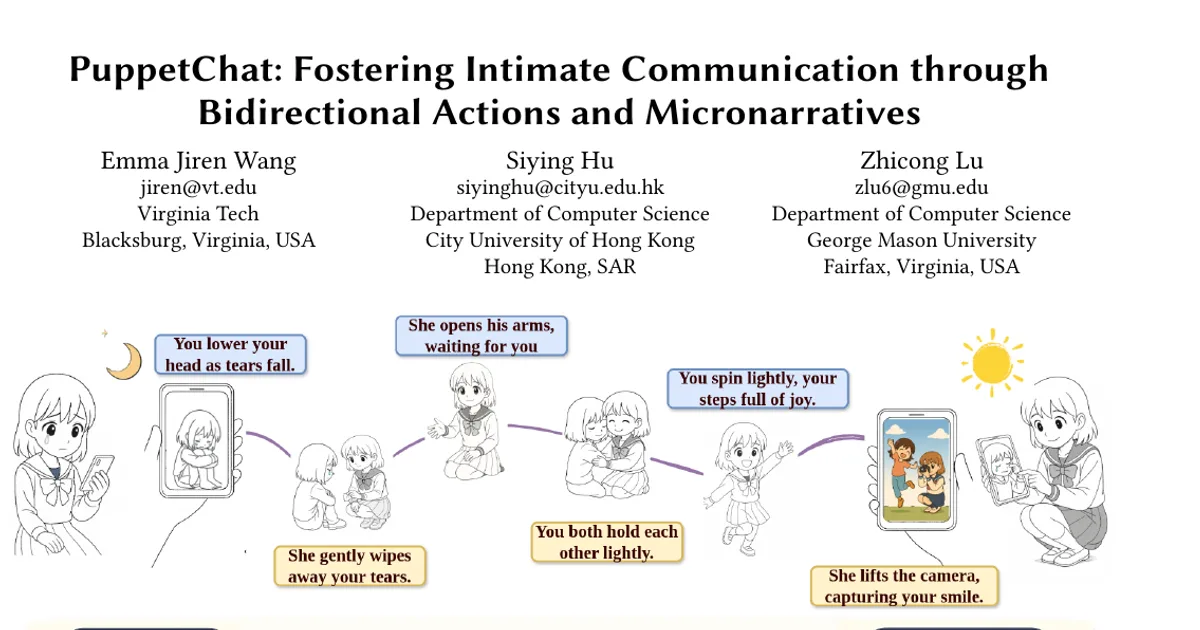
Everyday instant messaging sustains intimate relationships across distance, but its expressive tools are thin: single-tap reactions and vague emojis do not support two-way action responses, do not preserve a sense that the exchange is still going, and are weakly tied to who the partners are and what they have shared. The goal of this work is to restore expressive depth to chat by making replies into invitations rather than endpoints, and by grounding each interaction in the couple's own history. To do this, the authors built PuppetChat, which combines embodied puppet animations, complementary action recommendations, and short story-driven captions that users can edit before sending.
Key Contributions
- A novel interface paradigm for intimate communication. PuppetChat is presented as a system demonstrating how lightweight bidirectional avatar actions combined with AI-generated micronarratives can support more reciprocal and narratively grounded dyadic chat.
- Empirical insights into reciprocal and embodied interaction. Through a 10-day field study with 11 dyads (N=22), the authors identify mechanisms by which users employed responsive actions for "co-performance" and editable narratives for playful "co-construction" of meaning, strengthening relatedness.
- Design implications. The paper outlines concrete directions for technologies that move beyond one-directional reactions toward deeper narrative depth and interactional continuity in digital relationships.
- A concrete design process and artifact. A five-participant formative study produced four findings (F1–F4) that were distilled into four design goals (DG1–DG4), which in turn drove the implemented system, including a curated library of 42 actions annotated along dimensions such as emotion and interaction role.
Main Findings
- Reciprocal actions raised social presence. The authors report that reciprocal actions reliably increased social presence and a felt sense of co-performance, even in a non-immersive, text-based interface.
- Actions plus micronarratives turned replies into sequences. Lightweight and responsive actions paired with micronarratives maintained the flow of interaction instead of breaking it into disconnected turns.
- Editable, story-driven narratives enabled precise but face-saving self-disclosure. Users could sharpen meaning while preserving face, and the narratives seeded playful co-construction of meaning, such as inside jokes and private riffs.
- Accumulated traces supported reflection. Over time, the build-up of actions and captions created revisitable traces that supported reflection on shared moments.
- Overall effect on relatedness. Together these effects reportedly lowered the friction of nuanced expression while strengthening reciprocity and continuity, enhancing partners' sense of relatedness.
- Formative study findings (F1–F4). Users wanted reciprocal exchanges with clearer guidance for responses (F1); wanted actions grounded in personal narratives (F2); wanted flexibility to edit and control generated narratives (F3); and expressed mixed preferences for ephemeral versus persistent interactions, with replay valued when interactions were saved (F4).
- Avatar preference. In the formative study, participants regardless of gender responded more positively to human-like characters than to robot or abstract avatars, and none of the male participants expressed discomfort with the girl avatar.
- Not reported in the available content. The truncated text does not include the field study's detailed results section, so specific counts, themes with frequencies, or statistical tests from the 10-day study are not available here.
Methodology in Plain English
The work proceeded in three stages. First, a small formative study with 5 participants (3 women, 2 men) used an early demo prototype built around an abstract purple avatar and 12 actions. Each 30–40 minute session combined prototype demonstration with a semi-structured interview; the interface let participants type a short message, have an LLM recommend four candidate actions, and trigger the corresponding animation GIF. Two sample animations (throw-heart and carry-heart) from a human-like girl avatar and a robot avatar were shown briefly at the end for comparison. Crucially, the demo omitted personalized micronarratives, personal stories, a replay function, and complementary action recommendations, so the authors could probe expectations without steering them. Notes and transcripts were analyzed with a lightweight thematic analysis approach, with two authors coding independently and refining through discussion.
Second, those findings became four design goals (DG1–DG4) that drove the full system. The action library was built by collecting 215 animated GIFs from popular meme repositories, Giphy, and Tenor, then categorizing them along emotional valence (neutral, positive, negative) and interaction role (self-oriented versus responsive). The authors also analyzed over 20 conversation logs containing nearly 100 instances of GIFs, emojis, and emoticons, inductively coding communicative intent, and distilled a final set of 42 representative actions. Each action is stored as a structured object with a name, description, keywords, emotion, interaction role, an embedding array for fuzzy semantic matching, and ReactionCandidates linking it to complementary or reciprocal actions.
Third, the system ranks candidate actions with a scoring function that sums a text-based score, a context-based score, a user preference term in the range [−1, 1], and a small exploration noise term. The implementation uses fixed weights of 1.0 for text, 1.0 for context, and 0.5 for preference. The text score comes from three layers: keyword extraction with negation handling (a keyword/negation term of +3, with "I love you" scoring roughly +5 and "I don't love you" roughly −1), emotional alignment (+2 for positive or negative alignment, +1 for neutral), and embedding-based cosine similarity for metaphorical or indirect expressions. The context score adds a +5 bonus when an action matches the partner's most recent action through ReactionCandidates (for example, throw-heart to catch/carry-heart, hit-with-object to agony, cry to wipe-other's-face), and a +1 bonus for actions labeled responsive rather than self-oriented. The top four actions are shown to the user.
Finally, the full prototype was evaluated in a 10-day field study with 11 dyads of close partners or friends (N=22).
Why This Matters
Impact on research. The paper reframes presence in mediated communication from a static indicator into "respondable co-presence," arguing that awareness cues should invite a next turn rather than merely signal that someone is there. For HCI, it contributes a middle layer between thin reactions and effortful long messages — the editable micronarrative — and shows how LLM generation can be positioned as augmentation of user agency rather than replacement of it.
Real-world applications.
- Consumer messaging apps that want richer expression than reactions, emojis, and stickers, particularly for one-to-one close relationships.
- Long-distance relationship and friendship tools, where the paper notes that more frequent affective writing has been linked to stability in prior work.
- Family and caregiving communication, where the contact panel's relationship management icons distinguish partners, friends, and family by closeness.
- Lightweight emotional support scenarios: the paper's examples include complementary pairs such as cry and wipe-other's-face, and hit-with-object and agony, which map to comforting and playful repair.
Industry relevance. The approach is implementable on top of existing chat stacks: a curated, annotated action library with 42 items, a lightweight scoring recommender, and LLM calls for caption generation and regeneration. The weighting scheme and the ReactionCandidates mechanism are simple, inspectable alternatives to fully learned recommenders, and the paper's emphasis on user control — editing, overriding, or rejecting AI output — speaks directly to trust and safety expectations for AI features in social products.
Future Directions
- More avatar options and character customization. The authors state explicitly that offering additional avatar options is a valuable direction for future work; they standardized on a single stylized human-like character for consistency across 42 precisely timed actions and to reduce implementation overhead.
- Handling negative affect and repair. The related work notes that argument and repair, along with differences in expressing and recognizing emotion across gender and culture, are frequently under-addressed in expressive messaging systems.
- Scaling the action library and recommendation quality. The current library is 42 curated actions with a scoring formula using fixed weights; whether coverage and ranking hold up for broader relationship types and contexts is untested here.
- Longer deployments and broader relationship stages. The evaluation covers 10 days with 11 dyads; the paper's own framing stresses that disclosure intensity, frequency, and audience need to match relationship stage and setting, which a short study cannot fully examine.
Target Audience
HCI researchers and designers working on mediated intimacy, expressive messaging, and social presence; practitioners building chat features that use LLMs for generation, recommendation, or personalization; and relationship-communication researchers interested in how reciprocity and narrative artifacts shape felt closeness. The paper is also useful for graduate students seeking an example of the full design-research arc, from a five-person formative study through design goals, a working prototype, and a multi-day field study with 11 dyads.
Authors’ abstract
As a primary channel for sustaining modern intimate relationships, instant messaging facilitates frequent connection across distances. However, today's tools often dilute care; they favor single tap reactions and vague emojis that do not support two way action responses, do not preserve the feeling that the exchange keeps going without breaking, and are weakly tied to who we are and what we share. To address this challenge, we present PuppetChat, a dyadic messaging prototype that restores this expressive depth through embodied interaction. PuppetChat uses a reciprocity aware recommender to encourage responsive actions and generates personalized micronarratives from user stories to ground interactions in personal history. Our 10-day field study with 11 dyads of close partners or friends revealed that this approach enhanced social presence, supported more expressive self disclosure, and sustained continuity and shared memories.