Research
Puffin-World: Scaling a Unified Multimodal Model with Native 3D World States
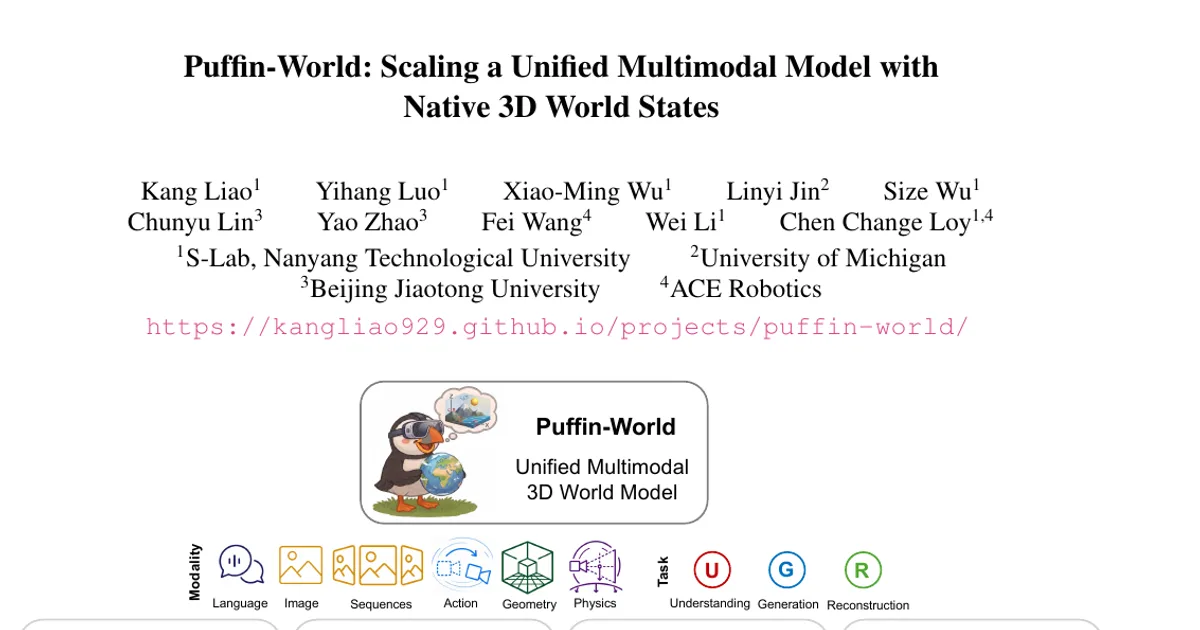
Puffin-World: Scaling a Unified Multimodal Model with Native 3D World States Overview Research area: Computer vision, specifically multimodal spatial intelligence and physical AI — the intersection of
- arXiv
- 2609.04196
- Published
- 2026-09-03
- Authors
- Kang Liao, Yihang Luo, Xiao-Ming Wu, Linyi Jin, Size Wu, Chunyu Lin, Yao Zhao, Fei Wang, Wei Li, Chen Change Loy
AI summary
Puffin-World: Scaling a Unified Multimodal Model with Native 3D World StatesOverview
Research area: Computer vision, specifically multimodal spatial intelligence and physical AI — the intersection of unified multimodal models, camera-to-world understanding, and generative 3D world models.
Technical level: Advanced. The paper assumes familiarity with diffusion transformers, flow matching, camera intrinsics/extrinsics, perspective fields, Plücker ray representations, VAEs, and large multimodal model training pipelines.
Scope: The paper introduces a single multimodal framework that perceives physical camera state, generates camera-controllable imagery, and jointly reconstructs geometry by explicitly modeling three "native 3D world states" (physics, geometry, appearance), together with a new 16-million-scale training dataset called Puffin-16M.
What This Paper Is About
Existing generative world models overwhelmingly predict only appearance-level RGB content, with no explicit notion of where the camera sits in the physical world or what the underlying scene geometry is, while unified multimodal models unify understanding and generation only for 2D semantics. The paper's goal is to build one model that jointly models physics (gravity field and latitude), geometry (depth), and appearance (images) so that world generation stays gravity-consistent and spatially stable under challenging camera motion. To do this at scale, the authors also construct Puffin-16M, a dataset of 15 million vision–language–camera triplets and 1 million trajectories.
Key Contributions
-
Puffin-World, a unified multimodal model for native 3D world states. It formulates physics, geometry, and appearance states and jointly perceives, generates, and reconstructs the 3D world within a single framework, without relying on external offline modules. Tasks are determined by the input composition (text, target cameras, reference views, and a four-channel role mask), not by task-specific subnetworks.
-
The Omni-Camera representation and a physics propagation mechanism. Omni-Camera is a per-pixel 9-dimensional dense camera condition concatenating an absolute field (per-pixel up-vector and latitude angle, 3 channels) with a relative ray field (ray origin and direction, 6 channels). Physics propagation recovers the absolute gravity direction for future frames by rotating the reference view's perceived gravity direction with the relative rotation between views, so all views in a trajectory share one gravity-anchored world frame.
-
Puffin-16M, a scaled dataset. It comprises Puffin-Cam-15M (15 million vision–language–camera triplets with diverse resolutions and aspect ratios) and Puffin-Traj-1M (1 million trajectories with diverse and challenging camera motions), released at the project URL. The source panoramic images were expanded from 200K in Puffin-4M to 900K.
-
Full open-source release plus large-scale annotation of public data. The authors released code, models, and datasets, and used Puffin-World's absolute camera physics understanding to annotate 28 widely used public datasets, covering approximately 44.5 million images.
Main Findings
-
Camera-to-world understanding reaches state of the art. Puffin-World attains the best median error and the best AUC at 5° across four public benchmarks. The specific numerical values of these metrics are not reported in the provided paper content, and the experiment section is truncated.
-
Free-viewpoint spatial simulation is camera-controllable. Given a text prompt and a desired Omni-Camera map, the model synthesizes images whose realized viewpoint and intrinsics adhere to that map, with more faithful distribution than strong general-purpose generators. No quantitative comparison values are reported in the provided content.
-
3D world modeling is action-conditioned and jointly reconstructs geometry. The model performs high-DoF action-conditioned text/image-to-3D generation while reconstructing per-view depth in the same denoising pass, sharing one flow-matching objective. Appearance and geometry targets are weighted separately with a time-dependent weight ω(τ) = ω_max · min(1, τ/τ₀) that ramps from 0 to ω_max over the first τ₀ iterations.
-
Depth is handled without a dedicated depth encoder or decoder. Depth is encoded as a three-channel RGB image using an invertible color mapping inspired by the 3D Hilbert curve in Vision Banana, and encoded by the same frozen VAE used for appearance; the nonlinear transform allocates more color range to nearby surfaces where geometric accuracy matters most.
-
Physics propagation prevents orientation drift. The model perceives the reference view's roll, pitch, and vertical FoV, derives gravity direction g₀, and rotates it into each view's frame. This keeps generation gravity-consistent under long horizons, single-view settings, and challenging motions, where relative-only representations accumulate orientation drift.
-
Long-horizon exploration is autoregressive in chunks. Consecutive chunks are linked in latent space — the next chunk conditions on the denoised target latent of the carried-over view rather than a re-encoded pixel image — avoiding compounding VAE encode–decode artifacts at chunk boundaries. Physics propagation is applied across the whole sequence so all chunks share one gravity-aligned frame.
-
Two safeguards preserve appearance quality when geometry is activated. Asymmetric attention prevents appearance and text queries from attending to geometry tokens (geometry tokens attend to all modalities), and a zero-initialized learnable geometry-modality embedding keeps the model functionally identical to the original multi-view generator at initialization.
-
Multi-task synergy supports closed-loop applications. The model enables mimic world exploration (3D world generation from the same initial viewpoint following a shared camera trajectory) and self-calibrated world exploration (automatically detecting and correcting gravity misalignment through predicted actions and imagined target observations), resembling the closed-loop paradigm of World-Action Models.
-
Dataset construction details. Roll and pitch were uniformly sampled from [-45°, 45°] and vertical FoV from [20°, 105°], yielding approximately 15M perspective images with aspect ratios including 1:1, 2:3, 3:2, 3:4, 4:3, 9:16, and 16:9; around 8M images were curated for camera-controllable generation. Captions with chain-of-thought spatial reasoning were produced with Qwen3-VL-8B-Instruct and Qwen3-VL-32B-Instruct. Camera height was annotated into five levels: underwater shot, low-position shot, eye-level shot, high-position shot, and aerial shot. Stanford2D3D was excluded from the source panoramas to keep evaluation on that benchmark fair.
-
Training uses four stages. Stage I learns the MLP projector at learning rate 1×10⁻⁴ with batch size 512; Stage II unfreezes all modules except the VAE at 2×10⁻⁵ (vision encoder gradients scaled by 0.1); Stage III post-trains cross-view generation at 5×10⁻⁵ with batch size 256; Stage IV adds geometry at 2×10⁻⁵ with batch size 128. AdamW is used with weight decay 0.05, betas (0.9, 0.95), and a cosine learning-rate schedule.
Methodology in Plain English
The authors start from the observation that the physical world is not just a stack of 2D images, so they define three things a world model should track at every moment: the physics (which way gravity points and how high the viewing ray is above the horizon), the geometry (how far away each pixel's surface is), and the appearance (the actual colors). They then design a single camera description that carries both kinds of camera information at once — an absolute part that says how the camera is tilted relative to the real world, and a relative part that says how the camera moves from view to view. This combined map is fed directly into the latent space of a diffusion transformer by adding it to the noisy image latent before patch embedding, and re-injected at a sparse set of transformer blocks so the camera signal stays effective at depth.
To keep a long camera trajectory anchored to the real world, the model first reads the absolute orientation of a reference view, converts it into a gravity direction, and then rotates that gravity direction into every future view using the known relative rotation between views. This lets the model generate many frames that all agree on which way is down, even though only the reference view was ever physically grounded.
For reconstruction, they avoid building a separate depth network. Instead, depth is painted into a normal-looking RGB image using an invertible color mapping, so the same frozen VAE and the same diffusion backbone can handle depth as just another modality. Appearance and depth tokens share the camera condition and view index and are told apart only by a channel in the role mask. To stop the depth task from damaging the already-good appearance model, appearance queries are blocked from reading geometry tokens, and a zero-initialized geometry embedding makes the model identical to the pre-existing generator at the start of training. Long sequences are produced chunk by chunk, with the last generated view passed forward as the next reference in latent space.
Why This Matters
Impact on research. The paper argues that prior work advanced on separate fronts — generative world models that predict appearance only, unified multimodal models that unify understanding and generation for 2D semantics only, and 3D world models that depend on relative camera motion without a global physical reference frame. Puffin-World attempts to close that gap by making physics, geometry, and appearance jointly representable in one model, and by anchoring generation to absolute physical concepts (gravity, uprightness, orientation) rather than only to relative camera embeddings. Its release of a 16-million-scale dataset, code, and models, plus annotations for 28 public datasets covering roughly 44.5 million images, is intended to lower the barrier for follow-up work.
Real-world applications:
- Virtual reality and free-viewpoint navigation, where a user moves through a generated scene and the view must stay physically plausible and gravity-consistent rather than drifting.
- Embodied intelligence and robotics, where agents need a persistent, world-grounded frame to act and predict the consequences of their motion.
- 3D content creation, since the model supports action-conditioned text-to-3D and image-to-3D generation with joint per-view geometry, producing depth alongside imagery.
- Camera and imaging pipelines, because the physics-perception pathway estimates roll, pitch, and vertical field of view from a single image — useful for automatic horizon correction and self-calibration.
- Autonomous driving and street-level capture, which the dataset explicitly covers through self-driving street views across different countries.
Industry relevance. The work targets sectors where generated or reconstructed scenes must obey physical constraints: AR/VR platforms, robotics, simulation, and generative media tooling. The unified single-model design — rather than a chain of separate perception, generation, and reconstruction modules — is relevant to practitioners who want one deployable system instead of several coupled offline components. The dataset annotations for 28 widely used public datasets also give the broader community absolute camera labels at a scale not previously available.
Future Directions
-
Scaling the model further. The authors explicitly motivate larger-scale data by noting that Puffin-4M's 4 million triplets were "insufficient for larger models." Whether the same unification holds at substantially larger model sizes is left open.
-
Details of the trajectory data and its effects. The provided content truncates mid-sentence in the Puffin-Cam-15M description and does not include the Puffin-Traj-1M construction pipeline or the full experimental results, so the specific recipe for the 1 million trajectories and the exact ablation numbers are not available here.
-
Autoregressive chunking at extreme horizon lengths. The sliding-context-window design is presented as a way to avoid encode–decode drift over long horizons; how far this extends before quality degrades is not established in the provided content.
-
Closing the loop with world-action models. The paper positions self-calibrated world exploration as resembling the closed-loop interaction paradigm of World-Action Models. Turning this resemblance into a fully general action-conditioned loop — where predicted actions, imagined observations, and corrected physical state feed each other indefinitely — is a natural next step.
-
Generalizing absolute grounding beyond gravity. The current absolute state covers gravity field, latitude, roll, pitch, and vertical field of view. Whether other physical quantities can be treated as propagatable world states in the same framework is not addressed.
Target Audience
This paper is most useful to researchers and engineers working on 3D world models, unified multimodal models, and camera-centric vision. Readers who will benefit most include: graduate students and researchers in spatial intelligence and physical AI; practitioners building generative 3D or novel-view synthesis systems who need camera-controllable generation with geometric output; teams working on AR/VR, robotics, and embodied agents that require a persistent gravity-aligned world frame; and dataset builders interested in how vision–language–camera triplets and camera trajectories are collected and annotated at scale. Because the paper assumes familiarity with diffusion transformers, flow matching, camera models, and perspective-field representations, a reader without a background in 3D vision or generative modeling will find the method sections demanding, though the motivation and dataset contributions are accessible.
Authors’ abstract
We propose Puffin-World, a unified multimodal architecture that integrates physical understanding, spatial simulation, and 3D world generation and reconstruction without relying on external offline modules. To reliably construct and interact with 3D worlds, our framework jointly models three native world states: physics (gravity field and latitude), geometry (depth), and appearance (image), together with a unified Omni-Camera representation that supports diverse tasks and flexible motions. Beyond modeling these states, we introduce a strategy for propagating physical dynamics across future frames. By grounding absolute camera properties in the real world, Puffin-World enables physically consistent and visually stable world generation. We further couple appearance and geometry within a single generative process, jointly synthesizing each future view and reconstructing its underlying geometry. This unified paradigm enables interleaved closed-loop applications requiring synergy across multiple tasks, including mimic and self-calibrated world exploration. To scale Puffin-World to complex scenarios, we construct Puffin-16M, comprising 15 million vision-language-camera triplets and 1 million trajectories featuring various and challenging motions. To foster further research in this area, we released the code, models, and datasets.