Research
Pseudo-Label Refinement for Robust Wheat Head Segmentation via Two-Stage Hybrid Training
Overview Research area: Computer vision, specifically semi-supervised semantic segmentation applied to agricultural imagery (wheat head segmentation). Technical level: Intermediate. The paper assumes
- arXiv
- 2512.11874
- Published
- 2025-12-07
- Authors
- Jiahao Jiang, Zhangrui Yang, Xuanhan Wang, Jingkuan Song
AI summary
Overview
Research area: Computer vision, specifically semi-supervised semantic segmentation applied to agricultural imagery (wheat head segmentation).
Technical level: Intermediate. The paper assumes familiarity with semantic segmentation, teacher–student self-training, pseudo-labeling, Test-Time Augmentation (TTA) and model ensembling, though it explains its pipeline clearly.
Scope: This paper describes a competition solution for the Global Wheat Full Semantic Segmentation Competition, combining a SegFormer (MiT-B4) backbone with an iterative teacher–student pseudo-label loop and a two-stage training schedule, evaluated on wheat head segmentation.
What This Paper Is About
Wheat head segmentation normally depends on large amounts of pixel-level labeled data, but in agricultural settings labeled data is scarce while unlabeled field imagery is abundant and visually varied. The paper's goal is to build a training procedure that extracts useful signal from unlabeled data through self-training, then concentrates the model's remaining capacity on the small set of true labels. The authors aim to improve generalization across diverse field conditions without collecting more manual annotations.
Key Contributions
- A systematic self-training framework tailored to wheat segmentation. The framework is designed around the specific constraints of the task: limited labels and many unlabeled images.
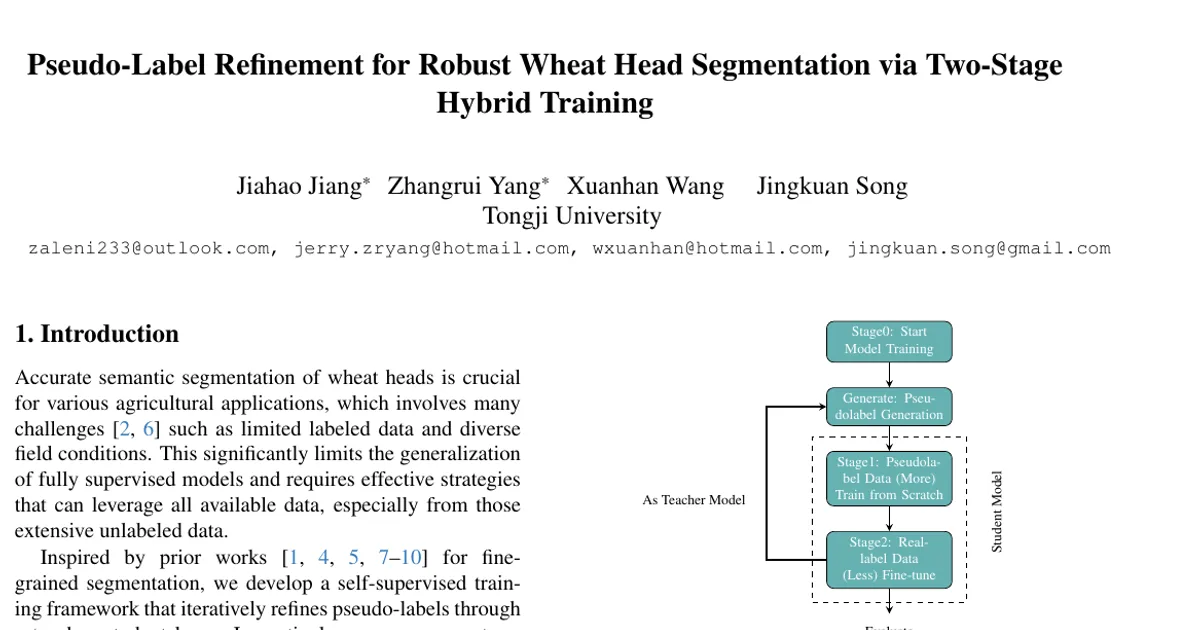
- An iterative teacher–student loop. A refined student model becomes the teacher for the next iteration, so pseudo-labels for unlabeled data are regenerated and improved each cycle, rather than being generated once.
- A two-stage hybrid training strategy within each cycle. The model is first pre-trained on a large set of high-confidence pseudo-labels at lower resolution (512x512) to learn general features, then fine-tuned on high-resolution (1024x1024) ground-truth data to capture fine detail.
- A competition-oriented inference pipeline. Predictions from multiple models trained during 10-fold cross-validation are averaged, and each model's predictions are further enhanced with extensive Test-Time Augmentation.
Main Findings
- Development Phase performance: The model achieved an mIoU of 0.7480 on the Development Phase dataset, using the competition-provided metric.
- Testing Phase performance: The model achieved an mIoU of 0.7099 on the Testing Phase dataset.
- Qualitative robustness: Figure 2 shows qualitative results on eight random test samples with input images, ground-truth and predictions; the paper states the model segments wheat heads effectively and demonstrates robustness across challenging scenarios.
- Limited labeled data used for final fine-tuning: The two-stage strategy's second stage relied on the provided 99 masked training data points for fine-tuning.
- Pre-training source for initial pseudo-labels: The initial model was fine-tuned from an ImageNet-1k pre-trained model to generate pseudo-labels.
- Ensembling and TTA were part of the final pipeline: Inference averaged predictions across models from 10-fold cross-validation and across TTA views (original, horizontal and vertical flips, 90-degree rotations, and multi-scale inputs at 0.75x and 1.25x).
- Not reported: The paper does not state the size of the unlabeled/pre-train dataset, the exact confidence threshold used for pseudo-label filtering, or how many teacher–student iterations were run (it says the iterative process "was repeated multiple times").
Methodology in Plain English
The authors start with a "teacher" model: a SegFormer with a MiT-B4 backbone, initialized from an ImageNet-1k pre-trained model and trained only on the small labeled set. This teacher is used to predict masks for the unlabeled images, producing pseudo-labels. Those pseudo-labels are filtered by a confidence threshold so only high-confidence ones enter the training set.
The "student" model, which has the same architecture, is then trained in two stages. In Stage 1 it is trained from scratch at 512x512 on the larger pool of pseudo-labeled data, for 40 epochs with a batch size of 8 and a learning rate of 6×10⁻⁵. In Stage 2 it is fine-tuned at 1024x1024 on the smaller set of true labels, for 25 epochs per fold with batch size 1, using the AdamW optimizer at an initial learning rate of 1×10⁻⁵, with 10-fold cross-validation. Because the Stage 2 student is better than the original teacher, it can be fed back in as the new teacher, regenerating improved pseudo-labels and repeating the cycle.
Heavy data augmentation is the main regularization: random cropping, horizontal and vertical flipping, 90-degree rotations, scaling (±20%), translation (±6.25%), rotation (±30°), brightness/contrast adjustments (±30%), HSV transformations and ImageNet normalization.
At inference, predictions from several of the cross-validation models are averaged, each having been passed through Test-Time Augmentation. Logits from each augmented view are mapped back to the original orientation and averaged; the combined logits are upsampled to 1024x1024, argmaxed, resized to the required 512x512 output with nearest-neighbor interpolation, and saved as a CSV file. Training ran on a single NVIDIA RTX 4090 D 24GB GPU (CUDA 12.4) under Ubuntu 20.04.6 LTS.
Why This Matters
Impact on research: The paper is a concrete demonstration that an iterative self-training loop plus a resolution-aware two-stage schedule can be assembled into a competitive segmentation system when labels are scarce. It also shows, through the gap between Development Phase (0.7480 mIoU) and Testing Phase (0.7099 mIoU), how much performance can shift when a model moves to unseen field conditions, which is a useful data point for anyone studying domain shift in agricultural vision.
Real-world applications:
- Crop phenotyping and yield estimation: counting and measuring wheat heads supports estimates of grain yield and head density.
- Plant breeding programs: automated head segmentation can accelerate screening of many breeding lines across field trials.
- Precision agriculture: head maps can inform targeted treatment, irrigation or harvest scheduling decisions at sub-field resolution.
- Agricultural robotics: segmentation masks are a prerequisite for autonomous or assistive harvesting and for automated field scouting platforms.
Industry relevance: Seed companies, agtech firms and agricultural equipment manufacturers all depend on scaling field measurements faster than manual annotation allows. A pipeline that converts cheap unlabeled field imagery plus a small labeled set into usable segmentation masks lowers the main cost barrier to deploying vision systems in agriculture.
Future Directions
- Backbone exploration inside the loop: The authors explicitly suggest future work could investigate the impact of different backbone architectures within this iterative framework; only SegFormer with a MiT-B4 backbone was used.
- Understanding the pseudo-labeling schedule: The paper states the iterative process was repeated "multiple times" but does not report the number of iterations or the confidence threshold, so the sensitivity of results to these choices is an open question.
- Closing the Development-to-Testing gap: The drop from 0.7480 to 0.7099 mIoU on the Testing Phase suggests that robustness to unseen field conditions is not fully solved by the current augmentation and ensembling strategy.
- Generalization beyond wheat: Whether the same teacher–student refinement recipe transfers to other crop segmentation tasks with similarly limited labels is untested here.
Target Audience
This paper is most useful to computer vision practitioners and machine learning engineers working on semi-supervised or self-training segmentation pipelines, and to researchers applying vision models to agriculture who need a practical template for training with very few labeled images. Competition participants, agtech engineers building field-imaging systems, and students studying pseudo-label refinement or teacher–student distillation would also benefit, since the paper documents concrete hyperparameters, augmentation settings and an inference strategy.
Authors’ abstract
This extended abstract details our solution for the Global Wheat Full Semantic Segmentation Competition. We developed a systematic self-training framework. This framework combines a two-stage hybrid training strategy with extensive data augmentation. Our core model is SegFormer with a Mix Transformer (MiT-B4) backbone. We employ an iterative teacher-student loop. This loop progressively refines model accuracy. It also maximizes data utilization. Our method achieved competitive performance. This was evident on both the Development and Testing Phase datasets.