Research
Pruning for Generalization: A Transfer-Oriented Spatiotemporal Graph Framework
Overview Research area: Spatiotemporal graph neural networks for multivariate time-series forecasting, specifically transfer learning across urban traffic sensor networks. Technical level: Intermediat
- arXiv
- 2602.04153
- Published
- 2026-02-04
- Authors
- Zihao Jing, Yuxi Long, Ganlin Feng
AI summary
Overview
Research area: Spatiotemporal graph neural networks for multivariate time-series forecasting, specifically transfer learning across urban traffic sensor networks.
Technical level: Intermediate. The core idea (prune noisy parts of a sensor graph before training) is intuitive, but the paper assumes familiarity with graph convolutional networks, Shannon entropy, Pearson correlation, and standard transfer-learning terminology. An appendix adds a Rademacher-complexity generalization analysis for readers with a theory background.
Scope: The paper proposes and evaluates TL-GPSTGN, a two-stage source-pretrain / target-fine-tune framework in which an entropy-and-correlation-based graph pruner removes unreliable boundary sensors and edges before an STGCN backbone forecasts traffic, tested on METR-LA, PEMS-BAY, and PEMSD7.
What This Paper Is About
Traffic forecasting models based on spatiotemporal graph convolutional networks (STGCNs) work well when a city has years of dense historical sensor data, but they degrade when deployed on a new or underdeveloped sensor network with few labels, and they tend to overfit to the topology of the region they were trained on. The authors argue that a major and overlooked bottleneck is the input graph itself: real road networks are "open systems" whose boundary sensors are driven by regions that are not represented in the modeled graph, and whose edges may be weakly correlated or redundant, so passing that noisy structure into message passing amplifies cross-domain shift. Their goal is to prune the graph down to a compact, internally consistent subgraph before spatiotemporal modeling, so that the transferred model needs fewer target labels.
Key Contributions
- Diagnosis of a transfer bottleneck: The authors state that uncurated graph context and boundary noise limit STGCN transferability, and that existing transfer-learning approaches (parameter sharing, domain adaptation, distillation) largely ignore this input-level unreliability.
- An entropy–correlation dual-criteria selector: The Information Entropy Analyzer (IEA) combines node-level Shannon entropy over binned traffic values with absolute Pearson correlation on candidate edges to produce an edge importance score, which is then thresholded to build a pruned adjacency.
- Outer-layer pruning: Rather than generic sparsification, the method explicitly targets externally-driven boundary sensors, defined as nodes whose pruned degree falls at or below a threshold
d_min; these are removed along with their incident edges, optionally iterated forLlayers to peel multiple outer rings. - A source-to-target transfer pipeline with empirical validation: The same Graph Pruning Processor is applied in both the data-rich source and data-sparse target domain, followed by source pretraining and target fine-tuning, with results reported on three traffic benchmarks and two migration settings.
Main Findings
- Single-dataset performance is competitive, not uniformly better. The paper explicitly states that TL-GPSTGN "is not always the best on single-dataset forecasting." On METR-LA at the 15-minute horizon it is the best of the compared models on MAE (3.37) and MAPE (6.58), beating STGCN (3.40, 6.71), though its RMSE of 6.62 is slightly above STGCN's 6.56. On PEMS-BAY and PEMSD7 at 15 minutes it is worse than STGCN (PEMS-BAY MAE 2.92 versus 2.50; PEMSD7 MAE 2.47 versus 2.38), and at the 30-minute horizon it is worse than STGCN across all three datasets (METR-LA 4.45 versus 4.41; PEMS-BAY 3.51 versus 3.26; PEMSD7 3.18 versus 3.05).
- Classical baselines are beaten in-domain. Across datasets and horizons, both STGCN and TL-GPSTGN outperform HA, ARIMA, FNN, and FC-LSTM according to the reported tables, with occasional exceptions (for example, FC-LSTM records the lowest MAE on METR-LA and PEMS-BAY at 30 minutes).
- Transfer is where the method wins. In the migration experiments (pretraining on METR-LA, adapting to PEMSD7-M and PEMS-BAY), the paper reports that TL-GPSTGN consistently outperforms STGCN across target datasets and horizons at matched Target/Source ratios. At a 25% T/S ratio on METR-LA to PEMSD7-M, TL-GPSTGN records MAE 2.56 / 3.41 (15 / 30 minutes) versus STGCN's 2.74 / 3.63. On METR-LA to PEMS-BAY at 15 minutes and 25% T/S, TL-GPSTGN records MAE 3.07, MAPE 4.94, RMSE 5.80 versus STGCN's 4.69, 7.70, 7.64.
- More target data helps both models. The paper states that Table III indicates improvement for both models as the T/S ratio increases, from 5% through 25%, and that the gap between TL-GPSTGN and STGCN persists at every ratio tested.
- Convergence and qualitative fit. Training/test curves for TL-GPSTGN on METR-LA show rapid early descent followed by stabilization at both 15- and 30-minute horizons, and transfer-learning loss on PEMSD7-M decreases steadily and converges. Qualitative plots at 10-minute resolution show TL-GPSTGN tracking ground truth more closely than STGCN, especially around sharp transitions and extreme values.
- Interpretation offered by the authors: pruning "mainly preserves predictive structure while reducing graph complexity and noise, rather than directly optimizing single-dataset error."
- Theory appendix. Generalization is analyzed via empirical Rademacher complexity bounds for linear layers, convolution layers, and a temporal convolution layer (align + causal convolution + residual + ReLU), composed across
Lblocks with Lipschitz propagation. The authors note the bounds are distribution-free and do not require plugging in numeric norms from initialization, and that weight decay reduces the filter-norm terms while normalization reduces feature-magnitude terms.
Methodology in Plain English
Imagine a city's traffic sensor network as a set of dots connected by lines. Some dots sit on the edge of the network, so their readings are heavily shaped by roads the model never sees. The authors' idea is to clean up the picture before training.
First, for every sensor, they bin its historical traffic values into B buckets and compute the Shannon entropy of that histogram. High entropy means the sensor carries rich, non-trivial variation; low entropy means it is boring or nearly constant. Second, for every pair of connected sensors, they compute the absolute Pearson correlation of their time series over the history window. Third, they multiply these together into a score for each edge — an edge matters if it connects two sensors that move together and if the sensors involved are genuinely informative.
Edges below a threshold (or outside the top-k per node) are cut. After cutting, the remaining graph gives each sensor a "pruned degree," and sensors with very small remaining support are declared boundary/outer-layer nodes and removed entirely along with their edges. This peeling can be repeated for L layers. The surviving signal is normalized (for example, z-scored per sensor), fed into a standard STGCN backbone arranged as stacked spatiotemporal convolution blocks in a temporal–graph–temporal "hamburger" pattern, and the predictions are mapped back to the original traffic scale by a Reductor that inverts the normalization.
Training happens in two stages: pretrain on a data-rich source network, then fine-tune on a data-sparse target network using a small labeled set. Crucially, the same pruning procedure is applied in both domains so that the source and target see a comparably clean internal subgraph.
Why This Matters
Research impact: The paper reframes cross-domain transfer in spatiotemporal forecasting as a problem of input selection rather than only of model adaptation. It argues that prior transfer work treats the adjacency matrix as a fixed, uniformly reliable input, and shows that a structure-aware inductive bias at the input level can change how well a pretrained model migrates. The appendix adds complexity bounds that connect norm control, normalization, and convolutional parameter sharing to generalization, giving the empirical claims a theoretical frame.
Real-world applications:
- Traffic routing and navigation systems that must work in cities with newly deployed or sparse sensor coverage.
- Signal control and congestion mitigation in regions where a dense historical record has not yet accumulated.
- Incident and disruption response, where the model must transfer a pattern learned in a data-rich region to a region with different topology and sensor placement.
- Deployment of forecasting models to underdeveloped or expanding road networks, which the paper names as a motivating scenario for transfer learning.
Industry relevance: Traffic datasets such as METR-LA and PEMS-BAY are the standard currency of intelligent-transportation research, and the problem the paper addresses — getting a usable model out of a small labeled target dataset — maps directly onto the economics of deploying forecasting systems city by city. The framework is built on the widely used STGCN backbone rather than a bespoke architecture, which lowers the barrier to adoption, and the pruning step is cheap relative to retraining.
Future Directions
- Exogenous signals: incorporating weather, events, and incidents, which the paper lists as future work.
- Adaptive and data-driven pruning policies: the current pruning uses fixed criteria (a threshold or top-k, and a degree threshold
d_min), so learning the pruning policy from data is an open question. - Multi-modal transportation systems: extending beyond single-mode road sensor graphs.
- Self-supervised or unsupervised pretraining: to further reduce reliance on labeled target data.
- Certain aspects are also left unaddressed in the available content: the paper references a "Code Link" but no URL appears in the provided content, the specific values chosen for the entropy bin count
B, the edge thresholdτ, the degree thresholdd_min, and the peeling depthLare not stated in the text shown, and the tables report mean errors without variance or repeated-run statistics.
Target Audience
Readers who will benefit most are graduate students and practitioners working on spatiotemporal graph neural networks, traffic forecasting, and transfer learning across heterogeneous sensor networks; researchers interested in graph structure learning and input-level inductive biases; and engineers in intelligent-transportation or smart-city teams who need a forecasting model to work on a target city with limited labeled data. Readers without exposure to graph convolutions or information theory will still follow the high-level argument but may need background reading for the entropy–correlation scoring rule and the Rademacher-complexity appendix.
Authors’ abstract
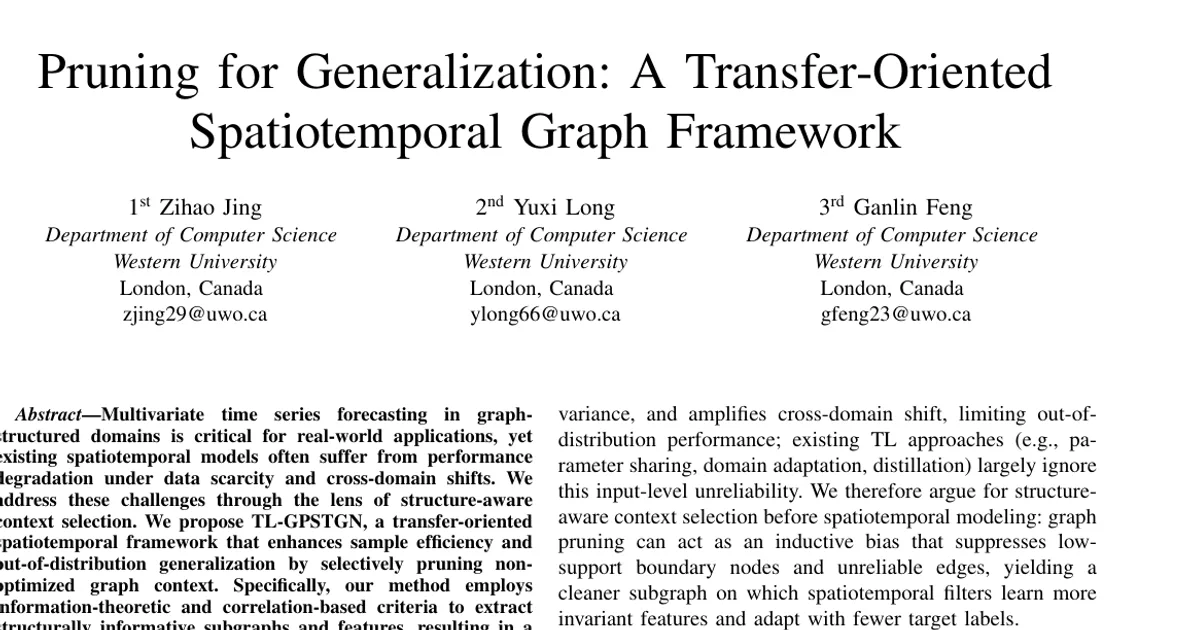
Multivariate time series forecasting in graph-structured domains is critical for real-world applications, yet existing spatiotemporal models often suffer from performance degradation under data scarcity and cross-domain shifts. We address these challenges through the lens of structure-aware context selection. We propose TL-GPSTGN, a transfer-oriented spatiotemporal framework that enhances sample efficiency and out-of-distribution generalization by selectively pruning non-optimized graph context. Specifically, our method employs information-theoretic and correlation-based criteria to extract structurally informative subgraphs and features, resulting in a compact, semantically grounded representation. This optimized context is subsequently integrated into a spatiotemporal convolutional architecture to capture complex multivariate dynamics. Evaluations on large-scale traffic benchmarks demonstrate that TL-GPSTGN consistently outperforms baselines in low-data transfer scenarios. Our findings suggest that explicit context pruning serves as a powerful inductive bias for improving the robustness of graph-based forecasting models.